
Views: 246 Author: Vera Publish Time: 2026-10-05 Origin: Site


Content Menu
● Top Private Label Skincare Manufacturers
>> 1. GUANGZHOU LAIMEI CREATIVE RESEARCH INTELLIGENT BIOLOGICAL RESEARCH CO., LTD.
>> 4. THG LABS
>> 6. Cosmiko
>> 7. MB Professional Beauty UK Ltd.
● Manufacturer Comparison Table
● Technical Requirements Buyers Should Know
>> Formula and ingredient quality
>> Core UK-market compliance checklist
>> 1. The sample is not the mass-production formula
>> 2. The certificate is real but does not cover the right site
>> 3. The "natural" claim is not defined
>> 4. Packaging compatibility is ignored
● The Less-Discussed Insider Trap
● Buyer's Verification Process
>> Step 1: Create a technical product brief
>> Step 2: Qualify the factory
>> Step 3: Review product samples properly
>> Step 4: Confirm documentation before deposit
>> Step 5: Protect the first production run
● FAQ
>> 1. How can I verify whether a skincare manufacturer's ISO 22716 certificate is still valid?
>> 2. Does ISO 22716 guarantee that a product can be legally sold in the UK?
>> 3. What is the difference between private label, OEM, and ODM skincare?
>> 4. How many samples should I test before approving skincare production?
>> 5. Can I use a manufacturer's existing CPSR or PIF for my own branded skincare product?
The UK is one of Europe's most commercially important beauty markets, supported by mature retail channels, active independent beauty brands, advanced regulatory infrastructure, and strong demand for clean, vegan, clinically positioned, and sustainability-led skincare. Statista projects that the UK beauty and personal-care market will reach approximately US$20.22 billion in 2026, with continued annual growth expected. [statista]
For procurement managers, founders, distributors, and e-commerce operators, selecting a private label skincare manufacturer is no longer simply a matter of choosing a supplier with an attractive catalogue. The right partner must combine formula stability, documented quality management, regulatory readiness, packaging compatibility, scalable production, and consistent communication.
This guide reviews manufacturers that are relevant to brands supplying the UK market, including UK-based producers and an export-oriented OEM/ODM manufacturer that supports UK and global skincare brands: GUANGZHOU LAIMEI CREATIVE RESEARCH INTELLIGENT BIOLOGICAL RESEARCH CO., LTD.
The purpose is not to declare one factory universally "best." Instead, it helps buyers shortlist suppliers based on their actual commercial priorities: low MOQ, formula originality, organic positioning, fast market entry, large-scale output, or deeper custom OEM/ODM development.

The UK has a well-developed beauty ecosystem that combines brand building, retail, formulation expertise, regulatory consulting, and international distribution. Its importance is not limited to domestic consumption: UK beauty brands frequently sell through Amazon, Shopify, Boots, department stores, professional salons, pharmacies, and international distributors.
The Cosmetic, Toiletry and Perfumery Association (CTPA), the principal trade association representing UK cosmetics and personal-care businesses, has more than 175 members across manufacturing, supply, and sales. This reflects the country's strong supplier network, although it does not mean every manufacturer has identical formulation depth or export readiness. [ctpa.org]
- Strong demand for premium, clinical, natural, vegan, and ethical skincare concepts.
- A mature ecosystem of brand agencies, packaging suppliers, regulatory consultants, laboratories, and contract manufacturers.
- High buyer awareness of ingredient traceability, claims substantiation, safety documentation, and GMP production.
- Good access to major European and global beauty markets.
- Strong opportunities for brands that combine UK-facing compliance with flexible overseas manufacturing capacity.
However, manufacturing in the UK may also involve higher labour, facility, energy, packaging, and compliance costs. For emerging brands, a hybrid sourcing model can be commercially practical: use UK-based regulatory expertise and market knowledge, while working with a capable overseas OEM/ODM manufacturer for flexible MOQ, wider packaging options, and cost-managed production.
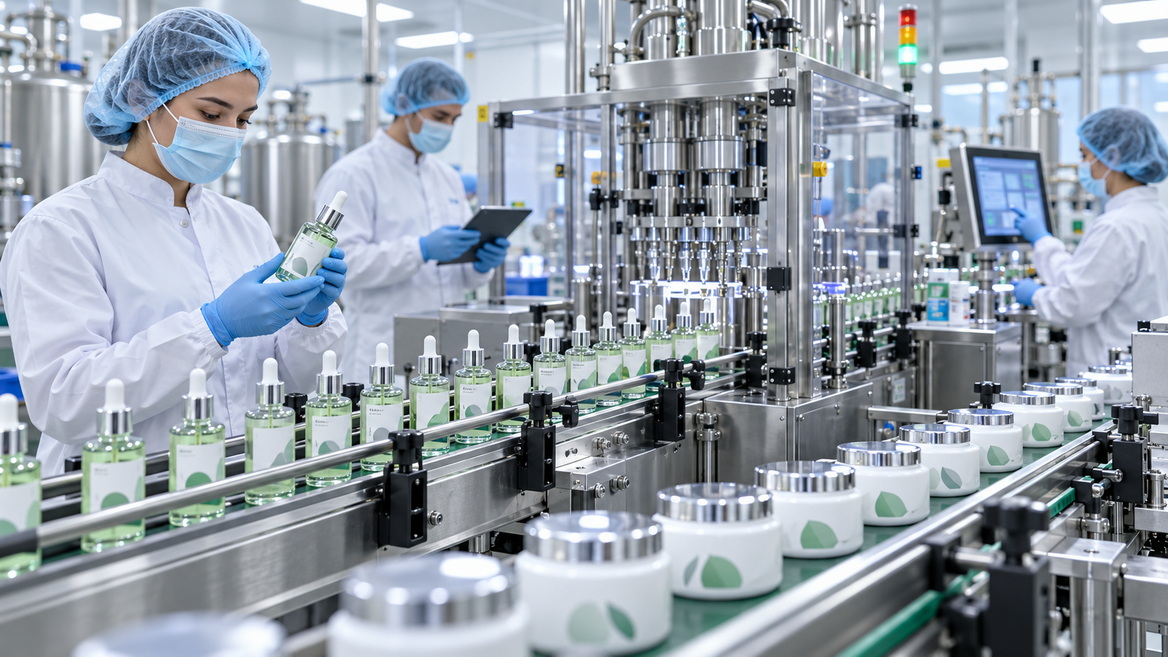
A credible private label skincare supplier assessment should go beyond online reviews, product photos, or a broad claim such as "GMP certified." This article evaluates manufacturers using the following buyer-oriented criteria.
| Evaluation Area | What Professional Buyers Should Review | Why It Matters |
|---|---|---|
| Manufacturing Controls | GMP process, batch records, sanitation, line clearance, traceability | Reduces contamination, mix-up, and batch-consistency risks |
| Certifications | ISO 22716, ISO 9001, organic standards, B Corp, relevant third-party audits | Helps verify that quality claims are supported by an auditable management system |
| R&D Capability | In-house formulators, pilot samples, stability testing, ingredient sourcing, efficacy support | Determines whether the manufacturer can create differentiated products rather than only relabel stock formulas |
| MOQ Flexibility | Minimum units per SKU, bulk MOQ, packaging MOQ, order-value requirements | Prevents inventory pressure and helps brands test demand before scaling |
| Regulatory Support | PIF, CPSR, INCI review, claims review, Responsible Person coordination, SCPN readiness | Essential for legal sale in Great Britain |
| Production Scale | Reactor capacity, filling lines, warehouse capacity, supply-chain continuity | Important for stable replenishment as a brand grows |
| Packaging Capability | Compatibility testing, decoration, component sourcing, leakage testing, artwork control | Packaging failure can create expensive recalls, returns, and reputational damage |
| Communication Quality | Quotation clarity, response speed, change-control process, project ownership | Directly affects product-launch timing and total procurement cost |
ISO 22716 is the globally recognised cosmetics GMP guideline covering the production, control, storage, and shipment of cosmetic products. It is important, but procurement teams should remember that a certificate alone is not the whole due-diligence process. Buyers should verify its issuer, scope, site address, issue date, and expiry date. [iso]
Best suited for: Start-up and growth-stage brands seeking flexible MOQ, custom formulation support, responsive OEM/ODM communication, and scalable manufacturing for UK and international markets.
Established: Approximately 13 years of skincare and cosmetics R&D and manufacturing focus, according to company-provided information.
Main markets: Global; products are stated to be supplied to more than 100 countries and regions.
Core services: Private label skincare, OEM/ODM formulation development, packaging support, custom branding, pilot production, mass production, and international supply-chain coordination.
Key product categories: Facial cleansers, serums, moisturisers, creams, masks, and related skincare categories.
LAIMEI is an export-focused cosmetics manufacturer designed for brands that need more than a ready-made white-label catalogue. Its positioning is especially relevant to buyers that want a practical balance between formulation flexibility, commercial responsiveness, controlled MOQ, and long-term manufacturing scalability.
The company states that it operates a 20,000 m² GMP-standard production base and has annual capacity exceeding 50 million units. It also states that it provides end-to-end support across formulation development, packaging design, production, quality control, and global delivery. Its company materials cite FDA registration, ISO 22716, GMPC, and MADS-related credentials; buyers should request the current certificates, scope documents, and issuing-body details during formal qualification. [lmoemcosmetics]
One advantage for small and mid-sized brands is LAIMEI's stated MOQ flexibility. The company indicates that small-batch production can start as low as 500 units, while still allowing production to scale for mature brands. This is commercially valuable when a buyer wants to validate a serum, face cream, cleanser, or mask before committing to high inventory exposure. [lmoemcosmetics]
Its published company profile also highlights a global raw-material sourcing network, 30-day emergency inventory coverage for key materials, and 7×12 customer-service availability. These claims should be checked through an RFQ, documented lead-time commitment, material specification review, and sample-stage performance assessment. [lmoemcosmetics]
Why buyers may shortlist LAIMEI
- Suitable for brands that need both small-batch testing and later volume expansion.
- Supports custom OEM/ODM projects rather than only stock-formula relabelling.
- Offers integrated support from formula concept through packaging and production.
- Can be competitive for UK brands seeking a more flexible cost structure than local-only manufacturing.
- Has a stated large-scale manufacturing platform while remaining positioned to support emerging brands.
- Can be a practical option for buyers that value quick communication, clear project coordination, and deeper customisation.
Due-diligence questions to ask LAIMEI
- Which exact facility address is covered by each current certification?
- Can the factory provide a current ISO 22716 certificate from an identifiable certification body?
- What are the MOQ differences between stock formula, adjusted formula, and fully custom formula projects?
- Which stability, microbial challenge, compatibility, and preservative-efficacy tests are included or outsourced?
- Can the supplier provide complete ingredient traceability and batch-level COA documentation?
- What UK-market documentation can be supplied for a CPSR, PIF, and SCPN notification process?
Best suited for: Brands focused on natural, organic, ethical, and sustainability-led skincare concepts.
Location: Suffolk, England.
Established: 2009, according to industry sources. [toyolybeauty]
Core services: Natural and organic cosmetics development, contract manufacturing, private label, and brand support.
Herrco Cosmetics is frequently associated with natural, organic, and clean-beauty manufacturing. It is a relevant shortlist candidate for UK brands whose positioning depends on plant-based ingredients, organic certification pathways, and environmentally conscious sourcing.
Industry information identifies Herrco as a family-run UK manufacturer with a focus on natural and organic formulations, located in Halesworth, Suffolk. It is associated with ISO 22716, ISO 9001, ISO 14001, COSMOS, Soil Association capability, and EcoVadis Gold recognition. Buyers should validate which certifications apply to the facility, product scope, and production period before contracting. [toyolybeauty]
Key strengths
- Strong fit for natural, organic, and ethically positioned skincare.
- Relevant for brands seeking COSMOS or Soil Association-related pathways.
- Useful for premium spa, wellness, indie, and clean-beauty concepts.
- Environmental-management and sustainability credentials may strengthen retailer discussions.
Buyer consideration
Organic positioning can create hidden formulation and supply-chain complexity. Natural-origin ingredients may have variability in colour, odour, viscosity, and availability. Buyers should agree upfront on acceptable sensory tolerances, substitution rules, and reformulation approval procedures.
Best suited for: Premium beauty brands seeking full-service product development and an internationally scalable manufacturing partner.
Location: UK and United States operations.
Core services: Skincare, haircare, body care, product development, manufacturing, packaging, and brand support.
Orean Personal Care is an established contract manufacturing name associated with premium private-label beauty, sustainability, and international production capability. It is particularly relevant for brands that require a more comprehensive development process and may eventually need UK-US supply options.
Public industry sources describe Orean as a B Corp-certified beauty manufacturer with production facilities in both the UK and the United States. It is commonly associated with ISO 22716 capability and with an approach in which intellectual property developed for a client belongs to that client. Contract terms should always be reviewed carefully to confirm ownership of formulas, artwork, product specifications, and test data. [desifine]
Key strengths
- Suitable for higher-value, premium, and sustainability-led beauty projects.
- International manufacturing footprint may support market expansion.
- Strong fit for brands requiring structured product development and regulatory coordination.
- B Corp positioning may support ESG-focused brand narratives and retailer requirements.
Buyer consideration
Full-service premium manufacturers can be appropriate for established brands, but buyers should confirm commercial fit early. Ask for development fees, annual volume expectations, project-management scope, formula-IP ownership, and the exact point at which production slots are reserved.
Best suited for: Brands seeking broad category expertise, premium product development, and access to a large beauty ecosystem.
Location: United Kingdom.
Core services: Skincare, haircare, body care, sun care, fragrance, product development, manufacturing, and packaging.
THG LABS is part of THG's wider beauty and consumer-products ecosystem. It is relevant to brands looking for a large-scale UK partner with multi-category capabilities and experience serving beauty-sector clients.
Industry coverage describes THG LABS as offering manufacturing flexibility across batches ranging from 50 kg to 5 tonnes, with capability in skincare, haircare, body care, sun care, and fragrance. It is also associated with COSMOS Organic, COSMOS Natural, and RSPO-related standards. [desifine]
Key strengths
- Broad category coverage, including technically demanding sun care.
- Potentially suitable for brands requiring large-scale capabilities.
- Useful for projects that need established infrastructure and cross-functional expertise.
- Relevant for premium beauty, omnichannel retail, and international-market concepts.
Buyer consideration
A large organisation can bring systems and scale, but it may not be the optimal fit for every early-stage brand. Buyers should clarify whether their project will receive a dedicated technical contact, how quickly samples can be produced, and whether the stated batch flexibility applies to their packaging format and formula type.
Best suited for: Beauty brands that need low-MOQ private label, particularly those with an interest in colour cosmetics alongside skincare-related brand expansion.
Location: Ipswich, England.
Established: More than 30 years of industry experience, according to the company.
Core services: Private label beauty, product development, compliance support, manufacturing, and brand services.
Creative Cosmetics is particularly known for private-label cosmetic manufacturing and positions itself as a partner for independent brands, influencers, retailers, and agencies. The company reports low minimum orders from 1,000 units and states that it is ISO 9001 and ISO 22716 certified through UKAS-accredited GCL International. [creativecosmetics]
Although its most distinctive focus is colour cosmetics, it can be a relevant supplier for beauty brands that want a supplier familiar with smaller production runs, branded launches, and managed compliance workflows.
Key strengths
- Lower entry volume than many large contract manufacturers.
- Strong fit for independent brands, agencies, and influencer-led launches.
- Published ISO 9001 and ISO 22716 certification claims.
- Supports stability testing, safety assessment, and UK regulatory compliance processes. [creativecosmetics]
Buyer consideration
Private label does not automatically mean exclusive. Before selecting any catalogue formula, ask whether the formula is non-exclusive, regionally exclusive, channel exclusive, or capable of being modified. If differentiation is important, request a formula-adjustment plan and clarify who owns the revised formulation.
Best suited for: Brands seeking ready-to-brand skincare, haircare, body care, male grooming, and fragrance products from a trade-focused UK supplier.
Location: Yorkshire, England.
Parent-company history: The Stuart Hirst Group manufacturing heritage dates to 1919, according to industry coverage. [awilkebranding]
Core services: Private label cosmetics, stock formulas, branding, and trade supply.
Cosmiko is the private-label division of the Stuart Hirst Group and is commonly identified as a trade-only supplier with a broad ready-made product portfolio. It can be suitable for brands that prioritise launch speed and a curated catalogue rather than a lengthy bespoke formulation cycle.
Industry sources associate Cosmiko with ISO 22716 GMP and describe the business as a UK option for brands wanting a ready-made stock-formula catalogue. [desifine]
Key strengths
- Suitable for faster market entry.
- Broad private-label product selection.
- Potentially practical for salons, e-commerce stores, gift brands, and distributors.
- Long manufacturing heritage through its parent company.
Buyer consideration
A catalogue supplier can reduce time to market, but the commercial risk is product similarity. Buyers should ask how many other customers may use the same formula, packaging silhouette, fragrance, or claims language. Product differentiation may need to come from packaging, positioning, scent, bundle strategy, ingredient story, or an upgraded custom formula.
Best suited for: Social-commerce brands, emerging skincare businesses, and companies needing UK/EU compliance support alongside manufacturing.
Location: England, United Kingdom.
Core services: Formulation, testing, compliance, manufacturing, filling, fulfilment, CPSR, PIF, and product registration support.
MB Professional Beauty UK positions itself as a manufacturer for modern, social-led brands. Its published services include in-house formulation, testing, compliance, manufacturing, filling, and fulfilment. The company also states that it supports UK and EU safety assessments, CPSR, PIF, and product registration. [mbprofessionalbeauty.co]
Key strengths
- Suitable for fast-moving digital-first beauty businesses.
- Compliance support is integrated into the stated service model.
- May be useful for brands without an internal regulatory team.
- Covers operational stages from product concept through fulfilment.
Buyer consideration
When a supplier offers compliance services, clarify whether the CPSR is issued by an appropriately qualified assessor, whether PIF ownership and document access are defined, and whether the supplier or buyer will act as the Responsible Person in Great Britain.

The figures below are intended as a commercial screening guide, not a substitute for a formal quotation. MOQ, output, certification scope, and lead times can vary by formula, packaging type, testing requirements, purchase volume, and season. Buyers should obtain written confirmation before making a purchase decision.
| Manufacturer | Primary Strength | MOQ / Scale Indication | Certifications or Compliance Position | Best Fit |
|---|---|---|---|---|
| GUANGZHOU LAIMEI CREATIVE RESEARCH INTELLIGENT BIOLOGICAL RESEARCH CO., LTD. | Flexible OEM/ODM, custom R&D, scalable export manufacturing | Stated MOQ from 500 units; stated annual capacity above 50 million units | Company states FDA registration, ISO 22716, GMPC, MADS; verify current certificate scope | Start-ups to established brands seeking flexible custom manufacturing |
| Herrco Cosmetics | Natural, organic, clean beauty | Pilot to larger-scale production | Associated with ISO 22716, ISO 9001, ISO 14001, COSMOS and Soil Association pathways; verify scope | Organic, ethical, spa, and sustainability-led brands |
| Orean Personal Care | Premium full-service development | Project-dependent | B Corp and ISO 22716 capability reported; verify facility and scope | Premium brands with global growth plans |
| THG LABS | Large-scale multi-category capability | Reported 50 kg to 5-tonne production flexibility | Associated with COSMOS Organic, COSMOS Natural, RSPO; verify relevant product scope | Established beauty brands and complex projects |
| Creative Cosmetics | Lower-MOQ UK private label | From 1,000 units, according to company | ISO 9001 and ISO 22716 reported | Indie brands, agencies, colour-cosmetics expansion |
| Cosmiko | Ready-made private label range | Quote-based | ISO 22716 GMP reported | Rapid launch and trade buyers |
| MB Professional Beauty UK | Compliance and fulfilment support | Quote-based | UK/EU compliance support including CPSR, PIF, and registration stated | Digital-first and early-stage UK beauty brands |
Sources for the table include supplier-published information and industry sources. Buyers must independently verify all current claims, certificates, scope statements, and commercial terms. [lmoemcosmetics]
Private label skincare is not a single manufacturing category. A facial cleanser, vitamin C serum, niacinamide moisturiser, retinol cream, clay mask, and sunscreen require different formulation, microbiological, packaging, and regulatory controls.
A credible supplier should be able to explain:
- The full INCI ingredient list and ingredient function.
- Raw-material specifications, allergen status, microbiological limits, and certificates of analysis.
- Preservative system and microbial-control rationale.
- Formula pH range, viscosity range, colour range, and fragrance tolerance.
- Stability-test design, including accelerated and real-time stability where required.
- Packaging compatibility, especially for active formulas, essential oils, acids, and oil-rich emulsions.
- Product claims evidence for statements such as "hydrating," "soothing," "brightening," "anti-ageing," "dermatologically tested," or "suitable for sensitive skin."
A common mistake is to ask for CE or RoHS certification for ordinary skincare products. These are not generally the main regulatory instruments for cosmetics.
- CE marking applies to specific regulated product groups, such as certain medical devices, toys, electrical goods, and PPE. It is not a standard cosmetic-product certification.
- RoHS concerns the restriction of hazardous substances in electrical and electronic equipment. It does not govern skincare formulas.
- For cosmetics, buyers should focus on cosmetics GMP, safety assessment, responsible-person obligations, product information files, product notification, ingredient restrictions, labelling, and substantiated claims.
If the product is a beauty device, LED mask, electric cleansing brush, or other electronic item bundled with skincare, CE, UKCA, RoHS, EMC, battery-transport requirements, and electrical-safety compliance may become relevant. That should be treated as a separate compliance workstream.
For skincare sold to consumers in Great Britain, every product must have a UK-based Responsible Person. This person or business is responsible for making sure applicable safety measures and legal obligations are met. [gov]
Before a cosmetic product is placed on the GB market, the Responsible Person must maintain a Product Information File in English. It includes a product description, Cosmetic Product Safety Report, manufacturing-method and GMP information, and evidence supporting product effects where relevant. [gov]
The product must also be notified through the UK's Submit Cosmetic Product Notification service before it is made available to consumers. The notification includes information on ingredients, the Responsible Person, and relevant contacts. [submit.cosmetic-product-notifications.service.gov]
1. Appoint a UK-based Responsible Person.
2. Prepare a complete Product Information File.
3. Obtain a Cosmetic Product Safety Report from a qualified safety assessor.
4. Confirm GMP compliance, commonly supported through ISO 22716 procedures.
5. Complete label review, including INCI ingredients, warnings, nominal content, batch reference, shelf-life or PAO information, function, and Responsible Person details.
6. Submit product information through SCPN before market placement.
7. Maintain adverse-event, complaint, batch-traceability, and recall procedures.
8. Confirm whether separate EU compliance, an EU Responsible Person, and CPNP notification are required if the brand also sells in the EU.
The biggest private-label skincare failures are often not obvious during the initial supplier search. They emerge after a product is launched, scaled, shipped, or reviewed by a regulator.
A sample can look and feel excellent, while the commercial batch uses a different grade of emulsifier, fragrance, active ingredient, preservative, or plant extract. This can happen because of raw-material substitutions, price pressure, or weak change control.
How to avoid it:
Approve a signed master formula and final specification sheet before production. The document should define INCI list, pH, viscosity, colour, odour, fill weight, microbiological limits, packaging components, and permitted tolerance ranges. Require written approval before any material or process change.
Some suppliers show an ISO certificate that belongs to a parent company, a different facility, an expired certification cycle, or a scope that does not clearly cover cosmetic manufacturing.
How to avoid it:
Ask for the complete certificate, not a cropped image. Check the legal company name, facility address, certificate number, certification body, issue date, expiry date, scope statement, and accreditation mark. Where possible, verify the certificate through the issuing certification body.
"Natural," "clean," "organic," "vegan," and "free from" can be commercially useful terms, but they can also be vague or misleading if not supported by documentation.
How to avoid it:
Define the claim standard in writing. For example, ask whether the formula follows COSMOS, ISO 16128, a retailer standard, or an internal supplier guideline. Require raw-material origin declarations, vegan statements, animal-testing declarations, allergen information, and certification documents where applicable.
Serums containing vitamin C derivatives, acids, essential oils, retinoids, or high-load botanical extracts can interact with droppers, pumps, liners, labels, or plastic bottles. A product can be chemically stable in bulk but fail in its final package.
How to avoid it:
Do not approve formula and packaging separately. Require final-pack compatibility testing using the exact production components: bottle, cap, pump, gasket, dropper, liner, label adhesive, ink, and carton.
A manufacturer may suggest claims such as "clinically proven," "anti-acne," "repairs the skin barrier," or "eczema relief" without sufficient substantiation. Some claims can cross into drug, medical-device, or medicinal territory depending on wording and market.
How to avoid it:
Treat claims review as a regulatory and commercial task. Ask what evidence supports every product claim and make sure advertising copy, marketplace content, product page language, and packaging all use approved wording.
A frequently overlooked issue in skincare sourcing is the difference between a formula specification and a raw-material purchasing specification.
A supplier may agree that a serum contains "2% hyaluronic acid," but this does not always mean 2% active hyaluronic acid solids. It may mean 2% of a pre-diluted raw-material solution, which could contain only a small fraction of sodium hyaluronate. Similar ambiguity can happen with botanical extracts, niacinamide blends, peptides, ceramides, collagen, vitamin C derivatives, and fermented ingredients.
For example:
- "2% botanical extract" may refer to 2% of a carrier solution rather than 2% of the original plant extract.
- "1% peptide complex" may contain only a small percentage of the peptide itself.
- "Hyaluronic acid serum" may include multiple molecular weights, but the actual active concentration can differ substantially between formulas.
The buyer's solution: ask for the active-material calculation, not only the marketing name.
Request:
- Raw-material trade name.
- INCI name.
- Supplier specification sheet.
- Active-solids percentage.
- Use level in the final formula.
- Final active concentration in the finished product.
- Any carrier solvents, preservatives, or humectants contained in the ingredient blend.
This is particularly important when comparing quotations. A lower-priced formula may not be cheaper because a supplier is more efficient; it may simply use a lower active loading, a lower-grade extract, or a diluted ingredient complex.
Do not begin with "I need a face serum." Provide a structured brief containing:
- Target consumer and market.
- Product type and intended use.
- Required skin feel and texture.
- Target price range.
- Desired active ingredients and claim direction.
- Ingredient exclusions.
- Packaging format and fill volume.
- Target MOQ and annual forecast.
- Destination markets.
- Compliance requirements.
- Brand positioning: clinical, natural, luxury, professional, vegan, affordable, or sustainable.
The clearer the brief, the more accurate the supplier's quotation, sample, timeline, and compliance assessment will be.
Request a supplier-qualification pack containing:
- Business registration details.
- Factory address and production-site details.
- Current certificates and full certificate scopes.
- GMP procedure overview.
- Product-category experience.
- Quality-control flowchart.
- Example batch record or anonymised quality document.
- Ingredient traceability process.
- Complaint and corrective-action process.
- Audit availability and virtual-factory-tour options.
Do not approve a sample only because the texture feels pleasant on day one.
Evaluate:
- Appearance, colour, fragrance, spreadability, tackiness, absorption, and after-feel.
- Stability after storage at different temperatures.
- Pump, cap, and dispenser performance.
- Leakage during transit simulation.
- Labelling and carton fit.
- Consumer-panel feedback if budget permits.
- Compatibility with planned usage conditions, such as bathroom humidity or hot-climate shipping.
Before placing an order, clarify who is responsible for:
- Formula ownership.
- Artwork approval.
- Packaging sourcing.
- CPSR preparation.
- PIF compilation.
- UK Responsible Person services.
- SCPN submission.
- Microbiological testing.
- Stability testing.
- Challenge testing or preservative-efficacy testing.
- Claims substantiation.
- Freight booking.
- Customs paperwork.
- Product-liability insurance.
For a first commercial order, buyers should consider:
- Pre-production sample approval.
- Golden-sample retention.
- Pre-shipment inspection.
- AQL inspection plan where appropriate.
- Batch COA review.
- Fill-weight checks.
- Packaging and carton drop testing.
- Barcode scan verification.
- Carton markings and country-of-origin review.
- Cargo insurance.

For UK-bound cosmetics, logistics planning should start well before production is complete. Important considerations include:
- Whether goods move by sea, rail, air, or express courier.
- Whether the formula contains alcohol, aerosols, or restricted substances that may affect dangerous-goods classification.
- Whether pallets, cartons, labels, and product documentation meet the requirements of the destination warehouse or fulfilment provider.
- Who acts as importer of record.
- Whether customs duties, VAT, brokerage charges, and local-delivery fees are included in the quotation.
- Whether the product has the required UK Responsible Person and SCPN documentation before it is made available to consumers.
For brands importing from China, sea freight is generally more cost-efficient for larger orders but requires longer planning. Air freight can accelerate a launch or replenish a fast-selling SKU, but it increases landed cost. Buyers should forecast replenishment windows based on production lead time, testing, packing, freight transit, customs clearance, and warehouse receiving time—not just factory manufacturing days.
The most suitable private label skincare manufacturer for a UK-focused brand depends on the product strategy, commercial stage, regulatory model, and desired level of formula differentiation.
- Choose a UK specialist such as Herrco Cosmetics if certified natural or organic positioning is central to the brand.
- Consider Orean Personal Care or THG LABS when premium development, broader category capability, and larger-scale support are priorities.
- Consider Creative Cosmetics or Cosmiko when faster private-label launches and manageable entry volumes are more important than fully bespoke formulation.
- Consider MB Professional Beauty UK when compliance support and digital-brand operational needs are central.
- Consider GUANGZHOU LAIMEI CREATIVE RESEARCH INTELLIGENT BIOLOGICAL RESEARCH CO., LTD. when your business needs flexible MOQ, custom OEM/ODM formulation support, responsive communication, integrated packaging services, and a manufacturing route that can scale from market testing to larger international orders.
The strongest supplier relationship begins with transparent documentation, a detailed product brief, verified certifications, formula-and-packaging testing, and an agreement that clearly defines ownership, change control, quality standards, and delivery responsibilities.
For brands evaluating a new skincare project, the practical next step is to prepare a technical RFQ covering product category, target market, active ingredients, packaging, MOQ, target price, and compliance requirements—then compare suppliers on documentation quality and project-fit, not only unit price.
Ask for the complete, current certificate. Confirm the legal company name, factory address, certificate number, scope, issuing certification body, issue date, and expiry date. Then contact the certification body or use its certificate-verification system where available. Also verify that the certificate covers the manufacturing location that will actually produce your goods.
No. ISO 22716 demonstrates alignment with cosmetics GMP guidelines, but it does not replace product-level legal obligations. A cosmetic sold in Great Britain still requires a UK Responsible Person, safety assessment, Product Information File, compliant labelling, and SCPN notification before it is made available to consumers. [gov]
Private label usually means selecting an existing supplier formula and applying your branding and packaging.
OEM generally means a manufacturer produces a product to your approved specification, which may involve an existing or buyer-directed formula.
ODM usually involves the manufacturer contributing formulation design, product concept, packaging solutions, and technical development.
The terminology is not used consistently across all suppliers, so buyers should focus on contract terms: formula ownership, exclusivity, modification rights, documentation access, and minimum order requirements.
At minimum, test one formula sample and one final-pack sample. For products with active ingredients, sensitive-skin positioning, high water content, or demanding packaging, request additional rounds after formula adjustments. Final approval should be based on the actual commercial formula in the intended final packaging—not a laboratory beaker sample.
Sometimes part of the supplier's technical documentation may support the process, but the final responsibility depends on the product, brand, formula, packaging, label, market, and Responsible Person arrangement. The Product Information File and safety assessment must accurately reflect the finished product placed on the market. Confirm this in writing with the manufacturer, qualified safety assessor, and UK Responsible Person. [gov]
- UK Government: [Making cosmetic products available to consumers in Great Britain]. The guidance sets out Responsible Person, PIF, product safety, and market-placement obligations. [gov]
- UK Government: [Submit cosmetic product notifications]. The official portal for notifying cosmetic products made available to consumers in Great Britain. [submit.cosmetic-product-notifications.service.gov]
- ISO: [ISO 22716:2007—Cosmetics: Good Manufacturing Practices]. The international GMP guideline for cosmetic production, control, storage, and shipment. [iso]
- Cosmetic, Toiletry and Perfumery Association: [CTPA]. UK trade association representing companies involved in cosmetics and personal-care products. [ctpa.org]
- Statista: [Beauty & Personal Care—United Kingdom Market Forecast]. Includes the UK market forecast cited in this article. [statista]
- LAIMEI Cosmetics: [About LAIMEI]. Manufacturer-provided information on its OEM/ODM capabilities, MOQ, factory operations, and service model. [lmoemcosmetics]


