
Views: 216 Author: Vera Publish Time: 2026-11-21 Origin: Site


Content Menu
● What Is the pH Cosmetics Trend?
>> pH-Balanced Skincare vs. pH-Responsive Makeup
>> Why "pH 5.5" Is Not a Complete Quality Claim
● How pH-Responsive Lipstick and Blush Work
>> Does Everyone Receive a Unique Shade?
>> Water-Free Products Need Different Measurement Methods
● Choosing the Right pH-Focused Product Concept
● A Six-Step Development Plan for pH Cosmetics
>> 1. Define the Product Brief
>> 2. Set a Product-Specific pH Specification
>> 3. Check Ingredient and Preservation Compatibility
>> 4. Evaluate Stability in the Intended Packaging
>> 5. Substantiate the Actual Claim
>> 6. Confirm Performance During Scale-Up
● Turning Customer Feedback Into Better Formulas
● Quality and Compliance: What Buyers Should Verify
>> Registration Is Not Product Approval
>> Colorants Must Be Appropriate for Their Intended Use
>> Manufacturing Standards Have a Defined Scope
● Developing pH Cosmetics With LAIMEI
● Frequently Asked Questions About pH Cosmetics
>> What Does pH-Balanced Mean in Skincare?
>> Is pH 5.5 Best for Every Cosmetic?
>> Are pH-Responsive Lip Products Truly Personalized?
>> Does Low pH Guarantee a Gentle Cleanser?
>> Can One Color-Changing Formula Be Used on Lips, Cheeks, and Eyes?
>> What Should a Brand Request Before Approving Production?
● Start Your pH Cosmetics Project With a Clear Brief
The pH cosmetics trend connects two compelling product stories: skincare designed around an appropriate acidic environment and makeup that changes color after application. For beauty brands, both offer development opportunities—but they require different formulations, testing methods, and consumer explanations.
At GUANGZHOU LAIMEI CREATIVE RESEARCH INTELLIGENT BIOLOGICAL RESEARCH CO.,LTD., our approach starts with a practical question: what should this product reliably deliver?
A cleanser needs more than an attractive pH number. A color-changing lip balm needs more than a dramatic demonstration. Both need stability, comfortable application, appropriate safety assessment, and claims that reflect actual performance.
This guide explains the science, identifies common development mistakes, and outlines how brands can turn pH-focused concepts into credible private-label and custom products.

In water-based systems, pH describes acidity or alkalinity. The familiar scale runs from 0 to 14, with 7 considered neutral under standard conditions.
In cosmetics, pH influences formulation decisions involving ingredient compatibility, preservation, product stability, and skin tolerance. However, its significance depends on the product.
A facial cleanser, an exfoliating serum, and a water-free lip balm cannot be evaluated using the same assumptions.
| Product concept | Main purpose | Development priority |
|---|---|---|
| pH-balanced skincare | Maintain a formulation environment suited to its intended use | Compatibility, tolerance, preservation, and stability |
| pH-responsive makeup | Develop visible color after contact with the application environment | Color development, consistency, comfort, and colorant compliance |
These categories can coexist within one brand, but they should not share interchangeable claims.
A color-changing lipstick does not automatically support the skin barrier. Similarly, a mildly acidic moisturizer does not become personalized simply because its pH resembles that of skin.
Skin has a naturally acidic surface environment, often called the acid mantle. This environment contributes to normal barrier function and interactions with resident microorganisms.
However, skin pH is not one universal number.
In a multicenter study involving 330 participants, researchers measured forearm skin before and after participants avoided showering and cosmetic application for 24 hours. Average measured pH decreased from 5.12 to 4.93, and the researchers estimated natural skin surface pH at approximately 4.7.
This is useful foundational evidence, not a universal specification for every body site or finished cosmetic.
A pH value tells buyers something important, but not everything.
A product's suitability also depends on:
- Surfactant type and concentration.
- Fragrance and other potential irritants.
- Active ingredient levels.
- Preservation and packaging.
- Application frequency and contact time.
- The condition of the intended user's skin.
From a development perspective, we would not select a cleanser solely because it measures pH 5.5. We would evaluate the complete formula and its intended use.
The better question is whether the finished product performs comfortably and consistently under realistic conditions.
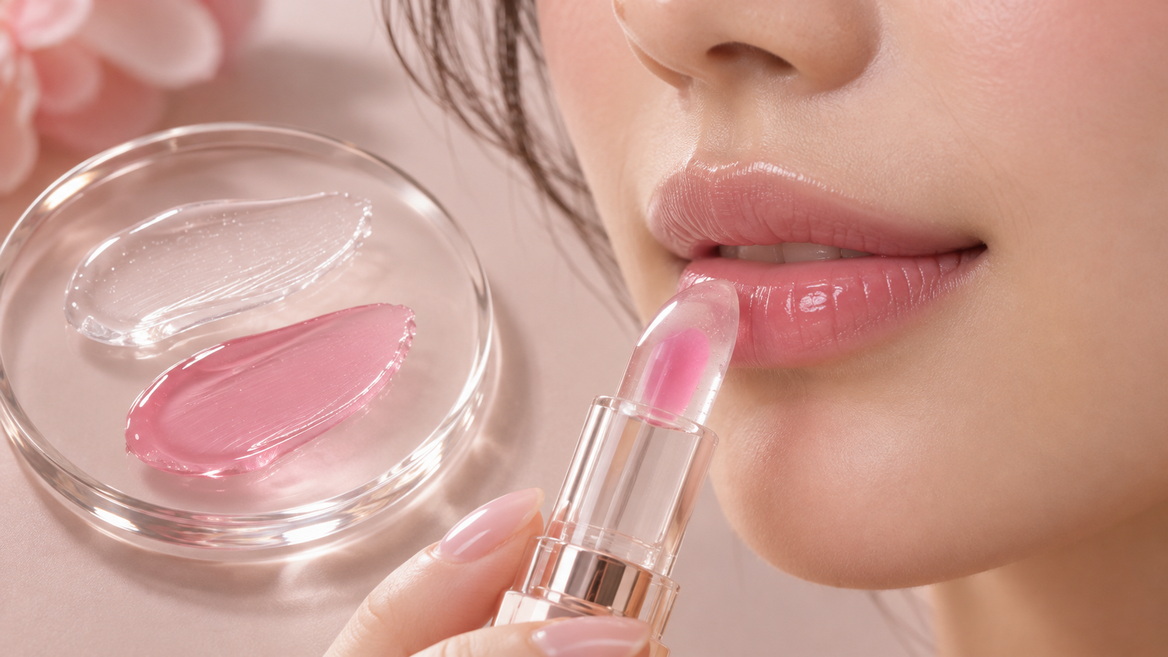
Color-changing makeup often uses dyes whose visible appearance changes with their chemical environment.
D&C Red No. 27 is one example associated with color-developing lip products. Moisture, changes in solubility, and the application environment can contribute to the appearance of pink coloration.
This explains why a product can look almost clear in its container yet produce visible color after application.
Not necessarily.
The final appearance can vary with natural lip color, product quantity, application conditions, and the formula itself. But that does not establish that the product calculates an individually ideal shade.
For brand communication, "develops a pink tint after application" is more defensible than "creates your scientifically perfect color."
We recommend evaluating color on a varied user panel rather than relying on one dramatic hand swatch.
Conventional pH measurement applies to aqueous systems. A water-free balm or oil should not receive a directly comparable pH claim without an appropriate, clearly defined method.
If a laboratory uses an extraction or dispersion procedure, the result describes that procedure—not necessarily an intrinsic pH of the untouched product.
This distinction matters when comparing samples from different manufacturers.
The strongest starting point is a defined customer need rather than a trend label.
A brand serving sensitive-feeling skin may prioritize a comfortable daily cleanser. A color cosmetics brand may prioritize a lightweight tint with an engaging application experience.
Product opportunity | Useful development question | Claim to avoid without evidence |
|---|---|---|
Facial cleanser | Does it cleanse effectively without unacceptable tightness? | "Cannot disrupt the skin barrier" |
Moisturizer | Does the complete formula support the intended hydration claim? | "Repairs every damaged barrier" |
Exfoliating serum | Are acidity, concentration, and exposure appropriate? | "Lower pH always means better results" |
Color-changing lip balm | Is color development attractive and repeatable? | "Creates a unique shade for everyone" |
Multi-use lip and cheek tint | Is the formula appropriate for both application sites? | "Suitable everywhere on the face" |
These questions help connect formulation choices to the experience customers will actually notice.
Specify the target market, product format, intended user, application area, texture, packaging, and desired claims.
"Develop a gentle daily cleanser" is a starting idea. A useful brief also explains what gentle means commercially: comfortable rinsing, low perceived tightness, or suitability demonstrated through a defined evaluation.
For aqueous products, establish a justified target and acceptable range.
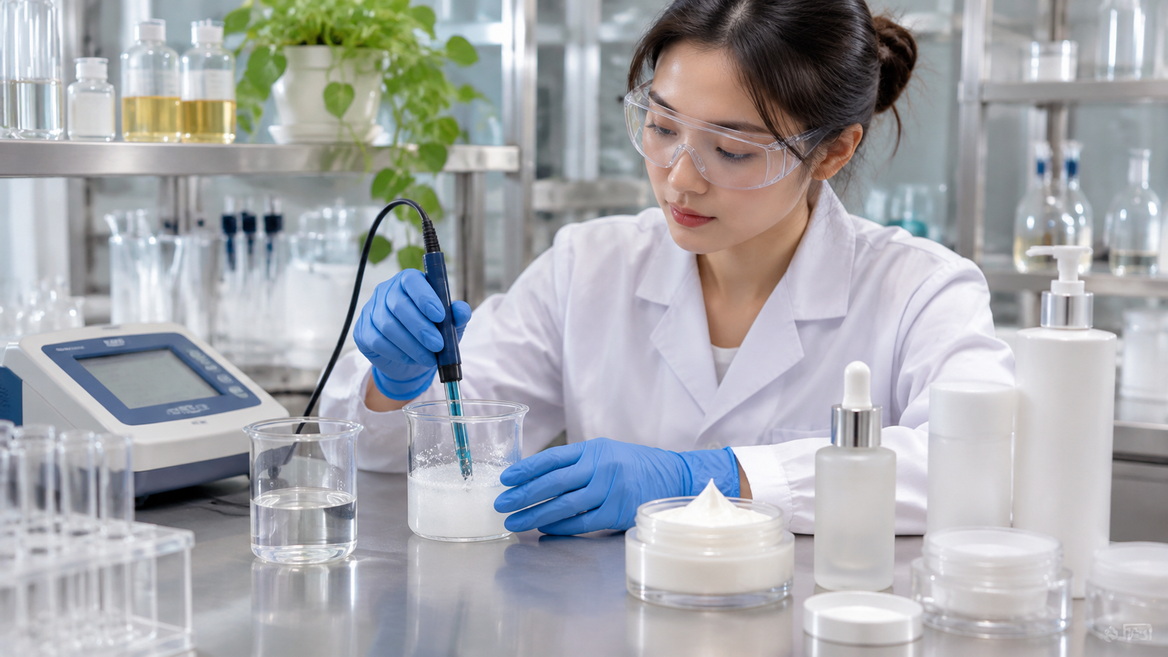
Document the measurement method, sample preparation, temperature, and equipment. Without consistent methods, differences between prototype results may reflect testing conditions rather than meaningful formulation changes.
Avoid imposing one pH target across an entire skincare range.
The selected pH must work with the complete ingredient system.
Review active ingredients, thickeners, emulsifiers, colorants, and preservatives together. Adjusting pH can change more than acidity; it may also affect texture, appearance, and stability.
A suitable reading alone does not establish adequate microbial protection.
Assess prototypes using a stability program appropriate to the formula and proposed shelf life.
Potential observations include:
- Changes in pH, odor, color, and viscosity.
- Separation or precipitation.
- Leakage and dispensing problems.
- Packaging discoloration or deformation.
- Changes in color-development behavior.
Accelerated observations can guide decisions, but they should not be presented as automatic proof of a particular shelf life.
Match the evaluation to the wording.
A hydration claim needs relevant hydration evidence. A wear-duration claim needs a defined wear assessment. A consumer-perception statement needs a documented questionnaire and an accurate description of the participants.
For color-changing products, standardize application quantity, lighting, observation times, and photography.
An approved laboratory sample is not the end of development.
Pilot and production batches should be checked against agreed specifications. Mixing conditions, processing sequence, and filling operations may affect finished-product characteristics.
Record acceptance criteria before production so both brand and manufacturer know what constitutes a releasable batch.
Useful customer feedback is specific, traceable, and connected to product decisions.
Rather than asking only whether testers "liked" a prototype, ask:
- Did the cleanser leave an uncomfortable tight feeling?
- Did the tint apply evenly?
- Was color development too strong or too subtle?
- Did the dispenser deliver a practical amount?
- Was the product comfortable during normal wear?
These are proposed evaluation questions, not customer testimonials.
Separate subjective preference from observed defects. A tester disliking a pink shade suggests a positioning or shade-development issue; repeated leakage suggests a packaging problem.
For published reviews, retain the original wording, obtain appropriate permission, and avoid turning individual experiences into universal performance promises.
For the United States, FDA facility registration and cosmetic product listing must not be described as FDA approval.
Under the Modernization of Cosmetics Regulation Act of 2022, applicable businesses face requirements involving registration, listing, safety substantiation, and adverse-event reporting, subject to relevant exemptions.
Brands should establish responsibilities before launch rather than treating compliance as a final labeling exercise.
A colorant permitted in one application is not automatically permitted in every cosmetic category.
This is especially important for multi-use products. Lip, cheek, and eye-area use may have different restrictions.
For example, FDA's colorant table lists D&C Red No. 27 for cosmetics generally, including lipsticks, but not for the eye area. Applicable batch-certification requirements must also be checked.
ISO 22716 provides cosmetic good manufacturing practice guidance covering production, control, storage, and shipment.
It does not prove that every finished formula delivers a particular benefit.
Buyers should review certificate validity, the certified facility, the covered activities, and the supporting product documentation.
Our company-provided profile describes 13 years of skincare and cosmetics research and manufacturing experience, supported by a 20,000-square-meter GMP-standard production base and reported annual capacity exceeding 50 million units.
Our stated product scope includes cleansers, serums, moisturizers, and masks, with support ranging from small-batch trials to larger production programs.
The profile also describes a research network led by a Brazilian professor, involving dermatologists, senior technical engineers, and more than 1,000 personnel across collaborating factory laboratories. This figure describes the stated collaborative network, not an independently verified count of direct employees.
For brand development, our one-stop service covers formulation, customized packaging design, and manufacturing. Our reported export footprint extends to more than 100 countries and regions.
For a pH-focused project, the practical value of these capabilities should be demonstrated through relevant samples, testing plans, specifications, and clear project documentation.
Our stated three-stage quality process covers incoming materials, in-process inspections, and finished-product release. Buyers should request project-specific records and current certification documents during supplier qualification.
It generally indicates that the manufacturer has selected a pH intended to suit the product's purpose and application. The phrase alone does not establish mildness, efficacy, or suitability for every skin type.
No. Appropriate pH depends on the product, ingredients, preservation system, and intended use. Water-free products also require different measurement considerations from aqueous formulas.
They can look different across users, but that does not prove individually optimized shade matching. Natural lip color, application amount, and product characteristics also influence the visible result.
No. Cleansing agents, their concentrations, contact time, and the overall formula matter. Mildness should be evaluated rather than inferred from a single number.
Only after reviewing ingredient permissions, safety, and performance for each intended area. A lip-safe colorant is not automatically approved for eye-area use.
Request the agreed specification, ingredient documentation, relevant safety and stability information, packaging assessment, approved reference sample, and a clear production quality agreement.
A successful pH-focused product combines understandable benefits with controlled formulation and honest communication.
Contact LAIMEI with your target market, preferred format, packaging concept, estimated order volume, and desired claims. Ask our team to discuss formulation feasibility, sampling, testing requirements, and the documentation needed for your intended launch.
Start with a product brief—not simply a trending ingredient or a pH number.
1. DLAB Custom Cosmetics. "The pH Trend: The Innovation Dominating the Cosmetics Market." June 2, 2025. Original article reviewed for topic coverage and content-gap analysis; the page displayed no published reader comments when accessed. [Read the original article]. [dlabcosmetics]
2. Lambers, H., Piessens, S., Bloem, A., Pronk, H., and Finkel, P. "Natural skin surface pH is on average below 5, which is beneficial for its resident flora." International Journal of Cosmetic Science, 28(5), 359–370, 2006. DOI: 10.1111/j.1467-2494.2006.00344.x. Supports the discussion of skin surface acidity and the 330-participant study. [View the PubMed record]. [pubmed.ncbi.nlm.nih]
3. U.S. Food and Drug Administration. "Modernization of Cosmetics Regulation Act of 2022 (MoCRA)." Supports the discussion of registration, product listing, safety substantiation, and exemptions. [Read the regulatory overview]. [fda]
4. U.S. Food and Drug Administration. "Cosmetics & U.S. Law." Explains manufacturer responsibilities and the distinction between cosmetic regulation and premarket approval. [Read the guidance]. [fda]
5. U.S. Food and Drug Administration. "Color Additives and Cosmetics: Fact Sheet." Supports intended-use restrictions, batch certification, and the regulatory treatment of color-changing pigments. [Read the fact sheet]. [fda]
6. U.S. Food and Drug Administration. "Color Additives Permitted for Use in Cosmetics." Provides application-area permissions, including those for D&C Red No. 27. [View the colorant tables]. [fda]
7. International Organization for Standardization. "ISO 22716:2007—Cosmetics—Good Manufacturing Practices (GMP)—Guidelines on Good Manufacturing Practices." Supports the explanation of the standard's manufacturing scope. [View the standard overview]. [iso]
8. Fort Worth Star-Telegram. "How Color-Changing Makeup Works and Popular pH-Activated Lipsticks." October 1, 2026. Secondary reporting containing cosmetic-chemist explanations of Red 27, moisture, and color development; not used as evidence of finished-product efficacy. [Read the explanatory article]. [amp.star-telegram]


