
Views: 238 Author: Vera Publish Time: 2026-11-19 Origin: Site


Content Menu
● Sensitive Skin Cleanser vs Micellar Cleanser: A Quick Comparison
● What Is a Sensitive Skin Cleanser?
>> What to Look for in a Gentle Rinse-Off Cleanser
>> Why Application Technique Matters
● What Is a Micellar Cleanser?
>> Why Micellar Water Suits Minimalist Routines
>> Does Micellar Water Need Rinsing?
● Which Cleanser Is Better for Sensitive Skin?
>> Dry, Tight, or Easily Irritated Skin
● Makeup and Sunscreen Removal: Where the Comparison Changes
>> Light Makeup and Everyday Buildup
>> Waterproof Makeup and Long-Wear Products
● A More Useful Expert Lens: Count Effort, Not Bottles
● A Practical Trial Before Changing Your Routine
>> Step 1: Test the Product on a Small Area
>> Step 2: Keep Other Products Consistent
>> Step 3: Record Useful Observations
● Minimalist Skincare Routines for Different Needs
>> Routine A: One Rinse-Off Cleanser
>> Routine B: Micellar Cleansing for Convenience
>> Routine C: Targeted Removal When Necessary
● What Skincare Brands Should Validate Before Launch
>> Build the Brief Around Actual Use
>> Evaluate the Finished Formula
● Developing a Cleanser With LAIMEI
>> Can a micellar cleanser also be a sensitive skin cleanser?
>> Is micellar water better than face wash for sensitive skin?
>> Can I use micellar water every day?
>> Do I need both products in a minimalist routine?
>> Does a cleanser need to foam to work?
>> Is home testing the same as allergy patch testing?
Choosing between a sensitive skin cleanser and a micellar cleanser starts with one important distinction: these categories overlap. "Sensitive skin" describes the intended user, while "micellar" describes a cleansing technology. A micellar cleanser can also be formulated for sensitive skin.
For a minimalist skincare routine, my starting recommendation is a gentle rinse-off cleanser when you want one dependable daily cleansing step. Micellar water is a useful alternative for light cleansing, convenient makeup removal, or situations with limited water access. Neither format is automatically gentler; the finished formula, what you need to remove, and your application technique matter more.
The goal is not simply fewer products. It is effective cleansing with the least unnecessary friction, residue, and discomfort.

For clarity, this article compares a gentle rinse-off cleanser marketed for sensitive skin with a water-like micellar cleanser.
| Comparison point | Sensitive skin rinse-off cleanser | Micellar cleanser |
|---|---|---|
| Typical format | Cream, milk, lotion, or gentle gel | Water-like liquid |
| Main purpose | Daily removal of oil, dirt, and surface buildup | Convenient cleansing and makeup removal |
| Application | Usually fingertips on damp skin | Usually a saturated pad; some formulas allow hand application |
| Rinsing | Required | Often optional, depending on instructions and tolerance |
| Main practical advantage | One straightforward wash-and-rinse step | Convenient when a sink is unavailable |
| Main potential drawback | An unsuitable formula may leave skin tight | Repeated wiping or remaining residue may cause discomfort |
| Makeup and sunscreen | Performance depends on the formula and products worn | May need a follow-up cleanser for thorough removal |
| Minimalist fit | Strong option for a regular daily routine | Useful when it genuinely replaces, rather than adds, a step |
There is no universal winner. A comfortable, effective routine depends on matching the cleanser to the person and the cleansing task.
A sensitive skin cleanser is intended for skin that readily experiences symptoms such as stinging, tightness, or irritation. The phrase does not identify one standardized formula or guarantee that every user will tolerate it.
Dermatology guidance favors gentle, non-abrasive cleansing rather than scrubbing. For reactive skin, fragrance-free products are a useful starting point.
When reviewing a product, look for:
- Clear instructions for daily facial use.
- A fragrance-free formula.
- A texture you can spread without vigorous rubbing.
- Straightforward rinsing instructions.
- A comfortable after-feel rather than a squeaky-clean finish.
Do not select a cleanser solely because it contains a fashionable ingredient. Glycerin or other moisturizing ingredients may be useful, but the complete formulation determines how the product behaves.
Even an appropriate cleanser can become uncomfortable when paired with hot water, abrasive tools, or repeated washing.
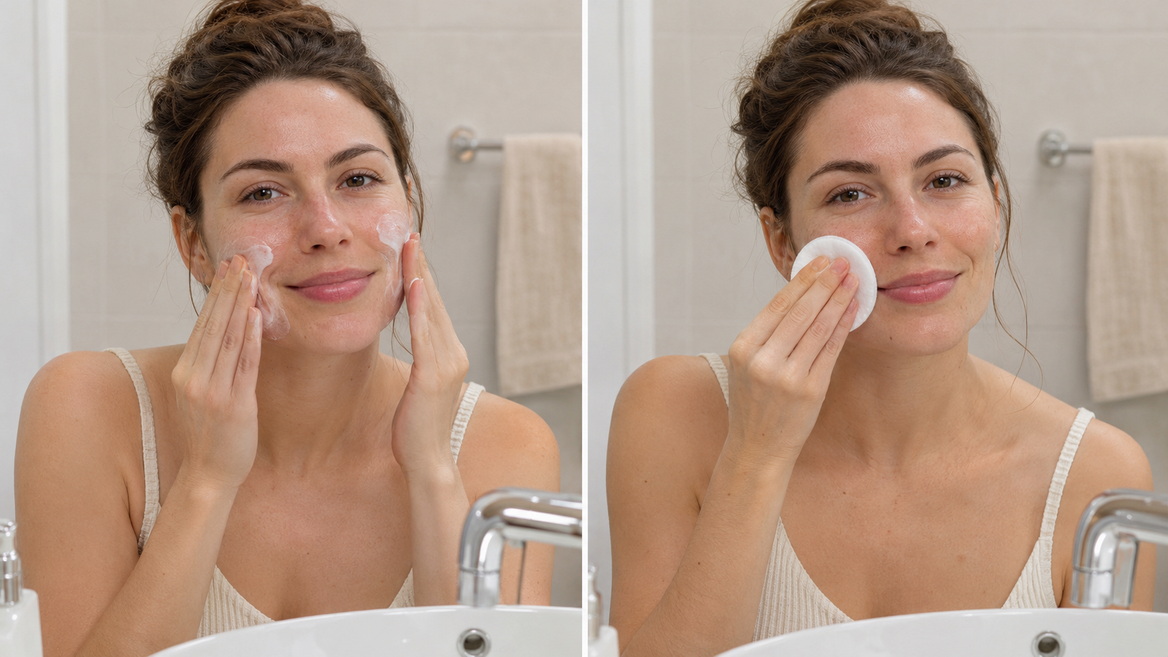
Apply it gently with your fingertips, rinse with lukewarm water, and pat dry. Dermatologists generally recommend limiting washing to twice daily and after heavy sweating, rather than repeatedly cleansing throughout the day.
Micellar water contains cleansing molecules that form tiny clusters called micelles. These help lift oil, dirt, and makeup from the skin.
Despite its water-like appearance, it is a cleanser—not plain water, and not automatically a toner.
Its main advantage is convenience. A suitable formula may provide a quick cleansing option without requiring a full wash-and-rinse process.
This can be helpful when:
- Traveling or camping.
- Removing light makeup.
- Cleansing somewhere without convenient sink access.
- Simplifying a routine that otherwise feels difficult to maintain.
However, convenience should be judged by the entire process. Several rounds of wiping followed by another cleanser may be less minimalist than one effective rinse-off wash.
Many micellar waters are designed for no-rinse use. Follow the product's instructions and assess your skin's response.
Some people tolerate the remaining formula comfortably; others experience irritation or dislike the residue. A gentle rinse may help when residue is uncomfortable, but persistent stinging or redness is a reason to stop using the product—not keep experimenting indefinitely.
The better option is the one that removes the day's buildup without requiring aggressive application or leaving persistent discomfort.
A fragrance-free rinse-off cream or lotion cleanser is a reasonable starting point. Fingertip application avoids the repeated pad contact commonly associated with micellar cleansing.
That does not make every cream cleanser suitable. If your skin repeatedly feels tight or stings after washing, reconsider the formula and technique.
Oily skin still needs gentle handling. Choosing the strongest cleanser available can create an uncomfortable routine without solving the reason your skin reacts.
A gentle gel may suit your texture preference. A micellar cleanser may also work, provided it removes the relevant buildup without excessive wiping. Judge the finished product rather than assuming that cream textures are always mild or clear liquids are always lightweight enough.
Rosacea requires particular care. Dermatology guidance recommends mild cleansing, fragrance-free products, gentle fingertip application, and thorough removal of rinse-off cleanser.
A rinse-off formula may therefore be practical when wiping triggers discomfort. Persistent redness, burning, or suspected rosacea warrants professional assessment rather than repeated product switching.
Micellar water may be sufficient for light cleansing. A gentle rinse-off cleanser may also do the job in one step.
The useful question is not "Which category cleans better?" It is "Does this particular product remove what I wear without repeated effort?"
Do not assume every micellar cleanser or sensitive skin cleanser removes waterproof makeup equally well.
Check the intended use, especially around the eyes. Avoid compensating for poor removal by scrubbing harder. A product specifically designed for the makeup you wear may be more appropriate.
Cleveland Clinic's micellar-water guidance recommends following with a gentle cleanser when removing sunscreen or cosmetic products.
That does not establish that everyone needs two cleansers every evening. Removal depends on the sunscreen, makeup, cleanser, and application method. If one suitable cleanser performs adequately and feels comfortable, an additional step may offer little practical value.
From a formulation and user-experience perspective, I would evaluate minimalism by the total cleansing process—not the number of products displayed on a shelf.
Consider three questions:
1. How many passes are needed?
2. How much rubbing is involved?
3. Does the process leave skin comfortable?
A single bottle that requires five pads and repeated rubbing is not necessarily the simpler option. Conversely, an occasional targeted makeup-removal step can make the overall routine easier.
This is an editorial decision framework, not a clinical scoring system. Its value is that it connects product choice with how people actually cleanse.
A controlled introduction is more informative than changing your cleanser, moisturizer, and treatment products simultaneously.
The American Academy of Dermatology recommends testing a skincare product on a small area twice daily for seven to ten days before broader use.
For a rinse-off product, follow the intended contact time and washing instructions. This home-use test is not the same as medical patch testing and cannot guarantee that a product will never cause a reaction.
Introduce one new cleanser at a time. Keep the rest of your routine stable where practical so that a reaction is easier to interpret.
Use a short daily note:
| Observation | What to record |
|---|---|
| Application comfort | Any burning, stinging, or discomfort |
| After-cleansing feel | Comfortable, tight, sticky, or dry |
| Removal effort | Number of washes or wiping passes |
| Visible changes | New redness, flaking, or swelling |
| Practical fit | Time, convenience, and willingness to repeat |
This is a personal observation log, not a diagnostic tool. Stop using a product that causes a reaction, and seek medical advice for significant or persistent symptoms.
For someone who wants a sink-based routine:
1. Cleanse gently according to the label.
2. Rinse thoroughly with lukewarm water.
3. Pat dry and apply a suitable moisturizer.
4. Use appropriate sun protection during the day.
Avoid adding scrubs, brushes, or a second wash simply because the routine seems too short.
For light cleansing or limited water access:
1. Apply the micellar product as directed.
2. Use gentle contact rather than repeated rubbing.
3. Rinse if instructed or if residue feels uncomfortable.
4. Follow with moisturizer and daytime sun protection.
If removal consistently requires multiple passes, reconsider whether that formula matches your needs.
For heavier makeup days, use a suitable remover where needed, followed by a gentle cleanser if required.
Keep this conditional. A step that helps on a waterproof-makeup day does not automatically belong in every evening routine.
For private-label brands, choosing between a sensitive skin cleanser and micellar water should begin with a clear user scenario.
Define:
- Target skin concerns and known tolerability needs.
- Makeup and sunscreen habits.
- Rinse-off or no-rinse positioning.
- Intended facial and eye-area use.
- Packaging, application method, and target market.
A "gentle" concept is incomplete without a realistic account of how consumers will use it.
A development brief should request appropriate stability, microbiological safety, packaging compatibility, and claim-support work.
For sensitive-skin positioning, ask what evidence supports the finished product—not just individual ingredients. If "dermatologist tested" is proposed, clarify the protocol, population, outcome measures, and meaning of the claim.
Similarly, facility credentials should not be presented as proof that a particular cleanser is suitable for every sensitive-skin user.

According to its supplied company profile, GUANGZHOU LAIMEI CREATIVE RESEARCH INTELLIGENT BIOLOGICAL RESEARCH CO.,LTD. brings 13 years of skincare and cosmetics manufacturing experience, a 20,000-square-meter production base, and reported annual capacity exceeding 50 million units.
The company describes integrated formulation, packaging, and manufacturing support, with products supplied to more than 100 countries and regions. These company-reported capabilities provide context for supplier evaluation; they are not independent evidence of a cleanser's clinical performance.
For a minimalist cleanser project, request comparable rinse-off and micellar samples against the same brief. Review cleansing performance, user comfort, packaging, testing requirements, and supporting documentation before choosing a format.
Contact LAIMEI with your target market, preferred texture, intended claims, packaging requirements, and expected order volume to discuss a tailored OEM/ODM development proposal.
Yes. "Micellar" describes the cleansing system, while "sensitive skin" describes the intended user. Suitability still depends on the finished formula and individual tolerance.
Not universally. It may be convenient and comfortable, but repeated wiping or residue can be problematic for some users. A gentle rinse-off cleanser may suit others better.
Potentially, if the product is intended for daily use and your skin tolerates it. Follow the instructions and stop if irritation develops.
No. Start with the fewest steps that cleanse adequately and feel comfortable. Add a separate removal step only when your makeup, sunscreen, or product instructions justify it.
No. Micellar water and non-foaming cleansers can cleanse without producing noticeable lather. Foam alone does not establish cleansing effectiveness or suitability.
No. Home testing can help identify an obvious reaction before wider use. Medical patch testing is a professional procedure used to investigate possible contact allergies.
1. American Academy of Dermatology. [Face Washing 101]. Guidance on gentle cleansers, fingertip application, water temperature, washing frequency, and moisturizing. [aad]
2. Cleveland Clinic. [Micellar Water: What It Is and How To Use It]. Explanation of micelles, cleansing uses, no-rinse application, and follow-up cleansing for sunscreen and cosmetics. [health.clevelandclinic]
3. American Academy of Dermatology. [7 Rosacea Skin Care Tips Dermatologists Recommend]. Guidance on fragrance-free products, mild cleansing, avoiding friction, and removing cleanser thoroughly. [aad]
4. American Academy of Dermatology. [How to Test Skin Care Products]. Seven-to-ten-day home testing instructions and advice for managing reactions. [aad]
5. The Klog. [Should You Rinse Off Micellar Water? Dermatologists Weigh In]. Secondary expert commentary on residual surfactants, individual tolerance, and optional rinsing. This is a commercial editorial source, not a comparative clinical trial. [sokoglam]


