
Views: 223 Author: Vera Publish Time: 2026-11-02 Origin: Site


Content Menu
● How We Evaluate Private Label Skincare Suppliers
>> What This Guide Does Not Assume
● Why Source Private Label Skincare From Finland?
>> A Specialized Manufacturing Network Rather Than a Mass-Production Cluster
>> Natural Formulation and Certification Capabilities
>> A Clear EU Regulatory Framework
● Supplier Comparison: Capacity, MOQ, and Certifications
● 1. GUANGZHOU LAIMEI CREATIVE RESEARCH INTELLIGENT BIOLOGICAL RESEARCH CO.,LTD.
>> An International Alternative for Cost-Conscious, Customization-Focused Brands
>> Core Strengths and OEM/ODM Scope
>> Markets and Procurement Considerations
● 2. Nordic BioCosmetic Production Oy
>> A Direct Fit for Finnish Private Label Skincare
>> Establishment and Manufacturing Background
>> Core Strengths and OEM/ODM Scope
>> Markets and Best-Fit Buyers
>> A Development-Oriented Option for Specialized Skincare Projects
>> Core Strengths and OEM/ODM Scope
>> Markets and Best-Fit Buyers
>> A Natural Skincare Manufacturer Requiring Private Label Qualification
>> Core Strengths and Potential Service Scope
>> Markets and Best-Fit Buyers
>> A Larger Finnish Manufacturing Prospect for Established Buyers
>> Core Strengths and Manufacturing Scope
>> Markets and Best-Fit Buyers
● Technical Standards That Matter in Private Label Skincare
>> Ingredient Specifications Matter More Than "Premium Grade"
>> Use Cosmetics Standards, Not Unrelated Certification Lists
● Buyer's Guide: From Supplier Screening to Stable Delivery
>> 1. Verify the Factory and the Contracting Entity
>> 2. Separate Formula MOQ From Packaging MOQ
>> 3. Approve More Than a Laboratory Sample
>> 4. Build a Complete Delivery Schedule
● Insider Pitfall: The Same INCI List Does Not Mean the Same Formula
● Conclusion: Select for Your Product, Not the Supplier's Headline
>> 1. How Can I Verify Whether a Manufacturer's ISO Certificate Has Expired?
>> 2. Who Is Responsible for EU Compliance When Products Carry My Brand?
>> 3. Does a Manufacturer's COSMOS Certification Cover My Product Automatically?
>> 4. Can I Transfer My Formula to Another Manufacturer Later?
>> 5. How Do I Prevent the First Commercial Batch From Differing From the Approved Sample?
Finland is worth considering when your skincare brand needs traceable manufacturing, natural formulation expertise, and a credible Nordic origin story. However, selecting a long-term manufacturing partner requires more than finding a supplier with Finnish branding. Procurement teams must establish where products are actually manufactured, which services the supplier performs in-house, and whether its quality documentation supports the intended market.
The European market provides a substantial commercial opportunity. According to Cosmetics Europe's Market Performance 2025 data, European cosmetics and personal care retail sales reached €110 billion in 2025. Skincare represented the largest category at €32.3 billion, while European cosmetics exports were valued at €29.8 billion. These are European industry figures—not Finnish production or private label market estimates. [cosmeticseurope]
This guide examines five sourcing options relevant to buyers researching private label skincare manufacturers and suppliers in Finland. Four are Finnish businesses; the first is a Chinese OEM/ODM alternative for buyers comparing Finnish production with international sourcing.
The selection is an editorial procurement shortlist, not a claim that every company has undergone an independent factory audit. Confirmed contract manufacturers and suppliers requiring further qualification are clearly distinguished.

A suitable supplier should demonstrate traceability across its formula, raw materials, manufacturing records, packaging, and compliance documentation.
For procurement purposes, the following assessment framework provides a practical starting point:
| Evaluation area | Suggested weighting | Evidence to request |
|---|---|---|
| Quality systems and regulatory readiness | 30% | GMP documentation, certification scope, safety documentation responsibilities, audit findings |
| Formulation and development capability | 25% | Laboratory capabilities, development examples, stability plans, ingredient specifications |
| Production and delivery reliability | 20% | Relevant batch sizes, filling capabilities, capacity allocation, delivery performance |
| Commercial flexibility | 15% | MOQ by formula and packaging, development charges, ownership terms |
| Communication and project management | 10% | Named project lead, approval workflow, escalation procedure |
These percentages are a proposed buyer evaluation model, not scores assigned to the companies below.
Finland's regulator, Tukes, identifies ISO 22716 as the relevant cosmetics GMP standard and explains that GMP covers personnel, premises, equipment, raw materials, packaging, production, finished products, and quality control. A certificate should therefore support a broader quality assessment rather than replace it. [tukes]
The following distinctions are essential:
- A supplier's advertised annual capacity is not necessarily capacity available to your project.
- A factory certificate does not automatically certify every finished product.
- A brand with its own factory does not necessarily accept third-party private label orders.
- FDA facility registration does not mean FDA approval.
- An attractive sample does not establish production-scale repeatability.
The FDA explicitly states that cosmetic facility registration and product listing are neither approval programs nor promotional tools. It also states that it does not issue certificates verifying cosmetic facility registration or product listing. [fda]
Finland's relevant manufacturing capabilities are distributed across several locations rather than concentrated in one large cosmetics export district.
For example:
- Nordic BioCosmetic manufactures in Tuusula, near Helsinki.
- Flow Cosmetics develops and manufactures skincare in Riihimäki.
- Berner operates cosmetics and hygiene manufacturing in Heinävesi.
- Vitae Clean Cosmetics provides a smaller-scale contract development and manufacturing option. [nordicbiocosmetic]
For buyers, the advantage lies in finding the right technical specialization—not assuming that every Finnish supplier offers the same cost structure, capacity, or services.
Finland offers identifiable suppliers with natural cosmetics expertise. Nordic BioCosmetic publicly offers contract manufacturing under COSMOS supervision by Ecocert Greenlife. Flow Cosmetics states that its products are Ecocert COSMOS certified. These are useful qualification signals, but buyers must still verify the scope relevant to their own product. [nordicbiocosmetic]
Products placed on the Finnish market must meet EU cosmetics requirements. Tukes explains that obligations include a responsible person, a safety assessment, product information, appropriate labelling, and CPNP notification. Specified label information must appear in Finnish and Swedish. [tukes]
Manufacturing in Finland can simplify some operational relationships, but it does not remove the brand owner's need to define regulatory responsibilities contractually.
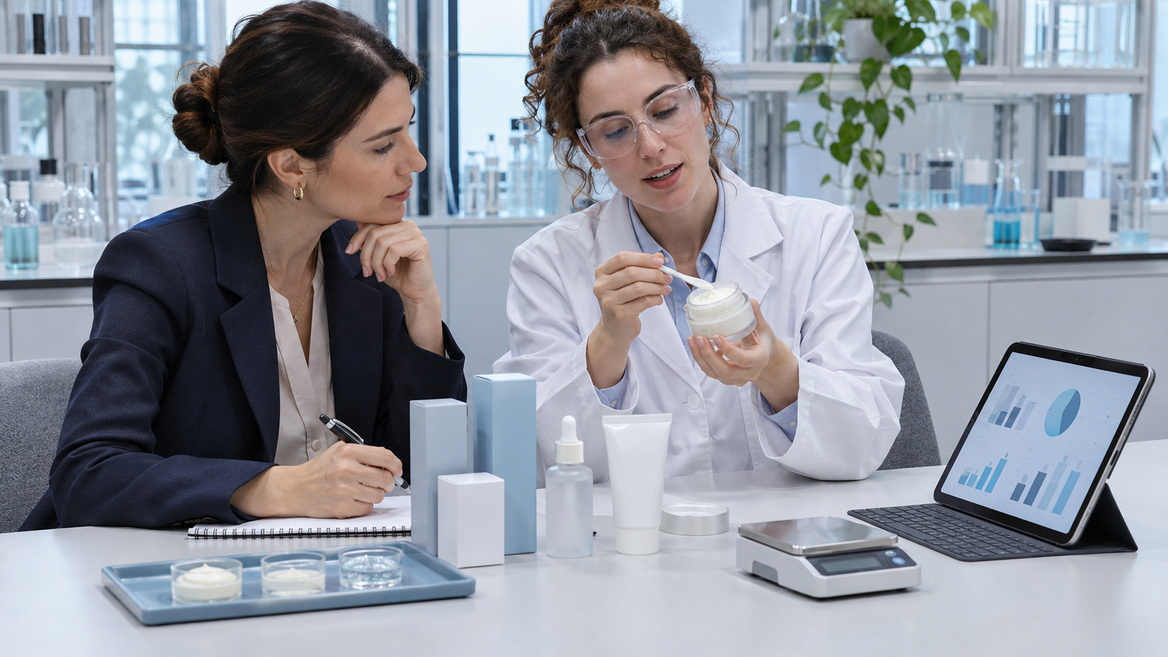
"Not publicly disclosed" means that a comparable figure was not established from the reviewed sources. It does not mean the supplier lacks capacity or certification.
| Supplier | Production location | Capacity information | Published MOQ | Certification or quality information | Qualification status |
|---|---|---|---|---|---|
| LAIMEI | Guangzhou, China | Company-provided brief reports a 20,000 m² base and over 50 million units annually; independently unverified | Website advertises orders as low as 500 units, subject to project confirmation | Company reports ISO 22716, GMPC, and FDA registration; supporting documents require verification | International OEM/ODM alternative |
| Nordic BioCosmetic Production Oy | Tuusula, Finland | Scalable production; no annual unit total published on reviewed page | 1,500 units minimum; approximately 5,000 units described as more efficient | GMP principles; COSMOS contract manufacturing supervised by Ecocert Greenlife | Explicit private label manufacturer |
| Vitae Clean Cosmetics Oy | Finland | No comparable annual capacity established | Request a project-specific quotation | Public service information includes safety assessment, documentation, CPNP support, and certification-process assistance; current certificates require confirmation | Contract development and manufacturing candidate |
| Flow Cosmetics | Riihimäki, Finland | Describes small-scale, small-batch manufacturing | Third-party MOQ not established | Own products described as Ecocert COSMOS certified | Contract manufacturing availability requires confirmation |
| Berner Oy | Heinävesi, Finland | Established manufacturing operations; no skincare-specific available capacity established | Request confirmation | Reports COSMOS-certified natural cosmetics manufacturing; verify current site and product scope | Larger manufacturing prospect; project acceptance requires confirmation |
Sources for supplier-published information: LAIMEI, Nordic BioCosmetic, Vitae company information, Flow Cosmetics, and Berner corporate reports. The LAIMEI production figures above originate from the company brief supplied for this article, not an independent capacity audit. [nordicbiocosmetic]
LAIMEI belongs in this comparison as an overseas sourcing alternative—not as a Finnish manufacturer.
The company-provided brief describes 13 years of skincare and cosmetics R&D and manufacturing experience. It also reports exports to more than 100 countries and regions. Its exact legal incorporation year should be confirmed through corporate registration documents rather than inferred from the experience claim.
LAIMEI's public website describes a private label model covering formula customization, packaging, and global compliance support. It advertises trial production with an MOQ as low as 500 units and after-sales consultation covering formula adjustments, packaging optimization, and logistics tracking. These are supplier statements rather than independently measured service results. [lmoemcosmetics]
The company is relevant to small and medium-sized brands seeking:
- Adaptation of existing formulations.
- Custom skincare development.
- Packaging coordination.
- Trial launches before larger commitments.
- A consolidated manufacturing and project-management relationship.
The supplied company brief lists cleansers, serums, moisturizers, and masks among its product categories. Its advertised small-batch model makes it a candidate for brands comparing launch economics across different manufacturing origins.
LAIMEI positions itself as an international supplier, while the company brief reports distribution across more than 100 markets. Buyers should request destination-specific references rather than treat this aggregate claim as evidence of experience in every regulatory jurisdiction.
Its published website describes a broader team exceeding 2,000 people, while the supplied brief references more than 1,000 associated laboratory professionals. These figures may describe different organizational boundaries. Procurement teams should distinguish direct employees, partner-factory personnel, laboratory networks, and staff assigned to their project. [lmoemcosmetics]
Before approval, request:
1. The exact contracting entity and production-site address.
2. Current ISO 22716 and other claimed certificates.
3. A capacity statement for the proposed product and filling line.
4. A written communication and sample-approval schedule.
5. Clear responsibility for EU safety assessment, product information, and notification.
The brief also mentions "MADS certification." Its issuing organization, standard, scope, and validity need clarification before it is presented as a procurement credential.
Nordic BioCosmetic provides one of the clearest publicly documented private label propositions in this shortlist. Its website states that it develops and manufactures products for other brands and focuses on private label rather than competing through its own consumer product portfolio. [nordicbiocosmetic]
The company traces its manufacturing heritage to 1960. However, a Finnish business directory records the current legal entity as established in 2018. These are different facts: manufacturing heritage should not be confused with the incorporation date of the company signing your contract. [nordicbiocosmetic]
Production takes place in Tuusula. Its published capabilities include creams, emulsions, serums, gels, oils, shampoos, and similar liquid-filled products. It states that makeup and stick deodorants are outside its current manufacturing scope. [nordicbiocosmetic]
Its service offering includes:
- Custom formulation development.
- Adaptation of existing formulas.
- Contract manufacturing.
- Filling and packaging.
- Natural cosmetics certification support.
- Documentation and turnkey project coordination.
The published minimum is 1,500 units, while batches of approximately 5,000 units are described as more production-efficient. A completely new development project is stated to typically require 6–12 months. [nordicbiocosmetic]
Its public proposition targets startups and established brands, with documentation positioned for EU markets. A complete customer-country breakdown is not publicly established.
This supplier is particularly relevant when Finnish manufacturing origin, custom liquid skincare, and potential COSMOS certification are central to the brand proposition. Confirm whether the quoted MOQ applies separately to each formula, fragrance, size, and packaging configuration.
Public Finnish company information records Vitae Clean Cosmetics as beginning operations in 2018. Its service description covers research and development, modification of existing recipes, production, packaging, safety assessment, documentation, and project management. [asiakastieto]
The listed product and service areas include:
- Skincare.
- Baby skincare.
- Spa and wellness professional cosmetics.
- Raw-material consulting.
- Product safety assessment.
- CPNP-related documentation.
- Certification-process assistance. [asiakastieto]
This makes Vitae relevant to buyers who need formulation and documentation support rather than only filling capacity.
Its publicly described capabilities are relevant to EU-market projects, although a verified export-country breakdown was not established.
The company merits consideration for development-led brands and specialized product concepts. Buyers should establish the size of the in-house team, which tests are outsourced, where each production step occurs, and how additional volume is handled.
No comparable public annual capacity or standard MOQ was established from the reviewed materials. Obtain both in writing before comparing its quotation with larger factories.
Flow Cosmetics states that it has operated since 2004 and develops and manufactures skincare in Riihimäki. Its public materials emphasize small-batch production and Ecocert COSMOS-certified products. [flowcosmetics]
A team page identifies a production manager with contract manufacturing responsibilities. That supports a sourcing inquiry, but it does not establish a universally available turnkey private label program, standard MOQ, or guaranteed acceptance of new projects. [flowcosmetics]
Flow's visible strengths include in-house product development, natural skincare experience, and small-scale manufacturing. Its product range demonstrates experience with body-care products and oil-rich formats such as balms and butters. [flowcosmetics]
For a procurement team, the next step is to determine whether Flow offers:
- Custom formulas under a customer's brand.
- Adaptation of established bases.
- Manufacturing from customer-owned formulas.
- Packaging procurement.
- Product-specific certification support.
These should be treated as qualification questions, not assumed services.
Flow operates a consumer brand and invites retailer relationships, including inquiries through its English-language website. Its main country-by-country market distribution was not verified. [flowcosmetics]
It is most relevant to buyers interested in smaller natural skincare projects who are prepared to establish commercial availability before detailed development work.
Berner dates its business history to 1883. Its Heinävesi operations include cosmetics and hygiene manufacturing, and its 2025 annual report states that Herbina hair and body products are manufactured at that plant. [berner]
Berner also reports contract manufacturing within its broader operating model. Nevertheless, this does not establish that every skincare category or startup private label project is currently accepted. [berner]
Berner is relevant because it offers evidence of established Finnish production infrastructure rather than only a brand or distribution operation.
Its public reporting also records the start of COSMOS-certified natural cosmetics manufacturing in Heinävesi. Buyers should request current certification evidence and confirm the exact scope applicable to their proposed products. [berner]
Berner describes itself as an internationalizing Finnish group. However, group-level market reach should not be confused with the customer markets served by a specific contract-manufacturing line. [berner]
Established buyers should use an initial qualification call to confirm product fit, available capacity, customer acceptance criteria, development responsibilities, and whether a dedicated private label agreement is commercially appropriate.

A useful raw-material specification should go beyond terms such as "premium," "clean," or "cosmetic grade."
Request, where relevant:
- INCI identity and supplier reference.
- Active content or assay range.
- Carrier, solvent, and preservative composition.
- Microbiological specifications.
- Relevant impurity limits.
- Allergen information.
- Storage conditions and retest periods.
The purpose is to make the formula reproducible and assessable. Tukes requires the responsible person to ensure product safety, ingredient compliance, supporting product information, and evidence for claimed effects. [tukes]
For conventional skincare, CE marking and RoHS should not be presented as substitutes for cosmetics compliance. The relevant foundation is the EU Cosmetics Regulation, supported by GMP, safety assessment, product information, and correct labelling. Different rules may apply if the project includes an electrical beauty device or a product classified outside cosmetics. [tukes]
For natural or organic positioning, verify the actual COSMOS certification pathway and product eligibility. A certified manufacturing operation does not automatically authorize every customer product to carry a certification logo. Nordic BioCosmetic explicitly describes product certification as a process it can help customers undertake. [nordicbiocosmetic]
Ask for the legal entity name, business registration, production address, and a process map showing outsourced activities.
During an audit, examine raw-material quarantine, weighing controls, water systems, cleaning records, calibration, bulk storage, filling, batch release, and complaint handling. These areas align with the manufacturing and control functions covered by cosmetics GMP. [tukes]
A quotation for 1,000 finished units may conceal a larger packaging commitment.
Ask separately for:
- Minimum bulk manufacturing batch.
- Minimum filling quantity.
- Bottle or jar purchasing minimum.
- Pump and closure minimum.
- Decoration minimum.
- Carton printing minimum.
- Ownership and storage terms for unused components.
Compare total launch cash requirements, not simply the finished-unit price.
Use an approval sequence that includes:
1. A documented product brief.
2. A version-controlled laboratory sample.
3. Packaging selection.
4. Stability, microbiological, and compatibility work appropriate to the product.
5. A pilot or representative production run.
6. A signed final specification and reference sample.
The safety assessment must be completed before market placement. Supporting evidence should relate to the product actually being sold, not merely to an earlier prototype. [tukes]
Request separate dates for formula approval, packaging approval, material availability, production, testing, batch release, and dispatch.
For context, Nordic BioCosmetic's published 6–12-month timeframe for completely new products shows why custom development should not be scheduled like a reorder of an existing formula. [nordicbiocosmetic]
For international shipments, define the Incoterm, importer, customs responsibilities, transport conditions, insurance, and handling of damaged or delayed goods. Tukes specifically requires distributors to ensure that transport and storage do not jeopardize product safety. [tukes]
A meaningful comparison includes manufacturing, packaging, development, testing, certification, regulatory services, freight, customs-related charges, and inventory exposure.
Finnish production and Chinese OEM/ODM sourcing should therefore be compared against the same technical brief and market-entry requirements. A lower ex-factory price is not automatically a lower total project cost.
A less obvious purchasing risk is uncontrolled raw-material substitution.
Two batches may carry the same ingredient list while using different commercial grades, extract concentrations, carriers, or supplier materials. Buyers should not rely on an unchanged INCI list as proof that nothing meaningful has changed.
This guide recommends a contractual change-control clause requiring written approval before changing:
- Critical raw-material suppliers or grades.
- Active concentrations.
- Preservative systems.
- Fragrance composition.
- Product-contact packaging.
- Manufacturing sites.
- Materially important processing parameters.
Also specify when changes trigger repeat testing, safety-assessment review, documentation updates, or new customer approval. This approach supports the responsible person's continuing obligation to maintain product safety and updated product information. [tukes]
The commercial lesson is straightforward: negotiate ownership of the specification and control of changes, not just ownership of the brand name.
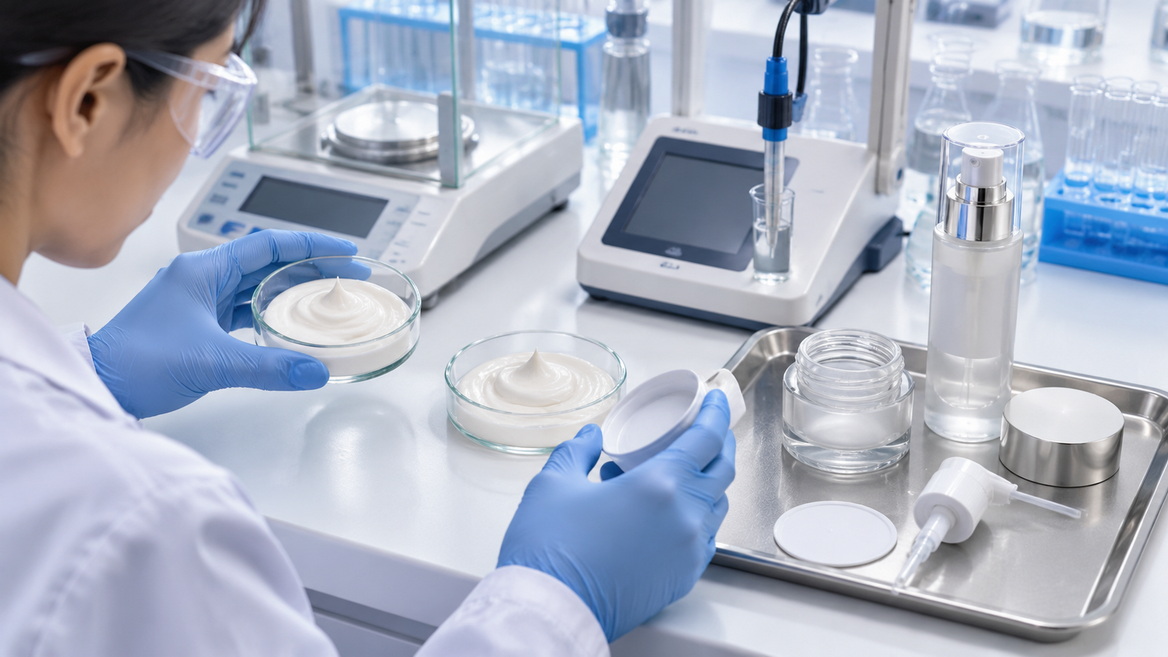
For an explicitly documented Finnish private label offering, Nordic BioCosmetic is a strong starting point. Vitae merits consideration for development-led projects. Flow requires confirmation of third-party project availability, while Berner is a larger manufacturing prospect whose acceptance criteria should be qualified early.
LAIMEI provides a non-Finnish comparison for buyers prioritizing flexible trial orders, customization, and coordinated OEM/ODM support. Its advertised 500-unit entry point is relevant to smaller brands, but certification, capacity, and destination-market support should be verified for the specific project. [nordicbiocosmetic]
To request a useful proposal from GUANGZHOU LAIMEI CREATIVE RESEARCH INTELLIGENT BIOLOGICAL RESEARCH CO.,LTD., prepare a brief covering your target market, product category, benchmark texture, ingredient restrictions, packaging format, initial quantity, target landed cost, and launch date.
Request a written development plan, project-specific MOQ, documentation checklist, and itemized quotation before committing to production.
Request the complete certificate and verify its legal entity, site address, standard, scope, certificate number, issuer, and validity dates.
Check the issuer's verification system and, where applicable, IAF CertSearch. The latter can display certification status, scope, issuing certification body, and accreditation information. If a certificate cannot be located, seek direct confirmation from the issuer rather than immediately assuming fraud. Also check for suspension or withdrawal, not only expiry. [iafcertsearch]
Do not assume the factory automatically assumes every obligation.
Tukes explains that a distributor placing a cosmetic product on the market under its own name or trademark becomes the responsible person. Importing from outside the EU/EEA creates additional role considerations. Define the legally appropriate arrangement in writing, including responsibility for the safety report, product information, CPNP notification, labelling, and post-market issues. [tukes]
No. Verify the manufacturer's scope and the certification requirements for the exact finished product.
Formula ingredients, processing, packaging, and label authorization may require review within the applicable certification process. Nordic BioCosmetic's offer to guide customers through product certification illustrates the distinction between a manufacturing capability and approval of a specific private label product. [nordicbiocosmetic]
That depends on your agreement.
Negotiate ownership or licensing of the formula, access to quantitative composition, raw-material specifications, relevant processing instructions, and rights to use supporting data. The responsible person needs adequate information to fulfill safety and documentation obligations, but those regulatory obligations do not by themselves settle commercial ownership. Define transfer rights before development begins. [tukes]
Agree on a final specification, sample version, packaging configuration, and batch-release criteria before production.
Specify measurable acceptance limits where appropriate, retain approved reference samples, and require written change control. Ask how the supplier documents weighing, processing, filling, testing, and release. These controls should sit within the manufacturer's GMP system rather than depend on an informal promise that production will "match the sample." [tukes]
The principal evidence used for this guide includes:
- Cosmetics Europe, "Our Industry," incorporating Market Performance 2025 figures for European retail sales, skincare, and exports. [cosmeticseurope]
- Tukes, "Obligations of the Responsible Person," covering safety assessment, product information, GMP, claims evidence, and CPNP notification. [tukes]
- Tukes, "Labelling of Cosmetics" and "Know Your Role," explaining Finnish and Swedish labelling and responsible-person arrangements. [tukes]
- LAIMEI, "About Us," covering advertised private label services, low-MOQ production, and project support. Company-supplied figures are identified separately in the article. [lmoemcosmetics]
- Nordic BioCosmetic, official private label manufacturing information, including product scope, minimum quantities, development timelines, and certification support. [nordicbiocosmetic]
- Finnish company information for Vitae Clean Cosmetics and Nordic BioCosmetic, used to distinguish operating history from legal-entity establishment. [asiakastieto]
- Flow Cosmetics, official company, team, and manufacturing information. [flowcosmetics]
- Berner, corporate history and annual reporting on Finnish production and contract manufacturing. [berner]
- FDA, cosmetic facility registration and product listing guidance, clarifying that registration is not approval. [fda]
- IAF CertSearch, certificate validation guidance. [iafcertsearch]


