
Views: 274 Author: Vera Publish Time: 2026-10-28 Origin: Site


Content Menu
● Why Consider Denmark for Private Label Skincare Manufacturing?
>> Established Expertise in Certified Personal Care
>> Access to a Substantial European Market
● How We Selected These Private Label Skincare Suppliers
● Private Label Skincare Manufacturer Comparison
● 1. GUANGZHOU LAIMEI CREATIVE RESEARCH INTELLIGENT BIOLOGICAL RESEARCH CO.,LTD.
>> An International Alternative for Flexible OEM/ODM Projects
>> Experience, Scale, and Markets
>> Core Strengths and OEM/ODM Scope
>> A Danish Partner for Sensitive-Skin and Certified Skincare Development
>> Core Strengths and Service Scope
>> MOQ, Quality, and Buyer Fit
>> Long-Established Cosmetics Manufacturing with Packaging Integration
>> Core Strengths and OEM/ODM Scope
● 4. Allison, Part of Nopa Nordic
>> A Nordic-Oriented Private Label Personal Care Manufacturer
>> Core Strengths and Service Scope
>> Buyer Fit and Procurement Questions
>> A Technical Contract Manufacturer Supporting Bespoke and Pilot Projects
>> Core Strengths and OEM/ODM Scope
● Technical Standards That Matter in Private Label Skincare
>> Start with Cosmetics Requirements, Not Unrelated Badges
>> Examine Ingredient Specifications, Not Just Ingredient Names
>> Match Testing to the Finished Product
● Buyer's Guide: From Supplier Screening to Repeat Orders
>> 1. Verify the Legal Entity and Manufacturing Site
>> 2. Issue the Same Technical Brief to Every Supplier
>> 3. Approve Samples in Stages
>> 4. Compare Total Landed Cost
>> 5. Build Delivery Terms Around Milestones
● Common Sourcing Pitfalls—and an Overlooked Insider Check
>> Pitfall: Buying an Ingredient Story Instead of an Active Specification
>> Pitfall: Assuming a Low MOQ Covers Every Component
>> Insider Check: Lock the Formula, Process, and Packaging Together
● Conclusion: Choose the Partner That Fits Your Commercial Model
>> 1. How Can I Verify Whether a Manufacturer's ISO Certificate Is Current?
>> 2. Can I Use a Manufacturer's Existing CPSR for My Own Private Label Product?
>> 3. Who Owns a Custom Formula, and Can I Transfer Production?
>> 4. Does a Factory's COSMOS or Nordic Swan Experience Mean My Product Can Carry the Label?
>> 5. Can a Danish Manufacturer's Sunscreen Documentation Be Reused for Other Countries?
Choosing a private label skincare manufacturer is a decision about more than formulas and filling prices. For professional buyers, the real challenge is finding a partner that can reproduce an approved product consistently, provide usable compliance documentation, and deliver repeat orders without unexpected changes.
Denmark offers several established manufacturers with experience in sensitive-skin formulations, certified personal care, and integrated product development. However, buyers should distinguish between a supplier's reputation and its suitability for a specific project. A factory serving established Nordic retailers may not offer the order flexibility required by an emerging skincare brand.
This guide evaluates four Denmark-based manufacturing businesses and one international alternative: GUANGZHOU LAIMEI CREATIVE RESEARCH INTELLIGENT BIOLOGICAL RESEARCH CO.,LTD. LAIMEI appears first as a China-based option for buyers comparing Danish production with a potentially more flexible international OEM/ODM model—not as a manufacturer located in Denmark.

Denmark's appeal lies less in being a low-cost manufacturing destination and more in its established capabilities in environmentally labelled personal care, mild formulations, and product-development support.
For example, Persano describes experience with Nordic Swan-labelled cosmetics dating to 1997, while DermaPharm offers development support covering ingredients, packaging, certifications, and claims. These capabilities are relevant to brands targeting Nordic retailers, pharmacies, and consumers seeking clearly documented product positioning. [persano]
Denmark's manufacturing base is geographically distributed rather than concentrated in one universally recognized cosmetics megacluster. The companies reviewed here illustrate that network: Persano operates in North Zealand, DermaPharm in Fårup, Allison in Esbjerg, and Pedlab in Vejle. Buyers should evaluate each site's capabilities rather than assume that a Danish address guarantees access to identical infrastructure. [dermapharm-dk]
Cosmetics Europe's 2025 socio-economic publication reports that European cosmetics and personal care retail sales reached approximately €104 billion in 2024. Skincare represented €30.1 billion, while cosmetics exports from Europe exceeded €29.4 billion. These are European figures, not Danish market size or Denmark-specific export statistics. [cosmeticseurope]
For buyers, the significance is practical: skincare sits within a large, established market where documentation, product safety, packaging, and substantiated claims are central to commercial readiness.
Manufacturing in Denmark does not automatically make a product compliant. Products placed on the EU market still require the applicable safety assessment, an EU Responsible Person, and notification through the Cosmetic Products Notification Portal, or CPNP. [single-market-economy.ec.europa]
The shortlist prioritizes identifiable manufacturing services and useful procurement information, rather than directory visibility or unsupported "top manufacturer" claims.
| Evaluation Area | What Buyers Should Examine | Why It Matters |
|---|---|---|
| Manufacturing identity | Legal entity, actual factory address, subcontracting arrangements | Identifies who produces and releases the goods |
| Formulation development | Existing formulas, bespoke development, scale-up support | Determines differentiation and development workload |
| Quality management | Relevant GMP controls, certificate scope, batch-release procedures | Supports repeatability and traceability |
| Testing capability | Microbiology, stability, packaging compatibility, claims evidence | Reduces safety and performance risks |
| Commercial flexibility | MOQ by formula, packaging, size, and decoration | Reveals the real launch commitment |
| Delivery reliability | Material availability, production allocation, release lead time | Makes delivery promises assessable |
| Regulatory support | Safety documentation, ingredient data, labelling assistance | Clarifies market-entry responsibilities |
These criteria form a due-diligence framework; the companies have not received numerical scores because equivalent audit evidence is unavailable.
Published certifications also need careful interpretation. A factory-level quality certificate, a product-specific ecolabel, and an organic certification are different forms of evidence. None should be treated as a substitute for the others.
The table distinguishes published information from company-supplied claims and undisclosed commercial terms. "Not publicly disclosed" means that no comparable figure was established from the reviewed sources—not that the manufacturer lacks capacity.
| Manufacturer | Manufacturing Location | Capacity Information | Published MOQ | Quality or Certification Information | Most Relevant Procurement Fit |
|---|---|---|---|---|---|
| LAIMEI | Guangzhou, China | Company-supplied: 20,000 m² facility and over 50 million units annually | Website advertises orders as low as 500 units; applicability requires confirmation | Company-supplied ISO 22716 and GMPC claims; current certificates require verification | Emerging brands comparing flexible OEM/ODM and integrated packaging support |
| DermaPharm | Fårup, Denmark | Annual unit capacity not publicly disclosed in reviewed material | 5,000–10,000 pieces per variant | Company reports IFS certification and certified-skincare development capabilities | Sensitive-skin, skincare, and sun-care projects with defined certification goals |
| Persano Group | North Zealand, Denmark | Reports millions of units and more than 1,500 care products; no comparable annual limit disclosed | Not publicly disclosed | Cosmetics production according to ISO 22716; relevant ecolabel and organic-development experience | Broader personal-care ranges and packaging integration |
| Allison, part of Nopa Nordic | Esbjerg, Denmark | Site-specific annual unit capacity not established | Not publicly disclosed | Group and product certification scope must be verified for the proposed project | Nordic-oriented face, body, and hair-care private label ranges |
| Pedlab | Vejle, Denmark | Annual unit capacity not publicly disclosed | Smaller manufacturing needs and pilot orders supported; numerical MOQ not published | Website states HACCP and GMP certification; exact cosmetics scope requires confirmation | Bespoke creams, lotions, gels, washes, and contract packing |
LAIMEI's low-MOQ statement comes from its website; the facility and annual output figures were supplied for this article. Danish supplier information comes from their published manufacturing and service descriptions. [dermapharm-dk]
LAIMEI is based in Guangzhou, China, rather than Denmark. Its relevance to this guide is comparative: buyers exploring Danish private label skincare manufacturers may also wish to assess an overseas partner for launch flexibility, packaging coordination, and custom formulation support.
The company describes a service model covering formula customization, packaging, manufacturing, and compliance coordination. Its website advertises trial production with MOQs as low as 500 units, alongside support for larger production orders. Buyers should confirm which formulas, pack sizes, and packaging options qualify for that minimum. [lmoemcosmetics]
According to the company information supplied for this article, LAIMEI has 13 years of skincare and cosmetics manufacturing experience, a 20,000 m² production base, annual capacity exceeding 50 million units, and product distribution across more than 100 countries and regions.
The exact legal incorporation year was not established from the reviewed About Us page. Thirteen years of operating experience should therefore not be converted into a definitive founding date without a business-registration record.
The supplied brief describes research collaboration involving professors, dermatologists, engineers, and associated laboratory personnel. However, the website uses a different, broader team figure. Buyers should request a clear breakdown of directly employed formulation scientists, quality personnel, affiliated laboratory staff, and group-level employees before using headcount as a procurement benchmark. [lmoemcosmetics]
LAIMEI merits consideration for:
- Custom cleansers, serums, moisturizers, and masks.
- Coordinated formula and packaging development.
- Pilot launches before larger replenishment orders.
- Brands seeking one commercial contact across multiple development tasks.
Its potential value lies in reducing coordination workload for smaller brands. Communication efficiency should nevertheless be tested through a sampling project: measure response time, technical answer quality, revision accuracy, and documentation delivery rather than relying on sales assurances.
Request current ISO 22716 and GMPC documents showing the legal entity, manufacturing address, issuer, scope, and validity. The company-supplied "MADS" designation also needs clarification before it is presented as a recognized procurement credential.
Any stated FDA registration should be assessed separately from EU market-entry requirements. It does not replace the EU safety, Responsible Person, and notification obligations applicable to products sold in Denmark. [single-market-economy.ec.europa]
LAIMEI is consequently a candidate for cost-sensitive, development-led projects—not a proven lower-cost choice until buyers compare equivalent specifications and total landed costs.

Founded in 1980 and headquartered in Fårup, DermaPharm develops and manufactures skincare, sun care, and haircare for its own brands and third-party customers. Its business serves healthcare and retail markets, making it relevant to buyers whose commercial positioning requires mild formulations and structured certification support. [archimed]
DermaPharm's private label offering includes ingredient selection, product development, packaging, design, certification guidance, and claims support. Its published facial-care range includes creams, eye creams, serums, masks, cleansers, micellar waters, mists, toners, and lip care. It also offers body, hand, foot, hair, and sun-care products. [dermapharm-dk]
One useful operational feature is its project-management model: the company states that each project receives an assigned project manager. It also advertises warehousing, inventory management, packing, and distribution services. [dermapharm-dk]
DermaPharm publishes an MOQ of 5,000–10,000 pieces per variant and states that production quality controls operate in accordance with its IFS certification. Buyers should confirm the current certificate's precise scheme, address, and scope rather than assuming that every possible product or process is covered. [dermapharm-dk]
This supplier is particularly relevant when a brand has a developed forecast and clear product-certification objectives. A buyer launching several variants should calculate the combined inventory commitment carefully: "per variant" can produce a substantially larger opening order than a brand-level minimum suggests.
Persano traces its history to 1936, when Persano Cosmetics began in Copenhagen. Its manufacturing later moved to Blistrup in North Zealand, and the group remains family-owned. [persano]
Its stated geographic reach includes consumers worldwide, although a current country-by-country sales breakdown is not disclosed in the reviewed materials. Buyers should distinguish broad international experience from evidence of familiarity with their particular destination market. [persano]
Persano offers cosmetics development and production alongside packaging capabilities. The group states that it produces more than 1,500 different care products and delivers millions of units. These figures indicate manufacturing breadth, but they do not establish available annual capacity for a new customer. [persano]
A notable differentiator is its own packaging production, which may simplify coordination between the formulation and container-development teams. Its product-certification support includes application management and follow-up for relevant schemes. [persano]
Persano states that its cosmetics are produced according to ISO 22716 and describes in-house chemical, physical, and microbiological analysis. It also reports experience with ECOCERT/COSMOS, Nordic Swan, and asthma and allergy labelling requirements. Eligibility must still be confirmed for each proposed product. [persano]
Persano is worth evaluating for multi-product personal-care ranges and projects requiring close packaging integration. Its MOQ is not publicly disclosed in the reviewed sources, so buyers should ask separately about bulk manufacturing, filling, component purchasing, and decoration minimums.
Allison identifies itself as a Danish private label manufacturer founded in 1970, with production based in Denmark and a location in Esbjerg. It is part of Nopa Nordic, rather than an independent alternative to that group. [linkedin]
Nopa Nordic describes Danish development and production supported by its own laboratory and development department. Its private label work covers personal care as well as other household categories; buyers should ensure that commercial discussions refer to the relevant personal-care site and team. [nopanordic]
Allison's published positioning covers products for hair, face, and body, with concept development and manufacturing support. Industry reporting identifies Denmark, Sweden, and Norway as established home markets and describes its interest in wider European expansion. [linkedin]
The group's experience in environmentally labelled products may be useful for retailers developing coordinated ranges. However, a sustainability-related group assessment should not be mistaken for a current product-specific skincare certification. Bureau Veritas's published discussion of Nopa Nordic and Allison concerns their work with the UN Sustainable Development Goals. [bureauveritas]
Allison is relevant to buyers developing Nordic-oriented personal-care assortments and seeking support beyond a single facial serum or moisturizer.
Before shortlisting, request:
- The exact manufacturing and filling site.
- MOQ per formula, fragrance, size, and packaging format.
- Applicable factory and product certificates.
- Whether an existing formula or new development is proposed.
- The technical and commercial implications of exclusivity.
Publicly reviewed materials do not establish a current numerical MOQ or site-specific annual capacity. Those figures should remain quotation-stage questions.
Pedlab, also identified as Pedersen's Laboratorium ApS, states that it was founded in 1979. Based in Vejle, it serves domestic and international customers across health and beauty, food, nutraceutical, and other technical categories. [pedlab]
Its private label skincare offering includes creams, lotions, gels, and washes. The company also advertises filling into bottles, tubes, jars, sachets, and other formats, with services ranging from complete bespoke manufacturing to conversion of customer-supplied materials. [pedlab]
Pedlab explicitly states that it can handle smaller manufacturing requirements and pilot orders. This makes it worth approaching for projects requiring technical collaboration before full commercial scale, although no numerical skincare MOQ is published. [pedlab]
The website states HACCP and GMP certification and describes in-house microbiological and chemical testing. Because Pedlab works across several industries, buyers should request documentation showing which quality standards apply specifically to the proposed cosmetics production line. Food-establishment approval alone is not evidence of complete cosmetics compliance. [pedlab]
Pedlab is a practical candidate for bespoke creams, gels, washes, or contract-packing requirements. Buyers should clarify whether packaging design, product safety documentation, claims substantiation, and market notifications are included or require external partners.
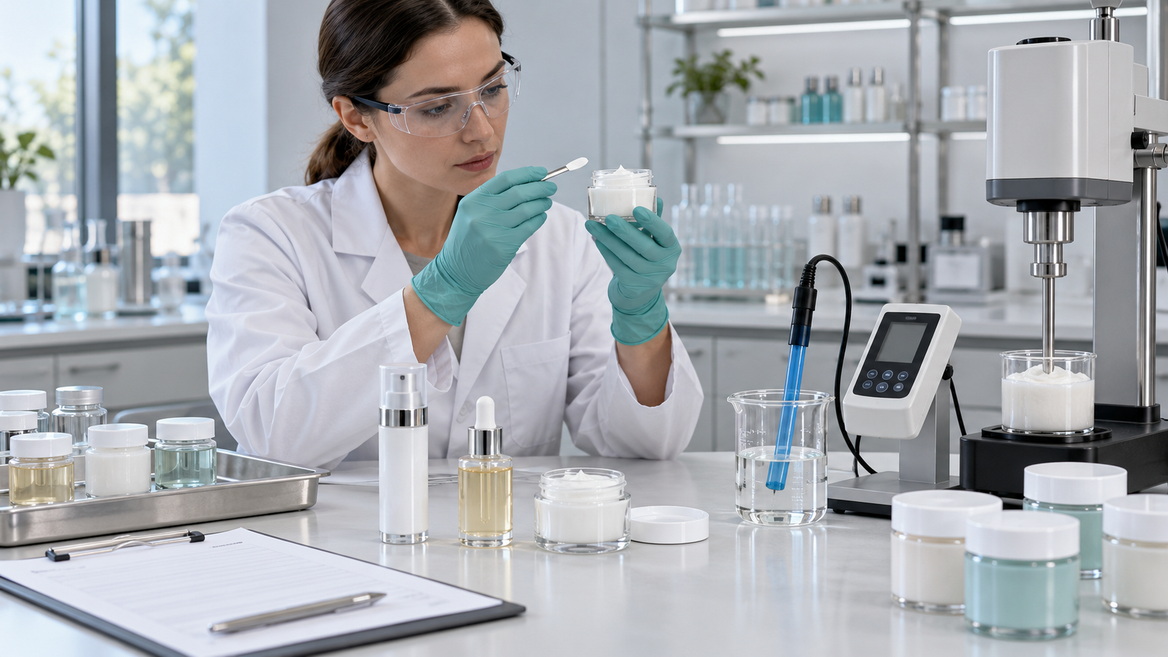
For ordinary skincare cosmetics, CE marking and RoHS are not the relevant baseline procurement credentials. They should not be inserted into a skincare supplier checklist simply because they are familiar in electronics or equipment sourcing.
The primary EU framework is Regulation (EC) No 1223/2009. Buyers should focus on cosmetic GMP, product safety assessment, ingredient restrictions, documentation, and substantiated claims. Products with medical-device, medicinal, biocidal, or electrical-device functions require a separate classification assessment. [single-market-economy.ec.europa]
"Cosmetic grade" is not a complete purchasing specification.
A useful raw-material specification should identify:
- INCI name and supplier reference.
- Assay or relevant active-content specification.
- Microbiological limits where applicable.
- Relevant impurities and contaminants.
- Storage conditions and retest or expiry information.
- Batch traceability and change-notification requirements.
The EU safety framework addresses ingredient characteristics, impurities, microbiological quality, and relevant packaging-material characteristics. Buyers need documentation detailed enough to support that assessment, not merely a marketing ingredient list. [health.ec.europa]
A factory's quality certificate does not prove that a new moisturizer has adequate preservation or that a serum remains stable in its chosen bottle.
A product-specific testing plan should address microbiological quality, preservation where applicable, stability, and packaging compatibility. ISO 17516 and ISO 11930 are relevant reference points for microbiological quality and preservation evaluation, respectively; the appropriate programme should be agreed with qualified technical personnel. [cosmeticsandtoiletries]
For natural, organic, or environmentally labelled positioning, ask which finished-product scheme is intended and whether the formula and packaging qualify. Persano's published certification services illustrate why applications, renewals, and formula changes require ongoing management rather than a one-time logo purchase. [persano]
Ask for the contracting entity, production address, filling location, subcontracting disclosures, and the documents supporting relevant quality claims.
Make sure those identities match across the quotation, certificate, audit report, and quality agreement. A certificate covering a different factory should trigger clarification before deposit payment.
Include the target market, product format, pack size, intended claims, preferred ingredients, exclusions, certification objectives, first-order quantity, and replenishment forecast.
Define what "custom" means. Selecting a stock formula, modifying its fragrance, developing a bespoke formula, and manufacturing a buyer-owned formula are different projects with different development costs and ownership implications.
Use a documented sequence:
1. Initial laboratory samples.
2. Revised samples against written feedback.
3. Samples in the proposed commercial packaging.
4. Pilot or production-representative samples.
5. Signed specifications and an approved reference sample.
Confirm which changes require renewed testing or safety review. A final product's safety documentation must relate to what will actually be marketed. [health.ec.europa]
Request separate figures for bulk product, components, filling, decoration, cartons, testing, development, and freight.
For imported products, identify the importer and EU Responsible Person arrangements before shipment. Manufacturing outside the EU does not remove the obligations attached to placing cosmetics on the EU market. [single-market-economy.ec.europa]
Do not compare a Danish delivered quotation with a Chinese ex-factory quotation as if they represent the same commercial commitment.
Ask suppliers to separate component procurement, manufacturing, filling, testing, batch release, and transport.
A promised "production lead time" may exclude packaging procurement or quality-release time. Require the quotation to define when the delivery clock starts and which approvals or payments are prerequisites.

A formulation may be marketed around a named ingredient without clearly stating whether the quoted percentage refers to the pure active or a diluted commercial blend.
For example, adding 2% of a raw material containing 10% active contributes 0.2% active before considering any other sources.
Avoid ambiguity by requesting the trade ingredient's composition and the finished-product active level under an appropriate confidentiality agreement. This is particularly useful when comparing quotations that appear to offer the same ingredient at very different prices.
Ask for four separate minimums:
- Bulk formula batch.
- Filling run.
- Packaging purchase.
- Printing or decoration.
Then establish who owns surplus components and who pays if artwork, specifications, or regulations change before they are used.
An easily overlooked risk is approving a formula while leaving its raw-material references, processing conditions, or final packaging insufficiently controlled.
Two products can have the same INCI list yet differ in supplier specifications, ingredient proportions, viscosity, dispensing behaviour, or stability. The EU safety framework explicitly considers composition, stability, microbiological quality, and packaging characteristics. [health.ec.europa]
Create an approval record tying together:
- Formula version.
- Approved raw-material references.
- Manufacturing and filling site.
- Critical processing specifications.
- Packaging component references.
- Finished-product release limits.
- Supporting test-report versions.
Require written change notification and a defined technical review before substitutions. This turns an attractive sample into a reproducible purchasing specification.
The suppliers in this guide suit different procurement priorities.
DermaPharm publishes useful variant-level MOQs and a broad development service. Persano offers long-established cosmetics manufacturing and packaging integration. Allison provides a Nordic-oriented private label route within Nopa Nordic. Pedlab explicitly supports smaller manufacturing and pilot requirements. [dermapharm-dk]
LAIMEI provides an international comparison for brands seeking lower-entry-order possibilities and coordinated OEM/ODM development, subject to project-specific confirmation and documentary verification. [lmoemcosmetics]
For a productive first discussion, prepare a brief specifying your target market, product category, intended claims, pack size, first-order volume, and certification requirements. Request samples, a document checklist, and an itemized quotation together.
Brands considering LAIMEI should use that brief to request a formula-and-packaging proposal, confirm eligibility for a low-MOQ launch, and review the supporting manufacturing and compliance documents before approving production.
Request the complete certificate rather than a cropped logo or screenshot. Check the legal name, site address, standard, scope, certificate number, issuing body, and validity dates.
Verify the document through the issuer's official channel and ask whether its status has changed. Also determine whether the certificate covers the actual manufacturing and filling operations proposed for your order.
For ISO 22716, distinguish a supplier's stated conformity with cosmetic GMP from a separately issued certificate. Persano, for example, describes production according to ISO 22716; buyers should request the precise evidence needed for their procurement policy. [persano]
Do not assume that an existing Cosmetic Product Safety Report automatically covers a relabelled or modified product.
Ask the Responsible Person and qualified safety assessor to confirm that the assessment covers the exact composition, packaging, intended use, exposure, and relevant labelling. Changes to fragrance, active level, packaging, or directions may require review.
The EU framework requires a product safety assessment before market placement, while CPNP notification is a separate obligation—not a substitute for that assessment. [single-market-economy.ec.europa]
Ownership depends on the contract. Paying a development fee should not be treated as proof that the brand receives unrestricted ownership or transfer rights.
Specify ownership or licence rights, exclusivity, quantitative-formula access, technical-transfer documents, test-report usage, and exit assistance. A transferable formula also needs sufficient manufacturing information to reproduce it reliably.
Make documentation access part of the negotiation because the product safety file requires more than a consumer-facing ingredient list. [health.ec.europa]
No. Supplier experience can make development easier, but it does not establish that a particular finished product qualifies.
Ask which standard applies, whether the exact formula and packaging are eligible, who submits the application, who holds the approval, and how changes or renewals are managed. Persano explicitly describes application and renewal support, illustrating the product-specific work involved. [persano]
Not automatically. Start by confirming product classification, permitted ingredients, claims, labelling, and evidence requirements in each destination.
Within the EU, UV filters are specifically regulated under the Cosmetics Regulation. A supplier's sun-care experience does not remove the need to assess the exact product and destination-market requirements. [single-market-economy.ec.europa]
Ask whether the evidence covers your final formula and whether the contract permits your brand to use the reports. Do not treat a generic "SPF tested" statement as a complete market-entry package.
- Cosmetics Europe's 2025 socio-economic publication: European market, skincare, employment, and export figures, reporting 2024 data. [cosmeticseurope]
- European Commission cosmetics legislation: Regulation (EC) No 1223/2009, safety assessment, Responsible Person, notification, claims, and amendments. [single-market-economy.ec.europa]
- European Commission regulatory text: product safety-file requirements, composition, stability, microbiology, and packaging considerations. [health.ec.europa]
- LAIMEI About Us: service model, advertised low-MOQ cooperation, and company-development descriptions. [lmoemcosmetics]
- DermaPharm private label services and company history: development scope, published MOQ, quality information, and establishment date. [dermapharm-dk]
- Persano history, production, quality, packaging, and certification services. [persano]
- Allison and Nopa Nordic company information: manufacturing positioning, group relationship, and development capabilities. [linkedin]
- Pedlab company information: founding year, private label skincare, pilot support, packing, and quality statements. [pedlab]
- Cosmetics & Toiletries: technical discussion of microbiological quality and preservative-efficacy testing. [cosmeticsandtoiletries]


