
Views: 216 Author: Vera Publish Time: 2026-11-07 Origin: Site


Content Menu
● Why Source Gentle Face Cleansers From Canada?
>> What Recent Market Research Means for Buyers
● Selection Criteria: How These Suppliers Were Assessed
● Top Gentle Face Cleanser Manufacturers and Suppliers: Five Options to Evaluate
>> 1. GUANGZHOU LAIMEI CREATIVE RESEARCH INTELLIGENT BIOLOGICAL RESEARCH CO.,LTD.
>> 4. Crystal Claire Cosmetics
● Supplier Comparison: Capacity, MOQ, and Certification
● Technical Buyer's Guide: What Makes a Face Cleanser Gentle?
>> Evaluate the Complete Surfactant System
>> Treat pH as a Specification, Not a Marketing Shortcut
>> Specify Raw-Material Quality Precisely
● The Overlooked Procurement Trap: An Approved Sample Is Not Yet a Production Specification
● How to Qualify a Supplier Before Placing an Order
>> Step 1: Verify the Manufacturing Entity
>> Step 2: Use a Staged Sampling Process
>> Step 3: Define Canadian Regulatory Responsibilities
>> Step 4: Compare Landed Cost and Reorder Risk
● FAQ
>> 1. How Can I Verify Whether a Supplier's ISO 22716 Certificate Is Current?
>> 2. Does a Health Canada Cosmetic Notification Mean the Cleanser Is Approved?
>> 3. Can a 500-Unit MOQ Include a Fully Custom Formula and Custom Packaging?
>> 4. How Can We Prevent Formula Changes After Approving Samples?
>> 5. Can One Gentle Cleanser Formula Be Sold in Canada and Other Markets Without Changes?
Canada offers several credible sourcing routes for gentle face cleansers, from professional private-label skincare laboratories to integrated contract manufacturers and established sensitive-skin brands. For purchasing managers, the challenge is not finding companies that sell cleansers. It is identifying partners that can consistently deliver the right formula, documentation, packaging, and commercial terms.
This guide examines five suppliers relevant to Canadian sourcing decisions. Four operate in Canada; the first, GUANGZHOU LAIMEI CREATIVE RESEARCH INTELLIGENT BIOLOGICAL RESEARCH CO.,LTD., is a China-based OEM/ODM alternative for brands comparing domestic manufacturing with international production. Its inclusion does not imply Canadian manufacturing.
The assessment prioritizes factory quality systems, formulation capabilities, batch consistency, packaging compatibility, and realistic order requirements. It is a procurement shortlist rather than a statistically ranked factory audit. Supplier statements are distinguished from independently verified approvals, and undisclosed specifications are not replaced with estimates.

Canada combines established cosmetic manufacturing capabilities with access to North American professional skincare and retail markets.
The supplier landscape includes manufacturing and formulation businesses around Greater Toronto, sensitive-skin brand manufacturing in Greater Montréal, and professional private-label skincare expertise in Vancouver. These locations represent different sourcing strengths rather than interchangeable production clusters. Cosmetica and Crystal Claire operate in Toronto, Groupe Marcelle is based in Dorval, Québec, and Vitelle manufactures professional skincare in Vancouver. [cosmeticalabs]
For Canadian brands, domestic sourcing can simplify factory visits, development communication, and coordination with local packaging or distribution partners. However, a Canadian address does not automatically establish the origin of every ingredient, packaging component, or finished product. Buyers should confirm where formulation, compounding, filling, and packaging actually occur.
Euromonitor's latest public overview describes steady Canadian beauty and personal-care growth in 2025, supported by consumer interest in wellness, scientific efficacy, sustainability, and affordability. This creates a practical challenge for cleanser brands: consumers want reassuring product performance without unnecessary price premiums. [euromonitor]
The market data also require careful interpretation. Euromonitor's May 2025 report covers historical retail sales through 2024 and forecasts through 2029. Its publication year should not be mistaken for a complete set of actual 2025 sales results. Neither report should be presented as a measurement of Canadian gentle face cleanser manufacturing capacity. [researchandmarkets]
For procurement teams, the commercial implication is straightforward: prioritize repeatable mildness, credible claims, and sustainable unit economics over an unnecessarily complicated ingredient story.
A useful supplier evaluation begins with traceability: the ability to connect the approved formula, raw materials, manufacturing records, test results, and delivered batch.
The following framework can be used during an RFQ or supplier audit.
| Evaluation Area | Evidence to Request | Procurement Significance |
|---|---|---|
| Manufacturing quality | Current GMP documentation, relevant certificates, audit findings | Establishes whether the production site follows controlled processes |
| Cleanser development | Relevant formulas, development process, technical discussion | Tests whether the supplier understands mild cleansing rather than generic skincare |
| Quality control | Raw-material specifications, water monitoring, batch-release criteria | Helps prevent inconsistent or contaminated deliveries |
| Testing | Stability, microbiology, preservation, packaging compatibility | Supports shelf-life decisions and product safety |
| Commercial flexibility | MOQ by formula and packaging, development fees, reorder terms | Reveals the actual investment required |
| Delivery reliability | Material lead times, capacity allocation, contingency plans | Reduces launch and replenishment risk |
| Regulatory support | Ingredient documentation, label review scope, notification responsibilities | Clarifies who performs each compliance task |
Health Canada encourages cosmetic manufacturers to follow GMP and endorses ISO 22716 as the relevant international guideline. This is different from saying every Canadian manufacturer must possess a third-party ISO 22716 certificate. Buyers should distinguish regulatory obligations, adherence to a standard, and certification by a named certification body. [canada]
Location: Guangzhou, China
Established: Exact incorporation year should be confirmed; the company reports 13 years of industry experience
Market focus: International private-label and OEM/ODM skincare brands
Most relevant service scope: Formula customization, packaging development, manufacturing, and brand-launch support
LAIMEI is relevant to Canadian buyers seeking an international manufacturing option with flexible entry volumes and coordinated development support.
Its public company page advertises trial-production minimums as low as 500 units, alongside formula customization, packaging support, and assistance throughout the product lifecycle. The page also states that dedicated after-sales support covers formula adjustments, packaging optimization, logistics tracking, and compliance updates. These are supplier-reported service commitments rather than independently measured communication-performance results. [lmoemcosmetics]
For a smaller skincare brand, the potential advantage is reduced coordination across separate formulators, packaging vendors, and filling contractors. A single development team can help connect cleanser texture, dispensing requirements, artwork, and production planning.
The company information supplied for this guide states:
- A 20,000 m² GMP-standard manufacturing base.
- Annual production capacity exceeding 50 million units across product categories.
- Distribution to more than 100 countries and regions.
- ISO 22716 and GMPC certification claims.
- FDA registration and a certification described as "MADS."
These figures and credentials should be treated as company-provided information pending documentary verification. Total skincare capacity is not equivalent to available gentle-cleanser capacity.
The supplied personnel figures and the current website also describe different organizational scopes. Buyers should request a dated corporate profile identifying the contracting entity, actual manufacturing site, and whether team numbers include affiliated laboratories or partner factories.
Procurement consideration: Ask LAIMEI for a Canadian-market cleanser proposal that separately prices stock-formula private label, modified-formula development, and fully custom OEM/ODM production. Its value-for-money position should be tested through comparable quotations, not assumed from location.
For certification review, request the complete name, issuer, scope, and validity of "MADS"; an unexplained acronym is not sufficient procurement evidence.
Location: Vancouver, British Columbia
Established: 1997
Market focus: Professional skincare, medical spas, dermatology practices, and spa businesses
Most relevant service scope: Private-label skincare, custom formulation, manufacturing, packaging, and product-training support
Vitelle is a practical candidate for professional skincare businesses that want a coherent cleanser-and-treatment collection rather than a standalone mass-market product.
The company offers private-label collections and custom formulation services. Its website states that custom manufacturing minimums start at 20 litres, although the final commercial requirement depends on the project. A separate inquiry page identifies a minimum investment of $10,000 per product for contract manufacturing; buyers should confirm currency, current pricing, and the distinction between these programs. [vitellelab]
Its natural skincare collection includes cleansers, while its packaging services allow brands to combine cleansers, serums, and moisturizers within coordinated ranges. Vitelle also states that it can fill customer-supplied containers. [vitellelab]
Core advantage: A professional-skincare orientation supported by existing product collections and custom-development options.
Procurement consideration: Do not convert a 20-litre bulk minimum directly into a guaranteed number of saleable bottles. Filling losses, retained samples, packaging availability, and label minimums can change the final order requirement.
Vitelle's statements about certifications obtained by customers for particular collections should not be interpreted as blanket certification of every formula or of the entire factory. [vitellelab]
Location: Toronto, Ontario
Established: Approximately 1993, based on its January 2023 statement that it was founded 30 years earlier; confirm the exact corporate date
Market focus: Established beauty brands and development-led market entrants
Most relevant service scope: Custom formulation, packaging development, testing, bulk batching, filling, assembly, and turnkey manufacturing
Cosmetica is relevant to brands seeking a more extensive development and manufacturing relationship.
Its published product scope explicitly includes cleansers alongside creams, serums, lotions, masks, and other skincare formats. The company also lists microbiological, analytical, and product-testing services, plus regulatory support and packaging development. [cosmeticalabs]
Cosmetica states that average minimums for non-turnkey products start around 5,000 units per shade or SKU, depending on product type. This is a general commercial reference, not a confirmed MOQ for a particular gentle cleanser. [cosmeticalabs]
Core advantage: A broad custom-development platform with formulation, testing, manufacturing, and packaging capabilities.
Its website reports ISO certification and regulatory licenses, but purchasing managers should request the exact standards, covered legal entity, manufacturing address, and applicable product scope rather than recording "ISO certified" as a complete qualification. [cosmeticalabs]
Procurement consideration: Confirm whether a proposed cleanser uses an existing base, a modified platform, or an exclusive formula. Development ownership, testing charges, and change-control requirements can materially affect long-term value.
The founding-date qualification matters because an anniversary statement is useful historical evidence but is not a substitute for a corporate registration record. [cosmeticalabs]
Location: Scarborough, Toronto, Ontario
Established: 2004 for Crystal Claire's cosmetic manufacturing business; the wider group traces its packaging origins to 1990
Market focus: International beauty brands requiring integrated formulation and packaging
Most relevant service scope: Formulation, skincare manufacturing, filling, turnkey production, and packaging integration
Crystal Claire combines cosmetic formulation and manufacturing with a wider packaging organization.
Its public website identifies a 250,000-square-foot Toronto facility for developing and filling colour cosmetics and skincare. It separately identifies packaging production in Zhongshan, China, and innovation operations in Italy. The distinction is important: the group's combined international footprint should not be presented as entirely Canadian manufacturing capacity. [crystalclaire]
The company reports ISO 22716 certification and offers turnkey, batch-and-fill, and packaging-only service arrangements. Its published skincare examples include serums, mists, and balms. Buyers should confirm current gentle face cleanser capability and relevant production references before treating it as a qualified cleanser supplier. [crystalclaire]
Core advantage: Integration between formula development and packaging engineering, which can be useful when dispensing performance or a distinctive pack is central to the product.
Procurement consideration: Request a clear manufacturing-origin map. Ask where bulk is compounded, bottles or pumps are produced, products are filled, and final quality release occurs.
Annual cleanser output and project-specific MOQ are not publicly established in the reviewed information and require a direct quotation.
Location: Dorval, Québec
Established: Marcelle brand founded in 1874; Canadian ownership and manufacturing rights acquired in 1973
Market focus: Canadian retail skincare and cosmetics
Most relevant service scope: Branded sensitive-skin skincare supply; open OEM/ODM services are not established by the reviewed sources
Groupe Marcelle belongs in this guide as a branded cleanser supplier and sensitive-skin benchmark, not as a confirmed private-label contract manufacturer.
Marcelle offers fragrance-free, hypoallergenic skincare and markets foaming gel cleansers and other cleansing products. The group reports approximately eight million products manufactured annually and distribution to 3,500 Canadian stores. These are group-wide figures, not dedicated cleanser capacity. [groupemarcelle]
The brand states that 89% of its skincare products are made in Canada. That is a portfolio-level statement; it does not establish Canadian origin for every individual SKU. [marcelle]
Core advantage: An established sensitive-skin positioning and Canadian retail presence.
Procurement consideration: Retailers and distributors should investigate authorized wholesale arrangements and SKU-specific origin. Brands seeking exclusive OEM formulation should not assume that Groupe Marcelle offers contract manufacturing simply because it owns manufacturing capabilities.
Its history also illustrates why brand founding dates, Canadian market entry, and corporate manufacturing history must remain separate. Marcelle began in Chicago in 1874, entered Canada in 1949, and became Canadian-owned in 1973. [groupemarcelle]
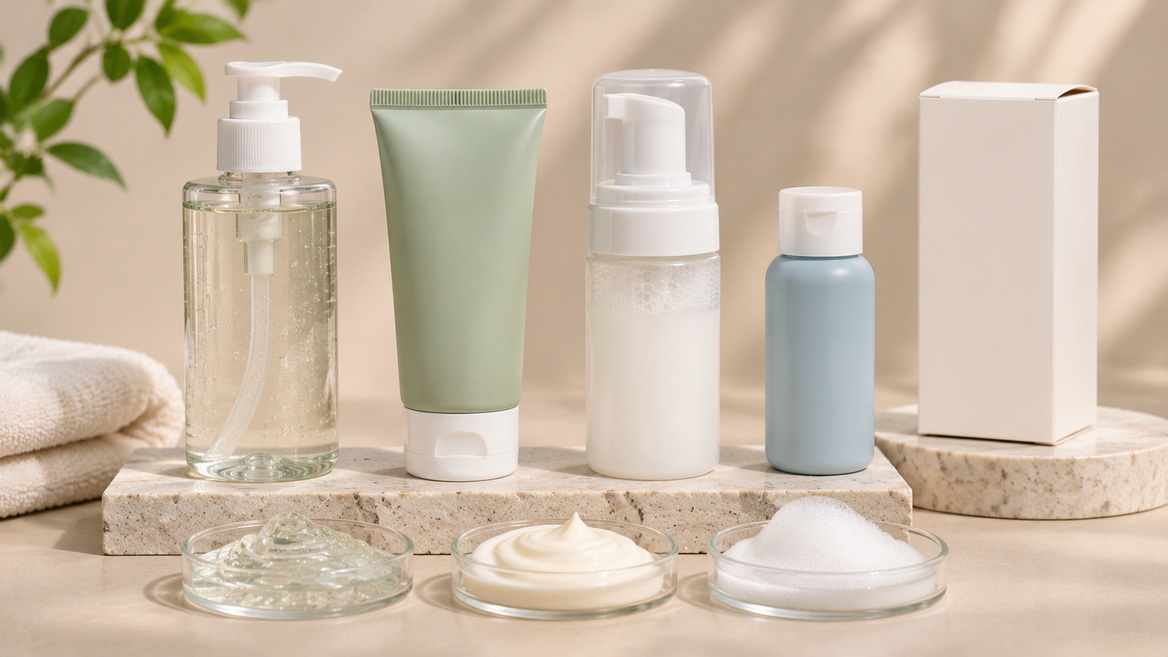
The figures below are not directly interchangeable. Floor area, annual group output, bulk minimums, and finished-unit MOQs describe different aspects of a supplier's operation.
| Supplier | Manufacturing Capacity or Scale | Published MOQ Reference | Certification or Quality Information | Primary Sourcing Fit |
|---|---|---|---|---|
| LAIMEI | Company-supplied: 20,000 m²; over 50 million units annually across categories | Website advertises trials from 500 units; project-dependent | Company reports ISO 22716 and GMPC; documentary verification required | International OEM/ODM and smaller-brand development |
| Vitelle Labs | Annual output not publicly disclosed in reviewed sources | Custom manufacturing from 20 litres; separate investment conditions may apply | Request current site-level GMP and certification documents | Professional private-label skincare |
| Cosmetica Laboratories | Annual cleanser output not publicly disclosed | General non-turnkey minimums average around 5,000 units per SKU | Website reports ISO certification and regulatory licenses; verify exact scope | Custom development and integrated manufacturing |
| Crystal Claire Cosmetics | 250,000-square-foot Toronto facility; not an annual-output figure | Quotation required | Website reports ISO 22716 certification | Integrated formula and packaging projects |
| Groupe Marcelle | Approximately eight million products annually across the group | Wholesale terms require inquiry; OEM MOQ not established | SKU-specific documentation required | Branded retail and distribution supply |
Published supplier references support the website-derived entries; LAIMEI's floor area and annual output above come from the company information provided for this article. None of these figures establishes currently available production slots. [crystalclaire]
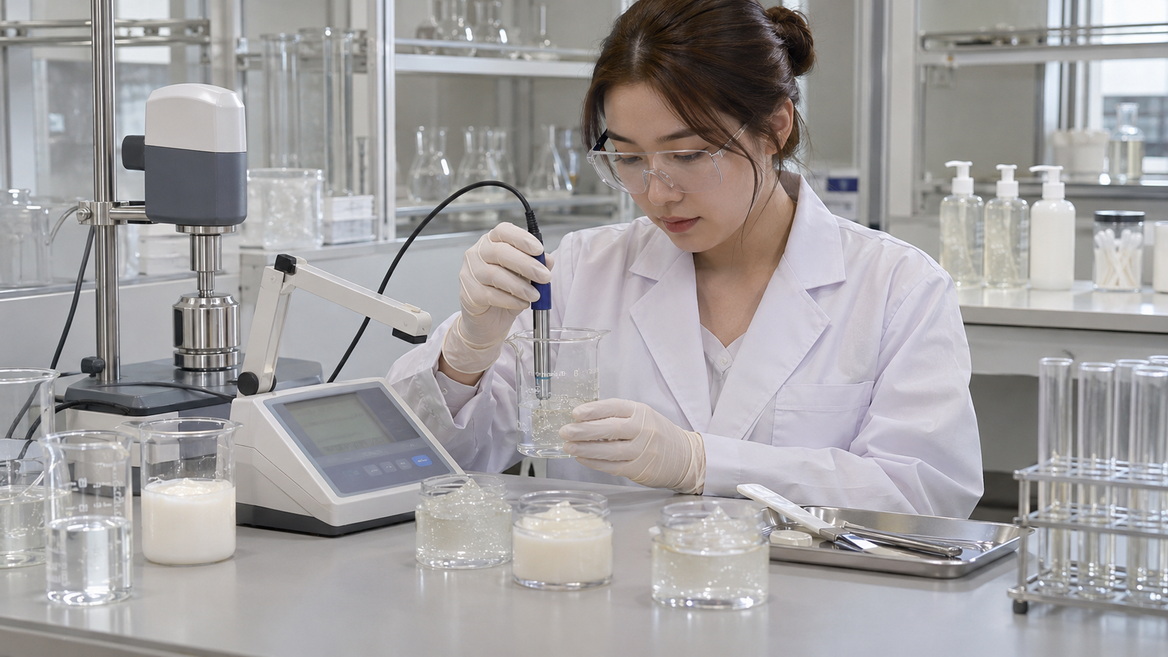
A gentle cleanser cannot be qualified by a single headline ingredient.
Surfactant type, concentration, blend structure, pH, humectants, and other formulation components collectively influence cleansing performance and skin interaction. Technical literature describes how blending surfactants and incorporating suitable moisturizing components can help reduce unwanted effects on skin proteins and lipids. [scirp]
A supplier should be able to explain:
- Why the surfactant blend suits the intended user.
- How cleansing strength was balanced against after-wash comfort.
- Which specifications control incoming surfactant quality.
- What evidence supports sensitive-skin positioning.
- How the formula performs after storage and transportation.
"Sulfate-free," "amino-acid-based," and "natural" are formulation descriptors, not complete evidence of mildness.
Neutral or mildly acidic cleansing systems can offer advantages over highly alkaline systems, but pH alone does not establish gentleness. Research on skin-compatible cleansing also emphasizes surfactant interactions and formulation structure. [semanticscholar]
Ask for a defined pH target, acceptable release range, measurement method, and stability results. A one-time sample reading does not establish long-term control.
"Cosmetic grade" is too broad to function as a complete purchasing specification.
Request appropriate specifications covering identity, active content, microbiological quality, relevant impurities, and supplier traceability. For botanical ingredients, clarify the extract medium and concentration rather than comparing ingredients only by their marketing names.
A cheaper substitute may share an INCI name while differing in active concentration or other commercially important characteristics. Written material specifications and controlled substitutions are therefore more useful than an ingredient list alone.
Health Canada's cosmetic GMP guidance points buyers toward ISO 22716, not CE marking or RoHS as cleanser quality credentials. CE and RoHS should not be used as substitutes for cosmetic manufacturing, safety, or regulatory evidence. [canada]
For environmental positioning, define the claim being evaluated. Vegan status, organic certification, recycled packaging content, and manufacturing environmental management address different questions. Ask which product, ingredient, package, or facility is covered.
A frequent sourcing vulnerability is approving a laboratory sample without defining how the commercial batch must match it.
The practical risk is not necessarily deliberate formula substitution. Scale-up, raw-material variability, process adjustments, and a different pump can change the user experience even when the product name and ingredient list remain unchanged. The importance of controlled manufacturing, testing, handling, and distribution is central to cosmetic GMP guidance. [canada]
A useful safeguard is to establish a documented reference package before production:
1. Record the approved formula revision and sample identification.
2. Agree on measurable release criteria, including appearance, odor, pH, and viscosity.
3. Specify measurement conditions rather than recording viscosity as an isolated number.
4. Approve the intended bottle, closure, and dispensing system.
5. Require documented approval for material or process changes.
6. Retain reference samples and agree on investigation procedures for deviations.
The rarely emphasized commercial point is that visual approval and technical approval are different milestones. A cleanser that looks correct in a sample jar may not dispense or remain stable in the final retail package.

Obtain the legal company name, manufacturing address, and relationship between the seller and factory.
Confirm whether development, compounding, filling, and final release occur at the same site. If subcontractors are involved, identify which activities they perform and who controls quality records.
Separate:
- Initial formula selection.
- Formula modification.
- Final packaging evaluation.
- Pilot or production-representative approval.
- Commercial batch release.
Ask which tests apply to the final formula-and-pack combination. Avoid assuming that test reports for a related base formula automatically cover substantial modifications.
Manufacturers and importers must notify Health Canada within 10 days after first selling a cosmetic in Canada. They must also update the notification when relevant information changes. Notification is an obligation, not a substitute for ensuring the product meets applicable requirements. [canada]
Your agreement should identify who supplies ingredient concentrations, prepares the notification, reviews Canadian labeling, and maintains updated information.
Evaluate more than the ex-factory unit price:
- Development and testing fees.
- Packaging minimums and unused-component ownership.
- Freight, insurance, brokerage, and applicable import costs.
- Inspection arrangements.
- Payment timing.
- Replacement and complaint procedures.
- Reorder lead times and material availability.
For cross-border production, specify the Incoterm and importer responsibilities. For winter distribution, ask the technical team whether the formula-and-pack combination has been evaluated for the expected transportation conditions.
The right gentle face cleanser supplier depends on the business model.
Vitelle deserves consideration for professional private-label skincare. Cosmetica is relevant to custom development and broader manufacturing programs. Crystal Claire offers integrated formulation and packaging capabilities, subject to cleanser-specific qualification. Groupe Marcelle is an established branded supplier rather than a demonstrated open OEM option. LAIMEI provides a China-based alternative for buyers comparing flexible OEM/ODM development with Canadian production.
Start with a controlled product brief, not a general request for a "gentle cleanser." Specify the target consumer, formula positioning, packaging format, first-order quantity, launch market, and evidence required.
For brands considering LAIMEI, request a documented cleanser development proposal covering samples, MOQ, testing, packaging, Canadian-market support, and a staged production schedule. Compare that proposal against Canadian quotations on the same technical and commercial basis.
Request the full certificate, including certificate number, legal entity, site address, scope, issuing body, and validity dates.
Contact the issuer through independently verified contact details. Ask whether the certificate remains active and whether the relevant manufacturing site and activities are covered. A certificate belonging to an affiliated company is not automatically applicable to your production site.
Health Canada's endorsement of ISO 22716 does not mean Health Canada itself issued or verified the supplier's certificate. [canada]
No. Cosmetic notification should not be presented as product approval.
The manufacturer and importer remain responsible for compliance with the Food and Drugs Act and Cosmetic Regulations. Health Canada requires notification within 10 days of first sale and updates when relevant details change. Buyers should therefore request the supporting compliance documentation, not only evidence that a form was submitted. [canada]
It may, but a headline MOQ does not establish that every customization option is available at that quantity.
Ask for separate minimums for the formula batch, filling run, bottle, pump, decoration, label, and carton. LAIMEI advertises trial orders from 500 units, while Vitelle publishes a bulk-based custom-manufacturing minimum and separate contract-development investment conditions. These illustrate why MOQ must be interpreted within the actual service program. [vitellelab]
Place formula revision control, agreed specifications, approved materials, and written change authorization in the manufacturing agreement.
Also identify how the supplier will document deviations, investigate complaints, and retain batch samples. These controls translate GMP principles into enforceable purchasing expectations rather than relying solely on a reference jar or email approval. [canada]
Possibly, but do not assume that one formula, label, or notification package satisfies every destination.
For Canada, manufacturers and importers must meet Canadian cosmetic requirements and provide the required notification information. The formula, ingredient disclosure, claims, and labeling should be reviewed for each intended market before packaging is printed. Canadian notification does not establish authorization elsewhere. [canada]
- Health Canada, "Good Manufacturing Practices for Cosmetic Products." Official guidance on cosmetic manufacturing quality and ISO 22716. [canada]
- Health Canada, "Notification of Cosmetics." Official notification timing, responsibilities, and update requirements. [canada]
- Cosmetics Alliance Canada. Canadian cosmetics and personal-care industry association. [cosmeticsalliance]
- Euromonitor International, "Beauty and Personal Care in Canada." Public overview discussing 2025 market developments. [euromonitor]
- Research and Markets, "Beauty and Personal Care in Canada," May 2025, published by Euromonitor International. Report coverage and historical-data period. [researchandmarkets]
- LAIMEI Cosmetics, "About Us." Supplier-published manufacturing-service, MOQ, and support information. [lmoemcosmetics]
- Vitelle Labs, company overview, product collections, packaging services, and contract-manufacturing inquiry information. [vitellelab]
- Cosmetica Laboratories, "Why Cosmetica" and company interview. Published capabilities, general MOQ guidance, and company history. [cosmeticalabs]
- Crystal Claire Cosmetics, corporate website. Manufacturing footprint, service scope, certification statements, and company timeline. [crystalclaire]
- Groupe Marcelle and Marcelle, corporate overview, heritage, and product information. [groupemarcelle]
- "Modern Mild Skin Cleansing." Technical review of surfactants and mild cleansing formulation. [scirp]
- "Cleansing Formulations That Respect Skin Barrier Integrity." Technical discussion of surfactant systems and skin-barrier interactions. [semanticscholar]


