
Views: 271 Author: Vera Publish Time: 2026-10-24 Origin: Site


Content Menu
● Why Source Gentle Face Cleansers from American Manufacturers?
● How We Selected These Gentle Face Cleanser Suppliers
● What Makes a Face Cleanser Technically Gentle?
>> Surfactant Architecture Matters More Than a Single Ingredient
>> pH Is a Specification, Not Proof of Mildness
>> Specify Raw-Material Quality and Preservation
>> Request Relevant Standards, Not Unrelated Badges
● Comparison Table: Capacity, MOQ, and Quality Credentials
● 1. LAIMEI: An Overseas OEM/ODM Option for Customization-Focused Brands
● 2. RainShadow Labs: A Bulk-Oriented Option for Smaller Launches
>> Procurement Advantage and Limitation
● 3. Pravada Private Label: A Clearly Tiered Route from Stock to Custom
>> Procurement Advantage and Limitation
● 4. Dynamic Blending: A Turnkey Development Partner
>> Procurement Advantage and Limitation
● 5. Nutrix: A Cross-Category Contract Manufacturing Option
>> Procurement Advantage and Limitation
● Buyer's Guide: Turning a Shortlist into a Reliable Supply Agreement
>> Start with a Detailed Product Brief
>> Use a Stage-Gated Sampling Process
>> Compare Total Landed Cost and Supply Risk
● An Overlooked Procurement Trap: The Same INCI List Can Hide a Different Product
● Conclusion: Match the Manufacturer to Your Product and Growth Plan
>> 1. How can I verify whether a manufacturer's ISO certificate is valid?
>> 2. Does an FDA-registered factory mean my cleanser is FDA-approved?
>> 3. Can we rely on "hypoallergenic" or "sensitive skin" wording instead of testing?
>> 4. Must we repeat preservative testing after changing fragrance, extracts, or packaging?
>> 5. Can a cosmetic cleanser claim to treat acne or eczema?
Choosing a gentle face cleanser manufacturer requires more than comparing ingredient lists and unit prices. Professional buyers need a partner that can translate a sensitive-skin positioning into a reproducible formula, substantiate product claims, maintain batch consistency, and deliver compliant products on schedule.
This guide compares four U.S.-based manufacturers and one China-based OEM/ODM alternative for brands sourcing for the American market: LAIMEI, RainShadow Labs, Pravada Private Label, Dynamic Blending, and Nutrix.
Geographic transparency matters. GUANGZHOU LAIMEI CREATIVE RESEARCH INTELLIGENT BIOLOGICAL RESEARCH CO.,LTD. manufactures in China, not America. It appears first as an overseas sourcing option for American-market projects—not as a U.S. manufacturer.
The companies below represent different procurement models, from small private-label launches to customized product development. Their order is not an independently audited ranking.

The United States combines a substantial beauty market with an established network of formulators, ingredient suppliers, packaging businesses, testing laboratories, and contract manufacturers.
According to the Personal Care Products Council's 2026 economic impact report, the U.S. personal care products industry generated $495.6 billion in total economic output in 2024, the latest year analyzed. The report also states that industry exports reached $15.8 billion in 2025. These figures cover the broader personal care industry; they are not estimates of the gentle face cleanser market alone. [personalcarecouncil]
The U.S. International Trade Administration identifies California, New Jersey, Florida, and Texas as major locations for cosmetics manufacturers. Its industry overview also describes a sector supported by thousands of small and medium-sized businesses engaged in research, manufacturing, distribution, and related activities. Although this overview is older than the 2026 industry report, it provides useful context for the country's manufacturing geography. [trade]
For buyers, domestic sourcing can simplify factory visits, working-hour coordination, and replenishment planning. Overseas production remains worth evaluating when customization, packaging integration, or target landed cost makes it commercially attractive.
The practical question is not simply "American or overseas?" It is which supply model provides the strongest combination of product performance, documentation, flexibility, and supply continuity.
This shortlist draws on public supplier information, official regulatory guidance, technical literature, and the company information supplied by LAIMEI. It does not represent factory inspections, independent product testing, or verification of every certificate.
Six procurement criteria guide the comparison:
| Selection criterion | What buyers should evaluate |
|---|---|
| Manufacturing quality | Relevant GMP systems, certificate scope, production records, and traceability |
| Formulation capability | Experience with rinse-off cleansers, sensitive-skin briefs, and custom development |
| Quality control | Incoming-material checks, in-process controls, microbiological testing, and release specifications |
| Commercial flexibility | Stock formulas, customization depth, minimum orders, and packaging options |
| Delivery reliability | Material availability, realistic production scheduling, and capacity allocation |
| Regulatory support | Safety documentation, ingredient information, labeling support, and clear responsibility allocation |
The most important distinction is evidence: a supplier's advertised capability should lead to documents, samples, and contractual commitments—not replace them.
Where annual output, cleanser-specific capacity, or minimum order quantities are unavailable, this guide identifies the gap rather than supplying an unsupported estimate.
A gentle face cleanser must remove unwanted material without creating unnecessary irritation or disrupting the skin barrier. Neither abundant foam nor a fashionable ingredient establishes mildness.
Surfactants perform the cleansing work. Their combination, concentration, interactions, and behavior in the finished formula influence both cleansing performance and skin compatibility.
Technical literature distinguishes traditional alkaline soaps from synthetic detergent systems, commonly called syndets. Traditional soaps typically have a higher pH, while syndets can be formulated closer to neutral or mildly acidic conditions. However, performance depends on the complete formulation—not simply its category. [pmc.ncbi.nlm.nih]
Ask prospective manufacturers to explain:
- Why they selected the surfactant blend.
- How they balance cleansing efficiency and after-feel.
- Whether the formula targets daily cleansing, makeup removal, or both.
- What testing supports sensitive-skin positioning.
- How the system behaves after fragrance, botanical, or viscosity changes.
"Sulfate-free," "amino-acid-based," and "plant-derived" describe aspects of a formulation. They do not independently prove that the finished cleanser is gentle.
A mildly acidic cleanser may suit a product brief, but pH alone cannot establish skin compatibility.
Published cleanser research shows that lower pH does not automatically make every surfactant system milder. In some studied anionic systems, formulation interactions affected irritation and barrier outcomes in ways that a simple pH comparison would miss. [jddonline]
Request a justified pH specification alongside finished-product testing.
"Cosmetic grade" is too broad to serve as the complete purchasing specification.
The technical agreement should identify applicable raw-material identity, purity, microbiological requirements, supplier approval rules, and change-control procedures. For botanical ingredients, request information relevant to their composition and contamination risks.
For water-based facial cleansers, preservation requires particular attention. ISO 11930 provides a framework for evaluating a cosmetic product's antimicrobial protection through preservation efficacy testing and microbiological risk assessment. It is especially relevant to water-soluble or water-miscible cosmetics. [iso]
For a conventional facial cleanser, focus the discussion on cosmetic GMP, safety substantiation, microbiological protection, stability, and appropriate claim support.
CE and RoHS should not be presented as substitutes for cosmetic manufacturing and safety evidence. Likewise, a natural ingredient story does not establish finished-product environmental certification. Any organic, vegan, cruelty-free, or sustainability claim should have a clearly defined scope and supporting documentation.

Supplier disclosures are not directly comparable. Annual output across multiple product categories is different from cleanser capacity, and bulk gallons are different from finished retail units.
| Manufacturer | Manufacturing location | Published capacity information | Published MOQ information | Publicly stated quality credentials |
|---|---|---|---|---|
| LAIMEI | Guangzhou, China | Company-provided figure: over 50 million pieces annually across product categories; cleanser allocation requires confirmation | Website advertises trial production from 500 units; formula and packaging conditions require confirmation | Company reports ISO 22716, GMPC, and FDA registration; current documents require verification |
| RainShadow Labs | St. Helens, Oregon, USA | Cleanser-specific annual capacity not established in reviewed official pages | Stock private label: 10 gallons; custom: 25 gallons | States GMP certification, ISO 22716:2007, and FDA registration |
| Pravada Private Label | Fort Myers, Florida, USA | Advertises 50–200,000 units per production run; not an annual capacity figure | Stock: 50 units; semi-custom: 250; custom: 2,500 | States GMP certification, ISO 22716, and FDA registration |
| Dynamic Blending | Vineyard, Utah, USA | Cleanser-specific annual capacity not publicly established in reviewed sources | Turnkey services page lists a starting minimum of 2,500 market-ready units | Public materials reference ISO 22716; verify current site and scope |
| Nutrix | Salt Lake City, Utah, USA | Cleanser-specific annual capacity not publicly established in reviewed official pages | Request a project-specific quotation | Describes its facility as FDA-registered and NSF ISO-certified; request the exact standard and current certificate |
LAIMEI's 500-unit starting point comes from its website; its annual capacity and certification statements come from the company brief supplied for this article. Other table entries reflect the suppliers' published disclosures. None should be treated as a binding production offer without written confirmation. [lmoemcosmetics]
FDA registration is not FDA approval. The FDA explicitly states that cosmetic facility registration and product listing do not indicate approval of a facility or its products. [fda]
GUANGZHOU LAIMEI CREATIVE RESEARCH INTELLIGENT BIOLOGICAL RESEARCH CO.,LTD. is a Guangzhou-based cosmetics development and manufacturing business.
- Location: Guangzhou, China.
- Operating history: The company reports 13 years of skincare and cosmetics experience; its exact legal incorporation year requires confirmation.
- Market coverage: The supplied company brief reports exports to more than 100 countries and regions; country-level sales shares are not disclosed.
- Service scope: Formula development, packaging design, manufacturing, and integrated brand-development support.
- Potential fit: Small and medium-sized brands evaluating customized cleansers and coordinated packaging support.
According to the supplied company profile, LAIMEI operates a 20,000-square-meter GMP-standard production base with annual output exceeding 50 million pieces across skincare categories. These are company-reported figures, not independently audited findings.
Its website describes a flexible cooperation model, including trial production from 500 units, formula adjustment, packaging optimization, logistics tracking, and post-launch support. This makes LAIMEI worth evaluating when a buyer wants fewer handoffs between product development, packaging, and production. [lmoemcosmetics]
LAIMEI's relevant positioning is integrated project support rather than an unqualified lowest-price claim. A buyer can ask one team to coordinate cleanser texture, ingredient positioning, packaging appearance, and production feasibility.
Its advertised consultation and after-sales support may also help smaller brands that lack dedicated technical procurement staff. Nevertheless, communication efficiency should be tested during sampling: measure response clarity, revision tracking, and the quality of written technical answers.
Request a consolidated dossier covering the actual manufacturing entity, production address, current certificates, quality agreement, and export-market documentation.
The supplied brief and public website describe team size differently. Buyers should clarify whether figures refer to direct employees, affiliated factories, laboratory partners, or a wider group. Similarly, request the full name, issuing organization, and scope of the company-reported "MADS" credential before treating it as a qualification.
LAIMEI is an overseas alternative, so compare landed cost and replenishment risk—not just its factory quotation.
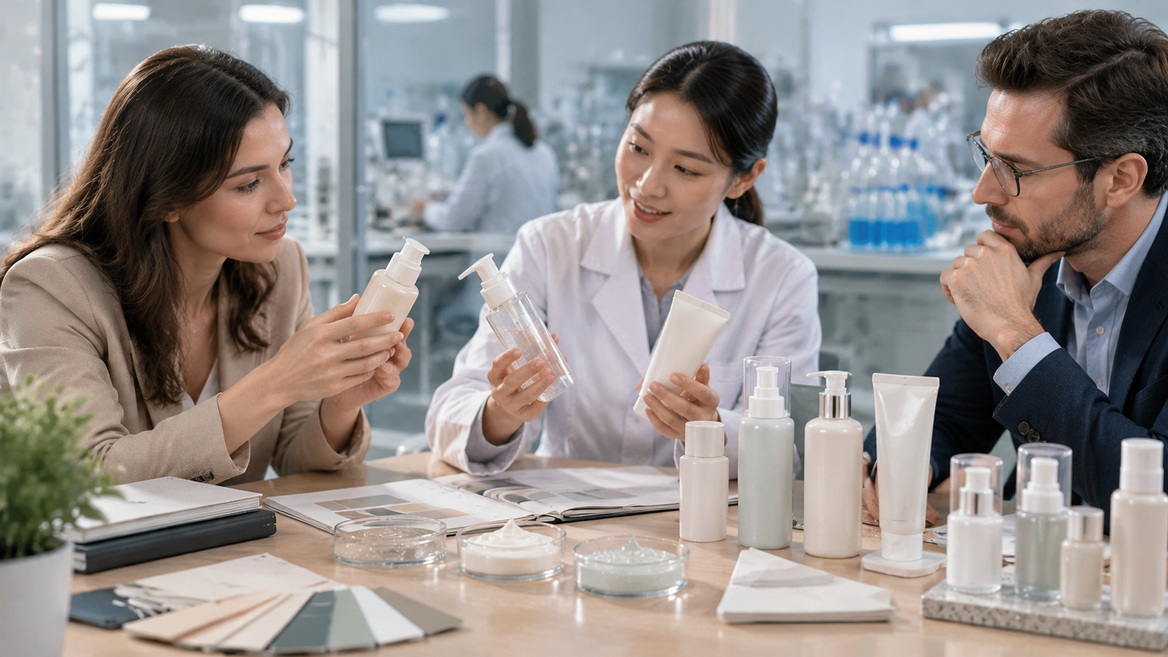
RainShadow Labs states that it has manufactured personal care products since 1983 in St. Helens, Oregon. Its website identifies the facility as FDA-registered and ISO-certified and displays ISO 22716:2007 and GMP credentials. [rainshadowlabs]
- Founded: 1983.
- Location: St. Helens, Oregon, USA.
- Market focus: Private-label and custom personal care brands; geographic revenue distribution is not publicly detailed in the reviewed pages.
- Service scope: Stock formulas, custom formulation, bulk supply, and filling services.
- Potential fit: Brands that prefer gallon-based purchasing and staged product validation.
RainShadow's published program starts at 10 gallons for stock private-label formulas and 25 gallons for custom formulations. Its FAQ distinguishes bulk purchasing from filling arrangements, an important detail for buyers budgeting their first order. [rainshadowlabs]
The bulk model gives buyers a different entry route from manufacturers that quote only in finished units. It can suit brands that already have packaging arrangements or want to evaluate stock formulations before pursuing customization.
However, a 10-gallon minimum is not a guaranteed retail-unit count. Fill volume, product density, processing losses, and retained samples affect the final saleable quantity.
Ask for a written yield estimate and a complete quotation covering containers, filling, labels, coding, and freight.
Pravada states that it has developed and manufactured beauty products for brands worldwide since 2009. Its current website separates stock, semi-custom, and custom services. [pravadaprivatelabel]
- Founded: 2009.
- Location: Fort Myers, Florida, USA.
- Market focus: Beauty brands worldwide; detailed regional sales shares are not disclosed.
- Service scope: Private-label skincare and haircare, semi-custom products, custom formulation, filling, and labeling.
- Potential fit: Brands that want clearly differentiated development routes.
Its dedicated face wash page lists minimums of 50 units for private label, 250 units for semi-custom products, and 2,500 units for custom formulation. [pravadaprivatelabel]
This tiered structure helps buyers distinguish market testing from deeper product differentiation.
Pravada also advertises in-house batching, filling, labeling, and shipment preparation, with production runs ranging from 50 to 200,000 units. That range describes run size, not independently verified annual capacity. [pravadaprivatelabel]
Before selecting the lowest-MOQ route, clarify what can change. Packaging customization, a fragrance adjustment, and an exclusive formulation are different commercial services.
Confirm formula ownership, exclusivity, testing costs, and the point at which a requested modification moves the project into a higher development tier.
Dynamic Blending's official company history identifies 2015 as its founding year. The Utah manufacturer offers product development and manufacturing across skincare categories, including cleansers, creams, gels, serums, and masks. [dynamicblending]
- Founded: 2015.
- Location: Vineyard, Utah, USA.
- Market focus: Brands seeking turnkey cosmetic development, including global projects; regional revenue shares are not disclosed.
- Service scope: Research and development, manufacturing, packaging coordination, and broader turnkey support.
- Potential fit: Brands developing a differentiated cleanser rather than simply relabeling a stock formula.
Its turnkey services page states a starting minimum of 2,500 market-ready units. Since published program details can change, confirm the applicable minimum for the proposed cleanser and packaging format. [dynamicblending]
An integrated development model can reduce coordination gaps between formulation, manufacturing, and commercial presentation.
The key procurement issue is development governance. Ask who owns the formula, how many revisions are included, what happens if the brief proves technically impractical, and which milestones trigger payment.
Public materials reference ISO 22716, but buyers should still request current certification covering the site that will actually manufacture their order. [dynamicblending]
Nutrix describes itself as a personal care contract manufacturer operating from Salt Lake City, Utah. Its official materials cover skincare, haircare, body care, oral care, and cosmetics, with services extending from development to finished products. [nutrixusa]
- Founded: 2015, according to its public company profile.
- Location: Salt Lake City, Utah, USA.
- Market focus: Private-label and contract-manufacturing customers across personal care; geographic sales distribution requires confirmation.
- Service scope: Product development, formulation, manufacturing, packaging, and labeling.
- Potential fit: Brands building a broader personal care portfolio around an initial cleanser. [linkedin]
Cross-category manufacturing can support buyers seeking consistency across a cleanser, moisturizer, and complementary products.
However, a broad portfolio does not automatically establish expertise in a specific sensitive-skin cleansing brief. Ask for relevant examples, testing capabilities, and scale-up experience with the proposed format.
Nutrix describes its facility as FDA-registered and NSF ISO-certified. Request the precise standard, certification scope, issuing body, and validity dates. Its reviewed official pages do not establish a dependable cleanser-specific MOQ or annual capacity, so obtain both in the quotation. [nutrixusa]
Send every shortlisted manufacturer the same brief:
- Target consumer and intended sales markets.
- Gel, cream, milk, foam, or another cleanser format.
- Intended cleansing performance.
- Fragrance and allergen preferences.
- Packaging type and fill volume.
- Target claims and required supporting evidence.
- Forecast first order and annual volume.
- Target landed cost and launch date.
Avoid asking only for a "gentle cleanser like a leading brand." A measurable brief produces more comparable quotations.
Separate development approval from production approval:
1. Evaluate a laboratory sample for texture, fragrance, foam, rinsing, and after-feel.
2. Agree on technical specifications and the required testing plan.
3. Assess the formula in the intended commercial packaging.
4. Review scale-up or pilot evidence where appropriate.
5. Approve the production standard and batch-release requirements.
A good laboratory sample is the beginning of qualification, not proof that commercial production will be identical.
Request examples of:
- Raw-material receiving and approval records.
- Batch manufacturing records.
- Finished-product certificates of analysis.
- Out-of-specification investigations.
- Retained-sample procedures.
- Complaint handling and recall traceability.
- Written change-control rules.
For U.S. distribution, allocate responsibilities under the Modernization of Cosmetics Regulation Act, or MoCRA. FDA guidance identifies facility registration, product listing, and safety substantiation as important obligations, with certain exemptions. The contract should establish who performs each applicable task rather than leaving "compliance support" undefined. [fda]
Ask quotations to separate formulation, testing, bulk manufacturing, packaging, filling, tooling, artwork changes, and shipping.
For imported products, clarify the importer of record, applicable customs classification, duties, delivery terms, and responsibility for damaged or leaking goods.
For every supplier, distinguish production time from the complete lead time. Formula approval, packaging procurement, testing, quality release, and transport all affect the launch schedule.
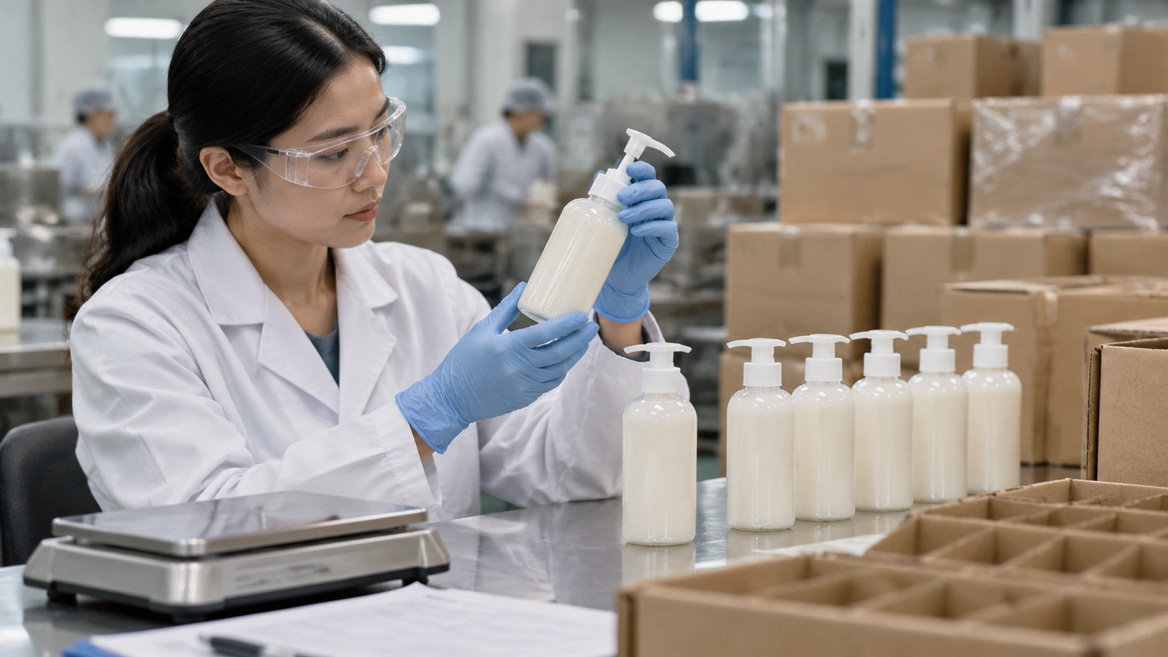
Two cleansers can display the same ingredient names while performing differently because the underlying specifications and manufacturing controls differ.
A frequently overlooked risk is raw-material substitution after sample approval. A change in surfactant grade, ingredient supplier, botanical extract specification, or processing method may affect the product without producing an obvious difference in the marketing description.
Use the supply agreement to control this risk:
- Define approved raw-material specifications.
- Require written notification of relevant substitutions.
- Establish when requalification or repeat testing is necessary.
- Retain an approved reference sample.
- Set agreed limits for pH, viscosity, appearance, odor, and microbiological quality.
- Require documented review before changes enter commercial production.
Another common trap is confusing "low MOQ" with a low total commitment. The cleanser may qualify for a small run while its custom bottle, decorated pump, or printed carton requires a much larger purchase.
Request both formula MOQ and packaging MOQ before approving the project.
The most useful shortlist depends on the sourcing model:
- LAIMEI offers an overseas OEM/ODM route to evaluate for integrated customization and smaller trial production.
- RainShadow Labs provides a bulk-oriented stock and custom model.
- Pravada separates low-volume private label from semi-custom and fully custom development.
- Dynamic Blending emphasizes turnkey product development.
- Nutrix offers broader personal care contract-manufacturing capabilities.
These distinctions reflect published service offerings, not independently tested superiority. [lmoemcosmetics]
For a meaningful comparison, send suppliers the same cleanser brief and request a documentation package, sample plan, testing proposal, and itemized quotation.
Brands considering LAIMEI can begin by sharing their target market, cleanser format, packaging requirements, expected volume, and launch schedule. Request a project-specific proposal together with current factory and quality documentation before making a production commitment.
Request the full certificate, including its number, legal entity, manufacturing address, scope, issuing certification body, and validity dates.
Verify the information through the certification body. IAF CertSearch can also help verify accredited management-system certificates within its coverage. A database search should supplement—not replace—checking the issuer and confirming that the certificate covers the actual production site. [iafcertsearch]
An authentic certificate for another group company or address may not qualify the factory making your cleanser.
No. FDA states that cosmetic facility registration and product listing do not indicate approval. It also states that it does not issue certificates verifying cosmetic facility registration or product listing. [fda]
Request appropriate evidence of applicable submissions, but do not accept a decorative "FDA certificate" as proof of product safety, manufacturing quality, or regulatory approval.
No. FDA states that there is no federal definition or standard governing "hypoallergenic" cosmetics. Cosmetic claims must still be truthful and not misleading. [fda]
Ask what evidence supports the specific wording, which finished formula was evaluated, and whether the study population and conditions match the intended positioning.
A general ingredient safety dossier is not automatically evidence for every finished-product claim.
Require a documented technical assessment rather than assuming the original results remain transferable.
ISO 11930 evaluates antimicrobial protection through preservation efficacy testing and risk assessment. Its framework recognizes that product protection must be evaluated for the relevant cosmetic system. [iso]
The manufacturer or qualified laboratory should explain whether a proposed change affects preservation, exposure during use, or the applicability of previous test results—and document whether repeat testing is required.
Claims can change the regulatory category.
FDA explains that products marketed to treat or prevent disease, or affect the body's structure or function, are drugs under U.S. law and must meet the applicable drug requirements, even when they also serve cosmetic purposes. [fda]
Review proposed claims before formulation and artwork approval. Do not assume that a factory qualified for conventional cosmetics can automatically support an acne-treatment cleanser.
- U.S. market scale and exports: Personal Care Products Council, "U.S. Personal Care Products Industry Drives Nearly $500 Billion in Economic Output," published May 18, 2026. Figures distinguish 2024 economic impact from 2025 exports. [personalcarecouncil]
- U.S. manufacturing geography and industry structure: International Trade Administration, "Cosmetics." The overview is dated 2021 and is used for structural context, not current market sizing. [trade]
- LAIMEI capabilities and trial MOQ: Official About Us page, supplemented by the company profile provided for this article. Company-supplied figures require buyer verification. [lmoemcosmetics]
- Supplier programs and credentials: Official RainShadow Labs, Pravada, Dynamic Blending, and Nutrix pages cited throughout this guide. Published terms remain subject to project-specific confirmation. [rainshadowlabs]
- Technical and regulatory guidance: FDA, ISO, IAF CertSearch, and published cleanser research cited at the relevant claims. [pmc.ncbi.nlm.nih]


