
Views: 228 Author: Vera Publish Time: 2026-10-21 Origin: Site


Content Menu
● What Does Exfoliation Actually Do?
● Mistake 1: Exfoliating Too Often for Your Skin
>> How to Find a More Suitable Frequency
● Mistake 2: Choosing an Exfoliator by Skin Type Alone
>> Match the Method to Your Current Skin Condition
● Mistake 3: Assuming Stronger Acids Mean Better Results
>> Read Beyond the Front Label
● Mistake 4: Stacking Exfoliants Without Reviewing Your Routine
>> Audit Your Routine Before Adding Another Product
● Mistake 5: Scrubbing Harder or Ignoring Application Instructions
>> Use the Instructions for the Actual Product
● Mistake 6: Skipping Moisturizer and Sun Protection
>> Why AHA Products Need Particular Attention
● How to Recognize and Respond to Over-Exfoliation
● A Better Exfoliation Routine: Start Simple and Observe
>> Step 1: Establish a Comfortable Baseline
>> Step 2: Choose One Product for One Goal
>> Step 3: Follow Directions and Track Tolerance
>> Step 4: Adjust Conservatively
● What Skincare Brands Should Consider When Developing Exfoliating Products
>> Build a Clear Product Development Brief
>> How LAIMEI Supports Brand Development
● Frequently Asked Questions About Facial Exfoliation
>> How Often Should I Exfoliate My Face?
>> Should Everyone Exfoliate at Least Once a Week?
>> Is Chemical Exfoliation Always Gentler Than a Scrub?
>> Can I Exfoliate While Using Retinol?
>> Should I Exfoliate Flaky Skin?
>> Do I Need Sunscreen If I Use Acids Only at Night?
Exfoliation mistakes can turn a promising skincare routine into a cycle of dryness, stinging, and uneven-looking texture. Whether you use a facial scrub, an exfoliating cleanser, or an acid serum, better results depend on choosing a suitable formula and recognizing when your skin needs less—not more.
My starting point when evaluating an exfoliating routine is simple: does it leave skin comfortable? A smoother appearance is not a meaningful improvement if cleansing or moisturizing becomes painful.
This guide explains six common facial exfoliation mistakes, how to adjust your routine, and what skincare brands should consider when developing products that customers can use confidently.

Exfoliation removes dead cells from the skin's outermost layer. Mechanical methods use friction from particles, brushes, or cloths. Chemical methods use ingredients such as alpha hydroxy acids, or AHAs, and beta hydroxy acids, or BHAs, to promote surface shedding. [aad]
For some people, exfoliation can improve the appearance of rough or dull skin. However, it is optional—not a universal requirement for healthy skin.
That distinction matters. Flaking does not automatically mean dead cells need scrubbing away. Dryness, irritation, and an unsuitable skincare routine can also leave skin looking rough. Adding another active product without considering the cause may make matters worse. [aad]
The goal is to support your skin's barrier, not repeatedly challenge its tolerance.
A fixed schedule sounds convenient, but there is no ideal frequency for everyone. Your skin type, the product's strength, and the rest of your routine all influence tolerance.
A mild rinse-off cleanser and a concentrated leave-on exfoliant should not automatically follow the same schedule. More aggressive exfoliation generally requires less frequent use. [aad]
Follow the product label and introduce only one new exfoliating product at a time. Avoid increasing both application frequency and formula strength together.
Watch for:
- Persistent redness or unusual warmth.
- Tightness that continues after moisturizing.
- New flaking or tenderness.
- Stinging when applying previously comfortable products.
These changes are reasons to pause and reassess, not signals that you need to "push through." If symptoms persist, seek professional advice rather than repeatedly experimenting. [aad]
"Oily," "dry," and "combination" are useful starting points, but they do not describe your skin's current condition.
Oily skin can still be irritated. Dry skin may sometimes tolerate mild exfoliation, but actively inflamed or uncomfortable skin needs a different approach.
| Skin condition or concern | Practical starting point | Main caution |
|---|---|---|
| Dry but comfortable skin | Consider a mild chemical exfoliant if needed | Do not treat every flake as buildup |
| Sensitive or easily irritated skin | Consider avoiding exfoliation or seeking guidance | Mechanical friction may be poorly tolerated |
| Oily, thicker skin | Consider an appropriately labeled chemical or mechanical product | Oiliness does not justify unlimited strength |
| Acne-prone skin | Keep the routine gentle and consider existing treatment | Aggressive scrubbing can worsen irritation |
| Skin prone to dark marks after irritation | Avoid aggressive exfoliation | Irritation may increase pigmentation |
These are selection principles, not prescriptions. Dermatology guidance specifically warns that stronger exfoliation may worsen dark marks in people susceptible to pigmentation after inflammation. [aad]
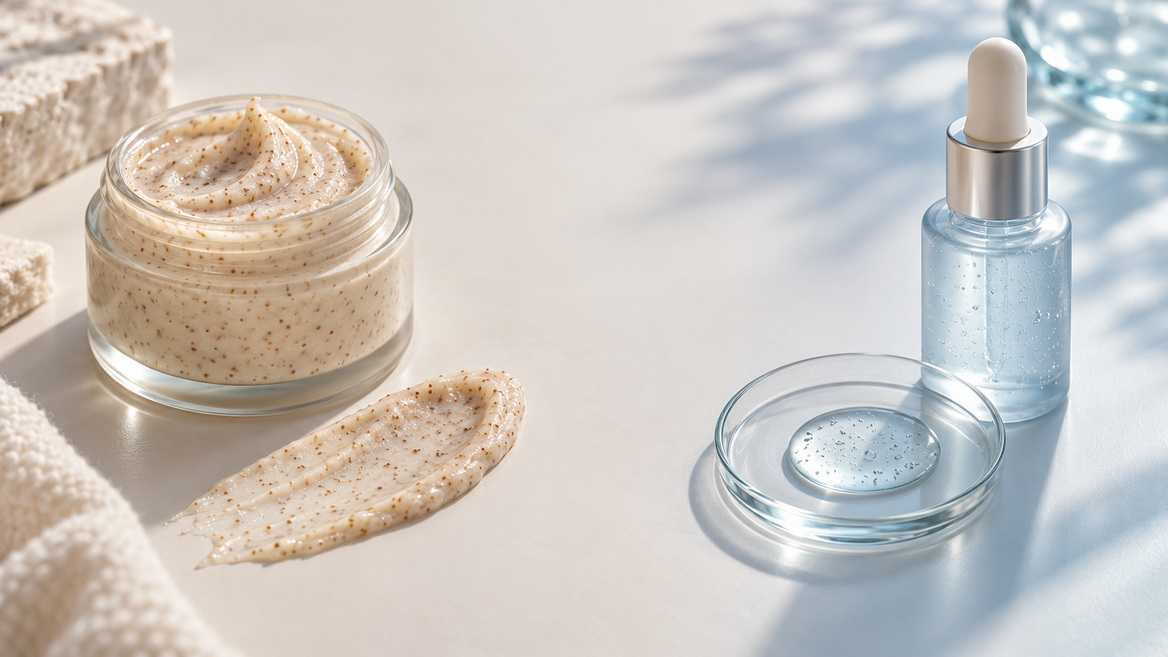
A large percentage on a bottle can attract attention, but it does not tell you everything about performance.
For AHA products, exfoliating activity depends on the acid type, concentration, finished-product pH, and other ingredients. Comparing two formulas solely by their advertised acid percentage can therefore be misleading. [fda]
Before choosing an exfoliant, check:
1. Is it intended for home use?
2. Is it rinse-off or leave-on?
3. How often does the manufacturer recommend applying it?
4. Are contact-time instructions provided?
5. Does the label identify situations in which use should stop?
Do not extend application time because a product feels mild. Likewise, a noticeable sting is not proof of superior performance.
From a formulation perspective, the relevant question is not "How strong can we make it?" but "What finished product suits the intended user and use conditions?"
An exfoliating cleanser, acid toner, resurfacing serum, and facial scrub can create an unnecessarily demanding routine.
The problem is not that every combination is inherently unsuitable. It is that several products may overlap without the user recognizing their combined burden.
Retinol, prescription retinoids, and benzoyl peroxide also deserve attention. These products can make skin more sensitive or prone to peeling, and additional exfoliation may worsen dryness or irritation. [aad]
List everything you use, including:
- Cleansers and cleansing tools.
- Toners, pads, and exfoliating liquids.
- Retinol or prescription treatments.
- Scrubs, masks, and occasional peels.
Then identify which products exfoliate or already cause dryness.
Combining physical and chemical exfoliation is not a requirement. If you use a product designed with both mechanisms, follow its instructions rather than adding a separate scrub on top.
For prescription routines, ask the prescribing clinician before changing treatment or adding exfoliation.
Pressure does not make an unsuitable scrub suitable. Repeated rubbing can turn a simple cleansing step into unnecessary irritation.
Mechanical exfoliation should be gentle. Avoid treating the nose, chin, or other textured areas as surfaces that need polishing until perfectly smooth.
Never exfoliate sunburned skin or areas with open cuts or wounds. [aad]
For a rinse-off scrub, use light pressure and rinse as directed with lukewarm water.
For a leave-on acid product, follow its specific application directions. Do not assume it should be massaged, rinsed off, or applied to damp skin simply because another exfoliant works that way.
This distinction is especially important when switching formats. A cleansing powder, exfoliating pad, and overnight serum may have very different intended uses.
If the directions are unclear, choose a better-documented product rather than guessing.
Exfoliation should not be an isolated step. What follows helps determine whether the overall routine remains comfortable.
Apply moisturizer after exfoliating to help keep skin hydrated. If the product leaves persistent tightness, adding more exfoliation is unlikely to be the answer. [aad]
During the day, use broad-spectrum, water-resistant sunscreen with SPF 30 or higher, alongside appropriate protective clothing and shade. [aad]
AHA-containing products can increase sensitivity to sunlight. Recommended precautions include sunscreen, protective clothing, and limiting sun exposure during use and for one week afterward. [fda]
This applies even when an AHA product is used at night. Evening application does not remove the need for daytime protection.
Make these precautions part of the routine from the beginning, rather than treating sunscreen as an optional finishing step.
"Over-exfoliation" describes a pattern of irritation associated with too much exfoliating activity. However, redness, burning, and peeling can have other causes, so a checklist cannot diagnose the problem.
A useful question is whether discomfort began after introducing an exfoliant, increasing its frequency, or combining it with other potentially irritating products.
1. Stop the suspected exfoliating product.
2. Avoid scrubs, brushes, and additional peels.
3. Keep cleansing gentle and use a moisturizer you already tolerate.
4. Maintain suitable sun protection.
5. Consult a dermatologist if symptoms are significant, persistent, or worsening.
Do not exfoliate again simply to remove the resulting flakes. Also, do not stop prescribed treatment without discussing it with the clinician responsible for your care.
There is no universal recovery deadline. Return to exfoliation only after the problem has resolved and, when needed, after receiving professional guidance. [aad]
Rather than creating an aggressive weekly calendar, build a routine you can evaluate.
First, make sure your cleanser, moisturizer, and daytime sun protection are comfortable. Adding exfoliation to an already irritating routine makes the cause of any reaction harder to identify.
Define the concern: surface roughness, dull appearance, or a particular issue requiring professional advice.
Select one appropriately labeled product instead of buying several overlapping treatments.
Record application dates and any subsequent discomfort. Keep other products stable while assessing the new addition.
A simple note—"comfortable," "tight," or "stinging"—can be more useful than chasing an immediate glow.
If irritation develops, stop and reassess. If the product is comfortable, that does not automatically mean you need to use more.
This approach turns exfoliation into a controlled choice rather than a routine you keep escalating. [aad]
For private label skincare brands, product quality involves more than selecting a fashionable acid or an appealing texture.
The development brief should connect the intended user, formula, application method, packaging, and instructions.
Useful questions include:
- Who is the intended customer?
- Is the product designed for occasional or more frequent use?
- What existing products might customers combine it with?
- Are rinse-off and leave-on directions unmistakable?
- What evidence supports the finished-product claims?
- What warnings and market-specific requirements apply?
AHA products illustrate why this matters: their performance depends on the complete formula, while sun-sensitivity precautions also need consideration. [fda]
According to company-provided information, GUANGZHOU LAIMEI CREATIVE RESEARCH INTELLIGENT BIOLOGICAL RESEARCH CO., LTD. offers skincare and cosmetics OEM/ODM services backed by 13 years of research, development, and manufacturing experience.
The company reports a 20,000-square-meter production base, annual capacity exceeding 50 million units, and service coverage across more than 100 countries and regions. Its offering includes formulation development, customized packaging design, manufacturing, and support from trial production through larger-scale supply.
For a prospective brand partner, the next step is a product-specific discussion supported by relevant facility documents, certification scope, testing plans, and target-market requirements—not assumptions based on company size alone.

There is no universal schedule. Frequency depends on your skin, the product, and other treatments you use. Follow the label and reduce or stop use if irritation develops. Stronger exfoliation generally needs less frequent application. [aad]
No. Exfoliation is not necessary for everyone. Some people are better served by a simple, comfortable routine, particularly when skin is sensitive or already irritated. [aad]
No. A mild chemical exfoliant may suit some people who do not tolerate scrubbing, but chemical formulas can also irritate. Acid type, concentration, pH, and the overall formulation matter. [aad]
Possibly, but additional exfoliation may worsen dryness and irritation. Review the entire routine and seek guidance if you use prescription retinoids or have sensitive skin. [aad]
Not automatically. First consider whether the flaking is associated with dryness, irritation, or an existing treatment. If the skin stings, burns, or feels inflamed, avoid scrubbing and seek advice when necessary. [aad]
Yes. Nighttime use does not eliminate AHA-related sun sensitivity. Use appropriate sun protection during treatment and for one week after stopping an AHA product. [fda]
1. IMAGE Skincare. "Top 6 Facial Exfoliation Mistakes & How to Prevent Them."
[https://imageskincare.com/blogs/skincare-blog/do-you-make-these-6-exfoliation-mistakes] [imageskincare]
2. American Academy of Dermatology Association. "How to Safely Exfoliate at Home."
[https://www.aad.org/public/skin-hair-nails/skin-care/exfoliation] [aad]
3. U.S. Food and Drug Administration. "Alpha Hydroxy Acids."
[https://www.fda.gov/cosmetics/cosmetic-ingredients/alpha-hydroxy-acids] [fda]
4. U.S. Food and Drug Administration. "Guidance for Industry: Labeling for Cosmetics Containing Alpha Hydroxy Acids."
[https://www.fda.gov/regulatory-information/search-fda-guidance-documents/guidance-industry-labeling-cosmetics-containing-alpha-hydroxy-acids] [fda]
5. American Academy of Dermatology Association. "Sunscreen FAQs."
[https://www.aad.org/public/everyday-care/sun-protection/shade-clothing-sunscreen/sunscreen-faqs] [aad]


