
Views: 216 Author: Vera Publish Time: 2026-10-20 Origin: Site


Content Menu
● Sensitive vs. Sensitized Skin: A Side-by-Side Comparison
>> Sensitive Skin Symptoms and Triggers
>> Is Sensitive Skin Always Genetic?
>> Common Causes of Acquired Irritation
>> A Crucial Distinction: Irritation Is Not Allergic Sensitization
● How to Tell Whether Your Skin Is Sensitive or Sensitized
>> 1. Build a Product and Symptom Timeline
>> 2. Compare Your Current Skin With Your Baseline
>> 3. Watch What Happens After Simplifying
>> When to Seek Medical Advice
● A Gentle Routine for Sensitive and Recently Irritated Skin
>> Step 1: Cleanse Without Scrubbing
>> Step 2: Use a Familiar Moisturizer
>> Step 3: Keep Sun Protection Practical
>> Step 4: Pause Unnecessary Irritating Products
>> Step 5: Reintroduce Products Carefully
● How to Test a New Skincare Product
● What Ingredient Labels Can—and Cannot—Tell You
>> Fragrance-Free Does Not Mean Reaction-Free
>> Natural Ingredients Are Not Automatically Gentler
>> Hypoallergenic Is Not a Universal Safety Guarantee
● Beyond the Comparison: A Better Development Framework for Skincare Brands
>> Define the Intended User Before Selecting Ingredients
>> Evaluate the Finished Formula
>> Measure More Than "Users Liked It"
● Turning Consumer Insight Into an OEM/ODM Product Brief
>> Develop Your Next Product Around Evidence
>> Can Skin Be Both Sensitive and Sensitized?
>> Can Sensitized Skin Become Comfortable Again?
>> How Long Does Skin Barrier Recovery Take?
>> Is Sensitive Skin the Same as a Skin Allergy?
>> Can Oily or Acne-Prone Skin Also Be Sensitive?
>> Does "Dermatologist Tested" Mean a Product Cannot Irritate?
Sensitive vs. sensitized skin can be difficult to distinguish when your face feels tight, burns after cleansing, or suddenly reacts to a favorite moisturizer. The symptoms often overlap, but the history behind them can be different. Understanding that history helps you choose a more comfortable routine—and helps skincare brands develop products with a clearer purpose.
The practical distinction is reactivity: sensitive skin describes a tendency to experience uncomfortable sensations, while "sensitized skin" commonly describes skin that has become reactive after irritating exposures. Neither label alone tells you whether you have an allergy, eczema, or another condition.
From a skincare development perspective, the useful question is not simply, "Which label fits?" It is, "What changed, what does this skin tolerate, and what evidence supports the next step?"

| Comparison | Sensitive skin | Sensitized skin |
|---|---|---|
| Common meaning | A tendency to experience stinging, burning, itching, or similar sensations | An informal description of acquired skin reactivity |
| Typical history | Repeated reactions, sometimes across different products or environments | Symptoms following a routine change, excessive exfoliation, or another exposure |
| Potential contributors | Sensory responses, barrier function, environmental triggers, and individual susceptibility | Irritating products, repeated friction, harsh cleansing, or environmental stress |
| Visible appearance | May look normal or show redness | May show dryness, peeling, redness, or roughness |
| Main care priority | Identify tolerable products and manage recurring triggers | Remove likely irritants and support recovery |
| Important limitation | Not necessarily a lifelong, purely genetic "skin type" | Not a precise medical diagnosis or proof of an allergy |
These categories can overlap. Someone with longstanding sensitivity can also develop irritation after using too many exfoliating products.
Sensitive skin is more than visible redness. An international expert definition describes it as unpleasant sensations—such as stinging, burning, pain, itching, or tingling—in response to stimuli that would not normally cause those sensations.
Importantly, skin can look normal while feeling uncomfortable.
Common experiences include:
- Stinging when applying certain skincare products.
- Burning or discomfort after cleansing.
- Itching without an obvious rash.
- Reactions associated with temperature changes.
- Difficulty tolerating fragranced products.
These experiences do not establish a diagnosis. Persistent redness or itching may require assessment for conditions such as contact dermatitis rather than being dismissed as "just sensitivity."
Calling sensitive skin an inherited skin type is convenient, but incomplete. Individual susceptibility matters, yet the clinical definition does not require a genetic cause or lifelong symptoms.
For consumers, this means avoiding fatalistic thinking: recurring sensitivity does not mean every product will cause problems.
For formulators, it means "for sensitive skin" should identify an intended user group—not substitute for finished-product testing.
In everyday skincare language, sensitized skin generally means skin that has become unusually reactive following an exposure or an overly demanding routine.
A familiar example is someone who introduces an exfoliating toner, increases retinoid use, and adds a scrub within the same week. When even a basic moisturizer starts stinging, the combined routine matters more than any single ingredient's reputation.
Potential contributors include:
- Frequent exfoliation or abrasive scrubbing.
- Combining several potentially irritating products.
- Harsh cleansing and repeated washing.
- Friction from towels or cleansing tools.
- Fragranced products that are poorly tolerated.
- Environmental exposures that worsen dryness or discomfort.
Timing offers clues, not proof. A reaction after using a product does not automatically reveal which ingredient caused it.
In medical discussions, sensitization can refer to the immune system becoming responsive to an allergen. That differs from the casual skincare meaning of "sensitized."
Irritant contact dermatitis and allergic contact dermatitis can look similar, but their mechanisms and management differ. Recurring reactions may require professional patch testing.
For that reason, a useful product guide should not promise that every "sensitized" reaction will disappear with moisturizer.
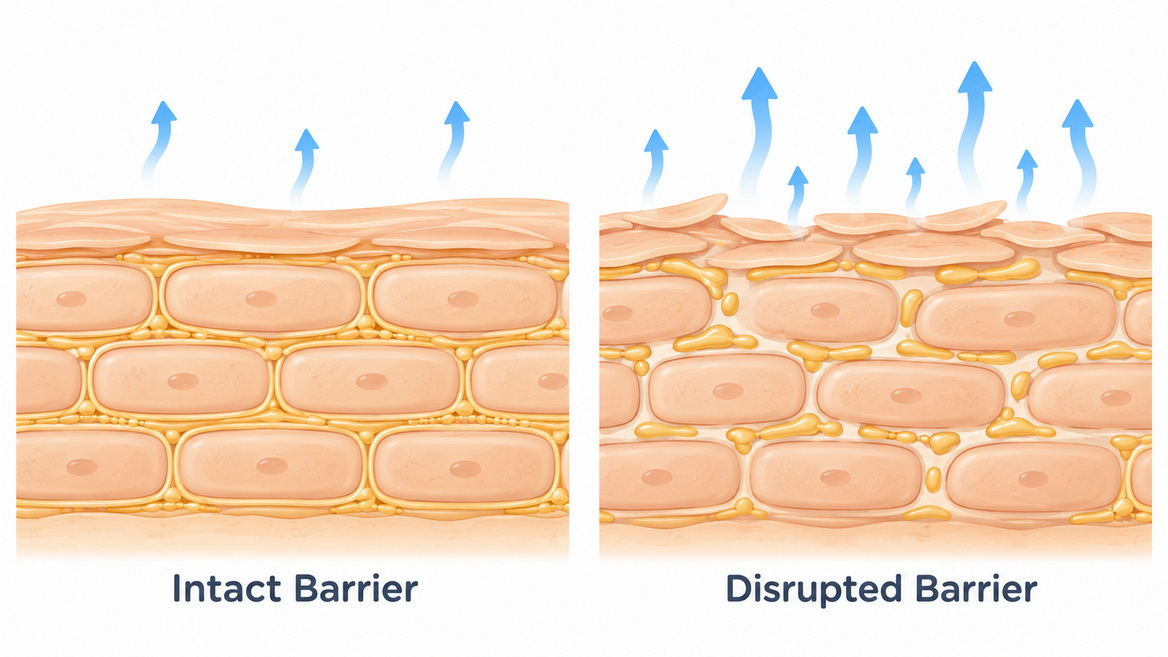
Rather than relying on one symptom, examine the pattern.
Record what you introduced, stopped, or used more frequently before symptoms appeared. Include cleansers, makeup, sunscreen, hair products, and treatments—not just serums.
Also note changes in washing habits, weather exposure, and friction.
Has your skin reacted repeatedly over many months, or did discomfort begin after a specific routine change?
Longstanding reactions suggest an ongoing susceptibility. A sudden change suggests investigating recent exposures. Neither pattern rules out an underlying skin condition.
Improvement after removing unnecessary products supports the possibility that the routine contributed. It does not prove a particular diagnosis or identify an allergen.
Avoid deliberately reapplying a product that caused a significant reaction simply to confirm your suspicion.
Arrange assessment for persistent, worsening, recurrent, blistering, or painful reactions. Seek urgent help for breathing difficulty or rapidly developing facial, lip, or tongue swelling.
A useful starting principle is fewer variables—not an increasingly complicated "repair" routine.
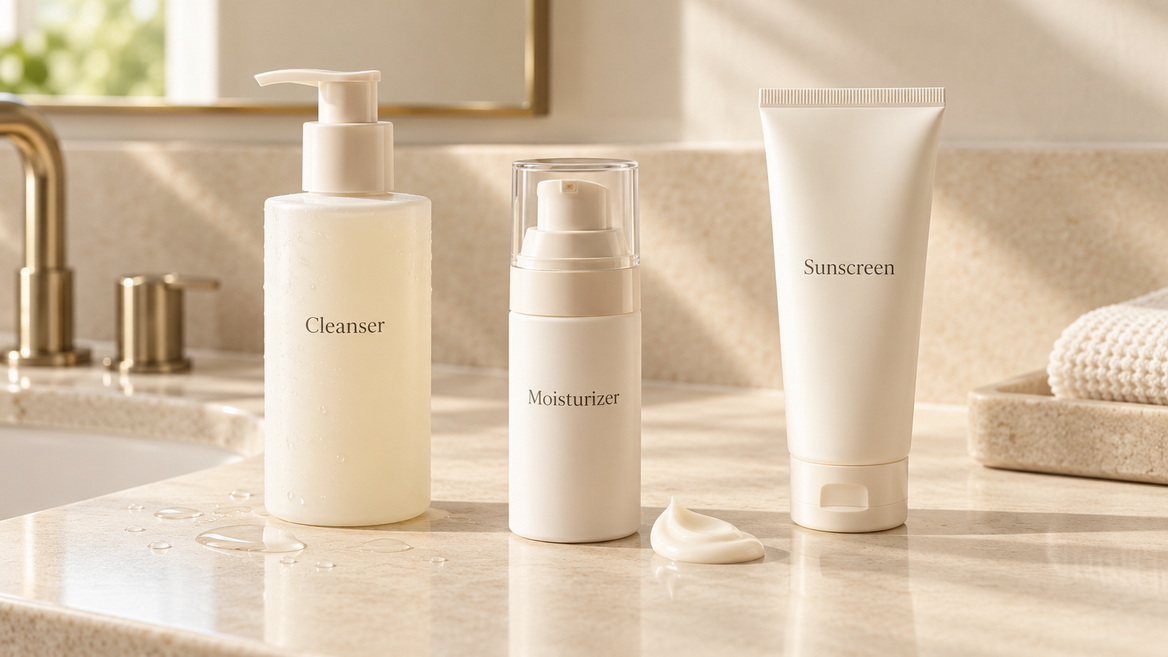
Choose a gentle cleanser you tolerate. Use lukewarm water, avoid abrasive tools, and pat rather than rub the skin dry.
A cleanser should remove what needs removing without leaving persistent burning or uncomfortable tightness.
Prioritize a moisturizer that has previously felt comfortable rather than introducing several new soothing products.
Ingredient lists may include humectants, emollients, and occlusives. These describe different formulation functions: attracting water, smoothing skin, and reducing moisture loss. No ingredient category guarantees that an individual formula will suit everyone.
Use a tolerated broad-spectrum sunscreen with SPF 30 or higher, alongside shade and protective clothing.
If sunscreen repeatedly stings, seek help selecting an alternative rather than repeatedly applying a clearly uncomfortable formula.
Temporarily set aside scrubs and nonessential exfoliating products while skin is uncomfortable.
If a prescribed treatment appears to be involved, discuss adjustments with the prescriber instead of making assumptions about how to stop or restart it.
Once skin is comfortable, introduce products individually. Follow their directions and monitor tolerance.
There is no universal recovery deadline. Improvement depends on the cause, exposure severity, and whether an underlying condition needs treatment.
The American Academy of Dermatology recommends testing a product on a small area twice daily for seven to ten days before wider use.
Use the amount you would normally apply. For rinse-off products, follow the recommended contact time and washing instructions.
Stop if a reaction develops.
This home-use check is not the same as diagnostic patch testing. It cannot guarantee facial tolerance or rule out allergy. Professional patch testing uses selected allergens and clinical interpretation to investigate allergic contact dermatitis.
Choosing skincare for sensitive skin requires more than finding a fashionable ingredient.
Fragrance avoidance can be helpful, particularly when fragrance is a known trigger. However, a fragrance-free formula may contain other ingredients an individual cannot tolerate.
"Unscented" also does not necessarily mean fragrance-free; fragrance-related ingredients may be used to mask an odor.
Botanical extracts and essential oils should be evaluated by composition, concentration, and tolerance—not by their natural origin.
Likewise, a synthetic ingredient is not automatically harsh.
In the United States, "hypoallergenic" has no federal standard or definition governing the term.
A stronger buying question is: What finished-product evidence supports the claim, and who participated in the assessment?
The difference between sensitive and sensitized skin has commercial consequences. Brands need a product brief that translates consumer discomfort into measurable development objectives.
A useful brief distinguishes between:
- Consumers reporting recurring sensitivity.
- Consumers seeking a simpler routine after overuse of active products.
- Consumers with diagnosed conditions who require medical guidance.
These audiences should not be treated as interchangeable. A cosmetic moisturizer should not be positioned as a treatment for allergic contact dermatitis.
A well-known soothing ingredient does not establish finished-product tolerability.
From a manufacturing perspective, the evaluation should consider the complete formulation: ingredient levels, pH where relevant, preservation, stability, packaging compatibility, and intended use.
A sensible assessment plan may include:
1. Safety review appropriate to the destination market.
2. Stability and packaging compatibility evaluation.
3. Microbiological quality and preservation assessment where applicable.
4. Supervised tolerability or consumer-use evaluation suited to the claim.
5. Clear recording of adverse reactions and participant withdrawals.
This is a development framework, not evidence that any particular product has passed these evaluations.
For a sensitive-skin positioning, useful study questions include:
- How many participants reported stinging or burning?
- When did discomfort occur?
- Did any participant discontinue use?
- Were participants selected using defined sensitivity criteria?
- Were improvements subjective, instrument-measured, or both?
A reported improvement means little without the sample size, duration, method, and comparator.

For GUANGZHOU LAIMEI CREATIVE RESEARCH INTELLIGENT BIOLOGICAL RESEARCH CO., LTD., this comparison offers a practical starting point for brand collaboration.
According to company-provided information, LAIMEI has 13 years of skincare and cosmetics development experience, a 20,000-square-meter manufacturing base, annual capacity exceeding 50 million units, and customers across more than 100 countries and regions.
Those capabilities can support development discussions around cleansers, moisturizers, serums, and masks. They do not, by themselves, establish sensitive-skin suitability.
A focused project brief should specify the target consumer, intended market, texture, fragrance policy, packaging, testing expectations, and proposed claims.
The company reports ISO 22716 and GMPC certifications and FDA registration. Buyers should request current documentation and confirm its scope. FDA facility registration is not product approval or proof of clinical performance.
Share your target market, product concept, preferred texture, packaging requirements, and expected order volume with LAIMEI. Request a formulation proposal alongside the planned safety, stability, and tolerability evaluation—not simply a list of trending ingredients.
The objective is a product with a clear purpose, realistic claims, and a user experience supported by appropriate evidence.
Yes. Someone with recurring sensitivity can also develop additional irritation after excessive exfoliation, harsh cleansing, or another exposure.
It often improves when contributing irritants are removed and care is simplified. Persistent symptoms need assessment because allergy or another condition may require different management.
There is no reliable universal timetable. The cause, severity, ongoing exposure, and underlying skin health all influence recovery. Avoid products promising guaranteed recovery within a fixed number of days.
No. Sensitive skin describes unpleasant responses to ordinarily tolerable stimuli. Allergy involves an immune response to a particular substance. Symptoms alone may not distinguish them.
Yes. Oiliness does not exclude sensitivity. A person can have excess surface oil while experiencing stinging or irritation, particularly from an overly aggressive routine.
No. The phrase does not tell you the full study design, participant characteristics, or results. Ask what was tested and what the findings actually support.
1. International Forum for the Study of Itch. ["Definition of Sensitive Skin: An Expert Position Paper."] Basis for the clinical definition and the distinction between symptoms and visible skin changes. [medicaljournals]
2. International expert position paper. ["Pathophysiology and Management of Sensitive Skin."] Background on sensitive-skin mechanisms and management considerations. [pubmed.ncbi.nlm.nih]
3. American Academy of Dermatology. ["How to Test Skin Care Products."] Guidance on seven-to-ten-day product testing, irritation, fragrance, and professional patch testing. [aad]
4. American Academy of Dermatology. ["How Can I Find Eczema-Friendly Products?"] Supporting guidance on fragrance-free product selection and broad-spectrum SPF 30+ sunscreen; this source specifically addresses eczema-prone children. [aad]
5. U.S. Food and Drug Administration. ["Allergens in Cosmetics."] Information on cosmetic allergies, ingredient avoidance, and diagnostic testing. [fda]
6. U.S. Food and Drug Administration. ["'Hypoallergenic' Cosmetics."] Regulatory context and limitations of hypoallergenic claims. [fda]
7. U.S. Food and Drug Administration. ["Registration & Listing of Cosmetic Product Facilities and Products."] Clarification that registration and listing do not constitute approval. [fda]
8. Eminence Organic Skin Care. ["Sensitive vs. Sensitized Skin: What's the Difference?"] July 14, 2026. Comparison article used as an editorial starting point, with clinical terminology clarified using the sources above. [eminenceorganics]


