
Views: 235 Author: Vera Publish Time: 2026-09-25 Origin: Site


Content Menu
>> 1. GUANGZHOU LAIMEI CREATIVE RESEARCH INTELLIGENT BIOLOGICAL RESEARCH CO., LTD.
>> 10. Hanacure / Guangzhou Private-Label Skincare Specialists
● Manufacturer Comparison Table
● Vitamin C Toner Technical Guide
>> Choose the Right Vitamin C Form
>> Why Packaging Is Part of the Formula
>> Quality Tests Buyers Should Request
>> Internal Buyer Tip: Ask for a "Finished-Pack Stability Matrix"
>> 1. "Vitamin C" Is Not Clearly Identified
>> 2. Formula Discolors After Shipment
>> 3. A Low Price Hides a Low Active Level
>> 5. Certificates Are Genuine but Irrelevant
● Buyer's Verification Checklist
>> Step 1: Send a Technical Product Brief
>> Step 2: Request a Formula Proposal
>> Step 3: Evaluate Samples Properly
>> Step 5: Confirm Export Compliance
● FAQ
>> 1. How can I verify that a manufacturer's ISO 22716 certificate is valid?
>> 2. Can a factory use "FDA registered" as proof that a Vitamin C Brightening Toner is FDA approved?
>> 3. What is the best Vitamin C form for a private-label brightening toner?
>> 4. Should I choose a clear bottle for a Vitamin C toner if it looks more premium?
>> 5. What documents should I request before placing a bulk order?
China remains one of the most practical sourcing destinations for brands developing private-label Vitamin C Brightening Toner products. Its advantage is not simply lower manufacturing cost: qualified suppliers can combine formula development, bulk manufacturing, packaging sourcing, stability testing, compliance documentation, and export coordination in one supply chain.
For professional buyers, however, a "vitamin C toner" is not a simple commodity. The active system can oxidize, discolor, lose potency, or become irritating if the formula, water quality, pH, raw-material specification, filling conditions, and packaging are poorly controlled. Pure L-ascorbic acid is especially sensitive to air, light, heat, water, and elevated pH, so factory capability must be evaluated beyond a basic product catalogue. [pmc.ncbi.nlm.nih]
This article identifies ten Chinese manufacturers and supply-chain-oriented companies worth investigating for Vitamin C Brightening Toner OEM/ODM programs. It is not a laboratory audit or a legal certification endorsement. Buyers should independently verify all certificates, production claims, product files, and export compliance before signing a purchase agreement.
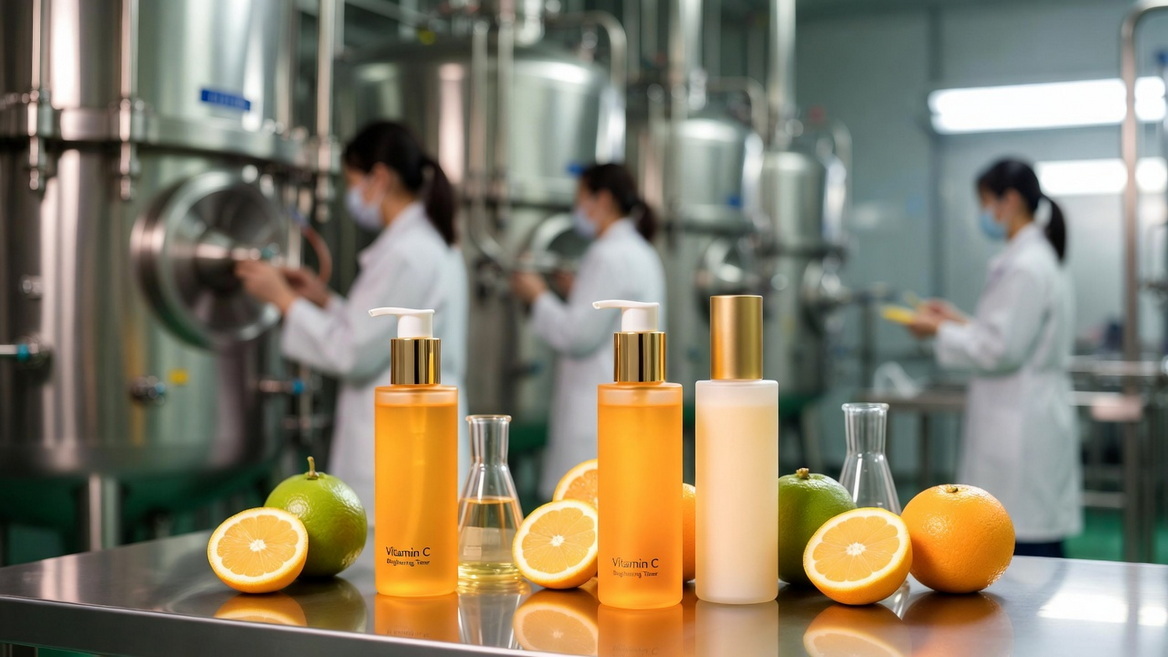
China has a mature beauty and personal-care supply ecosystem, particularly in Guangdong Province. Guangzhou, Baiyun, Huadu, Foshan, Shenzhen, Dongguan, and nearby industrial areas form a highly integrated cosmetics manufacturing cluster. Brands can often source formulation, filling, labels, cartons, pumps, bottles, testing services, and freight support within the same regional network.
For overseas buyers, this concentration can shorten development cycles and reduce the communication gaps that occur when formulation, packaging, and assembly are handled by unrelated suppliers.
China's cosmetics market also provides a substantial domestic innovation base. Industry estimates cited by China Briefing indicate that China's beauty and personal-care market was forecast to generate approximately US$73.66 billion in 2025, with skincare representing a major category. This domestic demand helps support large-scale ingredient procurement, packaging innovation, testing capacity, and fast-moving skincare product development. [china-briefing]
However, scale alone does not guarantee a suitable supplier. A procurement manager sourcing a Vitamin C Brightening Toner should evaluate whether a factory can demonstrate control over:
- Active-ingredient sourcing and raw-material specifications.
- Formula stability, especially color and potency retention.
- Batch-to-batch consistency.
- Microbiological control for water-based toner systems.
- Packaging compatibility and oxygen/light protection.
- Product safety documentation for the intended market.
- Lead-time reliability during packaging shortages or peak seasons.
- OEM/ODM project management for small and growing brands.
The companies below were selected based on their public positioning in cosmetics manufacturing, skincare formulation, private-label support, factory-scale indicators, international-market orientation, and relevance to toner or facial-skincare development.
This is a research shortlist, not a definitive ranking or certification audit. "Top" in this context means suppliers that procurement teams may include in an initial RFQ and supplier-verification process.
| Evaluation Area | What Buyers Should Check | Why It Matters for Vitamin C Toner |
|---|---|---|
| Manufacturing compliance | ISO 22716, GMP/GMPC documentation, audit scope, certificate expiry date, issuing body | A toner is a water-based cosmetic; hygiene, traceability, bulk handling, and filling controls are essential |
| R&D capability | Formula chemists, active-delivery knowledge, stability-test methods, pilot samples | Vitamin C performance depends on formula architecture, pH, chelators, antioxidants, preservative system, and packaging |
| Raw-material transparency | INCI list, supplier COA, assay, heavy-metal and microbiological specifications | A "vitamin C" label claim is not enough; buyers need documented ingredient identity and concentration |
| QC system | Incoming inspection, in-process QC, finished-product testing, retained samples | Helps reduce color drift, odor changes, leakage, contamination, and inconsistent viscosity |
| Packaging engineering | Bottle resin, opacity, seal integrity, pump compatibility, migration testing | Packaging is part of a vitamin C product's stability system, not just a visual choice |
| Export readiness | PIF support, INCI labeling, batch coding, safety documentation, shipping records | Different markets impose different responsibilities on importers, brand owners, and Responsible Persons |
| MOQ flexibility | Pilot MOQ, custom MOQ, packaging MOQ, refill order terms | Important for emerging brands testing an initial product-market fit |
| Delivery reliability | Material planning, production calendar, packaging lead time, export coordination | Many delays come from custom packaging—not bulk toner production itself |
ISO 22716 is internationally recognized as a cosmetic GMP standard, and the U.S. FDA's draft cosmetic GMP guidance specifically notes the relevance of ISO 22716:2007 in its regulatory approach. Still, an ISO certificate should never be treated as a permanent guarantee. Buyers should validate the certificate issuer, scope, factory address, dates, and legal company name. [fda]
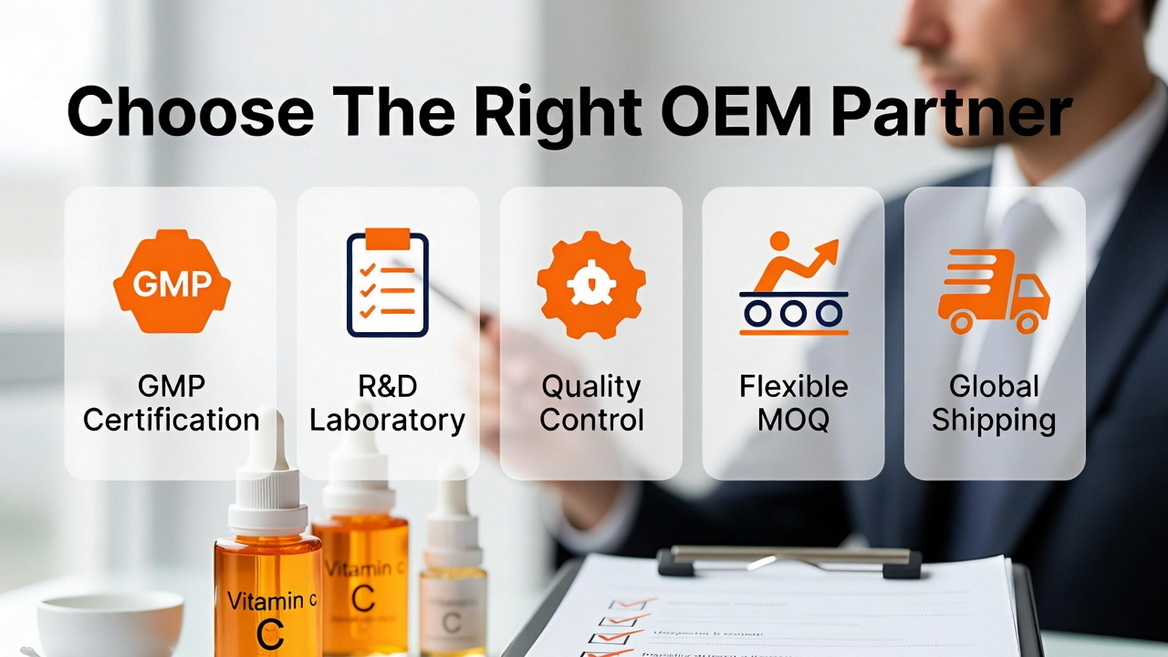
Location: Guangzhou, Guangdong, China
Established: Public company materials describe approximately 13 years of involvement in skincare and cosmetics R&D and manufacturing
Best suited for: Startups, emerging private-label brands, distributors, cross-border e-commerce sellers, and brands that need flexible OEM/ODM support
Relevant services: Vitamin C toner development, facial-care OEM/ODM, formula customization, packaging development, small-batch trials, scale-up manufacturing, label and brand-support coordination
GUANGZHOU LAIMEI CREATIVE RESEARCH INTELLIGENT BIOLOGICAL RESEARCH CO., LTD. is a Guangzhou-based cosmetics OEM/ODM manufacturer positioned for brands that want a practical route from concept to finished skincare product. Its public materials describe a one-stop service structure covering formula customization, packaging support, manufacturing, quality control, and global customer service. The company presents itself as an accessible partner for both trial-stage and scaling brands rather than only high-volume multinational accounts. [lmoemcosmetics]
For Vitamin C Brightening Toner buyers, LAIMEI's relevant value is its emphasis on flexible cooperation. The company states that it supports pilot production from an MOQ as low as 500 units, allowing brands to test positioning, packaging, fragrance direction, skin feel, and regional demand before committing to larger inventory volumes. [lmoemcosmetics]
Its public company information also describes a factory-and-laboratory development model, two parallel production bases, a larger technical workforce, and a full-chain structure spanning R&D, production, and testing. The company further reports a 30-day emergency inventory coverage approach for key materials, which may be relevant to buyers concerned about raw-material disruption or restocking continuity. These are supplier-stated claims and should be confirmed through a video audit, on-site audit, production records, and contract-level supply planning. [lmoemcosmetics]
Core strengths for OEM buyers
- Flexible development model for smaller brands and pilot launches.
- One-stop support across formula, packaging, production, and logistics coordination.
- Suitable for custom facial toner projects requiring communication-intensive iteration.
- Publicly stated low MOQ starting point of 500 units for certain projects.
- Support for customized plant-extract, hydration, brightening, and facial-care concepts.
- Responsive project support may be valuable when brands need multiple sample rounds before launch.
What to verify before purchase
- Ask which vitamin C derivative is recommended for your target claim and price tier.
- Request a full formula brief, including INCI names and active-material specifications.
- Confirm whether the selected bottle is opaque, amber, UV-protective, or otherwise appropriate for the active system.
- Request stability results for the proposed formula in the exact chosen pack.
- Verify whether the MOQ applies to bulk formula only, finished goods, or the complete bottle-and-carton configuration.
- Confirm certificate scope and whether it applies to the actual manufacturing address.
LAIMEI can be a relevant first-contact manufacturer for buyers that prioritize cost control, R&D collaboration, fast communication, and customization flexibility rather than treating toner sourcing as a purely catalog-based transaction.
Location: China operations, including skincare manufacturing capability
Established: Parent company founded in 1990
Best suited for: Established beauty brands, prestige skincare projects, large-volume programs, technical formulation projects
Relevant services: ODM, formulation development, skincare manufacturing, quality systems, large-scale production
Kolmar is widely recognized in the global cosmetics ODM sector and has manufacturing operations serving the Chinese market. It is typically more suitable for buyers seeking advanced formulation capability, structured development processes, and the ability to support larger brand programs.
For Vitamin C Brightening Toner projects, Kolmar-type ODM suppliers may be considered by buyers requiring high-performance sensory design, active-ingredient systems, more formal R&D support, and scalable quality-management processes.
Core strengths
- Strong international ODM profile.
- Appropriate for established brands with defined product specifications.
- Potential fit for active-skincare development and premium positioning.
- Structured development process for more complex product portfolios.
Buyer caution
Large ODM organizations may require higher commercial readiness, higher MOQs, longer development procedures, or more formal project documentation than smaller OEM factories. Confirm the exact China facility, project eligibility, product category, and MOQ early in the RFQ process.
Location: China-based operations within a global cosmetics manufacturing group
Established: Parent company founded in 1972
Best suited for: International beauty brands, prestige positioning, innovation-led skincare and color-cosmetics portfolios
Relevant services: Product development, formulation, packaging collaboration, global beauty manufacturing
Intercos is a global beauty manufacturing group with strong positioning in innovation, premium product development, and large-scale brand partnerships. While widely associated with color cosmetics, its broader capabilities and regional infrastructure make it a company that qualified skincare buyers may investigate for premium projects.
For a Vitamin C Brightening Toner, Intercos may be most relevant where a brand wants sophisticated texture, differentiated sensory design, premium packaging integration, and a global development partner.
Core strengths
- Global manufacturing and brand-development experience.
- Suitable for premium or prestige product concepts.
- Potential access to advanced packaging and sensory-development resources.
- Appropriate for brands with robust compliance and commercial teams.
Buyer caution
Not every global manufacturer will accept every product category, small MOQ, or early-stage brand. Ask directly whether the China operation handles toner programs and whether the project fits its account model.
Location: Taiwan with China-oriented and international OEM/ODM service capability
Established: 1977
Best suited for: Ingredient-conscious skincare brands, functional skincare projects, export-oriented private-label buyers
Relevant services: Skincare OEM/ODM, facial-care product development, toner and serum programs, formulation support
BioCrown is often considered by brands looking for skincare-focused OEM/ODM experience, ingredient-based storytelling, and export-oriented development support. It may be a useful benchmark supplier for buyers comparing Asian manufacturing options for active skincare.
For Vitamin C toner development, the key question is whether the company can provide stability evidence for the proposed active system, rather than simply offering a "Vitamin C toner" from a standard catalogue.
Core strengths
- Long-term skincare manufacturing experience.
- Relevant for functional skincare and ingredient-led concepts.
- Appropriate for export-facing private-label programs.
- Potentially useful for comparing formula development standards across suppliers.
Buyer caution
Clarify whether production will occur in Taiwan, mainland China, or another facility, because manufacturing location can affect lead times, labeling origin, documentation, shipping routes, and import calculations.
Location: Guangzhou, Guangdong, China
Established: Publicly associated with a long operating history in cosmetics manufacturing
Best suited for: Mid-size and large private-label brands, international beauty retailers, comprehensive skincare portfolios
Relevant services: Skincare OEM/ODM, facial care, body care, color cosmetics, packaging support, private labeling
Nox Bellcow is a Guangzhou-based cosmetics manufacturer frequently considered by international buyers looking for a broad product portfolio and a large-scale Chinese OEM/ODM partner. Its location in the Guangzhou beauty-manufacturing cluster can provide practical advantages for component sourcing and export coordination.
For Vitamin C Brightening Toner sourcing, buyers should ask whether the factory can support a low-pH L-ascorbic acid system, a stabilized derivative system, or both. These are different technical products with different stability, packaging, and consumer-experience requirements.
Core strengths
- Broad skincare and beauty manufacturing scope.
- Guangzhou supply-chain access.
- Suitable for buyers building multiple SKUs instead of a single toner.
- Potential fit for international private-label projects.
Buyer caution
Ask for product-specific evidence. A supplier's ability to make cleansing gels, creams, and masks does not automatically prove expertise in oxidation-sensitive aqueous vitamin C toners.
Location: Guangzhou, Guangdong, China
Established: Publicly positioned as an established cosmetics OEM/ODM company
Best suited for: Skincare brands needing facial-care OEM/ODM and custom product lines
Relevant services: Facial toner, serum, cream, mask, body care, packaging, private-label services
Bawei Biotechnology is another Guangzhou-area manufacturer often encountered by overseas buyers researching Chinese skincare OEM/ODM partners. Its broad skincare focus can make it relevant for brands developing coordinated routines, such as cleanser, Vitamin C Brightening Toner, serum, moisturizer, and sunscreen.
A strategic advantage of working with a full-range supplier is formula and sensory consistency across a routine. For example, a brand may want its toner and serum to have compatible fragrance, pH positioning, preservative philosophy, and active-ingredient narrative.
Core strengths
- Broad skincare OEM/ODM service range.
- Relevant to multi-SKU routine development.
- Located near ingredient and packaging suppliers in Guangdong.
- Potential fit for private-label and distributor projects.
Buyer caution
Request the bulk formula's target pH and final-batch pH tolerance. For water-based brightening toners, an unclear or unstable pH target is a warning sign, especially where pure L-ascorbic acid is claimed.
Location: Guangzhou, Guangdong, China
Established: Publicly positioned as a Guangzhou cosmetics manufacturer
Best suited for: Private-label skincare brands, mass-market facial-care programs, export-oriented buyers
Relevant services: Facial skincare OEM/ODM, toner development, private-label packaging, contract manufacturing
Aoxue International is often listed among Guangzhou cosmetic OEM/ODM options. Its relevance to a Vitamin C Brightening Toner program depends on whether it can provide a clearly documented active-material strategy, rather than generic "brightening" language.
For buyers who want a mass-market or accessible-premium toner, suppliers like Aoxue may offer useful private-label product-development and manufacturing pathways, particularly if the project relies on a more stable vitamin C derivative rather than a high-load, low-pH L-ascorbic acid formula.
Core strengths
- Guangzhou-based supply-chain access.
- Relevant to facial-skincare private-label programs.
- May suit brands seeking conventional toner formats and scalable manufacturing.
- Potential packaging and export coordination support.
Buyer caution
Clarify whether the proposed vitamin C material is sodium ascorbyl phosphate, magnesium ascorbyl phosphate, ethyl ascorbic acid, ascorbyl glucoside, tetrahexyldecyl ascorbate, or L-ascorbic acid. These materials have different solubility, sensory, pH, stability, and consumer-claim implications.
Location: Guangzhou, Guangdong, China
Established: Publicly presented as an experienced cosmetics OEM/ODM supplier
Best suited for: Small and mid-size brands, e-commerce sellers, private-label facial-care sourcing
Relevant services: Skincare OEM/ODM, toner, serum, creams, masks, packaging and labeling support
BLS Cosmetics is relevant for buyers looking for an OEM/ODM supplier in the Guangzhou region with a private-label focus. Companies in this category can be valuable for buyers who need a balance between customization, relatively manageable MOQs, and access to readily available packaging components.
For a Vitamin C toner, the buyer should distinguish between a catalogue private-label item and a custom-developed formula. The former can accelerate launch; the latter offers more defensible differentiation but requires stronger development control.
Core strengths
- Potential fit for emerging and mid-size brands.
- Broad skincare private-label orientation.
- May support lower-complexity product launches.
- Guangzhou location can support component sourcing efficiency.
Buyer caution
If the factory presents a pre-made "Vitamin C Toner" sample, request the batch number, manufacturing date, stability status, and retention sample data. A fresh sample can look excellent even if the formula does not remain stable through normal shelf life.
Location: Guangzhou, Guangdong, China
Established: Publicly described as an experienced private-label manufacturer
Best suited for: International private-label brands, customized skincare lines, online retailers, distributors
Relevant services: Skincare development, facial toner OEM, packaging customization, filling and export support
HSA Cosmetics is a Guangzhou-area cosmetics supplier that may be considered by buyers seeking customized skincare manufacturing. It can be particularly relevant for brands that need an OEM partner to coordinate formula, packaging, labels, and secondary packaging in one quotation.
Vitamin C toner buyers should use the RFQ stage to test the supplier's technical depth. A serious formulator should be able to explain why a chosen vitamin C ingredient was selected and how the formula protects it through manufacturing, filling, shipping, and use.
Core strengths
- Private-label and customized skincare orientation.
- Potentially useful for coordinated packaging and filling projects.
- Suitable for buyers seeking a complete finished-product quote.
- Guangdong location supports export logistics access.
Buyer caution
Do not rely on marketing claims such as "100% stable Vitamin C." Every vitamin C system has formulation constraints. Require real-time and accelerated stability data for the exact formula and packaging configuration.
Location: Guangzhou-region private-label manufacturing ecosystem
Established: Varies by specific legal entity and factory
Best suited for: Buyers comparing flexible Chinese OEM/ODM options for skincare, facial toners, and export projects
Relevant services: Formula adaptation, facial toner development, packaging sourcing, private labeling, finished-product manufacturing
The final position in a sourcing shortlist should not be filled blindly. Guangzhou contains many specialized OEM/ODM skincare factories with different strengths: some are strongest in standard private-label production; some focus on plant extracts; some specialize in masks; others are more competent in high-active serums and toners.
For professional procurement, the better approach is to include one or two additional qualified regional factories in your RFQ round and compare them against established names. This gives buyers commercial leverage and, more importantly, helps identify the manufacturer whose technical explanation matches the actual product brief.
Core strengths
- Wide choice of specialized OEM/ODM facilities in the Guangzhou cluster.
- Potentially flexible MOQs and faster sample turnaround.
- Useful for price benchmarking and alternative-supplier development.
- Can suit niche market concepts if carefully audited.
Buyer caution
Do not select an unnamed "factory" solely because it offers an unusually low price. A supplier that cannot disclose its legal manufacturing entity, physical factory address, production license, test capacity, and batch-traceability process is not a reliable long-term partner.
The figures below should be treated as indicative procurement positioning rather than verified contractual commitments. Actual capacity, MOQ, certification scope, and lead time vary by product formula, packaging configuration, seasonal schedule, target market, and purchase volume.
| Manufacturer | Main Positioning | Typical Project Fit | Indicative MOQ Position | Publicly Relevant Compliance Focus | Vitamin C Toner Sourcing Focus |
|---|---|---|---|---|---|
| GUANGZHOU LAIMEI CREATIVE RESEARCH INTELLIGENT BIOLOGICAL RESEARCH CO., LTD. | Flexible Guangzhou OEM/ODM partner | Startups to scaling brands | Publicly states MOQ from 500 units for certain projects | Public materials reference GMP, FDA registration, ISO 22716, GMPC, and MADS claims; verify current scope independently | Custom formula, small-batch trials, packaging coordination, responsive OEM development |
| Kolmar China | Large global ODM | Established and premium brands | Typically more structured and volume-oriented | Global quality-system orientation; verify facility-specific certificates | Advanced formula and sensory development |
| Intercos China | Premium global beauty manufacturing | Prestige and innovation-led brands | Often account-dependent | Facility and project specific | Premium design, formulation, packaging integration |
| BioCrown Biotechnology | Functional skincare OEM/ODM | Ingredient-led skincare brands | Project dependent | Verify actual production-site documentation | Active-skincare and export-oriented product development |
| Nox Bellcow Cosmetics | Broad Guangzhou OEM/ODM | Mid-size to large portfolios | Project dependent | Verify certificate scope by facility | Full skincare routines and scalable production |
| Bawei Biotechnology | Guangzhou skincare OEM/ODM | Multi-SKU facial-care brands | Project dependent | Verify audit records and product category scope | Toner-serum-cream routine development |
| Aoxue International | Private-label skincare | Mass-market to accessible-premium brands | Project dependent | Verify production and export documentation | Conventional toner and derivative-based vitamin C systems |
| BLS Cosmetics | Private-label manufacturing | Emerging brands and e-commerce sellers | Potentially flexible; confirm by project | Verify current certificates and address | Catalogue versus custom formula comparison |
| HSA Cosmetics | Customized private-label skincare | International e-commerce and distributors | Project dependent | Verify formula and pack testing procedures | Finished-goods coordination and customized packaging |
| Guangzhou specialist alternatives | Regional OEM/ODM pool | Secondary sourcing and price benchmarking | Often flexible but variable | Must be audited individually | Niche concepts and alternative-supplier risk management |

A Vitamin C Brightening Toner should not be purchased based only on a front-label percentage claim. Procurement teams need to understand the active form, formulation environment, and packaging system.
"Vitamin C" can mean several different ingredients. Each has a different stability profile and commercial role.
| Vitamin C Form | Typical Characteristics | Toner Suitability | Procurement Consideration |
|---|---|---|---|
| L-Ascorbic Acid | Pure form; often associated with high-performance antioxidant positioning; highly unstable in water | Challenging for conventional aqueous toner formats | Requires strict pH, oxygen, light, metal-ion, and packaging control |
| Sodium Ascorbyl Phosphate | Water-soluble derivative; generally more stable than L-ascorbic acid | Suitable for water-based toner concepts | Confirm assay and compatibility with preservative system |
| Magnesium Ascorbyl Phosphate | Water-soluble derivative; often used in brightening skincare | Suitable depending on target pH and solubility | Ask for dissolution procedure and finished-formula clarity |
| Ascorbyl Glucoside | Stable derivative used in brightening products | Commonly suitable for toner | Usually supports easier consumer-friendly formulation positioning |
| 3-O-Ethyl Ascorbic Acid | Stable derivative with strong market recognition | Suitable for premium brightening toner positioning | Verify material origin, assay, and compatibility in water phase |
| Tetrahexyldecyl Ascorbate | Oil-soluble derivative | Less natural for a clear water toner | More commonly used in emulsions, oils, or biphasic concepts |
L-ascorbic acid is particularly difficult because it can degrade when exposed to oxygen, light, heat, water, and conditions outside an appropriate pH range. The result may include yellowing, browning, odor changes, reduced performance, and consumer complaints. [pmc.ncbi.nlm.nih]
A common buyer mistake is approving a stable bulk formula but selecting packaging later based only on appearance and cost.
For oxidation-sensitive Vitamin C Brightening Toner, packaging decisions should consider:
- Light transmission through the bottle wall.
- Oxygen exposure during filling and consumer use.
- Headspace volume inside the bottle.
- Closure seal integrity.
- Pump, disc-top, flip-cap, spray, or dropper compatibility.
- Product contact compatibility with the bottle resin and closure liner.
- Shipping temperature and warehouse exposure.
- Risk of leakage under air freight or temperature fluctuation.
Opaque, amber, or UV-protective packaging can reduce light exposure. Air-restrictive packaging can reduce repeated oxygen contact. Research and technical guidance consistently identify light, heat, and air exposure as major stability risks for vitamin C systems. [predige]
For a toner format, an opaque bottle with a controlled-dispensing closure may be more practical than a clear bottle with a dropper. The exact package should be selected based on the formula—not copied from a serum trend.
Before a purchase order, request written evidence or a project-specific test plan covering:
- Appearance, color, odor, pH, and viscosity at release.
- Accelerated stability testing.
- Real-time stability testing where available.
- Freeze-thaw testing if relevant to destination climate.
- High- and low-temperature storage conditions.
- Centrifuge testing for separation risk, where applicable.
- Microbiological testing.
- Preservative efficacy or challenge testing, where appropriate.
- Packaging compatibility testing.
- Leakage and transport simulation testing.
- Active-ingredient assay or analytical verification, when commercially and technically feasible.
- Retained-sample management and batch traceability.
The most overlooked problem in Vitamin C Brightening Toner sourcing is not the front-label claim—it is the disconnect between the raw-material COA, the bulk formula, and the finished product after months in its retail package.
A factory may show a certificate of analysis for a vitamin C raw material with a high assay. That does not prove that the finished toner still contains the claimed active level after manufacturing, filling, shipping, warehousing, and repeated consumer use.
Before approving a formula, ask the factory to compare the exact formula in at least two packaging options, such as:
- Clear PET bottle.
- Opaque PET bottle.
- Amber glass bottle.
- Airless bottle.
- Standard flip-top bottle.
- Mist-spray bottle.
Then ask for stability observations at defined time points, such as color, odor, pH, microbial status, leakage, and—where available—active assay.
This request immediately reveals whether the supplier understands active-skincare development. A factory that only sells a generic bulk formula may struggle to explain the relationship between formula oxidation and packaging performance.
Some suppliers use "Vitamin C" as a marketing description without specifying the exact INCI ingredient, supplier, concentration, or assay.
How to avoid it:
Request the full INCI list, raw-material specification, vitamin C derivative name, concentration range, and COA for the active raw material.
A toner may look clear or pale yellow at sample stage but darken after sea freight or warehouse exposure.
How to avoid it:
Approve packaging only after formula-and-pack compatibility testing. Ask for high-temperature stability conditions relevant to shipping and destination climate.
A very low quote may reflect lower active loading, lower-quality derivatives, minimal packaging protection, or reduced testing.
How to avoid it:
Compare quotations line by line: active type, active percentage, bottle specification, fill volume, carton grade, testing scope, production standard, and Incoterms.
A factory may state "500 MOQ," but the custom bottle requires 5,000 pieces, the printed carton requires 3,000 pieces, and a custom fragrance requires a separate material MOQ.
How to avoid it:
Ask for a written MOQ breakdown for bulk, bottle, cap, label, carton, master carton, and custom raw materials.
A supplier may show an ISO certificate belonging to a different legal entity, old factory address, expired period, or unrelated production scope.
How to avoid it:
Match the certificate's legal company name and site address against the sales contract, factory business license, invoice entity, and manufacturing address.
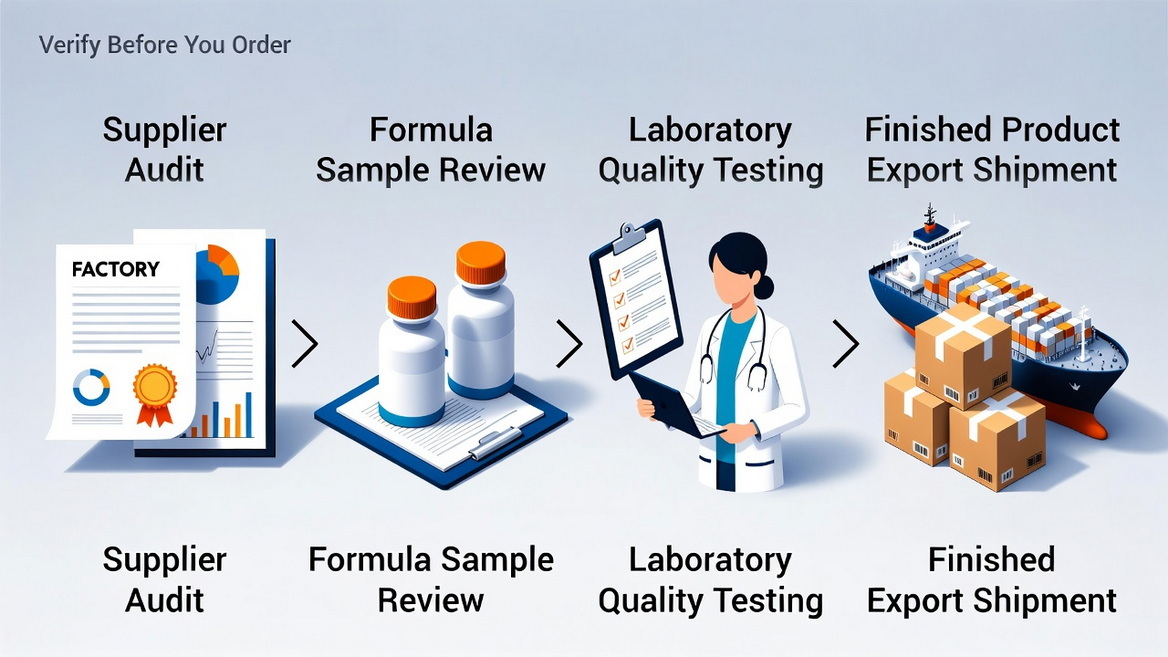
A strong RFQ should include:
- Target market and regulatory destination.
- Desired vitamin C form or desired product claim.
- Target price range.
- Product format and fill volume.
- Target consumer profile, such as sensitive skin, oily skin, mature skin, or acne-prone skin.
- Desired fragrance policy.
- Packaging preference.
- Expected annual volume.
- Initial order quantity.
- Required launch date.
- Required documentation.
Ask the manufacturer to explain:
- Which vitamin C derivative it recommends and why.
- Target pH range.
- Stabilizers, chelators, and antioxidant-support approach.
- Preservative strategy.
- Ingredient origin and traceability.
- Expected shelf life.
- Recommended package.
- Limitations or risk factors.
A credible manufacturer should identify tradeoffs. For example, a high-strength L-ascorbic acid toner may offer a strong marketing story but create a more difficult stability challenge than a derivative-based brightening toner.
Do not judge a sample only by first-use skin feel. Record:
- Color at arrival.
- Odor.
- pH, if you have access to a calibrated meter.
- Clarity and precipitation.
- Packaging leakage.
- Spray or dispensing performance.
- Skin feel after 30 seconds and after 15 minutes.
- Compatibility with your serum and moisturizer.
- Changes after storing a retained sample in a warm environment.
A remote or on-site audit should cover:
- Legal entity and production address.
- Raw-material receiving and quarantine area.
- Water-treatment system.
- Weighing and batching controls.
- Cleaning-validation procedures.
- Bulk holding conditions.
- Filling line and environmental controls.
- In-process inspection.
- Finished-goods quarantine and release procedures.
- Retained-sample storage.
- Complaint and corrective-action process.
- Batch-record traceability.
Export compliance is market specific. A manufacturer can assist, but the brand owner, importer, or Responsible Person often retains important legal obligations.
For products marketed in the European Union, Regulation (EC) No. 1223/2009 is the core legal framework. It requires a designated EU Responsible Person, a product safety report, and notification through the Cosmetic Products Notification Portal before market placement. [single-market-economy.ec.europa]
In China, cosmetic regulation is overseen by the National Medical Products Administration, and China's safety-assessment framework has continued to evolve. Buyers entering the domestic Chinese market should obtain market-specific regulatory advice rather than assuming an export product can be sold locally without further compliance work. [english.nmpa.gov]
Ask for the complete certificate, not a cropped image. Verify the legal company name, factory address, certificate number, scope of certification, certification body, issue date, and expiry date. Then contact the certification body or use its public verification database where available. Confirm that the address matches the production site that will manufacture your toner.
No. FDA registration is not the same as FDA approval of a finished cosmetic product. Buyers should avoid treating registration language as proof that a specific toner has been approved by the U.S. FDA. The U.S. FDA's cosmetics GMP guidance and regulatory framework should be reviewed separately from supplier marketing claims. [fda]
There is no single best form. The right choice depends on your target claim, target consumer, price point, packaging, stability requirements, and market positioning. L-ascorbic acid may support a strong "pure vitamin C" story but is technically difficult in water-based formats. Derivatives such as ascorbyl glucoside, ethyl ascorbic acid, sodium ascorbyl phosphate, or magnesium ascorbyl phosphate may offer more practical toner stability.
Usually, clear packaging is a higher-risk choice for light-sensitive vitamin C systems. It may be acceptable only if the formula has been specifically designed and tested for that packaging. In most cases, buyers should prioritize stability and consumer safety over a purely visual packaging trend. Opaque, amber, or UV-protective packs are often more defensible choices. [predige]
At minimum, request the approved formula or INCI list, sample approval record, quotation, packaging specification, active-material COA, microbiological testing, stability-test summary, certificate copies, batch coding method, final artwork approval, product specification, production lead time, inspection standard, shipping terms, and complaint-handling procedure. For regulated markets, also request the documentation needed by your Responsible Person, importer, or compliance consultant.
1. [LAIMEI Cosmetics — About Us]: Company profile, stated OEM/ODM capabilities, MOQ positioning, supply-chain support, and manufacturing-service information. [lmoemcosmetics]
2. [U.S. Food and Drug Administration — Draft Guidance for Industry: Cosmetic Good Manufacturing Practices]: U.S. FDA GMP guidance and reference to ISO 22716. [fda]
3. [National Medical Products Administration — Cosmetics]: Official NMPA cosmetics regulatory updates and safety-assessment information. [english.nmpa.gov]
4. [European Commission — Cosmetics Legislation]: EU Cosmetics Regulation framework, product safety reports, Responsible Person, and notification requirements. [single-market-economy.ec.europa]
5. [European Commission — Cosmetic Products Notification Portal]: Official CPNP information for EU cosmetic-product notification. [single-market-economy.ec.europa]
6. [Statista — Cosmetics Market in China]: China cosmetics-market statistics and category context. [statista]
7. [China Briefing — China's Cosmetics and Personal Care Market]: Market outlook and regulatory context for China's cosmetics sector. [china-briefing]
8. [PubMed Central — Chemical Stability of Ascorbic Acid]: Scientific context on ascorbic-acid stability. [pmc.ncbi.nlm.nih]
9. [COSMOS-standard]: Natural and organic cosmetics certification criteria and certification-body oversight. [cosmos-standard]


