
Views: 234 Author: Vera Publish Time: 2026-09-13 Origin: Site


Content Menu
● How We Evaluated Manufacturers
● Why Source Natural Skincare From China?
● Top 10 Natural Skincare Product Manufacturers in China
>> 1. GUANGZHOU LAIMEI CREATIVE RESEARCH INTELLIGENT BIOLOGICAL RESEARCH CO., LTD.
>> 3. Guangdong Tianzi Cosmetics Technology Co., Ltd.
>> 4. Ausmetics
>> 5. Guangzhou Ridgepole and Essence Co., Ltd.
>> 6. 8OEM
>> 8. Biohyalux
● Capacity, MOQ, and Certification Comparison
● Technical Requirements for Natural Skincare
● Buyer's Guide: How to Verify a Chinese Manufacturer
>> Step 1: Define Your Commercial Brief
>> Step 2: Verify the Legal Entity
>> Step 3: Authenticate Certificates
>> Step 4: Use a Structured Sampling Process
>> Step 5: Review Documentation Before Shipment
● Common Sourcing Problems—and How to Avoid Them
>> Problem 1: "Natural" Claims Without Formula Evidence
>> Problem 2: Low Quotes That Exclude Essential Work
>> Problem 3: Certificate Misuse
>> Problem 4: Inconsistent Botanical Raw Materials
>> Problem 5: Packaging Delays Mistaken for Factory Delays
● FAQ
>> 1. How can I verify that an ISO 22716 certificate is still valid?
>> 2. Is U.S. FDA registration the same as FDA approval for skincare products?
>> 3. What is a reasonable MOQ for natural skincare OEM production in China?
>> 4. Can a Chinese OEM manufacturer make products compliant for the EU, UK, U.S., and Middle East at the same time?
>> 5. How do I protect my custom natural skincare formula when working with an OEM?
China remains one of the world's most important sourcing bases for natural skincare products, combining mature cosmetic supply chains, ingredient-access advantages, packaging resources, formulation laboratories, and scalable OEM/ODM production. For purchasing managers, however, "natural" is not a sufficient supplier-selection standard. The real decision depends on formula traceability, production controls, market-specific compliance documentation, batch consistency, packaging compatibility, and the supplier's ability to support a brand from sampling through repeat orders.
China's cosmetics exports reached USD 7.82 billion in 2025, an increase of 9.2% year on year, demonstrating the continued importance of Chinese manufacturers in international beauty supply chains. At the same time, China's domestic natural-cosmetics market is projected to continue expanding through 2031, according to Statista Market Insights. [english.news]
This guide is designed for professional buyers looking for a long-term natural skincare product manufacturing partner—not simply the lowest initial quotation.

A credible natural skincare product manufacturer should be assessed as a production and compliance partner, rather than judged by marketing claims such as "organic," "clean," or "botanical." These words may have different legal meanings across markets, and in some cases they have no unified legal definition.
For this list, manufacturers were assessed against the following buyer-relevant criteria:
| Selection Criterion | What Buyers Should Verify | Why It Matters |
|---|---|---|
| GMP and quality systems | ISO 22716 scope, GMP documentation, audit reports, production-license information | Reduces avoidable risks in hygiene, batch consistency, records, release procedures, and recall readiness |
| R&D depth | Formulator background, formula library, stability testing, compatibility testing, claims-support capability | Determines whether a supplier can develop a differentiated, stable, market-appropriate formula |
| Natural ingredient control | INCI lists, supplier COAs, allergen declarations, origin documents, pesticide/heavy-metal controls where relevant | "Natural" raw materials can vary significantly by harvest, origin, odor, color, and microbial profile |
| OEM/ODM flexibility | MOQ, sample workflow, formula ownership terms, packaging sourcing, artwork support | Critical for startup brands, regional launches, and brands testing new categories |
| Production scalability | Filling lines, cleanroom conditions, annual or daily capacity, contingency planning | Helps ensure the supplier can move from test orders to stable commercial volume |
| Export readiness | EU/UK, U.S., ASEAN, Middle East, or other destination-market document support | A factory's local certifications alone do not automatically make a finished product compliant overseas |
| Delivery reliability | Raw-material lead times, packaging lead times, batch scheduling, shipment experience | Packaging and special ingredients often cause more delays than filling capacity |
| Transparency | Factory address, certificate number, inspection access, batch records, sample retention policy | Transparency is often a better predictor of supplier reliability than a polished website |
China's National Medical Products Administration (NMPA) requires cosmetics registrants, filing applicants, and entrusted manufacturers to organize production under its cosmetics GMP requirements. The framework covers quality assurance, personnel, equipment, materials, production, inspection, packaging, storage, transportation, sales, and recall management. [english.nmpa.gov]
> Important clarification: CE and RoHS are generally not the core compliance standards for topical skincare products. CE is primarily relevant to certain regulated devices, while RoHS applies to electrical and electronic equipment. For natural skincare, buyers should focus more closely on cosmetic GMP, ingredient safety, microbial quality, labeling, claims substantiation, preservative systems, stability, packaging compatibility, and the regulations in the destination market.
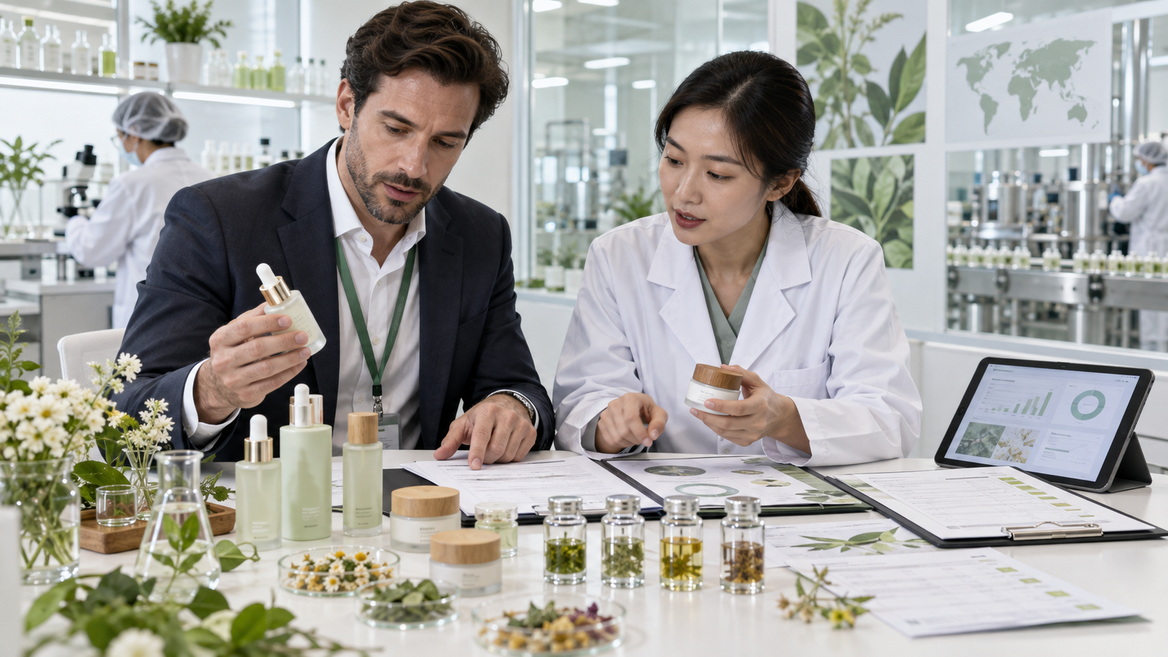
China's advantage is not one single factory cluster. Instead, it is an interconnected beauty-manufacturing ecosystem. Guangzhou and the wider Guangdong region are especially important for skincare OEM/ODM, packaging, molds, labels, pumps, bottles, contract filling, fragrance supply, and export logistics. Buyers can often coordinate formula development, primary packaging, secondary packaging, labeling, and freight preparation within one regional supply network.
For natural skincare brands, this ecosystem can be useful for categories such as:
- Botanical facial cleansers and cleansing balms
- Hydrating toners, essences, and emulsions
- Hyaluronic acid serums and ampoules
- Niacinamide, peptide, vitamin-C, and ceramide serums
- Clay masks, sheet masks, sleeping masks, and wash-off masks
- Plant-oil facial oils and body oils
- Moisturizers, eye creams, body lotions, and hand creams
- Scalp care, hair masks, and botanical hair-care products
- Sensitive-skin and fragrance-free skincare concepts
- Vegan, cruelty-free, halal-oriented, or naturally derived skincare lines
The key sourcing advantage is the ability to choose between standardized ODM bases for speed and custom OEM development for differentiation. A buyer can start with a well-tested base formula, then adjust texture, fragrance profile, active level, packaging, and branding. More established brands may instead commission a fully new formula supported by feasibility, stability, compatibility, and safety documentation.
The following companies serve different buyer profiles. Inclusion should not be interpreted as a guarantee that every manufacturer is suitable for every brand, market, formula, or order size. Buyers should conduct their own document review, factory audit, sample evaluation, and commercial due diligence before signing a supply agreement.
| Manufacturer | Location | Established | Suitable Buyer Profile | Natural Skincare/OEM Focus | Publicly Stated Certifications or Capabilities* |
|---|---|---|---|---|---|
| GUANGZHOU LAIMEI CREATIVE RESEARCH INTELLIGENT BIOLOGICAL RESEARCH CO., LTD. | Guangzhou, Guangdong | 13+ years of experience stated | Small and mid-sized brands seeking flexible custom support | Skincare, masks, serums, creams, cleansers, packaging and formula development | FDA registration, ISO 22716, GMPC, MADS stated |
| Skincraftlab | Zhongshan, Guangdong | 2007 | Brands requiring full-cycle skincare development | Face masks, eye masks, serums, patches, body care | ISO 22716, GMPC, FDA/SGS, BSCI, TÜV Rheinland stated |
| Guangdong Tianzi Cosmetics Technology Co., Ltd. | Guangzhou, Guangdong | Since 2005 stated | Brands needing scale and mature formula options | Eye patches, masks, efficacy skincare, private label | ISO 22716, GMPC, FDA, SGS stated |
| Ausmetics | Guangzhou, Guangdong | 1998 | International brands seeking an established OEM/ODM partner | Skincare, cosmetic OEM/ODM, private label | ISO 22716, GMPC, FDA registration, Halal, Sedex stated |
| Guangzhou Ridgepole and Essence Co., Ltd. | Guangzhou, Guangdong | 2003 | Botanical and concept-led beauty brands | Natural plant cosmetics, essential oils, petals, freeze-dried products | OEM/ODM product-development positioning stated |
| 8OEM | Guangzhou, Guangdong | 2011 | Export-oriented private-label brands | Skincare, cosmetic and fragrance private label | ISO 22716, FDA registration, Bureau Veritas GMP stated |
| TY Cosmetic | Guangzhou, Guangdong | 2009 | Brands seeking broad cosmetics and skincare OEM support | Skincare and beauty OEM/ODM | GMPC and ISO 22716 stated |
| Biohyalux | Shandong/China operations | Not independently confirmed for this article | Brands focused on hyaluronic-acid-related skincare | HA-centered skincare and ingredient-driven solutions | OEM availability commonly listed; verify site-specific documentation |
| Cosmax China | China operations | Parent company founded 1992 | Large brands needing established ODM resources | Premium skincare, makeup, functional beauty | Large-scale ODM operations; confirm plant-specific certifications |
| Kolmar China | China operations | Parent company founded 1990 | High-volume and mature-brand programs | Premium skincare, cosmetics, ODM | Large-scale ODM operations; confirm plant-specific certifications |
Best suited for: Small and medium-sized beauty brands that need responsive OEM/ODM support, formula customization, manageable production flexibility, and practical assistance from concept to finished goods.
GUANGZHOU LAIMEI CREATIVE RESEARCH INTELLIGENT BIOLOGICAL RESEARCH CO., LTD. is positioned as a Guangzhou-based skincare and cosmetics R&D and manufacturing partner with more than 13 years of industry focus. For international buyers, its strongest potential differentiator is not simply scale; it is the combination of custom-development support, flexible production planning, packaging assistance, and one-stop OEM/ODM coordination.
The company states that it operates a 20,000 m² GMP-standard production base with annual capacity exceeding 50 million units. Its product scope includes facial cleansers, serums, moisturizers, creams, masks, and related skincare categories. It also states that it has served customers in more than 100 countries and regions.
For brands without a large in-house product-development team, this kind of partner can be valuable because a single factory team can help coordinate:
- Product concept evaluation and ingredient-direction recommendations
- Formula development for botanical, hydration, brightening, barrier-care, anti-aging, and body-care concepts
- Private-label or OEM customization workflows
- Packaging recommendations and sourcing coordination
- Pilot samples before commercial production
- Product manufacturing, in-process checks, and finished-product release
- Export-oriented documentation preparation, subject to the target market and product category
The company states that its R&D organization includes dermatology professionals, senior technical engineers, factory laboratory personnel, and a research team led by a Brazilian professor. It also states that its broader R&D and laboratory network involves more than 1,000 specialists. Buyers should request a direct technical briefing to understand the actual project team assigned to their category, including the cosmetic chemist, regulatory coordinator, packaging engineer, and quality representative.
Reported quality credentials: U.S. FDA registration, ISO 22716, GMPC, and MADS certification. Buyers should request copies of current certificates, the issuing body, the complete scope, the registered production address, and the date of validity. China's NMPA GMP framework has applied to cosmetics production since July 2022, making documented GMP execution a basic expectation rather than a premium add-on. [english.nmpa.gov]
Why it may fit natural skincare brands: The company's stated support for formulation R&D and low-to-scalable production makes it potentially suitable for brands that want to avoid being locked into generic stock formulas. The most appropriate use case is a buyer that needs a commercially realistic formula-development process, clear communication, staged sampling, and room to refine a product before volume expansion.
Questions to ask before onboarding:
- What is the MOQ for an existing ODM formula versus a fully custom OEM formula?
- Can the factory provide a full INCI list and percentage ranges for key natural-origin actives?
- Which tests are included in the quoted development cost?
- Is stability testing completed in final packaging or only in laboratory containers?
- Can the factory provide batch-level COAs, microbiological test results, and retained-sample procedures?
- Who owns the final formula, artwork files, molds, and supplier-approved packaging specification?
Best suited for: Brands seeking a vertically integrated skincare partner for masks, serums, patches, eye-care products, and body-care ranges.
Skincraftlab states that it was founded in 2007 and operates from Zhongshan, Guangdong. It describes a 5,000 m² GMP facility, eight production lines, in-house R&D, packaging support, and service to more than 2,000 brands in over 30 countries. Its stated category strength includes face masks, serums, eye masks, patches, and body care. [skincraftlab]
The company publicly lists ISO 22716, GMPC, FDA/SGS, BSCI, and TÜV Rheinland credentials. Its development model may be attractive for brands that want a broad product range but prefer to work with one manufacturing partner for product concept, filling, packing, and export coordination.
For natural skincare programs, buyers should ask how the factory controls botanical extracts, fermentation-derived actives, fragrance allergens, preservative efficacy, and batch-to-batch sensory variation. Natural extracts can create odor, color, viscosity, and microbiological risks that do not appear in a basic formula brief.
Best suited for: Brands looking for high-capacity manufacturing in masks, patches, and efficacy-oriented skincare.
Guangdong Tianzi Cosmetics Technology Co., Ltd. presents itself as an OEM/ODM/OBM manufacturer operating since 2005. Its public materials state a 20,000 m² smart factory, 12 automated production lines, more than 5,000 formula options, daily capacity of 100,000 units, and an MOQ beginning at 5,000 units. It also states a 20–25-day lead time for applicable programs. [tianzioem]
The company's stated certifications include ISO 22716, GMPC, FDA-related registration or alignment, and SGS verification. Its product positioning focuses on eye patches, masks, and efficacy skincare products.
This manufacturer may be more appropriate for buyers that already have validated demand or need a supplier that can support a more standardized scale-up process. For a natural line, confirm whether the desired botanical ingredients are kept as meaningful formula components or merely used at marketing-level levels. Request the technical specification and percentage range, not just front-label claims.
Best suited for: Overseas brands seeking an established Guangzhou OEM/ODM partner with broad compliance expectations.
Ausmetics is described as an Australian-invested OEM/ODM skincare manufacturer based in Guangzhou and founded in 1998. Publicly available company information identifies ISO 22716 and GMPC certification, FDA facility registration, halal certification, and Sedex audit coverage. [ausmetics]
Its age and international positioning may make it a reasonable candidate for brands that prioritize a mature export workflow, broader documentation systems, and a supplier accustomed to working with overseas buyers.
A buyer should still confirm whether the factory is the legal manufacturer of record, whether the specific plant covered by the certificate is the actual production address, and whether the proposed product category falls within the certificate scope.
Best suited for: Botanical, essential-oil, floral, and distinctive concept-skincare brands.
Guangzhou Ridgepole and Essence Co., Ltd., formerly Guangzhou Ridgepole Cosmetics Co., Ltd., is described as having been founded in 2003. It is associated with natural plant cosmetics, essential oils, petal-based products, freeze-dried powder, product planning, research, testing, and ODM/OBM activities. [arielcosmetic]
This category specialization can be useful for brands that want a more visibly botanical product architecture rather than a generic serum with minor plant-extract additions. However, essential-oil and botanical-heavy formulas require special caution. Natural fragrances and essential oils may raise allergen, photosensitivity, and sensitive-skin concerns.
Before committing, ask for:
- Full fragrance-allergen disclosure for the target market
- IFRA documentation if fragrance is used
- Patch-test or safety-assessment support
- Preservation-challenge results
- Heavy-metal and microbiological specifications for botanical extracts
- Color and odor acceptance ranges for each batch
Best suited for: Private-label brands seeking a Guangzhou-based supplier with export-oriented cosmetics and packaging support.
8OEM describes itself as a Guangzhou OEM/ODM producer established in 2011. It states that it offers more than 500 formulations, supports private-label skincare, cosmetics, and fragrance, and exports to more than 50 countries. It publicly claims ISO 22716 GMP certification and U.S. FDA registration, with a monthly capacity of more than 500,000 units. [8oem]
The company may be relevant for brands that need a relatively defined private-label route with packaging and export support. Its public materials state that GMP certification is issued by Bureau Veritas and list a certificate-validity date through October 2026. [8oem]
That level of date-specific disclosure is useful—but buyers should still verify the certificate number directly with the issuing body and confirm the legal entity and operating address. A certificate can be genuine yet not cover the facility, category, or activity relevant to your product.
Best suited for: Brands requiring established Guangzhou OEM/ODM support across skincare and broader beauty categories.
TY Cosmetic is described as a Guangzhou-based cosmetics manufacturer founded in 2009. Public sources note GMPC and ISO 22716 certification and position the company as an OEM/ODM supplier serving skincare and broader cosmetics needs. [tyoemcosmetic]
This may make TY Cosmetic a useful comparison candidate when buyers want to source a skincare line alongside color cosmetics or other beauty categories. A multi-category factory can simplify supplier management, although buyers should assess whether its technical depth is equally strong across every product type.
For a natural skincare brief, ask whether the factory has category-specific experience with emulsions, anhydrous balms, water-based serums, sheet-mask essences, and preservative systems. Manufacturing a color cosmetic and manufacturing a microbiologically stable botanical serum are very different technical tasks.
Best suited for: Brands whose product proposition centers on hyaluronic acid, hydration, dermal feel, and ingredient-led skincare.
Biohyalux is commonly identified in industry sourcing lists as a Chinese supplier associated with skincare and hyaluronic-acid products. It is frequently considered by buyers searching for hydration-focused formulations, including serums, ampoules, masks, creams, and topical HA concepts. [guangzhoucantonfair]
For natural skincare positioning, hyaluronic acid needs careful marketing interpretation. HA may be biofermented and can fit many "naturally derived" positioning systems, but whether a product can be marketed as "natural" depends on the calculation method, local law, ingredient origin, and final formula—not just the presence of HA.
Buyers should request:
- Molecular-weight specification for hyaluronic acid
- Sodium hyaluronate versus other HA derivative information
- Fermentation-origin statement, when relevant
- Supplier COA and microbial limits
- Finished-product stability and compatibility data
- Claims-substantiation support for hydration claims
Best suited for: Larger brands seeking a global-scale ODM relationship and high-volume operational capability.
Cosmax is a major international cosmetics ODM organization with China operations. It is commonly associated with premium skincare, makeup, research-driven product development, and large-brand manufacturing programs. Industry sourcing materials identify Cosmax Guangzhou among suppliers typically considered for high-end skincare, often with larger MOQ expectations than smaller private-label factories. [guangzhoucantonfair]
Cosmax may be more appropriate for buyers with clearer product forecasts, established commercial channels, and a need for advanced ODM resources. It may be less appropriate for a new brand that requires very small test quantities or frequent formula changes.
For buyers interested in natural skincare, the key question is whether the supplier can support the intended naturality standard, ingredient story, claim strategy, and cost target without turning the product into an undifferentiated standard base formula.
Best suited for: Mature beauty brands requiring structured ODM development and robust scale.
Kolmar, including China-based operations associated with the broader Kolmar Group, is generally recognized in the cosmetics industry for ODM and premium beauty manufacturing. Industry lists commonly position Kolmar Guangzhou as a supplier suited to high-end skincare and MOQ levels beginning around 5,000 units for certain programs. [guangzhoucantonfair]
Kolmar's potential strength for established brands is its structured product-development process and manufacturing scale. However, its fit should be assessed commercially: a high-capacity ODM manufacturer may not prioritize small experimental launches in the same way as a flexible small-to-mid-sized OEM specialist.
For a botanical or natural skincare launch, make sure commercial teams and technical teams agree on the same definition of "natural." Ask whether the naturality claim relies on a recognized methodology, such as ISO 16128 calculations, and request supporting ingredient-origin records.
The following table should be used as an initial sourcing map only. Exact MOQ, production capacity, certificates, product scope, and lead time can change by formula, packaging component, market destination, and production schedule.
| Manufacturer | Publicly Stated Capacity | Typical/Published MOQ Signal | Certifications or Quality Signals to Verify | Strongest Fit |
|---|---|---|---|---|
| GUANGZHOU LAIMEI CREATIVE RESEARCH INTELLIGENT BIOLOGICAL RESEARCH CO., LTD. | 50+ million units annually stated | Request quotation by formula and packaging | FDA registration, ISO 22716, GMPC, MADS stated | Flexible OEM/ODM and brand-development support |
| Skincraftlab | Eight lines; 5,000 m² facility stated | Request project-specific MOQ | ISO 22716, GMPC, FDA/SGS, BSCI, TÜV Rheinland stated | Masks, patches, serums, body care |
| Guangdong Tianzi | 100,000 units/day stated | From 5,000 units stated | ISO 22716, GMPC, FDA, SGS stated | Eye patches, masks, efficacy skincare |
| Ausmetics | Not compared publicly in this guide | Request project-specific MOQ | ISO 22716, GMPC, FDA registration, Halal, Sedex stated | International OEM/ODM programs |
| Guangzhou Ridgepole | Not publicly standardized | Request project-specific MOQ | Botanical-product and R&D credentials to be verified | Essential oils, floral, plant-derived concepts |
| 8OEM | 500,000+ units/month stated | Request project-specific MOQ | ISO 22716, FDA registration, Bureau Veritas GMP stated | Export-ready private label |
| TY Cosmetic | Not publicly standardized | Request project-specific MOQ | GMPC and ISO 22716 stated | Broad beauty and skincare OEM/ODM |
| Biohyalux | Verify directly | Request project-specific MOQ | Ingredient, site, and product-specific documents | HA-centered skincare |
| Cosmax China | Large-scale operational capacity | Often higher MOQ; verify | Facility-specific GMP/ISO documentation | Established and high-volume brands |
| Kolmar China | Large-scale operational capacity | Often higher MOQ; verify | Facility-specific GMP/ISO documentation | Structured ODM and premium programs |

Natural skincare manufacturing is not simply a matter of adding aloe vera, green tea, centella asiatica, rose extract, or plant oils to a standard base formula. A reliable natural skincare manufacturer must manage the technical trade-offs between natural-origin ingredients, product safety, stability, sensory performance, shelf life, and regulatory claims.
Buyers should request technical files for all key ingredients, especially hero ingredients that will appear on the label or in product claims. Useful documents may include:
- INCI name and CAS number, where applicable
- Certificate of analysis
- Safety data sheet
- Allergen declaration
- Country of origin
- Microbiological limits
- Heavy-metal testing, particularly for clays, botanical powders, seaweed, and plant extracts
- Pesticide-residue information where appropriate
- Non-GMO, vegan, halal, kosher, or organic documentation if claimed
- Natural-origin calculation methodology if "natural" is a key brand claim
For ingredients such as botanical extracts, hydrosols, fermented materials, and natural oils, suppliers should define acceptance standards for color, odor, pH, active content, and microbial limits. An ingredient can be technically "natural" but still unsuitable if its variation destabilizes the finished product.
A natural formula requires the same discipline as a conventional formula. Buyers should expect evidence of:
- Accelerated stability testing
- Real-time stability monitoring where timelines allow
- Freeze-thaw evaluation when relevant
- Centrifuge testing where relevant
- Preservative efficacy or challenge testing for water-containing products
- Packaging compatibility testing
- Viscosity, pH, odor, color, and appearance monitoring
- Microbial testing for finished batches
A natural preservative system may be more challenging than a conventional one. If a supplier promises a "100% preservative-free" water-based serum with a long shelf life, treat that as a technical red flag unless they can provide a credible preservation strategy, validated testing, and an explanation of the product's water activity and packaging system.
Natural essential oils, citrus extracts, high-active formulas, low-pH vitamin C systems, and oil-rich balms can interact with packaging. The formula must be tested in the actual bottle, dropper, pump, tube, jar, or sachet—not merely in a laboratory beaker.
For example, a serum may pass stability testing in a glass bottle but discolor, leak, or lose fragrance balance in a low-grade plastic dropper assembly. Likewise, an oil formula can soften seals, deform certain components, or create pump failure.
Selecting a manufacturer requires more than viewing a website, requesting a quotation, or checking an Alibaba profile. Use a staged verification process.
Before contacting factories, prepare a concise but technically useful request for quotation. Include:
- Product category and intended use
- Target market or countries
- Desired consumer profile
- Key ingredients and ingredients to avoid
- Natural, vegan, fragrance-free, halal, or other positioning requirements
- Target price range
- Packaging type and approximate fill volume
- Initial order quantity and expected annual volume
- Required launch date
- Required documentation
- Whether you need ODM, semi-custom, or fully custom OEM development
A manufacturer cannot provide a realistic MOQ, lead time, or unit price without knowing the packaging, formula complexity, regulatory target, and expected volume.
Ask for the legal Chinese company name, unified social credit code, production address, and export entity name. These may not always be the same entity. Confirm who will manufacture the product, who will invoice you, and who owns the product-release responsibility.
Do not accept a certificate that only names a trading company if the actual factory has a different legal name or address.
For ISO 22716, GMPC, halal, BSCI, Sedex, or other certifications:
1. Request the full certificate, not a cropped image.
2. Check the legal entity name and the complete factory address.
3. Check the certificate number, scope, issue date, and expiration date.
4. Confirm the issuing certification body.
5. Use the issuing body's verification system where available.
6. Confirm the certificate covers cosmetics manufacturing—not only trading, packaging, or another activity.
7. Ask for the most recent surveillance-audit or renewal evidence.
ISO 22716 is a cosmetics GMP standard governing production, control, storage, and shipment practices. A current certificate is useful evidence, but it does not replace product-specific quality documentation or destination-market compliance work. [cosmetic.chemlinked]
A professional sampling process should have clear stages:
| Manufacturer | Publicly Stated Capacity | Typical/Published MOQ Signal | Certifications or Quality Signals to Verify | Strongest Fit |
|---|---|---|---|---|
| GUANGZHOU LAIMEI CREATIVE RESEARCH INTELLIGENT BIOLOGICAL RESEARCH CO., LTD. | 50+ million units annually stated | Request quotation by formula and packaging | FDA registration, ISO 22716, GMPC, MADS stated | Flexible OEM/ODM and brand-development support |
| Skincraftlab | Eight lines; 5,000 m² facility stated | Request project-specific MOQ | ISO 22716, GMPC, FDA/SGS, BSCI, TÜV Rheinland stated | Masks, patches, serums, body care |
| Guangdong Tianzi | 100,000 units/day stated | From 5,000 units stated | ISO 22716, GMPC, FDA, SGS stated | Eye patches, masks, efficacy skincare |
| Ausmetics | Not compared publicly in this guide | Request project-specific MOQ | ISO 22716, GMPC, FDA registration, Halal, Sedex stated | International OEM/ODM programs |
| Guangzhou Ridgepole | Not publicly standardized | Request project-specific MOQ | Botanical-product and R&D credentials to be verified | Essential oils, floral, plant-derived concepts |
| 8OEM | 500,000+ units/month stated | Request project-specific MOQ | ISO 22716, FDA registration, Bureau Veritas GMP stated | Export-ready private label |
| TY Cosmetic | Not publicly standardized | Request project-specific MOQ | GMPC and ISO 22716 stated | Broad beauty and skincare OEM/ODM |
| Biohyalux | Verify directly | Request project-specific MOQ | Ingredient, site, and product-specific documents | HA-centered skincare |
| Cosmax China | Large-scale operational capacity | Often higher MOQ; verify | Facility-specific GMP/ISO documentation | Established and high-volume brands |
| Kolmar China | Large-scale operational capacity | Often higher MOQ; verify | Facility-specific GMP/ISO documentation | Structured ODM and premium programs |
Never approve a commercial order solely on the basis of a hand-filled laboratory sample. Ask whether the final pilot sample uses the exact commercial formula, fragrance, packaging, filling equipment, and sealing process.
Depending on the market, category, and claims, buyers may need some combination of:
- Commercial invoice and packing list
- Batch number and manufacturing date
- Certificate of analysis
- Microbiological test results
- Stability-test summary
- Product specification
- Material safety data sheets
- Full INCI list
- Ingredient declarations
- Allergen declarations
- Product information file support
- CPSR or EU responsible-person support, where applicable
- CPNP support for EU cosmetics, where applicable
- U.S. MoCRA-related support, where applicable
- Certificate of free sale, where required
- Country-of-origin information
- Shipping classification and transport documentation
The exact package depends on the destination market. A factory that supplies products to Europe, the United States, the GCC, ASEAN, or Latin America should be able to explain what it can provide and what remains the responsibility of the brand, importer, responsible person, or local distributor.

Some suppliers use "natural," "organic," "herbal," or "clean" as general sales language. The actual formula may contain only a token amount of the featured botanical extract.
How to avoid it: Request the complete INCI list, key-ingredient percentage range, natural-origin calculation method, and evidence supporting front-label claims.
A low unit price may omit stability testing, challenge testing, artwork changes, packaging molds, special raw materials, compliance files, freight, or defective-packaging allowances.
How to avoid it: Ask for a line-by-line quotation separating bulk formula, primary packaging, secondary packaging, filling, testing, tooling, artwork setup, shipping cartons, and development charges.
A supplier may show a genuine certificate that belongs to another site, expired legal entity, parent company, or unrelated activity.
How to avoid it: Match the certificate's legal entity and address to the exact production site. Verify the number through the issuing body. Do not rely on logo displays alone.
Natural extracts can vary by season, geography, solvent, crop quality, and supplier. This can alter color, odor, active content, and microbial risk.
How to avoid it: Specify acceptance ranges and require COAs for key extracts. Include reference samples and define tolerances in the quality agreement.
In skincare projects, pumps, droppers, custom bottles, printed cartons, and labels can delay a launch more than the filling line.
How to avoid it: Approve packaging specifications early, request a critical-path schedule, and confirm which components are long-lead items before placing the purchase order.
One of the most important but under-discussed checks in natural skincare sourcing is this:
Ask to see stability and compatibility data for the final formula in the final commercial packaging—not only stability data for the bulk formula.
Many formulas are stable in a glass lab container but become unstable after contact with a pump spring, dropper bulb, inner liner, pigment, adhesive, plastic resin, or metallized cap. This is especially important for:
- Essential-oil blends
- Citrus oils and fragrance-heavy products
- Low-pH exfoliating products
- Vitamin C products
- Retinol or light-sensitive active products
- Oil-based serums
- Clay masks
- Botanical formulas with natural pigments
- Products using airless pumps or droppers
A factory that can provide a packaging-compatibility plan is usually more operationally mature than one that only sends attractive formula samples.
China offers a broad range of natural skincare product manufacturing options—from flexible Guangzhou OEM factories supporting startup brands to large ODM groups serving high-volume international programs. The right choice is not necessarily the largest supplier, the lowest-priced quotation, or the factory with the longest list of logos.
The right partner is the one that can demonstrate formula competence, transparent documentation, reliable quality control, realistic MOQ and lead-time planning, packaging compatibility, and a clear understanding of the regulations in your target market.
For small and mid-sized brands that need practical customization, responsive communication, formula-development support, packaging coordination, and scalable OEM/ODM production, GUANGZHOU LAIMEI CREATIVE RESEARCH INTELLIGENT BIOLOGICAL RESEARCH CO., LTD. is a manufacturer worth including in a structured supplier shortlist. Its stated 20,000 m² GMP production base, 50-million-unit annual capacity, global service coverage, and integrated approach to R&D, packaging, and manufacturing make it particularly relevant for brands that need more than a stock private-label catalog.
Before moving forward, request a technical consultation, product brief review, formula sample plan, certificate-verification package, and itemized quotation. A disciplined sampling and audit process is the most reliable way to turn a promising supplier conversation into a stable long-term manufacturing relationship.
Request the full certificate, including the certificate number, issuing body, legal company name, factory address, scope, issue date, and expiration date. Then verify the certificate through the issuing body's official directory or directly with the certification organization. Also request evidence of the latest surveillance audit. A certificate may be real but expired, limited in scope, or issued for a different production address.
No. FDA facility registration is not product approval, endorsement, or a guarantee that a cosmetic is compliant for sale in the United States. U.S. cosmetics are subject to specific legal obligations, including safety, labeling, and facility/product-listing requirements under the Modernization of Cosmetics Regulation Act framework where applicable. Brands should work with qualified regulatory professionals for market-specific compliance.
MOQ depends on formula complexity, packaging, custom components, filling format, and whether the project uses an existing ODM formula or a fully new OEM formulation. Standard products using existing packaging may begin at a few thousand units, while customized bottles, proprietary formulas, special pumps, or premium ingredients can require materially higher quantities. For example, Guangdong Tianzi publicly states MOQs from 5,000 units for applicable programs. Always request an MOQ by SKU, formula, packaging type, and production run. [tianzioem]
Potentially, but the buyer must define the markets before development begins. Ingredient restrictions, allergens, label requirements, claim rules, responsible-person requirements, safety assessments, language requirements, and registration obligations vary by market. Do not ask only whether a factory is "EU compliant." Ask exactly what documents, testing, formulation review, label support, and market-specific services it can provide for your intended destination.
Use a written manufacturing agreement and a separate confidentiality agreement. Define formula ownership, exclusivity scope, ingredient sourcing rights, minimum-purchase commitments, artwork ownership, mold ownership, non-disclosure obligations, quality specifications, change-control rules, rejected-batch procedures, and termination provisions. If formula ownership is critical, confirm whether the manufacturer will disclose the full formula, retain it confidentially, or provide only an INCI-level document.
- National Medical Products Administration, China: [Good Manufacturing Practice for Cosmetics]. China's cosmetics GMP requirements entered into force on July 1, 2022. [english.nmpa.gov]
- National Medical Products Administration, China: [Cosmetics Regulatory Information]. [english.nmpa.gov]
- Statista: [Revenue of the Natural Cosmetics Industry in China]. Market estimates and forecast coverage through 2031. [statista]
- Statista: [Cosmetics Market in China]. [statista]
- Xinhua: [Chinese Beauty Brands Deepen Presence in Southeast Asia]. Reports China's 2025 cosmetics exports at USD 7.82 billion. [english.news]
- Skincraftlab: [Company Profile]. Publicly stated facility, certification, category, and export information. [skincraftlab]
- Guangdong Tianzi Cosmetics Technology: [OEM/ODM Manufacturer Profile]. Publicly stated capacity, MOQ, formula, certification, and lead-time information. [tianzioem]
- 8OEM: [Cosmetic OEM Manufacturer in China]. Publicly stated capacity, certifications, export coverage, and certificate-validity information. [8oem]


