
Views: 224 Author: Vera Publish Time: 2026-11-23 Origin: Site


Content Menu
● How We Selected These Facial Cream Manufacturers
● Why Source Facial Cream from China?
>> Established Cosmetics Manufacturing Clusters
>> Continued Export Development
● Facial Cream Manufacturer Comparison: Capacity, MOQ, and Certifications
● The Top 10 Facial Cream Manufacturers in China
>> 1. GUANGZHOU LAIMEI CREATIVE RESEARCH INTELLIGENT BIOLOGICAL RESEARCH CO.,LTD.
>> 5. Guangdong Bawei Biotechnology
>> 7. Ausmetics
● Technical Buying Guide: What Makes a Reliable Facial Cream?
>> Specify Ingredient Quality Beyond the Ingredient Name
>> Evaluate the Emulsion Process, Not Just the Sample Texture
>> Test the Formula and Packaging as a System
>> Use Relevant Compliance Requirements
● The Overlooked Procurement Trap: An Unchanged Ingredient List Can Hide a Changed Product
● How to Qualify a Supplier Before Your First Order
>> 1. Verify the Manufacturing Entity
>> 2. Send Every Candidate the Same Development Brief
>> 3. Separate Formula Approval from Commercial Release
>> 4. Compare Total Landed Cost
>> 1. How can I verify whether a manufacturer's ISO certificate has expired or been suspended?
>> 2. Does FDA registration prove that a facial cream is safe or FDA-approved?
>> 3. Can a stock formula's preservative test cover my modified cream?
>> 4. Who owns the formula if I pay a custom development fee?
>> 5. How can I prevent an acceptable first batch from being followed by inconsistent reorders?
>> Industry Data and Manufacturing Clusters
>> Regulations, Testing, and Technical Guidance
China offers more than competitive production costs for facial cream brands. Its manufacturing ecosystem connects formulation laboratories, ingredient distributors, packaging suppliers, testing providers, and export services—making it possible to develop and manufacture a complete skincare range through a coordinated supply chain.
Recent trade figures demonstrate the scale of this ecosystem. According to the China Chamber of Commerce for Import & Export of Medicines & Health Products, China exported US$7.82 billion in cosmetics in 2025, up 9.2% year on year. Beauty and skincare products accounted for US$4.39 billion, increasing 8.3%. These are broad product categories, not facial-cream-only export figures. [cccmhpie.org]
For procurement managers, however, export growth does not answer the most important question: which manufacturer can consistently deliver your particular formula, packaging configuration, documentation, and reorder schedule?
This guide compares ten facial cream manufacturers in China, from flexible private label suppliers to multinational development and manufacturing groups. It explains their positioning, the information buyers should verify, and the technical issues that can determine whether a promising sample becomes a reliable commercial product.
Editorial disclosure: This is a commercially commissioned supplier shortlist, not an independently audited ranking by revenue, quality, or market share. LAIMEI appears first as the commissioning company. Manufacturer statements are identified as such; inclusion does not establish current certificate validity, available capacity, or suitability for a specific project.

A useful supplier comparison should evaluate more than factory photographs or the number of formulas in a catalog.
The following framework prioritizes information relevant to long-term purchasing decisions.
| Selection criterion | What buyers should examine | Why it matters |
|---|---|---|
| Manufacturing identity | Legal entity, production address, manufacturing license, subcontracting arrangements | Establishes who actually makes the product |
| Facial cream development | Emulsion expertise, ingredient selection, texture development, packaging compatibility | Connects formulation capability to the intended product |
| Quality controls | Incoming inspection, in-process checks, batch release, traceability, change control | Supports repeatable production |
| Testing support | Stability, microbiological quality, preservative efficacy, claim substantiation | Helps identify risks before launch |
| Delivery planning | Packaging availability, batch scheduling, release testing, contingency arrangements | Makes lead-time commitments more credible |
| Commercial fit | Formula MOQ, packaging MOQ, development fees, ownership terms | Determines whether the partnership fits the brand's scale |
For water-containing facial creams, microbiological protection deserves particular attention. ISO 11930 describes evaluation of a cosmetic product's antimicrobial protection, including preservative efficacy testing and risk assessment. A clean routine microbiological result is not the same as evidence that the preservation system will remain effective during use. [iso]
The shortlist includes Chinese companies and overseas-headquartered groups with manufacturing operations in mainland China. Group founding dates and China operating dates are distinguished where reliable information is available.
Guangzhou is a particularly relevant sourcing location for private label skincare.
Baiyun district's government describes a full-chain cosmetics cluster encompassing manufacturing and supporting services. By the first quarter of 2025, the district had 576 cosmetics enterprises above the designated statistical size threshold. Nearby Huadu also promotes an integrated chain covering raw materials, development, production, and brand services. [en.by.gov]
Shanghai, Suzhou, and Wuxi provide another important manufacturing corridor. COSMAX, Intercos, and Kolmar maintain operations in this region, giving buyers access to internationally connected development and production networks. [temp.cosmax]
These clusters can simplify supplier coordination. They do not eliminate the need to qualify the individual factory, formula, and packaging system.
The Guangzhou municipal government's coverage of its 2026 cosmetics industry report states that the city's cosmetics output exceeded RMB 120 billion in 2025. During the first seven months of 2026, cosmetics exports reached RMB 6.48 billion, increasing 33% year on year. These figures describe Guangzhou's broader cosmetics industry, not its facial cream segment alone. [eguangzhou.gov]
For international buyers, this provides useful context: China's appeal rests on supply-chain depth and export experience, not simply low quotations.
The table below separates disclosed information from details that require a project-specific quotation.
Capacity figures cover different product categories and reporting periods. They should not be interpreted as directly comparable facial cream output or as immediately available production slots.
| Manufacturer | Manufacturing capacity information | Facial cream MOQ | Certification information and verification status |
|---|---|---|---|
| LAIMEI | Company-provided brief states over 50 million units annually across categories; 20,000 m² facility | Website advertises orders as low as 500 units; project conditions require confirmation | Company reports ISO 22716 and GMPC; obtain current, site-specific certificates |
| COSMAX China | Corporate profile states 450 million cosmetics annually at Shanghai operations | Request quotation | Obtain the assigned China plant's current certificates |
| Kolmar China | China-facing website states over 450 million basic skincare and makeup units annually at Wuxi | Request quotation | Website lists ISO 9001, ISO 22716, ISO 14001, and ECOCERT; confirm site and scope |
| Intercos China | China facial-cream-specific capacity not established in reviewed sources | Request quotation | Request documentation for the actual production entity |
| Guangdong Bawei | Facial-cream-specific annual capacity not established in reviewed sources | Request quotation | Website reports ISO 9001, ISO 22716, GMPC, and ISO 14001 |
| NOX BELLCOW | Company profile states over one million skincare bottles daily across categories | Request quotation | Company reports ISO 22716, ISO 9001, GMPC, and other standards |
| Ausmetics | Website describes four production bases across China and Australia; cream-specific capacity not established | Request quotation | Company materials report GMP and ISO 22716; verify assigned site |
| TY Cosmetic | Cream-specific capacity not established in reviewed primary sources | Request quotation | Website publishes ISO 22716 documents for named manufacturing entities; verify entity and validity |
| Xiran Skincare | Facial-cream-specific capacity not established in reviewed sources | Request quotation | Request certificates identifying the production site and covered activities |
| Global Cosmetics | China facial-cream-specific capacity not established in reviewed sources | Request quotation | Request current factory certification and audit documentation |
Sources: manufacturer websites and company-provided LAIMEI information. Published capacity and certification claims have not been independently audited for this article. [temp.cosmax]
- Location: Guangzhou, Guangdong.
- Established: The company reports 13 years of industry experience; the exact legal incorporation year should be checked against its business license.
- Market coverage: The supplied company profile reports exports to more than 100 countries and regions; a geographic sales breakdown was not provided.
- OEM/ODM scope: Facial creams, cleansers, serums, masks, formulation development, packaging design, and finished-product manufacturing.
LAIMEI is worth evaluating for small and medium-sized brands seeking a development-oriented supplier rather than a production-only contractor.
Its company-provided profile describes a 20,000 m² GMP-standard manufacturing base and annual capacity exceeding 50 million units across product categories. It also describes a research network involving professors, dermatologists, engineers, and partner laboratory personnel. These are company statements and should be supported by an audit package when material to a purchasing decision.
LAIMEI's public website adds a practical commercial distinction: it advertises trial production from 500 units and support for formula adjustments, packaging optimization, logistics tracking, and ongoing communication. This positioning makes it relevant to brands seeking controlled launch quantities and coordinated customization. [lmoemcosmetics]
Its potential value proposition is the combination of development access, flexible production, and consolidated project communication—not a verified claim that it offers the lowest price.
Buyer checkpoint: Ask whether the quoted MOQ applies to a stock formula, a modified base, or a fully custom facial cream. Confirm the project manager, sampling milestones, response expectations, and certificate-holding legal entity before placing a deposit.
- Location: Shanghai and Guangzhou operations.
- Established: COSMAX group in 1992; COSMAX China in 2004; Guangzhou subsidiary in 2011.
- Market focus: Chinese brand customers within an international manufacturing and development network.
- OEM/ODM scope: Skincare, creams, lotions, essences, cleansing products, masks, and color cosmetics. [temp.cosmax]
COSMAX China is a relevant candidate for buyers prioritizing structured formulation development and substantial manufacturing scale.
Its corporate Shanghai profile states annual production capability of 450 million cosmetic products. The Guangzhou profile separately describes capacity of 200 million products annually. These are broad cosmetics figures rather than dedicated facial cream capacity. [temp.cosmax]
The group's technical materials identify cream development and skincare technologies involving delivery systems and ceramides. This makes COSMAX a useful comparison point for brands assessing research-intensive moisturizing products. [cosmax]
Buyer checkpoint: Confirm which China entity would develop and manufacture the cream. Request project-specific minimum volumes, formula ownership terms, development charges, and packaging responsibilities.
- Location: Beijing and Wuxi.
- Established: China operations date to 2007 for Beijing; confirm the incorporation and production-start dates of the specific contracting entity.
- Market focus: China, supported by a group network spanning Korea and North America.
- OEM/ODM scope: Product planning, research, formulation development, and production across skincare and makeup. [kolmar.co]
Kolmar China deserves consideration when a buyer wants a development-led manufacturing partner with a substantial regional production network.
Its China-facing website describes Wuxi capacity exceeding 450 million units of basic skincare and makeup annually. It also lists ISO 9001, ISO 22716, ISO 14001, and ECOCERT among its qualifications. Buyers should establish which certificates apply to the proposed factory and whether any product-specific certification covers their intended formula. [kolmarlab]
Buyer checkpoint: Request examples of technically comparable cream projects without seeking confidential customer information. Evaluate the development plan, testing responsibilities, and approach to commercial scale-up.
- Location: Suzhou, Jiangsu, with additional commercial presence in Guangzhou.
- Established: Intercos group in 1972; China manufacturing expansion in 2003.
- Market focus: International and regional beauty brands through a global development and manufacturing network.
- OEM/ODM scope: Skincare, personal care, color cosmetics, product development, manufacturing, and packaging. [intercos]
Intercos is relevant to brands developing a wider beauty portfolio or seeking internationally coordinated technical support.
Although widely associated with makeup, the group explicitly includes skincare in its service offering. Its history records the acquisition of skincare specialist CRB in 2006, while its China directory identifies multiple Suzhou entities and plants. [intercos]
The important sourcing distinction is between group capability and the services available at the assigned China facility.
Buyer checkpoint: Ask where formulation development, bulk manufacture, filling, and testing would take place. Do not assume every group technology is available at every plant.
- Location: Guangzhou, Guangdong.
- Established: 2006.
- Market focus: Brand clients across skincare and other cosmetics categories; request a current export-market breakdown.
- OEM/ODM scope: Product planning, formulation research, scaled manufacturing, and efficacy testing. [gzbawei]
Bawei stands out for the connection between manufacturing and testing support.
Its official website describes capabilities across skincare, masks, hair and body care, and makeup. It reports ISO 9001, GMPC, ISO 22716, and ISO 14001 certification. Its associated testing business lists CMA qualification and CNAS accreditation, together with microbiological, physicochemical, packaging, and human efficacy testing capabilities. [gzbawei]
For facial cream buyers, this combination is relevant when product claims require a carefully defined evidence program.
Buyer checkpoint: Accreditation is scope-specific. Check whether the exact proposed test method falls within the laboratory's current accredited scope rather than relying on an accreditation logo.
- Location: Zhongshan, Guangdong.
- Established: 2004.
- Market focus: Mainland Chinese and overseas customers.
- OEM/ODM scope: Skincare, facial creams, masks, and wipes. [hknbc]
NOX BELLCOW is an option for buyers considering larger skincare programs or sourcing several related product categories.
Its company profile describes extensive manufacturing facilities and daily production exceeding one million skincare bottles. Its product materials also include creams, although much of its public positioning emphasizes masks and wipes. [hknbc]
Buyers should avoid equating the supplier's overall skincare throughput with the output available for a particular high-viscosity cream, filling format, or batch size.
Buyer checkpoint: Audit the actual emulsification and cream-filling route proposed for the project. Ask for relevant batch sizes, changeover procedures, and current capacity allocation.
- Location: Guangzhou manufacturing operations within a wider China–Australia production network.
- Established: 1998.
- Market focus: International personal care customers; confirm destination-specific experience for the proposed China facility.
- OEM/ODM scope: Personal skincare, maternal and baby care, and related personal care products. [ausmetics]
Ausmetics merits consideration for brands whose briefs emphasize gentle positioning, family skincare, or a coordinated personal care range.
Its website describes four production bases across China and Australia, including a Guangzhou Zengcheng personal skincare facility. Company materials report GMP and ISO 22716 credentials. These should be checked against the exact manufacturing address in the quotation. [ausmetics]
A history in maternal and baby care is a useful screening signal, but it does not independently substantiate "hypoallergenic," "sensitive skin," or similar claims for a new facial cream.
Buyer checkpoint: Require product-specific safety and claim support, including the test protocol, participant population where applicable, and acceptance criteria.
- Location: Guangzhou, Guangdong.
- Established: 2009, according to company-published materials.
- Market focus: International private label brands, including e-commerce, spa, and salon channels.
- OEM/ODM scope: Cream formulation, packaging coordination, private label skincare, makeup, and finished-product manufacturing. [tyoemcosmetic]
TY Cosmetic presents a broad contract-manufacturing offer for brands seeking facial cream development alongside other categories.
Its cream page explicitly covers face creams and different moisturizing formats, while its service materials describe formulation, packaging, bulk formula, and finished-product projects. [tyoemcosmetic]
The website also publishes ISO 22716 documentation for named manufacturing entities. This is useful for due diligence, but buyers must determine which entity will perform their order and whether its document remains valid. [tyoemcosmetic]
Buyer checkpoint: Ensure that the business named in the manufacturing agreement, the certificate holder, and the production site are reconciled in writing.
- Location: Guangzhou, Guangdong.
- Established: 2013.
- Market focus: Beauty brands worldwide.
- OEM/ODM scope: Facial care, skincare, body care, hair care, formulation research, development, manufacturing, and quality control. [xiranskincare]
Xiran is a relevant supplier to screen for brands seeking a dedicated private label facial care partner.
Its company profile identifies in-house research laboratories and manufacturing facilities, while its face care materials describe OEM and private label services. It also offers stock-formula selection and custom development routes. [xiranskincare]
This range of cooperation models can be useful when a brand wants to compare a faster existing-formula launch with a more differentiated custom cream.
Buyer checkpoint: Ask how each route changes minimum volumes, development fees, testing obligations, and ownership. Do not assume that buying a customized product automatically provides exclusive formula rights.
- Location: Hong Kong headquarters and a mainland manufacturing site in Dongguan, Guangdong.
- Established: 2004.
- Market focus: Worldwide retailers, mid-sized beauty brands, and global companies.
- OEM/ODM scope: Skincare formulations, personal care, cosmetics, private label, bespoke development, and packaging coordination. [global-cosmetics]
Global Cosmetics offers another model for buyers evaluating cross-border development and commercial coordination.
Its official materials distinguish the Hong Kong business from its China production base and describe full-service development from concept to finished product. Its service positioning includes both skincare and broader beauty categories. [global-cosmetics]
Buyer checkpoint: Establish which entity signs the agreement, owns development deliverables, receives payment, and accepts responsibility for manufacturing quality and corrective action.
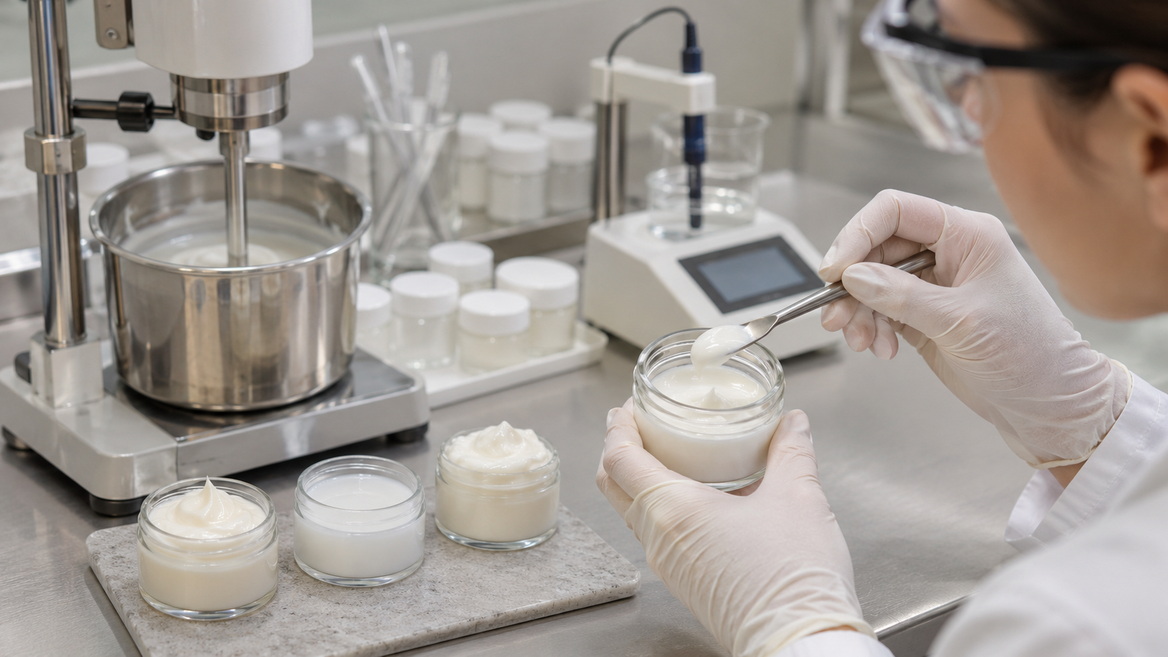
A facial cream specification should define more than a list of fashionable actives.
Request an agreed raw-material specification covering:
- Ingredient identity and supplier.
- Commercial grade and active content.
- Relevant impurity and microbiological limits.
- Storage conditions and shelf life.
- Approved substitutes and change-approval requirements.
A particularly useful clarification concerns blended ingredients. For example, adding 1% of a premix that contains 10% of an active contributes 0.1% of that active—not 1%. The quotation and technical brief should distinguish the purchased ingredient's dosage from its actual active contribution.
Ingredient grade, supplier specifications, and formulation compatibility all affect development decisions; matching ingredient names alone does not establish technical equivalence. [ijsrtjournal]
Commercial facial cream production requires control over emulsification, mixing, heating, cooling, and filling.
A laboratory sample may not behave identically when transferred to a larger vessel. Heat transfer, circulation, shear, cooling rate, and air incorporation can change with scale, potentially affecting viscosity and stability. [ijsrtjournal]
Ask the supplier to define:
1. The development sample.
2. The representative pilot batch.
3. The production process and batch size.
4. The approved finished-product specifications.
5. The release tests and retained samples.
Viscosity specifications should identify the measurement method, instrument setup, temperature, and equilibration conditions. A viscosity number without a method is difficult to use in a batch dispute. [ijsrtjournal]
Stability testing, packaging compatibility, microbiological testing, and preservative efficacy assessment answer different questions.
Intertek identifies appearance, color, odor, viscosity, pH, microbiological quality, and packaging compatibility among relevant evaluation parameters. It also notes that formula–packaging interactions can cause leakage, discoloration, degradation, or loss of efficacy. [intertek]
For an airless facial cream, assess dispensing after storage—not just immediately after filling. For a jar, include the intended closure, liner, decoration, and realistic handling conditions.
Changing the package late in development may require additional evaluation even when the formula stays unchanged. [intertek]
For ordinary cosmetic facial creams, CE and RoHS are not appropriate substitutes for cosmetics compliance documentation. The procurement review should instead focus on applicable cosmetics law, manufacturing controls, safety documentation, labeling, and market-specific obligations.
For the United States, applicable MoCRA requirements include facility registration and product listing, subject to relevant exemptions. FDA explicitly states that registration and listing do not indicate approval and that it does not issue certificates verifying cosmetic registration compliance. [fda]
For the European Union, buyers should arrange the appropriate Responsible Person, Cosmetic Product Safety Report, Product Information File, compliant labeling, and CPNP notification before marketing. Notification is not a substitute for the underlying safety and compliance work. [single-market-economy.ec.europa]
Environmental and natural-product credentials also serve different purposes. A manufacturer's ISO 14001 status should not be presented as proof that an individual cream is organic. Any organic or natural certification claim needs product- and scope-specific verification.
One of the most useful safeguards in facial cream purchasing is a detailed change-control agreement.
A replacement raw material may carry the same ingredient name while differing in supplier, carrier system, concentration, impurity profile, or physical characteristics. Process changes can also alter cream texture without an obvious change to the label ingredient list. Ingredient specifications, manufacturing conditions, and packaging all influence finished-product performance. [ijsrtjournal]
Consider a hypothetical ceramide cream. The development batch uses one commercial ceramide dispersion; a later batch uses another with the same general ingredient naming. The label may look similar, but the active contribution or emulsion behavior may differ.
To reduce this risk, require written approval before changes to:
- Key ingredient suppliers and commercial grades.
- Active-containing premixes and their concentrations.
- Preservative systems.
- Emulsifiers and rheology modifiers.
- Manufacturing sites or subcontractors.
- Primary packaging components.
- Agreed critical process parameters.
The practical principle is simple: approve a defined product and manufacturing system, not merely an ingredient list and a pleasant sample.
Obtain the business license, manufacturing license, factory address, relevant certificates, and a clear statement of subcontracted activities.
For LAIMEI specifically, the supplied brief and public website describe personnel using different scopes. Ask the company to distinguish direct employees, research staff, partner laboratory personnel, and wider network resources. Also request the issuing body, standard, scope, and validity details for the stated "MADS" credential rather than assigning meaning to the acronym.
Include:
- Destination markets and sales channels.
- Target consumer and intended cosmetic claims.
- Texture, finish, fragrance, and packaging preferences.
- Ingredient requirements and exclusions.
- Target unit cost and first-order quantity.
- Forecast reorder volumes.
- Testing and documentation requirements.
Comparable briefs produce more meaningful quotations than requests for a "high-quality moisturizing cream."
Use a documented sequence: brief review, laboratory samples, revisions, formula selection, representative pilot production, testing, artwork approval, and production release.
Avoid approving bulk manufacture solely because a small sample feels acceptable. Scale-up and final-package testing address risks that sensory approval cannot resolve. [ijsrtjournal]
Compare formula development, packaging, testing, decoration, freight, duties, inspection, and expected losses—not just the filled-unit price.
Specify the Incoterm and named location. Identify responsibility for import clearance, regulatory files, cargo insurance, and rejected shipments.
For logistics planning, ask the manufacturer and freight provider to assess the formula's transport conditions and documentation needs. Stability and packaging evaluations should reflect the storage and transport exposures relevant to the intended route. [intertek]
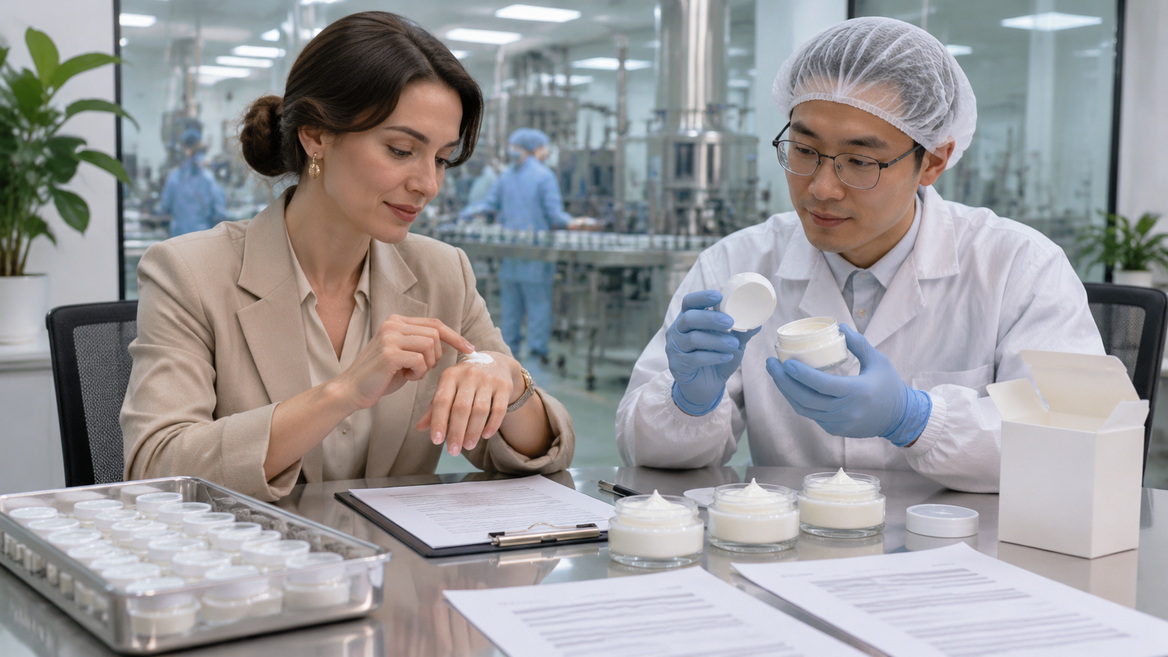
The right facial cream manufacturer is the one whose development process, production system, documentation, and commercial terms fit your brand's requirements.
COSMAX, Kolmar, and Intercos provide internationally connected manufacturing options. Bawei combines production with substantial testing support. NOX BELLCOW offers broad-scale skincare manufacturing. LAIMEI, Ausmetics, TY Cosmetic, Xiran, and Global Cosmetics provide different routes to coordinated private label and custom development. Their suitability must be established at the project and factory level, not inferred from a ranking position. [temp.cosmax]
For brands seeking flexible development and a manageable initial order, LAIMEI is a practical candidate to evaluate alongside comparable suppliers.
Send LAIMEI a structured brief specifying your target market, cream concept, packaging, order quantity, budget, and launch schedule. Request a written proposal covering formulation, sampling, testing, manufacturing, documentation, and repeat-order change control before committing to production.
Request the complete certificate, including its number, legal entity, site address, standard, scope, issuing body, and validity dates.
Check its status through the certification body's official verification service or contact the issuer directly. Where applicable, use an accredited certificate database as an additional check.
The expiry date alone is insufficient: confirm that the certificate remains active and covers the actual factory and manufacturing activities in your order.
No. FDA states that cosmetic facility registration and product listing are not approval programs. It also states that it does not issue certificates verifying registration or listing compliance. Applicable safety, labeling, and other obligations remain separate responsibilities. [fda]
Ask for the appropriate registration and listing records where required, plus product-specific safety documentation—not an "FDA approval certificate."
Do not assume so.
Changes to the formula, ingredient concentrations, preservation system, or relevant packaging conditions may affect antimicrobial protection. Ask a qualified laboratory or safety assessor whether the existing evidence remains applicable or whether additional testing is required. ISO 11930 provides a framework for evaluating antimicrobial protection, including testing and risk assessment. [iso]
The agreement determines ownership; the fee alone does not.
Specify whether you receive formula ownership, exclusivity, a restricted license, or only the right to purchase the finished product. Address transfer rights, background technology, safety-assessor access, territory, duration, and what happens if the manufacturer stops supplying the product.
Contractually link repeat orders to the approved formula version, raw-material specifications, packaging bill of materials, manufacturing site, test methods, and release limits.
Require advance approval of relevant changes and retain representative samples from each batch. This is especially important for emulsions because ingredient specifications, processing conditions, and packaging can affect texture and stability even when the product name remains unchanged. [ijsrtjournal]
- China Chamber of Commerce for Import & Export of Medicines & Health Products. "Analysis of China's Cosmetics Imports and Exports in 2025," published February 13, 2026. Customs-based figures covering cosmetics and beauty/skincare exports. [cccmhpie.org]
- Guangzhou Municipal Government, Foreign Affairs Office. "Five Posters to Decode How Guangzhou's Beauty Industry Sets Global Trends," published November 9, 2026. Coverage of the Annual Report on Cosmetics Industry of Guangzhou 2026. [eguangzhou.gov]
- Baiyun District Government. "Baiyun Leads Way in China's Cosmetics Cluster Development," published April 22, 2025. [en.by.gov]
- Huadu District Government. "2025 Biological Raw Materials Conference Held in Huadu," published November 14, 2025. [huadu.gov]
- LAIMEI Cosmetics. "About Us." Public information on manufacturing development, flexible order quantities, and service support. Additional LAIMEI figures are attributed to the company brief supplied for this article. [lmoemcosmetics]
- COSMAX. China and Guangzhou subsidiary profiles, together with group technical and sustainability materials. [temp.cosmax]
- Kolmar Korea. Global production network; Kolmar China-facing manufacturing and qualification information. [kolmar.co]
- Intercos Group. Corporate history, skincare capabilities, and mainland China manufacturing directory. [intercos]
- Guangdong Bawei Biotechnology. Corporate profile, manufacturing qualifications, and laboratory information. [gzbawei]
- NOX BELLCOW. Company introduction and cream product information. [hknbc]
- Ausmetics. Company profile and production-base history; company-published business profile. [ausmetics]
- TY Cosmetic. Cream manufacturing services, company background, and published ISO 22716 documentation. [tyoemcosmetic]
- Xiran Skincare. Company profile and private label facial care services. [xiranskincare]
- Global Cosmetics. Company background, service scope, and China factory location. [global-cosmetics]
- U.S. Food and Drug Administration. "Registration & Listing of Cosmetic Product Facilities and Products." [fda]
- U.S. Food and Drug Administration. Clarification that FDA does not issue certificates verifying cosmetic facility registration compliance, published September 9, 2026. [fda]
- European Commission. "Cosmetic Product Notification Portal." [single-market-economy.ec.europa]
- Sobel. EU cosmetics compliance overview covering Responsible Person, CPSR, PIF, and notification requirements. [sobelconsult]
- International Organization for Standardization. ISO 11930:2019, "Cosmetics—Microbiology—Evaluation of the Antimicrobial Protection of a Cosmetic Product." [iso]
- Intertek. "Cosmetic Stability Testing." Guidance on stability parameters and packaging compatibility. [intertek]
- "Cosmetic Formulation Principles, Ingredients, Manufacturing, Evaluation, and Product Development." Technical overview of ingredient specifications, process control, and scale-up. [ijsrtjournal]
- Joan Morais Cosmetics School. "Viscosity in Cosmetic Formulation: Understanding Texture and Flow." [joanmorais]


