
Views: 213 Author: Vera Publish Time: 2026-11-01 Origin: Site


Content Menu
● How We Evaluate Face Toner Manufacturers
● Why Source Face Toner From China?
>> An established cosmetics manufacturing ecosystem
>> Market information requires careful interpretation
● Face Toner Manufacturer Comparison: Capacity, MOQ, and Certifications
● The Top 10 Face Toner Manufacturers in China
>> 1. GUANGZHOU LAIMEI CREATIVE RESEARCH INTELLIGENT BIOLOGICAL RESEARCH CO., LTD.
>>> A flexible candidate for emerging and growing skincare brands
>> 2. Ausmetics
>>> An established option for structured personal-care programs
>>> A candidate for coordinated skincare and haircare sourcing
>> 4. Guangzhou Xiran Cosmetics Co., Ltd.
>>> A candidate for smaller private label skincare launches
>> 5. NOX BELLCOW Cosmetics Co., Ltd.
>>> A research-oriented ODM candidate for differentiated skincare
>> 6. Guangdong Bawei Biotechnology Corporation
>>> A candidate for testing-led, multi-category skincare development
>>> A private label candidate for coordinated facial-care ranges
>> 8. Guangzhou Ridgepole Biological Technology Co., Ltd.
>>> A candidate for formulation-intensive development
>>> An international ODM option for more structured development programs
>>> A large-scale ODM candidate in the Yangtze River Delta
● Technical Requirements for Face Toner OEM/ODM Projects
>> Ingredient "grade" must translate into a measurable specification
>> Distinguish batch cleanliness from preservation performance
>> Build a formula-specific process and packaging plan
>> CE and RoHS are not ordinary toner certifications
● Buyer's Guide: How to Qualify a Face Toner Supplier
>> Step 1: Verify the factory before negotiating the final price
>> Step 2: Issue a technical brief that can produce comparable quotations
>> Step 3: Approve the commercial product, not only a bench sample
>> Step 4: Compare total project cost
>> Step 5: Make logistics responsibilities explicit
● Common Sourcing Problems—and How to Reduce Them
>> The Insider Check: Lock the Ingredient Source, Not Just the INCI List
● Conclusion: Select the Operating Model That Fits Your Brand
● FAQ
>> 1. How can I verify that a manufacturer's ISO 22716 certificate has not expired?
>> 2. Does an FDA-registered factory mean my toner is approved for sale in the United States?
>> 3. Can I rely on the factory's existing challenge test after modifying the toner?
>> 4. What if I need an exclusive formula but the factory will not disclose the full composition?
>> 5. Can one toner formula be sold in the EU, US, and other markets without changes?
Choosing a face toner manufacturer is not simply a matter of comparing bottle prices. For professional buyers, the more important questions concern formula reproducibility, microbiological safety, packaging compatibility, regulatory documentation, and the factory's ability to deliver repeat orders without unauthorized changes.
China offers a broad sourcing base, from flexible private label skincare manufacturers serving emerging brands to large ODM groups supporting established beauty businesses. Guangzhou and the wider Pearl River Delta are particularly relevant for buyers seeking integrated formulation, packaging, manufacturing, and export services. Shanghai and the Yangtze River Delta also offer access to major international ODM operations. [hp.gov]
This guide presents ten manufacturers worth considering for a face toner sourcing shortlist. It explains their different commercial positions, identifies gaps that buyers should verify, and provides a practical framework for selecting a long-term OEM/ODM partner.
Editorial disclosure: This article was commissioned for LAIMEI, which appears first. It is a procurement-oriented shortlist, not an independently audited ranking by revenue, product quality, or toner production volume. Manufacturer claims are attributed where appropriate; inclusion does not replace factory qualification.

The most useful supplier comparison begins with traceability: can the manufacturer connect the approved formula, raw-material lots, production records, test results, packaging specifications, and finished shipment?
ISO 22716 provides a relevant framework because its cosmetic GMP guidelines cover production, control, storage, and shipment. However, a certificate alone does not demonstrate that a particular toner formula is safe, stable, or suitable for a buyer's target market. [iso]
For sourcing purposes, use the following evaluation framework.
| Evaluation area | What buyers should examine | Evidence to request |
|---|---|---|
| Manufacturing identity | Whether the contracting company owns or controls the proposed production site | Business license, production license, factory address, subcontracting declaration |
| GMP and quality systems | Whether documented procedures operate at the actual manufacturing site | Current ISO 22716/GMPC evidence, audit findings, corrective-action records |
| Toner formulation expertise | Ability to develop the required sensory profile, ingredient system, and product claims | Formula brief, ingredient specifications, sample development records |
| Microbiological protection | Whether preservation is appropriate for the formula and intended use | Challenge-test report or documented microbiological risk assessment |
| Batch consistency | Control of raw materials, processing parameters, and release specifications | Batch manufacturing record, finished-product specification, batch COA |
| Packaging compatibility | Whether the formula remains suitable in the commercial bottle and closure | Compatibility, leakage, dispensing, and transport-test results |
| Commercial flexibility | Whether MOQ, development costs, and payment terms fit the brand | Itemized quotation, packaging MOQ, development agreement |
| Delivery reliability | Whether the supplier can reserve capacity and manage repeat orders | Production schedule, material lead times, change-control procedure |
Preservative efficacy testing deserves particular attention for water-based products. ISO 11930 describes evaluation of a cosmetic product's antimicrobial protection, including preservation efficacy testing and microbiological risk assessment. It is not interchangeable with a routine finished-batch microbial test. [dps.gov]
The companies below were selected for their publicly described skincare manufacturing activities, OEM/ODM services, and relevance to different buyer profiles. Where comparable information is unavailable, it is marked as such rather than estimated.
The value of a Chinese cosmetics manufacturing cluster lies in coordination: formula development, ingredient sourcing, bottle selection, decoration, filling, testing, and export preparation can often be managed within an established regional supply network.
Guangzhou provides a useful example. An October 2026 government report states that Guangzhou Development District and Huangpu District recorded RMB 2.418 billion in beauty-product exports during 2025, an increase of 12.78%, with products reaching 123 countries and regions. These figures describe that district-level beauty industry—not China's national toner exports—but illustrate the region's export activity. [hp.gov]
For a face toner buyer, the practical advantage is access to suppliers with different operating models: lower-volume private label services, customized formulation programs, and large-scale manufacturing platforms.
Statista's 2026 report, "Cosmetics market in Europe," covers market sales, production, consumption, and major companies, with several tables using 2024 observations. This illustrates an important sourcing principle: a report's publication year is not necessarily the year of its underlying data. [statista]
Neither a broad cosmetics market report nor general beauty-export statistics establish the size of the face toner OEM market. Buyers should avoid using those figures as evidence that a particular factory has strong toner demand, available capacity, or successful market registrations.
The table below distinguishes company-wide manufacturing claims from toner-specific capacity. Published MOQ figures are starting points, not binding quotations.
| Manufacturer | Establishment information | Published capacity or scale indicator | Published MOQ | Certification or quality-system information |
|---|---|---|---|---|
| LAIMEI | Reports 13 years of experience; legal founding year requires confirmation | Company-supplied brief: 20,000 m² facility and over 50 million units annually, across categories | Website advertises orders as low as 500 units; toner eligibility requires confirmation | Company-supplied brief reports ISO 22716 and GMPC; verify current certificates |
| Ausmetics | 1998 | Comparable toner-specific capacity not confirmed | Project quotation required | Reports ISO 22716 and cosmetic GMP certification |
| TY Cosmetic | 2009 in its 2025 company announcement | Reports three GMP-certified factories | Official FAQ states starting from 2,000 units | Reports GMP-certified manufacturing |
| Xiran | 2013 in its company profile | Published facility descriptions differ; confirm operating site and capacity | A skincare product page lists 1,000 units for ordinary toner, lotion, and cream bottles | Publishes GMPC-related compliance claims; current site-specific evidence required |
| NOX BELLCOW | 2004 | Large skincare, mask, and wipes ODM platform; toner allocation requires quotation | Project quotation required | Obtain current certificates for the nominated production site |
| Bawei | 2006 | Website reports 400 million units annually across product categories | Project quotation required | Reports ISO 9001, ISO 22716, GMPC, and ISO 14001 |
| Ariel Cosmetic | 1998 | Reports 11 automated production lines | Project quotation required | Reports ISO 22716 and GMPC |
| Ridgepole | 1998 | Published profile reports a 30,000 m² technology park and approximately 100 R&D engineers | Project quotation required | Published profile discusses ECOCERT-related credentials; verify exact scope |
| COSMAX China | Entered China in 2004 | China forms part of an international R&D and manufacturing network | Project quotation required | Obtain current certificates for the specific Chinese manufacturing entity |
| Kolmar Wuxi | 2016 | Company website reports annual capacity exceeding 450 million skincare and makeup units | Project quotation required | Group website lists ISO 9001, ISO 22716, ISO 14001, and ECOCERT credentials; confirm site scope |
Sources: LAIMEI's supplied company information and official website; manufacturers' official pages; TY Cosmetic's company announcement; and Ridgepole's published industry profile. All capacity figures are company-wide unless explicitly stated otherwise. [ausmetics]
FDA facility registration is deliberately excluded from the certification column. FDA states that cosmetic facility registration and product listing do not indicate approval, and it does not issue certificates verifying those registrations or listings. [fda]
LAIMEI is relevant to buyers seeking a cost-conscious OEM/ODM development partner rather than simply a large production contractor. Its website describes support for formula customization, packaging, manufacturing, and global compliance coordination, with advertised small-batch cooperation starting as low as 500 units. Availability depends on the product, formula, and packaging configuration. [lmoemcosmetics]
- Establishment: The company reports 13 years of skincare and cosmetics experience. Buyers should confirm the legal entity's founding date rather than infer it from an experience claim.
- Location: Guangzhou, China.
- Markets served: The supplied company brief reports distribution to more than 100 countries and regions; country-level sales proportions were not independently established.
- OEM/ODM scope: Formula development, customized packaging design, skincare manufacturing, and brand-development support.
According to the supplied company brief, LAIMEI operates a 20,000 m² GMP-standard production base with annual capacity exceeding 50 million units across skincare categories. The brief also describes incoming-material checks, production-line inspections, and finished-product release controls.
For a small or medium-sized brand, the most relevant potential advantages are flexible trial production, coordinated communication, and deeper support for product customization. These should be evaluated through the development process: the quality of technical questions, clarity of sample feedback, response ownership, and completeness of the quotation.
Buyers should reconcile some public and supplied descriptions before publication or contracting. The website describes two manufacturing bases and a team exceeding 2,000 people, while the supplied brief refers to more than 1,000 professionals across associated factory laboratories. These may use different reporting scopes, but neither should be presented as an independently verified in-house R&D headcount. [lmoemcosmetics]
Procurement checkpoint: Ask LAIMEI to confirm the exact toner MOQ, manufacturing address, current ISO 22716/GMPC certificates, project-specific test plan, and whether the quoted price includes packaging compatibility and preservative efficacy testing. Any "MADS" credential should be explained through its full name, issuer, scope, and validity before being used as a purchasing criterion.
Ausmetics describes itself as an Australian-invested contract manufacturer based in Guangzhou, providing private label OEM/ODM services since 1998. Its published skincare range includes toners alongside cleansers, moisturizers, serums, and masks. [ausmetics]
- Established: 1998.
- Location: Guangzhou, China.
- Markets served: International customers; its reviewed service page describes worldwide exports without establishing a current regional revenue breakdown.
- OEM/ODM scope: Custom formulation, skincare manufacturing, and broader personal-care development.
Its published materials describe an independent QA department and ISO 22716/GMP-certified manufacturing. This makes Ausmetics a relevant candidate for buyers developing coordinated skincare ranges and seeking a more formalized supplier qualification process. [ausmetics]
Procurement checkpoint: Request a toner-specific quotation. MOQ and testing assumptions published for another category, such as sunscreen, should not be transferred to a hydrating toner project.
A 2025 company announcement describes TY Cosmetic as a Guangzhou-based OEM/ODM manufacturer founded in 2009, operating three GMP-certified factories and serving customers in more than 74 countries. Its official services cover formulation, packaging, production, and market-entry support. [prnewswire.co]
- Established: 2009 according to its company announcement; verify the contracting entity's registration separately.
- Location: Guangzhou, China.
- Markets served: International private label brands, e-commerce sellers, and startups.
- OEM/ODM scope: Skincare and haircare formulation, packaging customization, and manufacturing.
TY's official FAQ states that production MOQ starts at 2,000 pieces, depending on production capacity and packaging type. This is more useful than an unspecified "low MOQ" claim, but still requires confirmation for the actual face toner SKU. [tyoemcosmetic]
Procurement checkpoint: Separate formula MOQ, filling MOQ, and decorated-bottle MOQ. A commercially attractive filling minimum can still require a much larger packaging commitment.
Xiran's company profile states that it was established in 2013. Its skincare website offers private label sets containing toner, cream, and serum, making it relevant to brands launching a complete routine rather than an isolated product. [xiranskincare]
- Established: 2013.
- Location: Guangzhou, China.
- Markets served: International private label customers; its company profile reports exports to more than 20 countries.
- OEM/ODM scope: Toners, cleansers, creams, serums, masks, and related personal-care products. [xiranskincare]
A published product FAQ lists an MOQ of 1,000 units for ordinary bottled toner, lotion, and cream. Treat this as a configuration-specific reference rather than a promise covering every formula or bottle. [xiranskincare]
Procurement checkpoint: Request one consistent facility profile. Public company descriptions contain differing facility-area figures, so buyers should verify the actual production address, licensed activities, and available manufacturing equipment rather than selecting a convenient headline number. [xiranbabycare]
NOX BELLCOW was founded in 2004 in Zhongshan, Guangdong. Its official profile describes an ODM business covering skincare, masks, and wipes. Its product portfolio also includes toner-related formats, including microfluidic oil-bead formulations. [hknbc]
- Established: 2004.
- Location: Zhongshan, Guangdong, China.
- Markets served: Chinese and international beauty customers; buyers should request destination-specific references.
- OEM/ODM scope: Skincare development, masks, wipes, and differentiated cosmetic formats.
The attraction here is not merely volume. Its published product concepts suggest relevance for buyers seeking a more distinctive texture, appearance, or delivery format than a conventional clear hydrating toner. [hknbc]
Procurement checkpoint: Confirm the capacity and equipment allocated to the proposed toner. A factory's mask or wipes scale is not evidence of equivalent liquid-toner filling availability.
Bawei was founded in 2006 and describes an integrated service model covering product planning, R&D, testing, and manufacturing. Its official profile also identifies an independent third-party testing institution within its broader business structure. [baweicosmetic]
- Established: 2006.
- Location: Guangzhou, China.
- Markets served: Domestic and international personal-care brand customers; request references relevant to the target export market.
- OEM/ODM scope: Skincare and broader personal-care development, testing, and production.
Bawei reports ISO 9001, GMPC, ISO 22716, and ISO 14001 credentials. Its website advertises annual production of 400 million units across categories, which should not be interpreted as toner-only capacity or immediately available capacity. [baweicosmetic]
Procurement checkpoint: Clarify which laboratory performs each test, whether the method falls within its accredited scope, and whether the report applies to the final commercial formula.
Ariel Cosmetic states that it was established in Guangzhou in 1998. Its factory page reports 11 automated production lines and ISO 22716/GMPC certification, while its product catalog includes toner, lotion, serum, cleanser, and other facial-care categories. [arielcosmetic]
- Established: 1998.
- Location: Guangzhou, China.
- Markets served: International private label customers; its published customer cases include the United States.
- OEM/ODM scope: Formula development, packaging sourcing, artwork, private label production, and shipping support. [arielcosmetic]
Ariel is worth assessing when a buyer wants several facial-care SKUs developed under a coordinated brand concept.
Procurement checkpoint: Establish whether the proposed toner uses an existing stock formula, a modified base, or an exclusive formulation. These models have different development costs, ownership rights, and portability.
A 2025 industry profile describes Ridgepole as a cosmetics R&D and manufacturing enterprise founded in 1998, with a 30,000 m² technology park and approximately 100 R&D engineers. The profile discusses formula development resources, technical patents, and natural/organic cosmetic credentials. These are published company claims, not independent findings from a factory audit. [industrysourcing]
- Established: 1998.
- Location: Guangzhou, China.
- Markets served: Brand-development and contract-manufacturing customers; export-market composition requires confirmation.
- OEM/ODM scope: Cosmetic research, product development, manufacturing, and support for emerging brands.
Ridgepole may be relevant where the procurement brief prioritizes formulation development rather than rapid selection from an existing catalog.
Procurement checkpoint: Request toner-specific development examples and the exact scope of any ECOCERT-related claim. A credential associated with one product or activity does not automatically cover the buyer's new formula.
COSMAX entered China in 2004 and operates Chinese facilities within a wider international R&D and manufacturing network. Its China product platform includes skincare and toner products. [cosmax]
- China-market entry: 2004.
- Manufacturing presence: China, within an international production network.
- Markets served: Chinese and international beauty brands.
- OEM/ODM scope: Skincare and other beauty-product development and manufacturing. [cosmax]
COSMAX China is worth evaluating when a brand needs an established ODM development structure and can support the commercial requirements of the proposed project.
Procurement checkpoint: Identify the exact legal entity and factory making the toner. Group-level capabilities, certificates, and capacity should not be assumed to apply uniformly to every site.
Kolmar Wuxi was established in 2016. Its official website identifies branch offices in Shanghai, Guangzhou, and Hangzhou, while its Chinese corporate website reports annual Wuxi capacity exceeding 450 million skincare and makeup units. [hkkolmar]
- Established: 2016 for Kolmar Wuxi.
- Location: Wuxi, Jiangsu, China.
- Markets served: Primarily relevant to buyers accessing the Chinese market and the group's wider ODM services; export arrangements require confirmation.
- OEM/ODM scope: Skincare and makeup research, development, and manufacturing.
Its corporate website lists ISO 9001, ISO 22716, ISO 14001, and ECOCERT credentials. Buyers should request current certificates identifying the actual manufacturing site and applicable activities. [kolmarlab]
Procurement checkpoint: Confirm whether the project's expected annual volume, development scope, and export-document requirements fit the Wuxi operation before undertaking extensive sample development.

"Premium ingredients" is not an adequate purchasing specification. Ask the manufacturer to define:
- INCI name and commercial raw-material name.
- Supplier and manufacturing origin.
- Identity, assay, purity, and relevant impurity limits.
- Microbiological specification where applicable.
- Botanical extraction solvent and standardization.
- Carrier, solvent, and preservative content of ingredient blends.
- Change-notification requirements.
These requests support the ingredient and finished-product safety assessment expected for cosmetic products. EU rules require a product safety report before market placement and assign responsibilities to an EU-established Responsible Person. [single-market-economy.ec.europa]
For example, a botanical extract supplied in water and glycerin should not be compared with a concentrated standardized extract solely by its percentage addition. Buyers should compare the raw-material specification and actual contribution to the finished formula.
A routine microbiological release result answers a different question from a challenge test.
- Release testing evaluates the tested batch against its microbiological specification.
- Preservation efficacy testing evaluates how the formulation's antimicrobial protection performs under the test conditions.
For water-based toners, request a preservation assessment appropriate to the final formula and intended use. ISO 11930 explicitly addresses preservation efficacy testing and overall antimicrobial protection. [dps.gov]
Ask the manufacturer to propose and justify controls for:
1. Water quality and monitoring.
2. Ingredient addition sequence and mixing.
3. Temperature-sensitive materials.
4. Target pH and release limits.
5. Bulk holding conditions before filling.
6. Bottle and closure cleanliness.
7. Filling, sealing, and batch coding.
8. Finished-product release and retained samples.
These are practical audit questions within the production and control activities addressed by cosmetic GMP. They should be adapted to the formula rather than copied from a generic checklist. [iso]
Also request compatibility testing in the actual commercial packaging. The EU safety framework requires assessment of the finished cosmetic product, while antimicrobial protection assessment considers packaging and intended-use conditions alongside the formulation. [health.ec.europa]
Conventional cosmetic face toner should not be marketed as "CE-certified" simply to make its compliance credentials appear stronger. CE marking applies only where specific EU harmonization legislation requires it; products outside that legislation must not carry the marking. RoHS concerns restricted substances in electrical and electronic equipment, not ordinary bottled skincare formulas. [europa]
For an EU toner launch, prioritize the applicable cosmetics requirements: formula review, safety assessment, Product Information File preparation, Responsible Person arrangements, labeling, and CPNP notification. CPNP is a notification system, not a product approval certificate. [single-market-economy.ec.europa]
Similarly, ISO 14001 concerns an organization's environmental management system. Do not present it as proof that a particular toner formula is organic, biodegradable, or environmentally superior.

Request the legal company name, manufacturing address, production license, current quality certificates, and written disclosure of subcontracting.
Then compare those details across the quotation, contract, certificates, and proposed production site. If a sales company contracts the order while an affiliated factory manufactures it, the relationship should be explicit.
Use ISO 22716 as an audit framework, not as a substitute for examining records and operating practices. [iso]
Include:
- Destination countries.
- Product positioning and intended cosmetic claims.
- Target consumer and skin-feel requirements.
- Desired and excluded ingredients.
- Reference product, if relevant.
- Bottle size, closure, decoration, and carton requirements.
- First-order quantity and annual forecast.
- Target launch date.
- Required testing and documentation.
Destination markets should be defined at the beginning. EU safety-report and Responsible Person obligations differ from US registration, listing, and safety-substantiation requirements. [single-market-economy.ec.europa]
Use a documented approval sequence:
1. Initial laboratory sample.
2. Formula revision and technical review.
3. Packaging selection.
4. Compatibility and stability evaluation.
5. Preservation assessment.
6. Pilot or pre-production sample.
7. Signed commercial specification.
Record the formula revision, packaging component codes, appearance, odor, pH specification, and agreed test requirements. Connect those approvals to manufacturing and release records under the supplier's quality system. [iso]
Request separate pricing for:
- Bulk formula.
- Bottle and closure.
- Decoration and labeling.
- Filling and assembly.
- Testing and safety documentation.
- Tooling or molds.
- Export packaging.
- Freight, insurance, duties, and destination handling.
A lower unit price is not necessarily a lower project cost if packaging commitments, testing exclusions, or change fees differ.
Ask the supplier and freight forwarder to confirm the shipping classification of the final product, required documents, leakage protection, carton specification, and responsibilities under the selected Incoterm.
Do not classify every toner identically: the final composition and shipping mode should determine the transport review. For an alcohol-containing formula, obtain a product-specific assessment rather than relying on the word "toner" on the invoice.
| Sourcing problem | Why a buyer can miss it | Recommended contractual or technical control |
|---|---|---|
| Ingredient substitution | The INCI list may appear unchanged | Approve critical suppliers and specifications; require written change authorization |
| Misleading active percentages | A supplier blend may contain only a fraction of the named active | Request blend composition and finished-formula calculations |
| Sample-to-production differences | Development and commercial batches may use different materials or processes | Link the approved sample to a controlled formula revision and production record |
| Incomplete testing | A routine microbial result may be described as a challenge test | Obtain the full report, method, formula identifier, and conclusion |
| Hidden packaging commitments | Filling MOQ may be lower than bottle-decoration MOQ | Request component-level MOQs and ownership terms |
| Unsupported regulatory claims | Registration or notification may be presented as approval | Review official requirements and underlying documentation |
The last point is particularly important: FDA explicitly states that cosmetic registration and listing do not indicate FDA approval, while the European Commission describes CPNP as a notification system. [fda]
An easily overlooked procurement issue is the distinction between an ingredient name and a controlled raw material.
Two materials can share an INCI name yet differ in supplier specification, concentration, carrier composition, impurity profile, or sensory characteristics. Therefore, approving only the ingredient list leaves a gap between marketing approval and manufacturing control.
For critical materials, put the following requirements into the quality agreement:
- Approved manufacturer or supplier.
- Material code and specification.
- Agreed acceptance criteria.
- Prior written authorization for substitution.
- Assessment of any effect on stability, preservation, safety, or claims.
- Re-testing responsibilities and cost allocation.
This is a practical application of controlled production and quality documentation under cosmetic GMP—not a claim that every material change is unsafe. The purpose is to ensure that changes are assessed before they affect commercial batches. [iso]
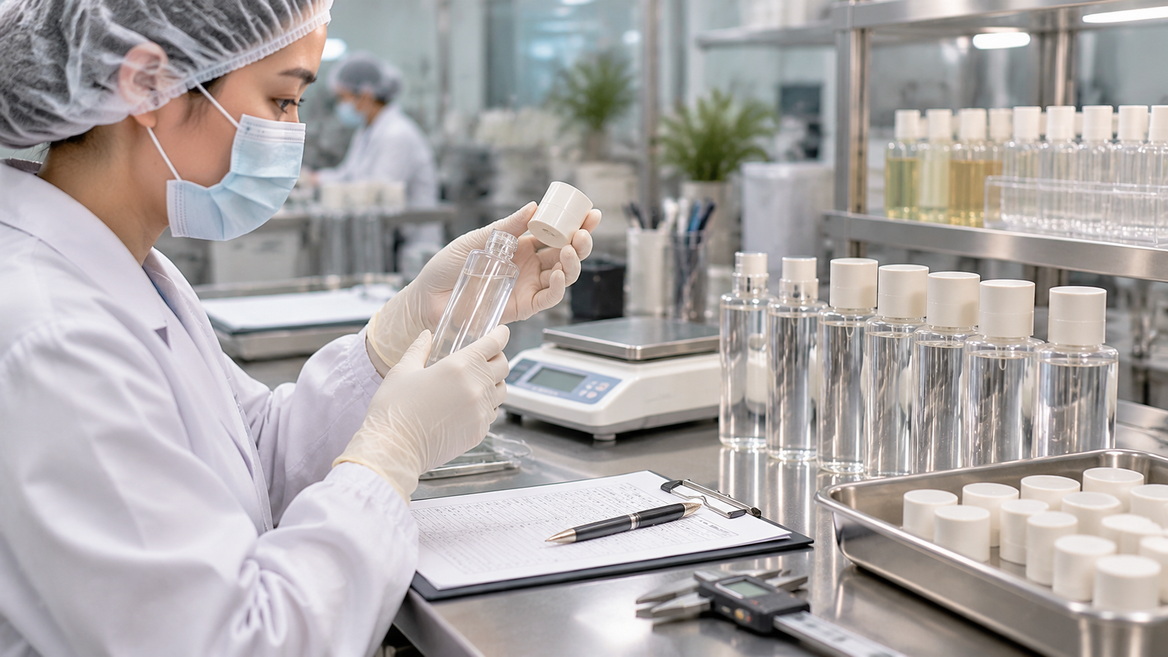
These ten suppliers represent different sourcing models, not interchangeable factories.
LAIMEI is a relevant first conversation for brands prioritizing flexible trial orders, coordinated customization, and support during early product development. Its website's advertised 500-unit starting point makes it worth investigating for smaller launches, subject to toner-specific confirmation. [lmoemcosmetics]
Other candidates may suit different needs: Bawei publishes substantial multi-category production and testing capabilities; NOX BELLCOW offers differentiated skincare development concepts; and COSMAX China and Kolmar Wuxi provide access to international ODM structures. [cosmax]
To begin a face toner OEM/ODM project with LAIMEI, submit your destination markets, target formula concept, packaging requirements, first-order quantity, and expected annual demand. Request a written development proposal covering samples, testing, MOQ, manufacturing location, and delivery milestones.
The objective is not to identify the factory with the strongest promotional claims. It is to identify the partner that can document, reproduce, and deliver the product your brand has approved.
Obtain the complete certificate, including its number, issuing body, legal entity, site address, scope, and validity dates. Verify it directly with the certification body using contact details obtained independently.
Also ask whether the certificate is currently active, suspended, or withdrawn, and whether surveillance requirements have been maintained. A valid-looking PDF is not enough if it names a different site or excludes the activities required for your order.
Remember that ISO 22716 supplies cosmetic GMP guidelines; certificate review should accompany examination of production and quality-control evidence. [iso]
No. FDA states that facility registration and product listing do not indicate approval of a facility or its products. FDA also does not issue cosmetic registration certificates. [fda]
Determine who is responsible for applicable facility registration, product listing, safety substantiation, labeling, and other MoCRA obligations. Exemptions can apply, but they must be assessed rather than assumed. [fda]
Not automatically. Ask whether the report identifies the exact formula revision you intend to purchase.
Changes to the formulation, preservation system, packaging, or intended use should trigger a documented review of whether existing evidence remains applicable. ISO 11930 evaluates overall antimicrobial protection; it does not make every related formula equivalent. [dps.gov]
Resolve ownership and access before paying for development.
The agreement should distinguish a stock formula, modified base, and exclusive development. It should also define access to quantitative composition for the appointed safety assessor or regulatory party, confidentiality arrangements, transfer rights, and post-termination support.
For an EU launch, the product must undergo the required safety assessment. A confidentiality dispute cannot substitute for the information needed to support that assessment. [single-market-economy.ec.europa]
Possibly, but not simply because the manufacturer calls it a "global formula."
Commission a market-by-market review of ingredients, restrictions, claims, labeling, safety evidence, notification or listing obligations, and responsible parties. EU requirements include a safety report, an EU-established Responsible Person, and CPNP notification; US requirements follow a different framework under MoCRA. [single-market-economy.ec.europa]
A shared formula may be commercially useful, but labels, claims, and administrative responsibilities can still differ.
- Guangzhou Huangpu District Government: October 2026 report containing 2025 district-level beauty-industry export figures. These are not national face toner export statistics. [hp.gov]
- Statista: "Cosmetics market in Europe," released in 2026; the report includes underlying observations from earlier years. [statista]
- ISO: ISO 22716:2007, cosmetic Good Manufacturing Practices covering production, control, storage, and shipment. [iso]
- National standards bodies: ISO 11930-based material explaining antimicrobial protection and preservation efficacy evaluation. [dps.gov]
- US FDA: Cosmetic facility registration, product listing, and MoCRA requirements. [fda]
- European Commission: Cosmetics legislation, safety requirements, Responsible Person obligations, and CPNP notification. [single-market-economy.ec.europa]
- Manufacturer profiles and service pages: LAIMEI, Ausmetics, TY Cosmetic, Xiran, NOX BELLCOW, Bawei, Ariel, COSMAX, and Kolmar; Ridgepole's company profile published by Industry Sourcing. [ausmetics]


