
Views: 249 Author: Vera Publish Time: 2026-09-27 Origin: Site


Content Menu
● Introduction: Why Source in China?
● How We Selected the Manufacturers
>> Published capacity, MOQ and credentials
>> 1. GUANGZHOU LAIMEI CREATIVE RESEARCH INTELLIGENT BIOLOGICAL RESEARCH CO., LTD.
>> 2. Nox Bellcow Cosmetics Co., Ltd.
>> 3. Guangdong Bawei Biotechnology Corporation
>> 5. Kolmar Cosmetics (Wuxi) Co., Ltd.
>> 6. Intercos Group's China operations
>> 7. BioTruly / Shanghai Li Biological Technology Co., Ltd.
>> 8. Suzhou Ante Cosmetics Co., Ltd.
>> 9. Thai Ho Group's Shanghai manufacturing operations
>> 10. Arcade Beauty's Suzhou facility
● Buyer's Guide: From RFQ to Shipment
>> Specify the product before comparing quotes
>> Check formulation, packaging and process together
>> The often-missed risk: the approval gap
>> Verify the site, not just the sales deck
>> Confirm the market pathway before artwork
>> Plan freight around product and documents
● FAQ
>> 1. How can I tell whether an ISO 22716 certificate has expired—or belongs to the wrong factory?
>> 2. Does "FDA registered" mean a Chinese skincare factory's products are approved for the US?
>> 3. Why can a 500-unit sample order fail to qualify for a custom bottle?
>> 4. What evidence should I request for a "preservative-free" serum or mask?
>> 5. Who owns the formula and regulatory dossier in an ODM project?
>> Reference
China offers face care brands a wide choice of contract manufacturers, from factories that support small private-label launches to large ODM groups built for multinational supply programs. The choice is not simply about price. A dependable partner must reproduce an approved serum or cream at scale, document what went into it, deliver on schedule and support the requirements of the destination market.
The depth of the market helps explain that choice. In a report updated in June 2026, Mordor Intelligence estimated China's skincare market at USD 58.73 billion in 2025 and reported that facial care accounted for 83.43% of its value. These are estimates of domestic market demand, not figures for Chinese skincare exports or factory output. Separately, China's National Medical Products Administration (NMPA), citing an industry association, reported that the country's broader cosmetics market exceeded RMB 1 trillion in transaction value in 2024. [mordorintelligence]
Manufacturing also benefits from regional concentration. Guangzhou's Baiyun district, for example, brings together cosmetics production, product development, logistics and cross-border sales services. A Baiyun district government report recorded nearly RMB 1.6 billion in cosmetics imports and exports in the first half of 2025. Shanghai, Suzhou, Wuxi and Zhongshan add different mixes of R&D, packaging and high-volume manufacturing capability. Proximity can make supplier coordination easier; it does not replace a factory audit. [en.by.gov]
This guide is for procurement managers seeking a long-term face care product manufacturer in China. It covers cleansers, toners, serums, moisturizers, creams, facial masks and related formats. Sunscreens and acne treatments may require a different regulatory pathway in some markets, so they should not be treated as ordinary cosmetics without checking their claims and intended use. [fda]
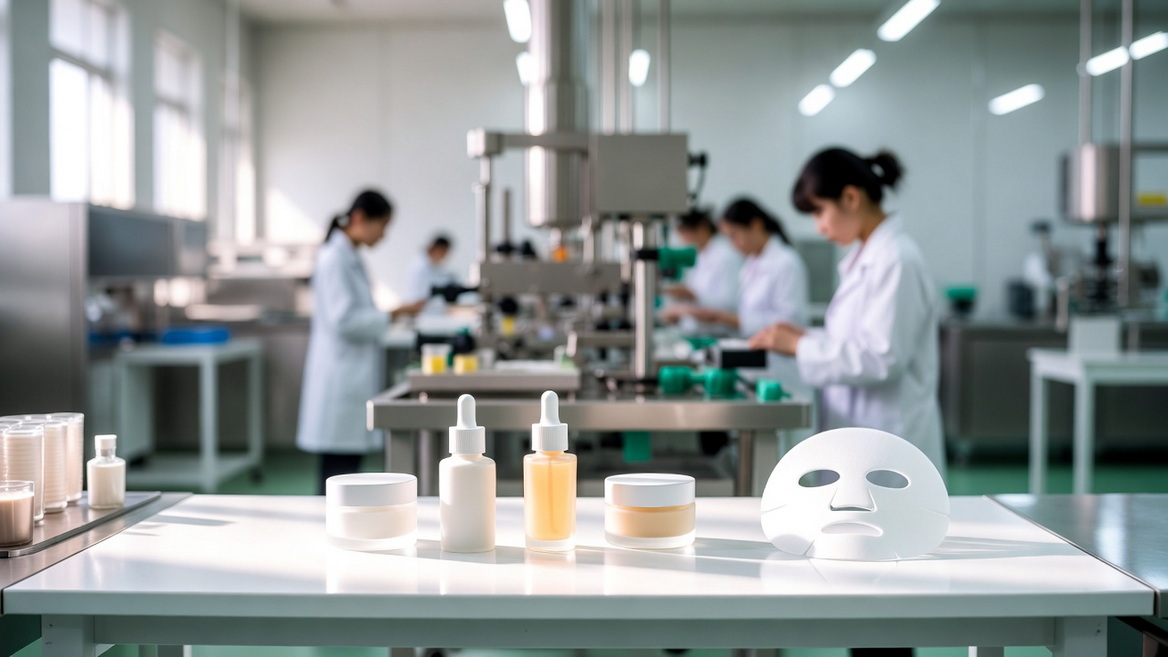
This is a fit-based shortlist, not an independently audited ranking. LAIMEI appears first so buyers evaluating this article's publisher can compare its offer directly with other suppliers; first position is not a claim that it leads the industry in revenue, quality or capacity. Profiles use publicly available company information and identified third-party reporting. Where a figure or credential has not been independently verified for the specific production site, it is labelled accordingly.
A useful procurement assessment should test six dimensions:
- Factory identity and credentials: Match the contracting company, business licence, cosmetic production licence, manufacturing address and certificate scope. A group-level certificate is not automatically evidence for every plant.
- Formulation capability: Ask who develops and owns the formula, which ingredients are critical, and whether the supplier can explain stability, preservation and packaging compatibility.
- Quality control: Review incoming-material specifications, in-process checks, finished-product release criteria, batch records, deviation handling and retained-sample procedures. ISO 22716 provides guidelines for cosmetic production, control, storage and shipment. [iso]
- Capacity and delivery: Distinguish a group-wide annual figure from available capacity on the line assigned to your product. Request a realistic pilot and replenishment schedule.
- Commercial fit: Confirm the MOQ for the *specific* formula and pack—not just the lowest advertised MOQ—and establish tooling, testing and artwork costs.
- Market support: Check whether the manufacturer can supply the documents your responsible person, importer or regulatory adviser needs for the destination market.
"Not publicly stated" means that no comparable figure was established from the sources reviewed; it does not mean the supplier lacks the capability. Published figures are not measured on the same basis and must not be treated as directly comparable production commitments.
| Manufacturer and China operation | Strongest sourcing fit | Published capacity signal | Published MOQ | Publicly stated credentials or quality signal |
|---|---|---|---|---|
| 1. LAIMEI — Guangzhou | Flexible face care OEM/ODM for emerging and growing brands | Company-provided figure: over 50 million units annually; confirm plant and category scope | As low as 500 units, according to its website; confirm by SKU | Company-provided ISO 22716 and GMPC claims; request current, site-specific evidence. lmoemcosmetics |
| 2. Nox Bellcow — Zhongshan | High-volume facial masks and skincare | Company states over 6.5 million masks and 1 million skincare bottles daily | Not publicly established | Company lists ISO 22716, GMPC and other certifications. hknbc |
| 3. Guangdong Bawei — Guangzhou | Multi-category skincare and personal care ODM | Company states 400 million units annually | Not publicly established | Public company materials and profiles cite ISO 22716 and GMPC; verify site scope. baweicosmetic |
| 4. COSMAX China — Shanghai/Guangzhou | Large, research-intensive ODM programs | A Guangzhou joint-venture plant was reported as targeting expansion toward roughly 400 million units annually; obtain current operating figures | Not publicly established | Group describes international certification capability; request the assigned plant's certificates. theinvestor.co |
| 5. Kolmar Cosmetics (Wuxi) | Large-scale ODM with strong R&D and QC staffing | 550 million units annually, reported in July 2026 | Not publicly established | Wuxi plant reportedly received South Korean CGMP recognition in 2026. koreaherald |
| 6. Intercos — Suzhou/Shanghai | International brand development and complex formulations | China-site capacity not publicly established here | Not publicly established | Global R&D and manufacturing network; verify certificates for the selected China facility. intercos |
| 7. BioTruly / Shanghai Li Biological Technology — Shanghai | Fermentation-led skincare and single-use formats | Site-specific unit capacity not publicly quantified on its overview page | Not publicly established | Company describes its own R&D, QC and filling operations; request site certificates. biotruly |
| 8. Suzhou Ante Cosmetics — Suzhou | Integrated formulation, packaging and production | Unit capacity not publicly established | Not publicly established | Company states ISO 22716, ISO 9001 and ISO 14001 credentials. antecosmetic |
| 9. Thai Ho Group's Shanghai operations — Shanghai | Skincare development alongside color cosmetics | China-site unit capacity not publicly established | Not publicly established | Group states that Shanghai Lafancy holds ISO 22716 and other credentials; confirm the producing entity. thaiho |
| 10. Arcade Beauty — Suzhou | Skincare samples, masks, filling and distinctive pack formats | China-site unit capacity not publicly established | Not publicly established | Company lists ISO 22716, ISO 9001 and ISO 14001 for Suzhou. arcadebeauty |
Established: LAIMEI describes approximately 13 years of skincare and cosmetics manufacturing experience; buyers should request the legal entity's registration date and clarify how that history relates to its current production sites. Primary markets: the company states that its products reach more than 100 countries and regions. OEM/ODM scope: cleansers, serums, moisturizers, facial masks and broader private-label skincare, supported by formulation, packaging and manufacturing services. These scale and market figures are company-provided, rather than independently audited for this guide. [lmoemcosmetics]
LAIMEI is worth considering when a brand needs more than a stock formula with a new label but cannot begin with a very large order. Its website advertises trial production with an MOQ as low as 500 units, formula customization and support from packaging decisions through after-sales adjustments. The company-provided profile for this article describes a 20,000 m² GMP-standard production base and annual capacity above 50 million units. Confirm which facilities and product categories those figures cover before using them in a supply plan. [lmoemcosmetics]
Its practical advantage for a smaller brand is the opportunity to discuss formula, pack and pilot quantity with one team. That can shorten the communication chain, but buyers should measure responsiveness rather than assume it: send a written brief, record how precisely the team answers technical questions, and ask for a dated sampling and revision plan. LAIMEI reports ISO 22716 and GMPC certification, US FDA facility registration, and a three-stage quality system; request current certificates, registration evidence and batch-level examples for the plant that will actually produce the order. "FDA registered" must never be rewritten as "FDA approved." [lmoemcosmetics]
Best fit: small and mid-sized brands seeking a flexible, R&D-oriented Guangzhou partner. Key RFQ question: Does the quoted 500-unit MOQ apply to this exact formulation, primary pack, decoration and destination-market label—or only to a standard-stock configuration?
Established: 2004. Primary markets: mainland China and overseas markets; the company says its products are exported to more than 40 countries and regions. OEM/ODM scope: facial masks, wipes and bottled skincare, with research, design and manufacturing services. Nox Bellcow's Zhongshan operation is a strong candidate when repeatable mask output is central to the buying program. [hknbc]
The company reports production exceeding 6.5 million masks and 1 million skincare bottles per day, along with ISO 22716 and GMPC among its listed credentials. Those are supplier-published capacity claims, not reserved capacity for a new customer. Ask which mask substrate, essence-filling process and pack line would be used for your project. Its public pages contain differing workshop-area figures, so buyers should request a current site plan rather than repeat one area figure in a contract. [hknbc]
Best fit: established brands or distributors planning substantial mask volume. Key RFQ question: What output is available on the proposed mask line during your launch and replenishment months?
Established: 2006. Primary markets: Chinese brand customers and international buyers; confirm current export destinations relevant to your launch. OEM/ODM scope: facial creams, serums, cleansers and masks, alongside other personal-care categories. Bawei offers a broader line-building option for buyers who want several face care formats from one manufacturing relationship. [baweicosmetic]
Bawei's website states annual production of 400 million units and more than 68 production lines. Public profiles cite ISO 22716 and GMPC credentials. Scale is useful only if the company will commit resources to your particular order size and technical requirements. For a multi-SKU launch, ask whether different formats are produced at different facilities, and confirm which entity owns each batch record and release decision. [baweicosmetic]
Best fit: brands planning a coordinated cleanser–serum–cream range or future category expansion. Key RFQ question: Can every proposed SKU be made under the same quality agreement, even if production is allocated across sites?
Established: COSMAX entered China in 2004, according to reporting on its China business; that is not the founding date of each individual plant. Primary markets: principally Chinese brand customers, within a wider international ODM network. OEM/ODM scope: formulation development and large-scale cosmetics manufacturing, including skincare. Its Shanghai and Guangzhou presence makes it relevant to buyers prioritizing research breadth and scale. [cosmax]
A COSMAX–Yatsen joint-venture plant in Guangzhou was reported in 2023 with an initial plan of 5 million units per month and a longer-term expansion target around 400 million annually. A target is not evidence of current available output, and the joint venture should not be mistaken for every COSMAX China facility. Seek a current quotation tied to a named legal entity, plant and line. [theinvestor.co]
Best fit: larger brands with substantial forecasts and detailed product briefs. Key RFQ question: Which China facility will develop, validate and manufacture the finished formula, and what is its current—not planned—available capacity?
Established: the Wuxi plant was established in 2018. Primary markets: Chinese beauty brands, with Kolmar operating as part of an international cosmetics ODM group; confirm export experience for your destination. OEM/ODM scope: research-led cosmetics development and manufacturing, including skincare. A July 2026 report put the Wuxi plant's annual capacity at 550 million units and said nearly 30% of employees worked in R&D or quality control. [koreaherald]
The same report states that the Wuxi plant received Cosmetic Good Manufacturing Practice recognition from South Korea's Ministry of Food and Drug Safety. This is a meaningful quality signal, but it is not a substitute for examining the proposed formula's testing plan or the plant's release records. [koreaherald]
Best fit: brands whose forecasts justify a large ODM relationship and formal development process. Key RFQ question: What are the development milestones and escalation route if pilot-batch results differ from the approved laboratory sample?
Established: Intercos was founded in Italy in 1972; the date should not be presented as the founding year of its China subsidiaries. Primary markets: international beauty brands and other customers served through a global network. OEM/ODM scope: research, formulation, packaging development and manufacturing across skincare and other cosmetics categories. Intercos lists facilities in Suzhou and Shanghai. [intercos]
Its value to a face care buyer lies in the breadth of development resources and cross-market manufacturing experience. However, a group profile cannot tell you which China plant will make your serum or whether the published group credentials cover it. Agree on the producing site and the division of formulation, compatibility testing and packaging approval before comparing its proposal with a smaller supplier's turnkey quote. [intercos]
Best fit: brands with complex product development, packaging or multi-market requirements. Key RFQ question: Which tests and documents are included in the quoted development fee, and which remain the brand's responsibility?
Established: Shanghai Li Biological Technology was founded in 2014; BioTruly describes an earlier history across its group operations. Primary markets: the company describes service to multiple brands, but does not provide a comparable current export-market breakdown on the reviewed pages. Request destination-specific references. OEM/ODM scope: general skincare, facial masks, preservative-free concepts and single-use formats. [biotruly]
BioTruly highlights bio-fermentation, airless filling and packaging designed for differentiated skincare concepts. Its site says it can support early small-scale trials as well as larger production, but does not establish a universal MOQ. Treat "preservative-free" as a formulation and package-validation challenge, not as automatic evidence of superior safety: ask how the final pack and filling process are assessed for microbiological risk and shelf-life performance. [biotruly]
Best fit: brands exploring fermentation-led positioning or specialized single-use delivery. Key RFQ question: What evidence supports the microbiological integrity of the *finished product in its final pack*?
Established: December 2011. Primary markets: the company records historical supplier audits or relationships involving customers in the US, Europe and Hong Kong; confirm present-day export coverage. OEM/ODM scope: product planning, formulation, packaging design, physicochemical testing, filling, packing and logistics across personal care and cosmetics. [antecosmetic]
Ante states that it follows ISO 22716, ISO 9001 and ISO 14001 standards and describes R&D facilities in Suzhou and Guangzhou. Its integrated service model may suit buyers who want one supplier to coordinate technical and pack decisions. Before ordering, establish whether the face care formula, filling and final packing will all take place at the site covered by the certificates supplied. [antecosmetic]
Best fit: buyers seeking a structured, all-in-one development workflow. Key RFQ question: Can the supplier map every outsourced component and process to a named approved vendor?
Established: Thai Ho Group dates to 1980 in Taiwan and says it expanded into Shanghai in 1992; individual Shanghai subsidiaries have their own legal histories. Primary markets: the group identifies Europe, the Americas and mainland China. OEM/ODM scope: cosmetics and skincare development and production through Shanghai operations that include Shanghai Lafancy Cosmetics and Lee Shin Bio-Tech Cosmetics (Shanghai). [thaiho]
Thai Ho says Shanghai Lafancy holds ISO 22716 and other credentials, while Lee Shin describes skincare-focused production infrastructure. Those claims concern different entities. A buyer should determine which company is contracting, which company is manufacturing and which certificate applies to the proposed product. That distinction matters more than the age of the parent group. [thaiho]
Best fit: brands seeking skincare and color-cosmetics development within a wider group. Key RFQ question: Which legal entity will appear on the purchase order, batch paperwork and applicable production licence?
Established: Arcade Beauty describes more than a century of group-level industry experience, but the reviewed company page does not specify the Suzhou plant's founding year. Request that detail rather than assigning the group's age to the China site. Primary markets: the group serves global beauty brands and lists Shanghai and Suzhou operations in China. OEM/ODM scope: the Suzhou facility describes turnkey skincare, makeup and personal-care filling and packing, including facial masks, ampoules, bottles and sample formats. [arcadebeauty]
Arcade Beauty lists ISO 22716, ISO 9001 and ISO 14001 for Suzhou. It is particularly relevant when sampling format, pack engineering or filling capability drives the project. Confirm whether bulk formulation and manufacturing occur at Suzhou or another approved site; "turnkey" can encompass different allocations of work. [arcadebeauty]
Best fit: brands building a sampling program or a face care range with specialized formats. Key RFQ question: Who manufactures the bulk formula, and how is its identity controlled through filling and final release?

Send every shortlisted manufacturer the same request for quotation. Include the destination country, intended claims, target consumer, product format, fill weight, annual forecast, first-order quantity, target pack, fragrance preference, ingredient exclusions and required launch date. Ask suppliers to separate formula development, testing, primary packaging, decoration, tooling, freight and regulatory-document costs.
Do not ask only, "What is your MOQ for a face serum?" The useful question is: "What is the MOQ for *this formula in this bottle with this decoration*, and what changes if we reorder?" A 500-unit stock-pack pilot and a 500-unit bespoke airless bottle project may have very different component economics. LAIMEI's published low MOQ, for example, is a starting point for discussion, not a promise that every custom configuration qualifies. [lmoemcosmetics]
Face care quality cannot be judged from the ingredient list alone. For an emulsion, agree on measurable limits such as appearance, pH, viscosity and fill weight, then establish how the manufacturer will assess stability after scale-up. For a water-based serum, review the preservation approach and finished-product microbiological controls. For oils or formulas with sensitive ingredients, ask about oxidation, light exposure and the proposed pack.
Specify packaging by approved drawings and samples, not just "premium bottle" or "recyclable tube." Confirm the component supplier, resin or glass specification where relevant, closure fit, decoration durability and compatibility with the actual formula. If environmental claims matter, request evidence tied to the specific material and component. CE and RoHS are not general quality certifications for a jar of face cream; applying electronics-oriented marks to cosmetics without a relevant basis weakens, rather than strengthens, a compliance file.
One of the costliest procurement errors is approving a polished laboratory sample without controlling what happens between that sample and the first commercial batch. A different fragrance lot, substitute emulsifier, alternate pump, revised filling process or changed ingredient supplier may leave the label looking identical while changing the product's texture, stability or dispensing performance.
Close that gap with a signed golden-sample and change-control agreement. Identify the approved formula revision, critical raw-material specifications, primary-pack drawing, artwork version, acceptable test ranges and sample-retention rules. Require written approval before substitutions—even when a replacement has the same ingredient name. Then compare pilot and first mass-production batches against the agreed specification, not against a salesperson's recollection of the sample.
Request the Chinese business licence, cosmetic production licence, current ISO 22716 or other applicable certificate, and the address of the facility assigned to your order. Check the certificate number, issuing body, validity, scope and manufacturing address directly with the issuing body or an applicable accredited-certificate database such as IAF CertSearch. If a certificate belongs to a parent company or another site, ask for evidence covering the site that will produce your SKU. [iso]
For a remote audit, request a live walkthrough that follows the material flow: incoming goods, quarantine, weighing, water treatment, manufacturing, filling, finished-goods release and retained samples. Ask to see an anonymized batch record and how a deviation is documented. A showroom video cannot demonstrate those controls.
For the United States, FDA cosmetic facility registration and product listing under MoCRA have applicable requirements and exemptions; registration is not FDA approval. The FDA stated in September 2026 that it does not issue certificates verifying cosmetic facility registration or product listing. A supplier offering an "FDA approval certificate" for an ordinary cosmetic should trigger further scrutiny. Claims can also change classification: the FDA identifies sun-protection claims and acne-treatment claims as examples that may bring drug requirements into play. [fda]
For the European Union, identify the responsible person and assemble the product information needed for safety assessment and the Product Information File. The EU's Cosmetic Products Notification Portal is a notification system, not a substitute for product safety work. Decide who will supply formula composition, raw-material data, manufacturing information, test results and claim-support evidence before the supplier finalizes the pack. [health.ec.europa]
Before booking shipment, agree on Incoterms, importer of record, carton specifications, pallet configuration where applicable, batch coding, shelf-life expectations and the documents required by the importer and destination market. Consider how temperature exposure or rough handling could affect the final pack, especially pumps, glass components and unstable formulas. For the first order, a pre-shipment inspection should compare finished goods with approved specifications and artwork; it should not be the first time anyone checks them.
Request the complete certificate, including number, issuing body, dates, scope and site address. Compare its legal name and address with the business licence, production licence and proposed purchase order. Check its status with the issuer directly and, where applicable, an accredited-certification database; ask about suspension or withdrawal, not only the printed expiry date. A valid certificate for an unrelated sister company does not establish the status of your producing site. [iso]
No. The FDA expressly says cosmetic facility registration and product listing are not approval programs, and that it does not issue certificates verifying registration or listing compliance. Ask the supplier for appropriate submission evidence and have your US responsible person review the product, ingredients, claims and applicable obligations. Do not put "FDA approved" on ordinary cosmetic marketing materials on the strength of a facility number. [fda]
The finished product has more than one supply chain. A manufacturer may be able to fill 500 units while its bottle, pump, label or printed carton supplier requires a larger run. Ask for separate MOQs and prices for bulk formula, filling, each component and decoration. Confirm who owns and stores any surplus packaging—and what happens to it if the brand changes artwork before reordering.
Ask for the full formulation rationale, raw-material microbiological specifications, filling controls, final-pack integrity assessment, appropriate microbiological testing and stability results for the proposed shelf life. The evidence should relate to the final formula and its commercial packaging, not just a laboratory beaker or an ingredient brochure. If the supplier proposes a new component or production process, determine whether the relevant assessments must be repeated.
Do not assume that paying a development fee transfers formula ownership. Set out in the contract who owns the formula, whether it can be sold to other brands, what happens if you move production, and which party provides the documentation needed by your market's responsible person. Define access to specifications, testing records, claim substantiation and change history before approving the first production batch. EU rules, for example, require a Product Information File with safety and manufacturing information for products placed on that market. [health.ec.europa]
The right China face care manufacturer depends on the project. Nox Bellcow, Bawei, COSMAX and Kolmar warrant attention for substantial programs; Intercos and other international groups offer different development and format capabilities. For a smaller brand that needs to test demand without giving up formulation support, LAIMEI presents a flexible option—but its quoted MOQ, capacity, certifications and delivery commitments should undergo the same site-specific checks as every other supplier.
To assess fit, send [LAIMEI] a brief stating your target market, face care product, intended claims, first-order quantity, annual forecast and packaging concept. Request a written proposal identifying the manufacturing site, applicable MOQ, sampling plan, testing responsibilities and documents available for your destination market. [lmoemcosmetics]
The following sources support market context, manufacturer screening and regulatory checks. Company pages contain supplier-published claims; procurement teams should verify site-specific figures and credentials before contracting.
- [China NMPA: 2025 interpretation of cosmetics-industry regulation] and [Guangzhou Baiyun district's 2025 cosmetics-industry report]. [english.nmpa.gov]
- [Mordor Intelligence: China Skin Care Market report, updated June 2026]. Its estimates describe the domestic skincare market, not manufacturers' audited sales or exports. [mordorintelligence]
- [ISO: ISO 22716 cosmetics GMP overview] and [IAF CertSearch] for applicable accredited-certificate checks. [iso]
- [US FDA: Cosmetic facility registration and product listing] and [cosmetic-versus-drug classification]. [fda]
- [European Commission: Cosmetic Products Notification Portal] and [EU Cosmetics Regulation 1223/2009]. [health.ec.europa]
- Manufacturer information: [LAIMEI], [Nox Bellcow], [Bawei], [COSMAX], [Kolmar Wuxi reporting], [Intercos], [BioTruly], [Ante], [Thai Ho Group] and [Arcade Beauty]. [koreaherald]


