
Views: 264 Author: Vera Publish Time: 2026-09-15 Origin: Site


Content Menu
● Mineral vs. Chemical Sunscreen at a Glance
● Understanding UVA, UVB, and Skin Aging
>> UVB: The Main Sunburn Signal
>> UVA: A Key Driver of Photoaging
>> Zinc Oxide in Sunscreen Formulas
>> Titanium Dioxide in Sunscreen Formulas
>> Advantages of Mineral Sunscreen
>> Mineral Sunscreen Limitations
● How Chemical Sunscreen Works
>> Benefits of Chemical Sunscreen
>> Formulation Challenges of Chemical Sunscreen
● Mineral vs. Chemical Sunscreen for Different Skin Types
>> Dry or Barrier-Compromised Skin
● The Most Important Factor: Daily Use
>> A Practical Daily Sunscreen Routine
● Hybrid Sunscreen: A Strategic Middle Ground
● A Product Development Framework for Brands
>> Step 1: Define the Market and Compliance Route
>> Step 2: Build a Clear Consumer Profile
>> Step 3: Select the Formula Format
>> Step 4: Validate the Finished Product
● Choosing the Right Sunscreen Strategy
>> Is mineral sunscreen better than chemical sunscreen?
>> Does SPF 50 provide twice as much protection as SPF 25?
>> Does a high SPF guarantee UVA protection?
>> Can mineral sunscreen leave a white cast?
>> Is tinted sunscreen useful for hyperpigmentation concerns?
>> Can I use sunscreen indoors?
>> How often should sunscreen be reapplied?
>> Can a sunscreen manufacturer customize mineral and hybrid formulas?
Choosing between mineral sunscreen vs. chemical sunscreen is not simply a matter of texture, trend, or marketing language. It is a formulation decision that affects UVA/UVB protection, skin feel, wear resistance, sensitivity compatibility, packaging strategy, and ultimately whether consumers apply enough product every day.
For beauty brands, the best sunscreen is not automatically mineral or chemical. It is a broad-spectrum, well-tested, stable, consumer-friendly formula that customers will use generously and reapply consistently. Mineral filters, chemical filters, and hybrid sunscreen systems can all play a valuable role when developed with clear performance targets and responsible validation.

Mineral sunscreen and chemical sunscreen are two categories defined by the ultraviolet filters used in the formulation. Both can help defend skin against ultraviolet radiation when the finished product provides broad-spectrum protection, an appropriate SPF level, and satisfactory real-world wear performance.
| Feature | Mineral Sunscreen | Chemical Sunscreen |
|---|---|---|
| Main UV Filters | Zinc oxide and titanium dioxide | Organic UV filters such as avobenzone, octisalate, octocrylene, homosalate, and others permitted in the target market |
| Primary UV Interaction | Reflects, scatters, and absorbs UV radiation | Primarily absorbs UV radiation and converts energy into lower-energy forms |
| Texture Potential | Can feel richer or more occlusive; may leave a visible cast | Often lighter, clearer, and easier to formulate for invisible daily wear |
| UVA Coverage | Zinc oxide can provide strong broad UVA coverage | Depends heavily on the filter combination and photostability system |
| Sensitive-Skin Fit | Often preferred for users with sensitive or reactive skin | Can be suitable, but individual filters and the total formula may cause stinging for some users |
| Cosmetic Challenge | White cast, drag, dispersion, and pigment compatibility | Eye sting, instability, solubility, and regional filter restrictions |
| Best Brand Opportunity | Sensitive skin, children, post-treatment, tinted SPF, outdoor care | Daily facial SPF, makeup-compatible SPF, clear body products, high-SPF lightweight formats |
| Hybrid Potential | Can be combined with organic filters | Can be combined with mineral filters to balance protection and aesthetics |
A common oversimplification is that mineral sunscreen only "reflects" UV rays while chemical sunscreen only "absorbs" them. In reality, UV filters can involve more than one optical mechanism. Mineral filters, especially modern micronized and surface-treated particles, also absorb a meaningful portion of UV radiation. What matters to the consumer is the tested protection of the final product, not a simplified single-mechanism claim.
Sunlight contains different wavelengths that affect the skin in different ways. For sunscreen development, the two most discussed categories are UVA and UVB.
UVB rays are strongly associated with visible sunburn. SPF primarily indicates protection against UVB-related erythema, which is why a higher SPF number should not be interpreted as a complete measure of anti-aging protection.
For daily consumer education, the clearest message is this: SPF describes sunburn protection, while broad-spectrum labeling signals UVA and UVB protection. A product can have a high SPF yet still be an incomplete daily choice if it does not provide robust UVA coverage.
UVA rays penetrate more deeply into the skin than UVB rays. They are associated with oxidative stress and can contribute to visible signs of premature skin aging, including:
- Fine lines and wrinkles
- Uneven skin tone
- Dark spots and persistent pigmentation
- Loss of skin firmness
- Dullness and texture changes
- Worsening of certain hyperpigmentation concerns
For brands developing daily facial sunscreen, UVA performance deserves the same commercial attention as SPF. Consumers increasingly understand that anti-aging sunscreen should protect more than against burning during a beach holiday. They expect daily defense while commuting, driving, sitting near windows, and spending time outdoors.
Research on photoaging also indicates that visible light and infrared radiation may be relevant considerations, particularly for consumers concerned about pigmentation and uneven tone. This creates a strong opportunity for tinted sunscreen products that pair broad UV protection with iron oxides or other pigment technologies designed for a more complete daily-wear approach. [pmc.ncbi.nlm.nih]
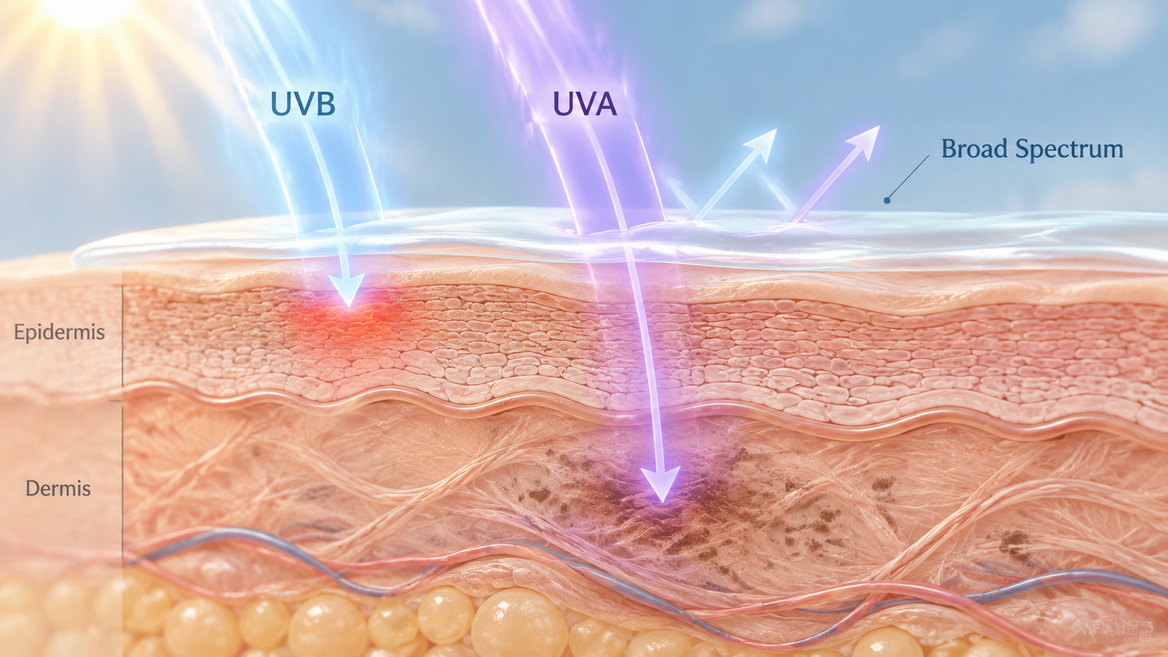
Mineral sunscreens use inorganic UV filters, primarily zinc oxide and titanium dioxide. In the United States, these are the two mineral sunscreen active ingredients widely recognized in consumer product labeling. [aad]
Zinc oxide is valued because it can offer broad UV coverage, including meaningful UVA protection when correctly selected, dispersed, and used at an effective level within the finished system.
From a formulation perspective, zinc oxide can support:
- Broad-spectrum protection goals
- Strong UVA contribution
- Photostable performance
- Sensitive-skin positioning
- Fragrance-free and minimalist formula concepts
- Tinted mineral sunscreen development
However, zinc oxide is not automatically easy to formulate. Particle size, surface treatment, dispersion quality, oil phase selection, film-forming technology, emulsification, viscosity, and pigment matching all influence both protection and user experience.
A mineral SPF with poor dispersion can feel gritty, look streaky, perform inconsistently, or leave an unacceptable white cast. A sophisticated mineral sunscreen requires more than adding zinc oxide to a base cream. It requires careful formulation engineering and finished-product testing.
Titanium dioxide is often used to strengthen UVB protection and improve SPF efficiency. It can be especially useful in mineral sunscreen systems designed for high-SPF positioning. However, titanium dioxide alone may not provide the same long-UVA coverage as a carefully designed zinc oxide-based system.
For this reason, many broad-spectrum mineral sunscreen formulas use zinc oxide, titanium dioxide, or both. The exact combination should be determined by the desired SPF, UVA objective, texture target, tint level, regulatory market, and stability data.
Mineral sunscreen has several strong commercial and consumer-facing advantages:
- It can be positioned for sensitive skin and simplified skin-care routines.
- Zinc oxide is useful when brands want broad UVA support.
- It is often preferred by users who experience eye sting from certain organic UV filters.
- It can work well in post-procedure-oriented skin-care categories when appropriately formulated and professionally positioned.
- It integrates naturally into tinted sunscreen, BB cream, tone-up cream, and complexion-protection concepts.
- It can support a premium skin-care narrative when paired with barrier-supporting ingredients such as ceramides, panthenol, squalane, ectoin, or suitable humectants.
The largest obstacle is cosmetic elegance. Consumers may dislike mineral sunscreens that feel heavy, pill under makeup, create a grey or purple cast, collect in facial hair, or look obvious in photography.
For global brands, this is especially important. A formula that appears transparent on lighter skin tones may look ashy on medium-to-deep skin tones. Inclusive product development should therefore include wear testing across a broad range of skin tones, lighting conditions, and application levels.
The goal should not be to promise "zero white cast" before testing. The goal should be to formulate and validate a sunscreen that offers comfortable, even, and inclusive wear for the intended target audience.
Chemical sunscreen uses organic UV filters. These filters absorb ultraviolet energy and release it at a lower energy level. The term "chemical sunscreen" is common in consumer education, although "organic UV filter sunscreen" can be more technically precise.
The available filter palette varies significantly by market. A formula developed for one country may not be allowed, practical, or commercially optimal in another. Brands planning international distribution should consider regulations from the beginning of product development rather than treating compliance as a final-stage checklist.
Chemical sunscreen systems are often selected because they can create a lighter sensory experience. They may be easier to formulate into clear gels, lightweight lotions, fluid emulsions, spray formats, and makeup-compatible facial products.
Their key advantages may include:
- Clear or nearly invisible application
- Lightweight, fast-spreading textures
- Strong consumer appeal for daily facial use
- Easier integration into serum-like or fluid sunscreen concepts
- Better compatibility with many complexion shades without relying on tint
- Potential for high SPF performance with a more elegant finish
- Flexible options for oil-control, matte, dewy, and water-resistant formats
For a commuter sunscreen, a men's lightweight SPF gel, a makeup-gripping sunscreen primer, or a clear body SPF spray, an organic-filter system may offer a meaningful sensory advantage.
Organic filters require careful compatibility work. Not every filter behaves well with every solvent, emulsifier, antioxidant, fragrance, pigment, preservative, or packaging component.
A well-developed chemical sunscreen should address:
- Photostability: Some filters require a stable supporting filter system or stabilizing ingredients.
- Solubility: Crystallization can affect appearance, feel, and protection consistency.
- Eye-area comfort: Some formulas may sting or migrate when consumers sweat.
- Skin compatibility: Fragrance, alcohol, high filter loads, or individual filter sensitivity can affect tolerance.
- Packaging compatibility: Certain filters and solvents can interact with packaging materials.
- Regional compliance: Approved actives, concentrations, claims, and testing expectations differ across markets.
A good chemical sunscreen is not simply "lighter than mineral." It is a balanced, stable, consumer-tested delivery system with verified broad-spectrum performance.
The ideal sunscreen depends on the individual, the local climate, routine preferences, skin concerns, and application habits.
A fragrance-free mineral sunscreen, especially one led by zinc oxide, is frequently a practical starting point for consumers with sensitive skin. The simplified active-filter approach may be appealing to users who report eye sting or discomfort with some organic-filter products.
However, "mineral" does not automatically mean non-irritating. A formula can still contain fragrance, essential oils, drying alcohols, harsh preservatives, or poorly selected pigments. The complete formula matters.
Oily skin often benefits from lightweight textures, quick dry-down, and a non-greasy finish. This can make fluid chemical sunscreens or carefully engineered hybrid sunscreens attractive options.
For brands, useful product directions include:
- Oil-control sunscreen gel
- Matte sunscreen fluid
- Lightweight SPF essence
- Non-comedogenic daily sunscreen lotion
- Tinted mineral SPF with sebum-balancing powder technology
Avoid making acne-treatment claims unless the formula, testing, and local regulations support them. Instead, focus on texture, finish, comfort, and compatibility with a daily skin-care routine.
Dry skin may benefit from sunscreen products that combine UV protection with moisturization. Mineral, chemical, and hybrid formulas can all work when paired with skin-conditioning ingredients.
Useful ingredient categories may include:
- Glycerin
- Hyaluronic acid
- Panthenol
- Betaine
- Ceramides
- Squalane
- Allantoin
- Ectoin
- Skin-compatible emollients
A sunscreen does not need to replace a moisturizer, but a well-designed moisturizing SPF can reduce the number of morning routine steps and improve daily compliance.
For deeper skin tones, white cast is not a minor product detail; it is a central usability issue. Clear organic-filter sunscreens may offer a straightforward option, while tinted mineral sunscreen can provide an excellent alternative when pigment dispersion and shade performance are well developed.
A brand should test mineral sunscreen under natural daylight, indoor office lighting, flash photography, and common consumer application levels. It should also assess whether the product oxidizes, pills, transfers, or emphasizes dry patches during the day.
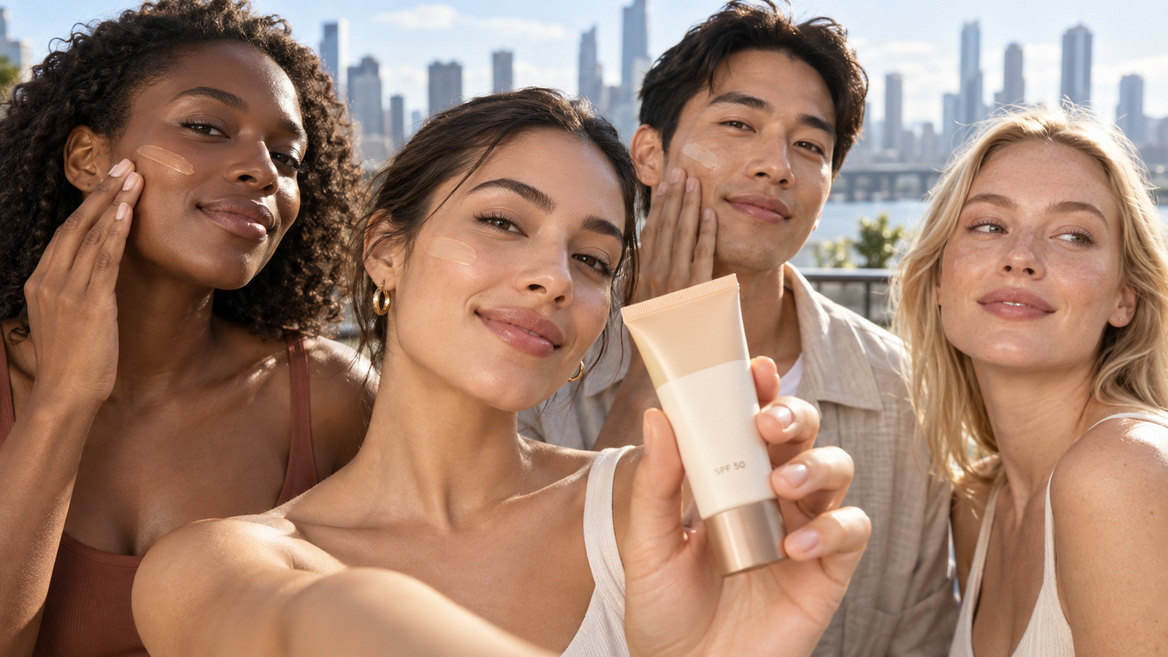
The mineral sunscreen vs. chemical sunscreen debate can distract consumers from the more important behavior: applying enough sunscreen and reapplying it when exposure continues.
Dermatology guidance commonly recommends broad-spectrum, water-resistant sunscreen with SPF 30 or higher. SPF 30 filters approximately 97% of UVB radiation under test conditions, while SPF 50 filters approximately 98%; neither figure means complete protection. [aad]
For everyday face and neck use, encourage consumers to apply a generous, even layer. For extended outdoor exposure, sweating, swimming, or towel drying, reapplication becomes essential.
1. Apply sunscreen as the final step of a morning skin-care routine, before makeup.
2. Use enough product to create an even film across the face, ears, neck, and other exposed skin.
3. Choose broad-spectrum SPF 30 or higher for routine daily use.
4. Reapply at least every two hours during ongoing outdoor exposure.
5. Reapply sooner after swimming, excessive sweating, or towel drying.
6. Use hats, sunglasses, shade, and protective clothing alongside sunscreen.
The best sunscreen is the one a consumer can apply at the right amount, enjoy wearing, and repurchase consistently.
Hybrid sunscreen combines mineral and organic UV filters in one formula. This category is highly relevant for private-label and custom sunscreen development because it can solve multiple formulation challenges at once.
A hybrid formula may help brands balance:
- UVA and UVB coverage
- Higher SPF potential
- Improved transparency on skin
- Lower visible cast than a fully mineral formula
- More comfortable sensory performance
- Better pigment compatibility in tinted products
- Enhanced water resistance and film formation
For example, a tinted daily hybrid SPF 50 may use zinc oxide to support broad UVA coverage, selected organic filters to optimize SPF and transparency, iron oxides to improve complexion blending, and skin-care ingredients to create a comfortable moisturizing finish.
This is not a shortcut. Hybrid sunscreen still requires rigorous testing for SPF, broad-spectrum performance, stability, preservative efficacy, packaging compatibility, wear resistance, and consumer acceptability. But from a product-portfolio perspective, it can be one of the most versatile formats for brands serving diverse climates and skin tones.
For brands sourcing mineral sunscreen, chemical sunscreen, or hybrid sunscreen, product selection should start with the target user rather than a trending claim.
Identify where the product will be sold before selecting UV filters. Sunscreen regulations differ by region, and approved active ingredients, permitted concentrations, label claims, and testing frameworks must align with the destination market.
Define the intended customer:
- Sensitive-skin consumer
- Outdoor sports user
- Daily urban commuter
- Parent and child category
- Mature-skin consumer
- Oily or acne-prone skin user
- Melanin-rich skin consumer
- Luxury skin-care buyer
- Budget-conscious mass-market shopper
This profile shapes the appropriate sunscreen format, finish, packaging, price range, and claim direction.
Common options include:
- Mineral sunscreen cream
- Tinted mineral sunscreen
- Lightweight chemical sunscreen fluid
- Clear sunscreen gel
- Hybrid sunscreen lotion
- Water-resistant sport sunscreen
- Sunscreen stick
- Sunscreen spray
- Tone-up sunscreen
- SPF primer
- SPF foundation or BB cream
Each format creates different formulation requirements. A sunscreen stick needs firmness and pay-off. A fluid needs suspension stability. A spray needs application uniformity and packaging performance. A tinted product needs shade consistency and pigment dispersion.
Sunscreen claims must be supported by testing on the finished formula. Critical assessments may include:
- SPF testing
- Broad-spectrum testing
- Water-resistance testing, where claimed
- Stability testing
- Microbiological testing
- Preservative challenge testing
- Heavy-metal and raw-material controls where applicable
- Packaging compatibility testing
- Human repeat-insult patch testing or appropriate compatibility assessments
- Consumer wear testing
For a brand, the most valuable supplier is not one that only offers a stock formula. It is a manufacturer that can translate a consumer brief into a compliant, scalable, validated finished product.

Choose mineral sunscreen when your brand priorities include sensitive-skin positioning, zinc oxide-led broad-spectrum concepts, tinted SPF, family products, or a more traditional physical-filter story.
Choose chemical sunscreen when your priority is an invisible, lightweight, fast-absorbing product for everyday use, makeup layering, humid climates, clear sprays, or high-SPF fluid formats.
Choose hybrid sunscreen when you want to balance broad protection, elegant texture, lower white cast, and global consumer appeal.
The key commercial question is not, "Which sunscreen is better?" It is: Which tested formula will deliver the right protection, sensory experience, and repeat-use behavior for your target customer?
For brands seeking a custom sunscreen solution, GUANGZHOU LAIMEI CREATIVE RESEARCH INTELLIGENT BIOLOGICAL RESEARCH CO., LTD. supports the journey from formulation concept and packaging development to scalable manufacturing. With 13 years of skin-care and cosmetics development experience, a 20,000 m² GMP-standard production base, annual capacity exceeding 50 million units, and end-to-end OEM/ODM support, the company can help transform a sunscreen brief into a differentiated market-ready product.
Whether you are planning a zinc oxide mineral sunscreen, a lightweight broad-spectrum facial SPF, a tinted anti-photoaging sunscreen, or a high-performance hybrid sunscreen, begin with a defined target market, measurable product requirements, and a development partner equipped for formulation validation and stable scale-up.
Neither category is universally better. Both can provide effective UV protection when the product is broad spectrum, has a suitable SPF, is applied generously, and is reapplied as needed. Mineral sunscreen may be preferred by some sensitive-skin users, while chemical sunscreen may feel lighter and more invisible on skin.
No. SPF values do not increase in a simple linear way. Under standardized testing, SPF 30 filters about 97% of UVB rays and SPF 50 filters about 98%. Higher SPF can provide an added margin of protection, but no sunscreen blocks all UV radiation. [tuftsmedicine]
No. SPF primarily relates to UVB-related sunburn protection. Look for a broad-spectrum claim to confirm that a product also provides UVA protection. [fda]
Yes. Zinc oxide and titanium dioxide can create visible whitening, especially on medium-to-deep skin tones. Advanced dispersion technology, optimized particle selection, tinting, and hybrid filter systems can improve cosmetic appearance.
Tinted broad-spectrum sunscreen can be a valuable option because research suggests visible light may contribute to photoaging and pigmentary concerns. Products containing iron oxides may offer an additional practical approach for users who are concerned about uneven skin tone. [pmc.ncbi.nlm.nih]
Daily sunscreen may be useful indoors when you receive meaningful daylight exposure near windows or go outside during the day. Your choice should reflect your actual exposure pattern, skin concerns, and lifestyle.
During continued outdoor exposure, reapply at least every two hours. Reapply sooner after swimming, sweating heavily, or towel drying. [aad]
Yes. An experienced OEM/ODM manufacturer can customize sunscreen format, texture, finish, UV-filter system, fragrance profile, packaging, tint, water-resistance direction, and supporting skin-care ingredients, subject to destination-market requirements and appropriate finished-product testing.
1. [U.S. Food and Drug Administration — Sunscreen: How to Help Protect Your Skin from the Sun]
2. [American Academy of Dermatology — Sunscreen FAQs]
3. [Guan LL, Lim HW, Mohammad TF. Sunscreens and Photoaging: A Review of Current Literature]
4. [Tufts Medicine — A Dermatologist's Guide to Sunscreen: SPF, UVA/UVB and Bemotrizinol]
5. [Krutmann J. Daily Photoprotection to Prevent Photoaging]
6. [GoodRx Health — Chemical vs. Mineral Sunscreen: Which Is Better?]
7. [CeraVe — What Is a Hybrid Sunscreen? Mineral vs. Chemical Sunscreen]


