
Views: 264 Author: Vera Publish Time: 2026-09-26 Origin: Site


Content Menu
● What Is the Difference Between Enzyme and Chemical Exfoliation?
>> Enzymes vs. acids at a glance
● How Do Enzyme Exfoliants Work?
>> What does the research establish?
● How Do AHA and BHA Exfoliants Work?
>> Why does sun protection matter with AHAs?
● Which Exfoliant Fits Your Skin?
>> A cautious first-use routine
● What Should Brands Test Before Launch?
>> A practical development checklist
● Can a Formula Combine Enzymes and Acids?
● How Can Laimei Support Development?
>> Are enzyme exfoliants safer than acid exfoliants?
>> Can I use an enzyme exfoliant and an AHA together?
>> Is papaya extract the same as papain?
>> Is a higher acid percentage always better?
>> Should I exfoliate every day?
>> Do enzyme products eliminate the need for sunscreen?
>> What proof should a brand request from an exfoliant manufacturer?
Enzyme vs. chemical exfoliation is not simply a choice between "gentle" and "strong." Enzyme exfoliants use active proteins to help remove dead cells at the skin's surface. Acid exfoliants, such as alpha hydroxy acids (AHAs) and beta hydroxy acids (BHAs), promote shedding through different mechanisms. The better option depends on the finished formula, the user's skin, and the result the product is designed to deliver.
For skincare brands, the decision goes further. An exfoliant must remain effective through manufacturing and storage, feel comfortable during use, and support claims the brand can substantiate. This guide compares how enzymes and acids work, where each can fit in a routine, and what to test before launching an OEM/ODM exfoliating product.

The terminology needs one clarification: enzyme exfoliation is itself a form of chemical exfoliation. In product discussions, however, "chemical exfoliation" commonly means exfoliation with non-enzymatic acids. That is the distinction used here.
Enzymes such as papain, associated with papaya, and bromelain, associated with pineapple, are proteases. They break down proteins involved in the outermost layer of skin. Their intended exfoliating action is primarily at the surface.
Acid exfoliants include AHAs, such as glycolic and lactic acid, and BHAs, most commonly salicylic acid. AHAs are frequently chosen for products aimed at improving the appearance of rough texture and uneven tone. Salicylic acid is often considered for oily-feeling, congestion-prone skin. These are formulation directions, not guarantees that every product containing an ingredient will produce the same result.
| Decision factor | Enzyme exfoliants | Acid exfoliants |
|---|---|---|
| Typical examples | Papain, bromelain, microbial proteases | Glycolic acid, lactic acid, salicylic acid |
| Main formulation question | Will measurable enzyme activity remain through shelf life? | Are acid level, final pH, and use instructions appropriate? |
| Common product positioning | Surface smoothing and a mild-feeling ritual | Targeted texture or oily-skin products |
| Sensitive-skin consideration | May be worth exploring, but irritation or allergy is still possible | A mild formula may work, but stronger exfoliation can irritate |
| Evidence limitation | Fewer robust comparative human studies | More established research for some acids, especially AHAs |
| Purchasing mistake to avoid | Assuming a fruit extract contains an effective dose of active enzyme | Judging strength from the percentage on the label alone |
Neither category is automatically safer or more effective. Exposure time, concentration, pH, supporting ingredients, packaging, and individual tolerance all matter.
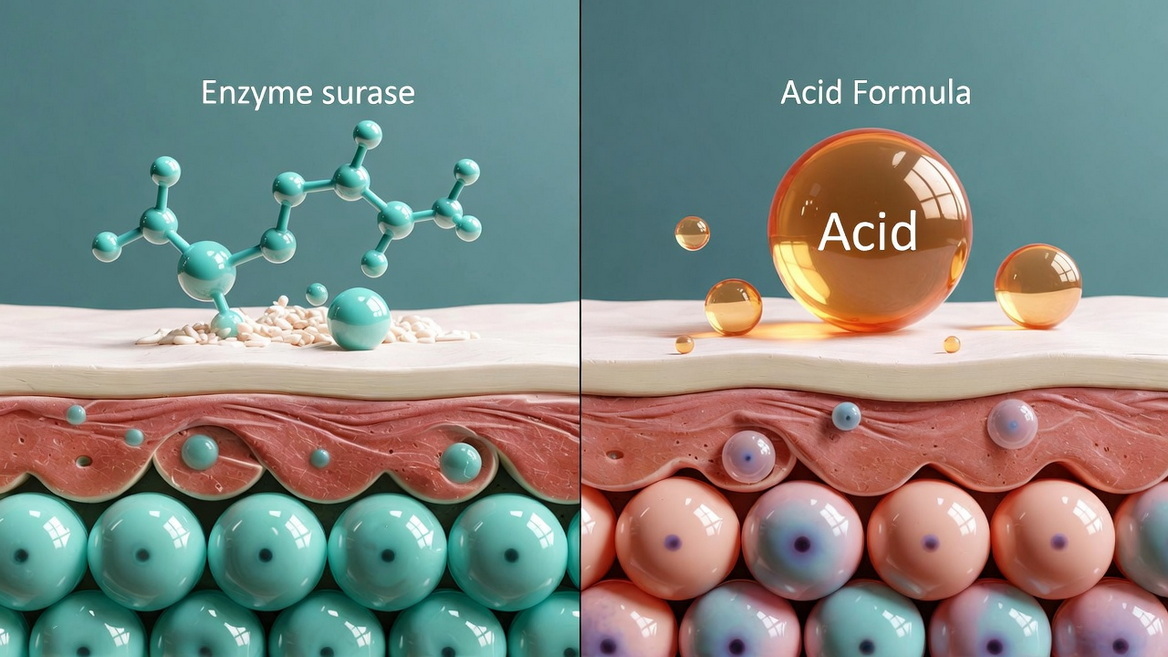
Proteolytic enzymes act on proteins in the outer skin layer. In a functioning formula, this can help loosen material that contributes to a rough or dull-looking surface. That makes enzymes attractive for rinse-off masks, powder products, and other concepts built around a short, controlled application.
But ingredient presence is not proof of enzyme activity. An ingredient list might name papaya extract without establishing that the finished product contains enough active papain to exfoliate. The distinction matters to both shoppers and brand teams: an appealing ingredient story is not the same as a measurable performance claim.
Enzymes also have practical weaknesses. Their activity can change with pH, temperature, moisture, and other formula components. Processing and storage may reduce the activity present when a customer finally opens the product. Some users may experience irritation or sensitivity to a proteolytic ingredient, so "enzyme" should not be treated as a synonym for "irritation-free."
A review of published research on proteolytic exfoliants identified 11 relevant articles, with few clinical trials using enzymes as exfoliants. The findings supported their potential to exfoliate, but the authors called for stronger human studies.
A more recent review likewise described enzyme performance as highly dependent on the finished formulation and found limited long-term, direct clinical comparisons with acid exfoliants. The practical takeaway is straightforward: do not promise that enzymes outperform acids—or that they suit every sensitive-skin user—without product-specific evidence.
Acid exfoliants encourage shedding of surface skin cells. Their effect varies with the ingredient and the complete product, not just a headline concentration. For AHAs, the type of acid, its concentration, the product's final pH, and other ingredients all influence exfoliation.
Glycolic acid and lactic acid are familiar AHA choices for surface-texture concepts. Salicylic acid, a BHA, appears in products positioned for oily or blemish-prone skin. A brand should be especially careful when moving from cosmetic language about appearance to claims that a product treats a condition; intended-use claims can affect how a product is regulated.
A 10% acid product is not necessarily equivalent to another 10% acid product. The formulas may have different pH values, delivery systems, contact times, and directions. Likewise, a brief-use peel should not be treated as interchangeable with a leave-on serum. Compare finished products, not isolated percentages.
Research summarized by the U.S. Food and Drug Administration found increased ultraviolet sensitivity after AHA use. In one study it describes, sensitivity to UV-induced skin reddening increased by 18% after four weeks of AHA application. That figure describes the studied conditions; it is not a prediction for every product or user.
For applicable topical cosmetics containing AHAs, the agency recommends labeling that warns of increased sun sensitivity and advises sunscreen, protective clothing, and limited sun exposure during use and for a week afterward. Brands developing an AHA product should account for this guidance when planning packaging, directions, and market-specific label review.
Start with the concern you want to address, then consider your skin's current tolerance. The table below is a selection guide, not a diagnosis; either type may be unsuitable if the finished formula irritates your skin.
| Skin situation or goal | Reasonable starting consideration | What to watch |
|---|---|---|
| Easily reactive skin seeking surface smoothing | A carefully formulated, short-contact enzyme product | Patch-test; stop if it stings or causes persistent redness |
| Rough-feeling or dull-looking skin | A mild AHA product or an enzyme product | Compare comfort and results over time rather than choosing by label alone |
| Oily-feeling, congestion-prone skin | A salicylic-acid product, if appropriate | Avoid layering several exfoliants to chase faster results |
| Current dryness, burning, or peeling | Pause exfoliation | Focus on a simple routine and seek professional advice if symptoms persist |
| A routine already using retinoids or benzoyl peroxide | Review the routine before adding an exfoliant | Combining irritating products may worsen dryness or discomfort |
| Skin prone to dark marks after irritation | Favor caution over aggressive treatment | Excessively strong exfoliation may contribute to unwanted discoloration |
Sensitive skin does not have to choose enzymes by default. A well-designed mild acid product may be more comfortable than a poorly designed enzyme product. Conversely, someone who dislikes an acid formula may prefer the feel of an enzyme mask. Tolerance belongs to the finished product and the person using it, not to an ingredient category alone.
1. Choose one exfoliant. Do not introduce an enzyme mask and an acid serum on the same day.
2. Follow the product's directions. Pay particular attention to rinse-off time and whether the product is intended to remain on skin.
3. Start conservatively. Give your skin time to show how it responds before considering more frequent use.
4. Apply moisturizer afterward if appropriate for the product and your routine.
5. Protect exposed skin from the sun. Follow any product-specific sun-safety directions, particularly for AHAs.
6. Stop if irritation develops. Persistent burning, marked redness, or worsening peeling is a reason to reassess rather than exfoliate more often.
Do not exfoliate sunburned skin or open wounds. If you have a skin condition, use prescription products, or cannot tell whether your barrier is irritated, ask a dermatologist before adding an exfoliant.
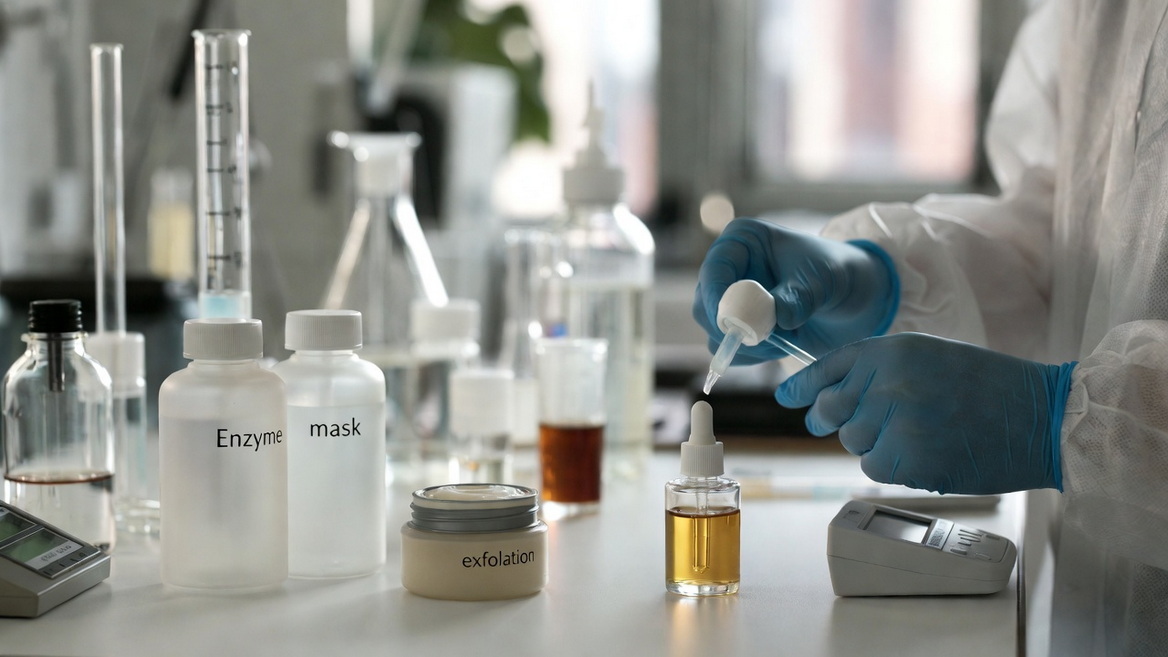
A useful OEM/ODM comparison must extend beyond the ingredient deck. Imagine a brand evaluating a papain mask against a lactic-acid serum. The mask's appealing fruit story does not establish active enzyme performance; the serum's stated acid percentage does not establish its real-world strength. Both require finished-product evaluation.
For an enzyme concept, request evidence that activity survives realistic manufacturing and storage conditions. For an acid concept, document the final pH, ingredient level, use conditions, and labeling decisions. For both, evaluate stability, product quality, user tolerance, and whether proposed marketing claims match the testing performed.
- Define the audience and claim. "Helps skin feel smoother" calls for a different evidence plan than a stronger, condition-related claim.
- Choose the format. Decide whether a rinse-off mask, cleanser, or leave-on treatment suits the intended experience.
- Set measurable specifications. For enzymes, consider finished-product activity; for acids, consider final pH alongside ingredient level.
- Test stability in the intended package. Include conditions relevant to manufacturing, shipping, and expected storage.
- Assess tolerance under intended use. Test the complete formula, not only the featured active.
- Review market-specific labels. Ingredient declarations, directions, warnings, and claims need review for each destination market.
- Confirm production consistency. Agree on batch records, quality checks, and acceptance criteria before scaling.
This approach can prevent a costly mismatch: a product that sounds convincing in a launch brief but no longer performs as intended at the end of its shelf life.
Possibly—but combining them is a formulation decision, not an automatic upgrade. Each active needs conditions that preserve its intended function. Some enzymes lose activity under conditions selected for an acid exfoliant, while combining exfoliating effects may make a product less comfortable for users.
A brand considering a hybrid should ask its formulator to test enzyme activity in the finished system, acid-related specifications, stability over time, and tolerance under the exact directions for use. If the blend cannot demonstrate a meaningful benefit over a simpler formula, two separate products may tell a clearer story and give users more control.
The broader lesson is that more exfoliating ingredients do not necessarily create a better exfoliant. A focused product with clear instructions may serve a defined audience better than a complex formula whose performance or comfort is difficult to verify.
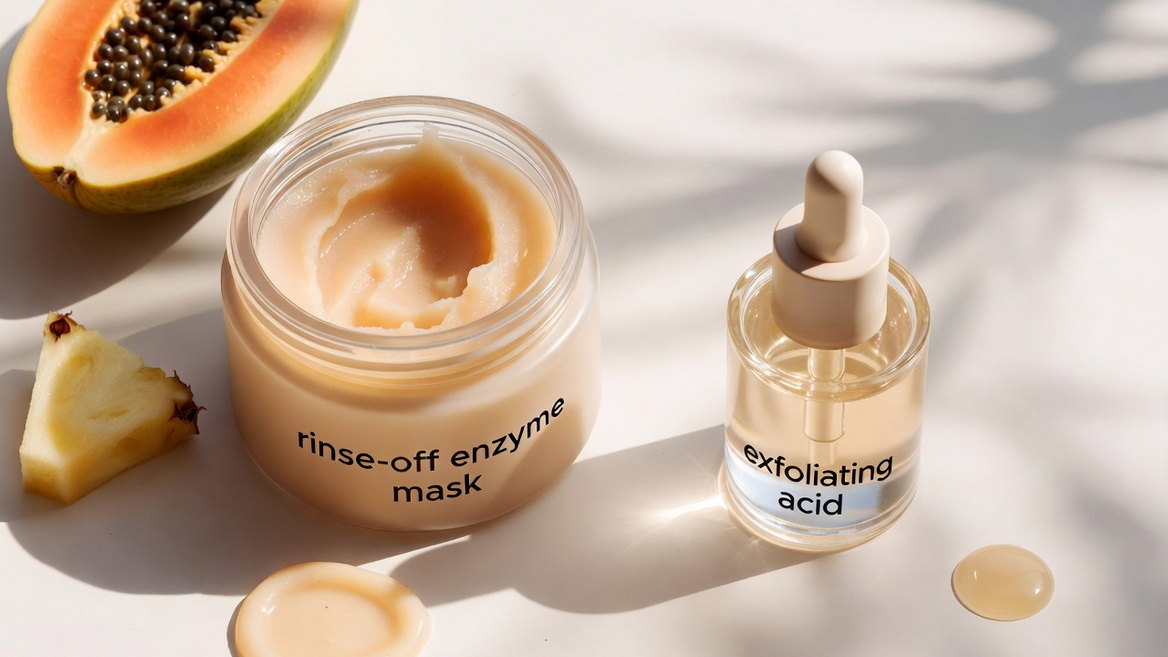
GUANGZHOU LAIMEI CREATIVE RESEARCH INTELLIGENT BIOLOGICAL RESEARCH CO., LTD. provides OEM/ODM skincare development, packaging, and manufacturing services. According to company-provided information, its operations include a 20,000 m² production base, annual capacity exceeding 50 million units, and support from small-batch trials through larger-scale production. Those company figures are provided here as background, not independently verified performance results for a specific exfoliating formula.
For an enzyme or acid exfoliant, a productive development brief should specify the target user, product format, desired skin feel, intended markets, packaging preferences, and claim boundaries. The next step is to agree on a testing plan rather than assume an ingredient name alone will deliver the desired result.
Ready to develop a differentiated exfoliant? Contact Laimei with your target market and product concept to request an OEM/ODM formulation discussion, sample-development plan, and proposed quality and stability checks.
Not inherently. Enzymes may offer a mild-feeling surface-exfoliation option in an appropriate formula, but they can still irritate or cause sensitivity. Acids also vary substantially by formula and use instructions. Compare the complete products and your own response.
It may be possible, but using both at once can increase the chance of discomfort. Start with one product and follow its directions. If a brand is developing a combined formula, it should test both active performance and finished-product tolerance rather than assume the ingredients are compatible.
No. Papaya extract describes an ingredient source or preparation; papain is a particular proteolytic enzyme. An ingredient list alone does not show how much active enzyme remains in the finished product during its shelf life.
No. Acid type, final pH, the rest of the formula, and contact time also matter. A higher displayed percentage cannot establish that a product is more effective or more appropriate for a particular user.
Not by default. The right frequency depends on the product, your skin, and the rest of your routine. Follow the label, start cautiously, and reduce or stop use if redness or irritation appears.
No. An enzyme product is not a substitute for sun protection. AHA users should pay particular attention to product warnings about increased sun sensitivity during use and for a week after stopping.
Ask for finished-product specifications and testing relevant to the claim: for example, enzyme-activity and stability results for an enzyme formula, or final-pH information for an acid formula. Also request appropriate quality, tolerance, packaging, and labeling documentation for the intended markets.
The scientific, skincare-safety, and regulatory information above is based on the following sources. Company descriptions and capacity figures were supplied in the brief and have not been independently verified.
1. American Academy of Dermatology Association. "[How to Safely Exfoliate at Home]." Guidance on skin-type considerations, existing products, irritation, and at-home use. [aad]
2. U.S. Food and Drug Administration. "[Alpha Hydroxy Acids]." Information on AHA performance factors, adverse effects, and UV-sensitivity research. [fda]
3. U.S. Food and Drug Administration. "[Guidance for Industry: Labeling for Cosmetics Containing Alpha Hydroxy Acids]." Recommended consumer sun-sensitivity warning. [fda]
4. Bouziani, A., Özel, R., and Güngör, Ö. "[Cosmetic Enzymes as Formulation-Integrated Actives: Mechanisms, Delivery, and Functional Evidence]." *Journal of Cosmetic Dermatology*, 2026. Review of enzyme mechanisms, stability, and evidence limitations. [pmc.ncbi.nlm.nih]
5. "[An Overview of the Use of Proteolytic Enzymes as Exfoliating Agents]." *Journal of Cosmetic Dermatology*, 2022. Review of published enzyme-exfoliation studies and research gaps. [onlinelibrary.wiley]
6. U.S. Food and Drug Administration. "[Registration & Listing of Cosmetic Product Facilities and Products]." Regulatory context for facility registration and product listing; registration does not indicate product approval. [fda]


