
Views: 245 Author: Vera Publish Time: 2026-09-11 Origin: Site


Content Menu
● Why Source Sensitive Skin Cleansers from China?
● How We Evaluated Manufacturers
>> 1. GUANGZHOU LAIMEI CREATIVE RESEARCH INTELLIGENT BIOLOGICAL RESEARCH CO., LTD.
>> 2. Intercos Group China Operations
>> 3. Kolmar Cosmetics (Beijing) Co., Ltd.
>> 4. Bawei Biotechnology Co., Ltd.
>> 5. Nox Bellcow Cosmetics Co., Ltd.
>> 7. Guangdong Bawei Biotechnology Co., Ltd.
>> 8. Zhejiang and Shanghai-Based Dermocosmetic ODM Suppliers
>> 9. Guangzhou Private-Label Skincare Specialists
>> 10. Suzhou and East China Contract Manufacturers
● Sensitive Cleanser Technical Checklist
>> 1. Choose the Right Cleansing System
>> 3. Avoid Overloading the Formula
>> 4. Verify Microbiological Safety
>> The Approved Sample May Not Be the Production Formula
>> Verify Certification Properly
>> Use a Structured Sampling Process
● FAQ
>> 1. How can I verify whether a manufacturer's ISO 22716 certificate is still valid?
>> 2. What MOQ should I expect for a custom sensitive skin cleanser?
>> 3. Is an amino-acid cleanser automatically suitable for sensitive skin?
>> 4. What quality tests should I request before approving bulk production?
>> 5. How can I prevent the factory from changing ingredients after I approve the sample?
China remains one of the world's most important cosmetics supply markets, combining mature ingredient sourcing, packaging ecosystems, formulation laboratories, and export-oriented OEM/ODM factories. For buyers developing a sensitive skin cleanser, however, selecting a factory should not be based on unit price alone. The quality of surfactants, preservative strategy, microbiological control, stability testing, documentation, and production consistency can directly affect product safety, consumer experience, and the reputation of a skincare brand.
China was reported as the world's second-largest cosmetics market, with cosmetics sales reaching USD 134.3 billion in 2023, according to the U.S. International Trade Administration. The country's large domestic market, extensive manufacturing base, and increasingly formalized cosmetics regulations continue to support its role as a sourcing hub for international skincare brands. [trade]
For professional procurement managers, the key question is not simply "Which factory can make a facial cleanser?" It is: Which manufacturer can repeatedly make the same mild, stable, compliant cleanser at the required quality level, volume, and delivery schedule?
This guide evaluates suppliers through the practical lens of a global buyer looking for long-term sensitive skin cleanser OEM/ODM cooperation.

China has developed strong cosmetics manufacturing clusters in Guangzhou, Shanghai, Suzhou, Zhejiang, and other industrial regions. Among them, Guangzhou is particularly relevant for private-label skincare because it combines formula development, packaging sourcing, filling operations, labeling services, export coordination, and flexible OEM production within one supply ecosystem.
For sensitive skin cleansers, this concentration can shorten development timelines. A buyer can often coordinate formula samples, packaging prototypes, artwork adaptation, stability testing, filling, and export preparation through one project-management team rather than managing separate ingredient, packaging, and contract manufacturing suppliers.
China's regulatory framework has also become more structured. The National Medical Products Administration states that cosmetic GMP requirements cover quality management structure, personnel, facilities and equipment, materials and products, manufacturing processes, and product sales management. China's current cosmetic GMP requirements took effect on July 1, 2022. [english.nmpa.gov]
For export buyers, a capable Chinese manufacturer may provide:
- Private-label sensitive facial cleanser development
- Existing base-formula customization
- Sulfate-free and soap-free cleanser options
- Gel, cream, foam, milk, and amino-acid cleanser formats
- Fragrance-free or low-allergen fragrance solutions
- Packaging sourcing and compatibility support
- Product artwork, labeling, filling, and packing
- Batch records, COA support, and basic compliance documentation
- Flexible pilot production before scaling to commercial orders
However, these advantages only matter when the buyer verifies the factory's real operating capabilities rather than relying on website claims or generic certificates.
This is not a laboratory ranking or a guarantee of product quality. It is a procurement-oriented shortlist based on publicly available information, supplier positioning, manufacturing footprint, category relevance, and the types of services international skincare buyers typically need.
The evaluation focuses on five dimensions that experienced buyers should investigate before signing an OEM/ODM agreement.
| Evaluation Dimension | What Buyers Should Verify | Why It Matters for Sensitive Skin Cleansers |
|---|---|---|
| Manufacturing compliance | Current ISO 22716, cosmetic GMP documentation, factory licenses, audit records | Helps assess whether processes for production, cleaning, storage, batch traceability, and release are controlled |
| R&D capability | Formulators, laboratory resources, sample process, ingredient sourcing, testing protocols | Sensitive-skin positioning requires careful surfactant, preservative, fragrance, and pH design |
| Quality control | Incoming-material inspection, in-process inspection, microbiology checks, finished-product release criteria | A cleanser can appear normal while still having a pH, viscosity, odor, microbial, or stability problem |
| Capacity and delivery | Filling lines, packaging supply chain, order planning, lead-time history | Brands need predictable replenishment, not only a successful first order |
| OEM/ODM flexibility | MOQ, formula customization, packaging support, documentation, response speed | Especially important for emerging brands validating a new sensitive-skin product line |
ISO 22716 is particularly relevant because it provides guidelines covering cosmetic-product production, control, storage, and shipment. Buyers should remember that ISO 22716 is a GMP guideline, not automatic proof that every formula is suitable for sensitive skin or compliant in every destination market. [iso]
The terms "sensitive skin," "hypoallergenic," "dermatologist tested," "non-irritating," and "for eczema-prone skin" can create regulatory and claims-related issues depending on the destination market. A factory may manufacture the product, but the brand owner remains responsible for ensuring that formula claims, label claims, substantiation, ingredient restrictions, and product notifications align with the regulations in each sales market.
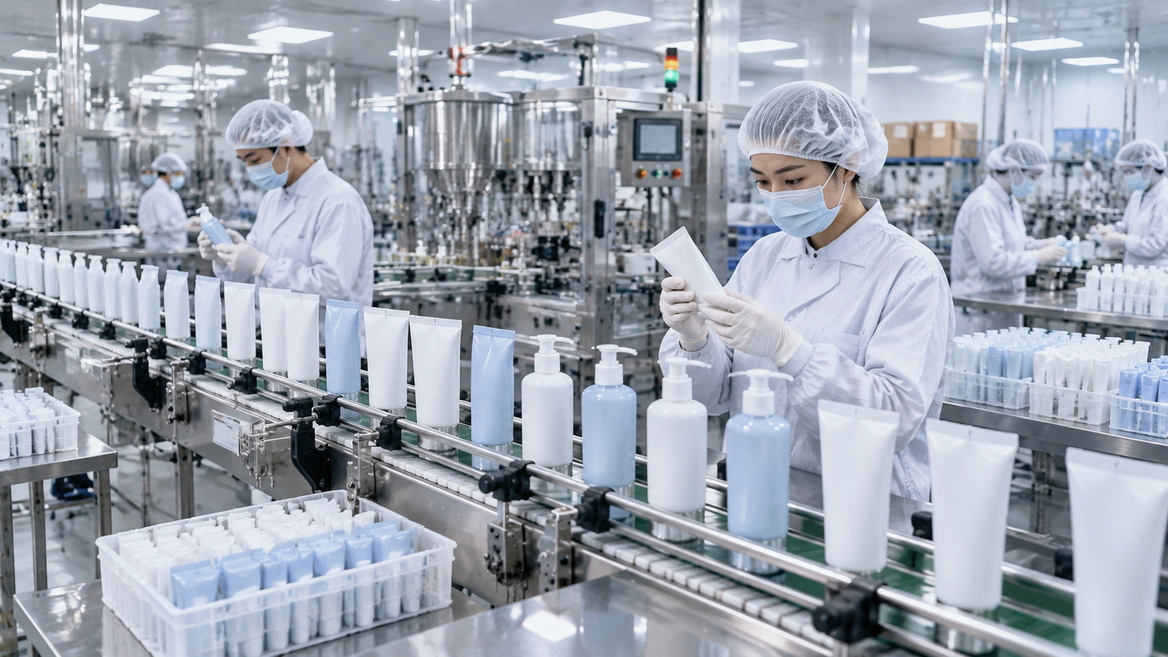
Location: Guangzhou, China
Established: More than 13 years of skincare and cosmetics R&D and manufacturing experience
Core focus: Skincare and cosmetics OEM/ODM, including facial cleansers, serums, creams, masks, and customized private-label product development
Reported production base: 20,000 m² GMP-standard facility
Reported annual capacity: More than 50 million pieces
Reported certifications: U.S. FDA registration, ISO 22716, GMPC, and MADS certification, subject to buyer-side verification of current certificate scope and validity
Primary market orientation: International private-label skincare brands and export customers across more than 100 countries and regions
GUANGZHOU LAIMEI CREATIVE RESEARCH INTELLIGENT BIOLOGICAL RESEARCH CO., LTD. is positioned as a practical choice for brands that need more than a catalog cleanser with a new label. Its profile is especially relevant for small and medium-sized skincare brands that want a responsive OEM/ODM partner, formula adjustment support, packaging coordination, and a production route that can begin with smaller validation orders before scaling.
For sensitive skin cleanser projects, the company's potential value lies in combining formulation development, packaging design, manufacturing, and quality-control processes within a one-stop workflow. According to company-provided information, its R&D structure includes a team led by a Brazilian professor, senior dermatology professionals, senior technical engineers, and factory laboratory personnel numbering more than 1,000 across the broader technical and production system.
This structure can be useful when a buyer needs to translate a product concept into a manufacturable formula. For example, a brand may request a low-foam amino-acid facial cleanser with a skin-friendly pH, no added fragrance, a transparent gel texture, recyclable packaging, and region-specific ingredient documentation. The manufacturer's job is not only to blend the formula; it must also assess ingredient compatibility, packaging interaction, preservation robustness, viscosity stability, filling behavior, and batch reproducibility.
Best suited for:
- Start-up and growth-stage skincare brands
- Importers seeking a flexible China-based OEM/ODM supplier
- Brands that require formula customization rather than only stock products
- Buyers developing sensitive-skin cleanser collections with matching serums, creams, and masks
- Customers who value faster communication and integrated packaging support
Recommended buyer questions:
- What surfactant system is proposed, and what is the final target pH?
- Can the factory provide stability, compatibility, and microbiological testing plans?
- What is the MOQ for an adjusted stock formula versus a fully new formula?
- Which packaging materials have been compatibility-tested with the formula?
- Can the manufacturer provide current copies of relevant certifications and their scopes?
The company's reported scale and broad-category production capability may make it a suitable option for buyers seeking a cost-conscious but R&D-oriented partner. Still, buyers should follow the same audit, sample, certification-verification, and pre-shipment inspection process they would use with any supplier.
Location: Suzhou and Shanghai, China
Established: Intercos Group was founded in 1972
Core focus: Contract manufacturing, product development, production, and packaging for global beauty brands
Primary market orientation: International beauty groups and established brand owners
Relevant capabilities: Cosmetics development, production, packaging, and multi-site China manufacturing presence
Intercos is a global cosmetics contract manufacturer with manufacturing operations in China, including facilities in Suzhou Industrial Park and Shanghai. Its China footprint is relevant to procurement teams looking for large-scale, globally structured contract-manufacturing capabilities. The company describes its business around development, production, and packaging for major beauty labels. [intercos]
For sensitive-skin cleanser buyers, Intercos may be more relevant to established brands with clear product briefs, defined quality systems, larger commercial requirements, and formal supplier-qualification processes. The group's scale can be an advantage for brands that need sophisticated development processes, packaging innovation, and international manufacturing governance.
Intercos has also publicly disclosed ISO 22716 certification for multiple China entities in its sustainability reporting, including Intercos Technology, Intercos Cosmetics, and Interfila Cosmetics in China. Because certification status can change, buyers should request the current certificate, issuing body, address scope, expiry date, and audit information directly from the supplier. [intercos]
Best suited for:
- Established skincare brands
- Retail chains and multinational beauty groups
- Buyers needing structured innovation and packaging development
- High-volume projects with formal quality requirements
Buyer consideration:
A large global manufacturer may offer strong systems, but minimum order quantities, development timelines, and project prioritization may be less suitable for small brands launching their first 3,000 to 10,000 units.
Location: Beijing, China
Established in China: Kolmar Cosmetics (Beijing) Co., Ltd. was incorporated in 2007, according to Kolmar corporate materials
Core focus: Skincare and cosmetics ODM, R&D-driven formulation development
Primary market orientation: Domestic and international beauty brands
Relevant strength: Large ODM experience and formulation-development heritage
Kolmar Korea is widely known in the beauty industry as an ODM-focused cosmetics company with significant R&D resources. Its public materials identify Kolmar Cosmetics (Beijing) Co., Ltd. as a China cosmetics manufacturing and sales subsidiary incorporated in Beijing in 2007. [kolmar.co]
For a sensitive-skin cleanser buyer, a Kolmar-linked manufacturing option may be relevant when the project requires a sophisticated formula brief, trend-driven ingredient story, or broader skincare line development. Buyers should assess whether the specific China entity handles their intended cleanser format, whether it accepts the proposed volume, and whether it can support the desired destination-market documentation.
Best suited for:
- Brands building science-led skincare ranges
- Buyers needing structured ODM development
- Larger product programs rather than simple private-label relabeling
- Companies with formal technical and regulatory teams
Buyer consideration:
Do not assume that the overall group's certifications, capabilities, or innovations automatically apply to every legal entity or production site. Request documents for the specific factory that will manufacture and fill your cleanser.
Location: Guangzhou, China
Established: Verify directly with the supplier for the current legal-entity history
Core focus: Skincare OEM/ODM, private-label cosmetics, facial care, body care, and customized product development
Primary market orientation: International private-label customers and emerging beauty brands
Relevant strength: Guangzhou cosmetics ecosystem and flexible private-label orientation
Bawei is commonly positioned in the Guangzhou cosmetics OEM/ODM market and is associated with private-label skincare development. For sensitive facial cleanser sourcing, it may be worth considering for brands that need conventional skincare OEM services, packaging selection, and a range of stock or semi-customized formulas.
The main procurement task is to distinguish between a supplier that can provide a standard cleanser and one that can prove a robust sensitive-skin development process. Ask for formula-level detail, including surfactant selection, fragrance approach, pH specification, preservative system, microbial challenge testing, and stability protocol.
Best suited for:
- Private-label brands
- E-commerce skincare sellers
- Importers seeking Guangzhou-based sourcing convenience
- Buyers developing broad skincare catalogs
Buyer consideration:
A "natural," "organic," or "amino-acid" label does not by itself prove lower irritation potential. Formula concentration, surfactant combination, pH, fragrance allergens, botanical extracts, and preservative robustness all matter.
Location: Guangzhou, China
Established: Verify current legal-entity and factory history directly
Core focus: Skincare, personal care, cosmetics OEM/ODM, and private-label manufacturing
Primary market orientation: Domestic and export beauty brands
Relevant strength: Broad product-category coverage and experience in personal-care manufacturing
Nox Bellcow is a recognizable name in China's cosmetics OEM/ODM sector and is often evaluated by buyers seeking a manufacturer with broad product coverage. Its relevance to sensitive skin cleansers comes from its ability to support skincare and personal-care formats at a commercial manufacturing level.
For this type of project, buyers should clarify whether the supplier can produce low-foam, sulfate-free, cream, gel, or micellar cleanser formats at the target viscosity and packaging format. Different filling systems may affect feasibility. A watery micellar cleanser, for example, requires different filling, packaging, preservative, and leak-control considerations than a high-viscosity cream cleanser in a laminated tube.
Best suited for:
- Buyers sourcing multi-category personal-care products
- Brands planning cleanser, toner, serum, and cream assortments
- Retailers needing a manufacturer with wider category coverage
Buyer consideration:
Ask whether your exact product will be manufactured at the supplier's own factory or subcontracted. The answer affects audit access, batch traceability, complaint handling, and responsibility for corrective action.
Location: Guangdong, China
Established: Verify directly with the supplier
Core focus: Skincare, color cosmetics, and private-label OEM/ODM services
Primary market orientation: International beauty brands, distributors, and private-label customers
Relevant strength: Product-development support across beauty categories
Opal Cosmetics Group is frequently listed among China-based OEM/ODM options for private-label beauty projects. It may be useful for buyers looking to develop a broader beauty portfolio alongside a facial cleanser, such as makeup-removal products, face creams, masks, or body care.
For sensitive cleanser development, buyers should avoid treating a supplier's broader cosmetics capability as proof of specialized mild-cleansing expertise. A factory that excels at color cosmetics may still need to demonstrate its control over microbiological preservation, low-irritation surfactant selection, pH adjustment, raw-material traceability, and stability testing for rinse-off skincare.
Best suited for:
- Brands seeking both skincare and makeup supply options
- Buyers looking for packaging and product-development coordination
- Companies building a multi-category private-label portfolio
Buyer consideration:
Request an ingredient list and technical data sheet for the proposed base formula before approving samples. Confirm whether the final commercial formula will match the approved sample formula exactly.
Location: Guangdong/Guangzhou manufacturing cluster
Established: Confirm directly with supplier
Core focus: OEM/ODM skincare, facial care, body care, hair care, and private-label cosmetics
Primary market orientation: International wholesalers, online brands, and private-label buyers
Relevant strength: Broad standard-formula library and customizable product options
This supplier category represents a common strength of the Guangzhou manufacturing cluster: access to ready-made base formulas, packaging vendors, label suppliers, and export service providers. This can be efficient for buyers moving quickly from concept to market.
For a sensitive-skin cleanser, an existing base formula can reduce development time and early-stage cost. But a buyer should ask whether the formula has documented stability history, whether it has been sold successfully in comparable climates, and whether any changes—such as removing fragrance, changing an extract, or using a new packaging tube—require re-testing.
Best suited for:
- Faster private-label launches
- Buyers starting with a validated base formula
- E-commerce brands testing market demand
- Importers who need packaging and production coordination
Buyer consideration:
A stock formula that is changed "only slightly" can become a new technical risk. Removing fragrance, switching preservatives, changing a surfactant, or adopting new packaging may alter stability, odor, color, viscosity, and microbial performance.
Location: Zhejiang and Shanghai, China
Established: Varies by supplier
Core focus: Premium skincare, active-ingredient products, dermocosmetic positioning, and export-oriented ODM development
Primary market orientation: Mid-market to premium skincare brands
Relevant strength: Access to ingredient suppliers, pharmaceutical-adjacent talent pools, and export logistics
Shanghai and Zhejiang suppliers can be strong candidates for brands seeking a more science-led skincare positioning, particularly when the cleanser must align with a broader active-skincare range. These manufacturers may have experience with niacinamide, ceramides, panthenol, beta-glucan, ectoin, hyaluronic acid, and barrier-support marketing concepts.
However, adding fashionable skincare ingredients to a cleanser does not automatically improve the product. A cleanser is a rinse-off formula. The formula must first perform its core role: cleanse effectively while minimizing tightness, excessive foam, eye sting, and barrier disruption. A long ingredient list can raise cost and complexity without delivering meaningful rinse-off benefits.
Best suited for:
- Premium skincare brands
- Buyers with detailed product briefs
- Brands building cleanser-and-treatment routines
- Projects that require a sophisticated ingredient narrative
Buyer consideration:
Ask the factory to explain the functional reason, use level, and rinse-off relevance of every high-cost hero ingredient. If it cannot explain why an ingredient is included, it may be present mainly for marketing.
Location: Guangzhou, China
Established: Varies by manufacturer
Core focus: Low-to-mid MOQ private-label skincare, packaging customization, fast product launches
Primary market orientation: New brands, Amazon sellers, distributors, salons, and social-commerce businesses
Relevant strength: Flexible ordering and high speed from concept to sample
Smaller or mid-sized Guangzhou private-label factories can be attractive when a buyer needs rapid samples, a lower initial commitment, and hands-on communication. Some may be better suited to early-stage product validation than very large OEM groups.
The trade-off is that buyers must conduct even more detailed due diligence. A factory with a polished website and quick sales response may be using outsourced production, shared formulas, or third-party filling lines. None of these models are automatically unacceptable, but they must be disclosed and controlled contractually.
Best suited for:
- Small brands with limited initial volumes
- Retailers testing a niche "sensitive skin" line
- Businesses seeking faster sample iterations
- Buyers needing close packaging coordination
Buyer consideration:
Use a three-stage order model where possible: lab sample, pilot batch, then commercial batch. Do not jump directly from an unverified sample to a large container order.
Location: Suzhou, Shanghai, Jiangsu, and surrounding East China clusters
Established: Varies by supplier
Core focus: Contract manufacturing, technical skincare, large-volume filling, and structured quality systems
Primary market orientation: Larger domestic and international brands
Relevant strength: Industrial infrastructure, pharmaceutical-adjacent supply chains, and established logistics networks
Suzhou and surrounding East China industrial areas are attractive for buyers who prioritize formal operations, large-scale capacity, and proximity to Shanghai's logistics and business infrastructure. Intercos is one example of a global manufacturer with multiple relevant manufacturing sites in Suzhou and Shanghai. [intercos]
For sensitive-skin cleanser programs, East China suppliers can be especially relevant when the buyer has a detailed quality agreement, forecasting process, large-volume purchasing plan, and a need for more structured change-control procedures.
Best suited for:
- High-volume brand programs
- Buyers requiring formal quality agreements
- Companies with long-term forecasts and planned replenishment
- Projects requiring multi-market documentation support
Buyer consideration:
A higher-capacity factory is not necessarily more flexible. Confirm the minimum order quantity, line scheduling policy, lead time during peak season, and whether your SKU will meet the supplier's minimum economic batch size.
The figures below are procurement indicators, not independently audited manufacturer specifications. Buyers should obtain written quotations, current certificates, and project-specific capacity confirmation before making sourcing decisions.
| Manufacturer / Supplier Type | Main Strength | Indicative MOQ Position | Capacity Position | Certifications to Request | Recommended Buyer Profile |
|---|---|---|---|---|---|
| GUANGZHOU LAIMEI CREATIVE RESEARCH INTELLIGENT BIOLOGICAL RESEARCH CO., LTD. | Flexible OEM/ODM, formula support, packaging coordination, multi-category skincare | Flexible; request project quote | Reported 50M+ pieces annually | FDA registration, ISO 22716, GMPC, MADS; verify current scope | Small and medium skincare brands, export private-label projects |
| Intercos China operations | Large global contract-manufacturing network and structured development | Usually higher | Large-scale | ISO 22716 and site-specific quality documentation | Established and multinational brands |
| Kolmar Cosmetics Beijing | ODM and formulation-development heritage | Usually medium to high | Large-scale | Site-specific GMP and quality documentation | Science-led and established skincare brands |
| Bawei Biotechnology | Guangzhou private-label and skincare OEM/ODM | Low to medium | Confirm by SKU | ISO/GMP and facility-specific records | E-commerce and private-label brands |
| Nox Bellcow | Broad skincare and personal-care scope | Medium | Medium to large | GMP/ISO and batch-control records | Multi-category beauty buyers |
| Opal Cosmetics Group | Skincare and beauty portfolio development | Medium | Confirm by SKU | Site-specific quality records | Beauty brands needing portfolio support |
| Guangzhou private-label specialists | Speed, lower entry barrier, flexible packaging | Low to medium | Varies | Manufacturing license, GMP/ISO, test reports | New brands and market-test programs |
| East China contract manufacturers | Structured processes and large-volume manufacturing | Medium to high | Large-scale | ISO 22716, audit reports, change-control system | Long-term high-volume buyers |
A sensitive skin cleanser should be evaluated as a technical product, not just a marketing concept. It should clean skin while avoiding unnecessary irritation, tightness, excessive stripping, fragrance overload, or unstable preservation.
Common mild cleansing approaches include:
- Amino-acid surfactant systems
- Glucoside surfactants
- Amphoteric surfactants such as cocamidopropyl betaine
- Low-foaming cream cleanser systems
- Emulsified cleansing milk formats
- Micellar cleanser systems for no-rinse or low-rinse use
Amino-acid surfactants are popular in sensitive-skin positioning, but the label alone is not enough. A formula can contain one amino-acid surfactant and still be harsh if the overall surfactant blend is too aggressive or if the product has an unsuitable pH.
Healthy skin has a naturally acidic surface environment. Many mild facial cleansers are formulated near a skin-friendly pH range, commonly around pH 5 to 6, although the appropriate target depends on the specific formula, ingredient system, product claim, and stability profile.
Ask the manufacturer for:
- Target pH specification
- Acceptable pH tolerance
- Batch pH test results
- pH measurement method
- Adjustment procedure if a batch falls outside specification
Sensitive-skin consumers are often attracted to long "clean beauty" ingredient lists, but more ingredients can mean more compatibility and irritation risks.
Potentially problematic areas may include:
- Heavy fragrance systems
- Essential oils
- High levels of cooling agents
- Unnecessary colorants
- High-load exfoliating acids
- Complex botanical blends with weak traceability
- Poorly controlled preservative systems
This does not mean every fragrance, botanical ingredient, or preservative is automatically unsuitable. It means the supplier should be able to explain why it is present, how it is controlled, and how the finished product has been tested.
A cleanser contains water and is used in humid bathroom conditions. Preservation and microbiological control are therefore major quality issues.
Request evidence of:
- Microbiological testing specifications
- Preservative efficacy or challenge testing where appropriate
- Water-quality management
- Bulk holding-time controls
- Filling-room hygiene procedures
- Finished-product microbial release testing
- Batch traceability records
The NMPA framework explicitly addresses manufacturing controls involving materials, products, facilities, quality assurance, quality control, and process management. [english.nmpa.gov]

One industry issue that experienced buyers often learn only after a costly complaint is this:
A supplier may provide a good laboratory sample made with premium ingredients, then later substitute a lower-cost surfactant, fragrance, thickener, preservative, extract, or packaging material during commercial production. Sometimes the change is intentional; sometimes it happens because the original ingredient is unavailable, the buyer asked for a lower price, or the purchasing team used an alternative raw material without proper change control.
This is particularly risky for sensitive skin cleansers because small changes can affect:
- Foam level
- Cleansing strength
- Skin feel after rinsing
- Odor
- Transparency
- Viscosity
- pH
- Microbial stability
- Consumer irritation complaints
Put the following into the quality agreement or purchase contract:
- A locked master formula with INCI names and ingredient specifications
- A rule that no raw-material substitution is permitted without written approval
- Reference sample retention for both buyer and factory
- Agreed finished-product specifications for pH, appearance, odor, viscosity, fill weight, and microbiological limits
- Pre-shipment sample approval process
- Batch number traceability
- Clear corrective-action and claim-handling procedures
This is more important than negotiating a small reduction in price per unit.
Do not accept a certificate image sent through WhatsApp as sufficient verification. Ask for:
1. The full certificate PDF.
2. The legal entity name.
3. The exact factory address.
4. The certification scope.
5. The certificate number.
6. The issue date and expiry date.
7. The name of the issuing certification body.
8. The certification body's online verification method.
9. A recent third-party audit report, if available.
10. Confirmation that your product will be made at the certified site.
ISO 22716 addresses cosmetic GMP guidelines for production, control, storage, and shipment. Its value depends on whether it applies to the actual legal entity and plant producing your order. [iso]
A practical sampling workflow is:
1. Submit a clear product brief.
2. Request a base-formula proposal and ingredient list.
3. Review the proposed formula, claims, packaging, and target cost.
4. Receive laboratory samples.
5. Test samples internally or through a third-party laboratory.
6. Select the final formula and lock specifications.
7. Conduct packaging compatibility and stability testing.
8. Approve a pilot batch.
9. Confirm pre-production sample.
10. Start mass production only after written approval.
For a sensitive skin cleanser, the product brief should include:
- Desired cleanser type: gel, foam, cream, milk, balm, or micellar
- Desired foam level
- Target skin type and usage occasion
- Fragrance-free or fragrance policy
- Ingredient exclusions
- Target pH
- Required claims
- Packaging type and fill volume
- Destination market
- Target retail price and target ex-factory cost
- Forecast volume and launch date
Sensitive cleanser brands often focus on formula first and leave packaging until late in the process. That creates avoidable delays.
The selected packaging must be tested for:
- Leakage during transport
- Pump function or cap torque
- Formula compatibility
- Label adhesion
- Ink resistance
- Temperature variation
- Shipping-carton strength
- Pallet configuration
A low-viscosity gel cleanser may leak from packaging that works well for a cream cleanser. A formula with certain essential oils or active ingredients may also interact with some plastics, seals, inks, or liners.
Before sharing a new formula concept or packaging artwork, use:
- A mutual non-disclosure agreement where appropriate
- A manufacturing agreement
- A quality agreement
- Artwork approval forms
- Formula ownership clauses
- Tooling ownership clauses
- Non-substitution clauses
- Product-liability and recall procedures
- Destination-market compliance responsibilities
For export projects, clarify whether the manufacturer is supplying only production or also providing regulatory support. These are not the same service.

China offers a broad range of sensitive skin cleanser manufacturing options, from flexible Guangzhou private-label suppliers to large international contract manufacturers with multi-site production networks. The right supplier depends on the buyer's real needs: formula complexity, MOQ, compliance expectations, packaging requirements, target market, budget, and growth forecast.
For small and medium-sized skincare brands, GUANGZHOU LAIMEI CREATIVE RESEARCH INTELLIGENT BIOLOGICAL RESEARCH CO., LTD. is worth evaluating as a Guangzhou-based OEM/ODM partner that combines reported large-scale manufacturing capability with flexible customization, integrated brand support, and a practical focus on serving export-oriented private-label customers. The strongest reason to consider such a partner is not a generic marketing claim—it is the potential ability to move from concept, to sample, to validated production with clear communication and controlled specifications.
Before choosing any supplier, request documents, review samples, verify certifications, inspect the actual manufacturing site where possible, and formalize quality requirements in writing. A well-documented supplier-selection process is the foundation for a cleanser that customers can repurchase confidently.
Request the original certificate PDF, check the certificate number, confirm the legal company name and factory address, verify the issue and expiry dates, and contact or search the issuing certification body where possible. Also ask for a recent audit report. Do not assume that a certificate held by a parent company applies to every subsidiary, production site, or outsourced facility.
MOQ depends on formula complexity, packaging type, filling format, raw-material requirements, and whether the product uses an existing base formula or a new formula. A stock formula with standard packaging may allow a lower MOQ, while a fully customized formula with custom tubes, pumps, cartons, and third-party testing usually requires a higher commitment. Always request an MOQ quote separately for samples, pilot production, and commercial production.
No. "Amino-acid cleanser" describes part of the surfactant approach, not the full irritation profile. The final formula may still include strong co-surfactants, fragrance, essential oils, acids, or other ingredients that are not ideal for the target consumer. Ask for the complete INCI list, target pH, surfactant system, preservative system, and test plan.
At minimum, discuss stability testing, packaging compatibility testing, microbiological testing, appearance, odor, pH, viscosity, fill-weight control, and batch-retention procedures. For a sensitive-skin claim, consider whether patch testing, consumer-use testing, ophthalmological testing for eye-area claims, or dermatologist-supervised testing is appropriate for your intended market and marketing language.
Include a locked master formula and written no-substitution clause in your quality agreement. Require written approval before any raw-material, preservative, fragrance, packaging, or processing change. Keep a sealed reference sample of the approved formula, request batch records, and use independent pre-shipment inspection for commercial orders.
- [ISO 22716:2007—Cosmetics: Guidelines on Good Manufacturing Practices]. ISO explains that the standard covers guidelines for cosmetic-product production, control, storage, and shipment. [iso]
- [NMPA Announcement on Good Manufacturing Practice for Cosmetics]. China's NMPA states that the cosmetic GMP requirements took effect on July 1, 2022. [english.nmpa.gov]
- [NMPA Provisions for Supervision and Administration of Manufacturing and Marketing of Cosmetics]. The regulation addresses requirements for cosmetic quality systems, facilities, materials, processes, and sales management. [english.nmpa.gov]
- [U.S. International Trade Administration: China Consumer Goods Market Guide]. The guide reports that China was the world's second-largest cosmetics market and cites USD 134.3 billion in cosmetics sales for 2023. [trade]
- [Intercos Group Manufacturing Operations]. Intercos lists cosmetics manufacturing facilities in Suzhou and Shanghai, China. [intercos]
- [Intercos Group Sustainability Report]. The report identifies ISO 22716-certified Intercos entities in China. [intercos]


