
Views: 216 Author: Vera Publish Time: 2026-11-14 Origin: Site


Content Menu
● How We Selected These Face Serum Manufacturers
>> 1. Manufacturing Identity and Quality Systems
>> 2. Serum Development Capability
>> 3. Testing and Batch Consistency
>> 4. Commercial and Delivery Fit
● Why Source Face Serum Manufacturing in China?
● Face Serum Manufacturer Comparison
● The Top 10 Face Serum Manufacturers in China
>> 1. GUANGZHOU LAIMEI CREATIVE RESEARCH INTELLIGENT BIOLOGICAL RESEARCH CO.,LTD.
>> 4. Guangdong Bawei Biotechnology
>> 6. BioTruly
>> 10. Zicail
● Face Serum Technical Requirements Buyers Should Understand
>> Define Ingredient Specifications, Not Just Ingredient Names
>> Evaluate the Formula and Final Packaging Together
>> Use Relevant Compliance Evidence
● Buyer's Guide: From Factory Verification to Shipment
>> Step 1: Verify the Actual Manufacturer
>> Step 2: Issue a Detailed Development Brief
>> Step 3: Approve Samples Through Controlled Stages
>> Step 4: Compare Total Landed Cost
>> Step 5: Plan Delivery Around Approval Milestones
● The Overlooked Pitfall: Approving a Sample Without Freezing Its Commercial Identity
● Conclusion: Match the Manufacturer to Your Procurement Model
● FAQ
>> 1. How can I verify whether a manufacturer's ISO certificate has expired or been suspended?
>> 3. Can I use an existing serum test report after changing the bottle or dropper?
>> 4. Who owns a custom serum formula, and can another factory manufacture it?
>> 5. How should I compare a 500-unit MOQ with a 3,000-unit MOQ?
● Source Notes and Further Reading
>> Trade Data and Regulatory Guidance
Choosing a face serum manufacturer in China requires more than comparing sample textures and unit prices. A long-term manufacturing partner must deliver consistent formulations, traceable ingredients, suitable packaging, reliable production schedules, and documentation that supports your target market.
China offers a broad supplier base, from flexible private label skincare factories to multinational original design manufacturers. Its export infrastructure is substantial: World Bank WITS data records approximately US$2.31 billion in Chinese exports under HS 330499 in 2025. This category includes skincare and other beauty preparations; it is not a face-serum-only market estimate. [wits.worldbank]
This guide compares ten manufacturers with different operating models and explains how procurement teams can evaluate their suitability.

A useful shortlist should explain both why a supplier deserves consideration and what remains to be verified.
The manufacturers below were assessed through publicly available company information, product relevance, manufacturing disclosures, and technical service capabilities. No factory visits, comparative laboratory testing, or independent certificate audits were conducted for this article.
Buyers should establish which legal entity manufactures the product, where filling takes place, and whether its quality-system documentation covers that site.
ISO 22716 addresses cosmetic good manufacturing practices, including production, control, storage, and shipment. It is more relevant to serum manufacturing than an unrelated collection of certificate logos. [iso]
A suitable partner should explain ingredient specifications, formulation constraints, packaging compatibility, and the evidence needed to support product claims.
The ability to manufacture a pleasant sample is not the same as demonstrating that its commercial version will remain safe and stable.
Evaluation should cover raw-material qualification, process controls, finished-product specifications, microbiological quality, and product-specific stability evidence.
Preservative efficacy testing and microbiological risk assessment are important parts of evaluating antimicrobial protection; ISO 11930 provides a relevant framework. [cdn.standards.iteh]
MOQ, packaging availability, communication, development responsibilities, and production scheduling determine whether a technically capable supplier is commercially suitable.
The largest factory is not automatically the right partner for a first launch. Equally, a low initial MOQ does not prove that a supplier can manage repeat orders consistently.
Two manufacturing regions appear repeatedly in this shortlist.
Guangdong—including Guangzhou, Zhongshan, and Zhuhai—hosts suppliers such as LAIMEI, Bawei, Nox Bellcow, Ariel, TY Cosmetic, Zicail, and Easycare. Shanghai and the wider Yangtze River Delta include COSMAX's Shanghai operations, BioTruly, and Kolmar Wuxi. Together, these locations illustrate the depth of China's skincare manufacturing ecosystem. [lmoemcosmetics]
For buyers, the practical advantage is choice: established formulation platforms, specialized packaging concepts, integrated testing services, and different production scales.
However, export experience does not establish that a particular serum complies with every destination market. The manufacturer and brand must agree on the exact documentation and regulatory responsibilities for each launch.
Capacity figures below cover the stated business or product category—not dedicated serum output unless explicitly identified. They are supplier-reported or published figures, not audited available capacity.
"Not established" means the reviewed evidence did not support a dependable comparable figure.
| Manufacturer | Manufacturing Scale or Capacity Evidence | Published MOQ Signal | Quality or Certification Evidence | Primary Procurement Fit |
|---|---|---|---|---|
| LAIMEI | Client-supplied brief: 20,000 m² base and over 50 million units annually; not independently verified | Website advertises trial production from 500 units; project conditions apply | Client reports ISO 22716 and GMPC; request current documents | Emerging brands seeking development support and flexible launches |
| COSMAX China | Multiple China operations; comparable current serum capacity not established | Project quotation required | Obtain certificates for the nominated manufacturing site | Structured, research-led ODM programs |
| Nox Bellcow | Website reports 120,000 m² GMP workshops and over one million skincare bottles daily | Project quotation required | GMP workshop claim; verify current certificates separately | High-volume skincare procurement |
| Bawei Biotechnology | Integrated formulation, testing, and manufacturing; comparable unit capacity not established | Project quotation required | Publicly lists ISO 22716, GMPC, ISO 9001, and ISO 14001 | Brands requiring integrated development and testing |
| Kolmar Wuxi | Published 2026 report states 550 million units annually across categories | Project quotation required | Korean MFDS CGMP recognition reported in 2026 | Larger, system-driven ODM projects |
| BioTruly | Group website describes over 100 million products produced within a year; not serum-specific | Small experimental production mentioned; numerical MOQ not established | Request site-specific quality documents and product testing | Fresh-mix and specialized packaging concepts |
| Easycare | Website describes approximately 100,000 m² across two production bases | Project quotation required | GMP workshop and CNAS laboratory claims; verify scope | Personalized facial-care development |
| TY Cosmetic | Scalable manufacturing advertised; dependable numerical capacity not established | Project quotation required | Certification documentation offered through its website | Multi-category OEM/ODM projects |
| Ariel Cosmetic | Comparable numerical capacity not established | Flexible order quantities advertised; obtain SKU-specific quote | Obtain current manufacturing-site certificates | SME-focused export private label skincare |
| Zicail | Website claims seven self-owned factories; comparable output not established | Website advertises 3,000 units; confirm per SKU | Request current site-specific certificates | Standard private label ranges with packaging support |
Sources: LAIMEI's supplied company brief and website; manufacturers' public profiles; published reporting on Kolmar Wuxi. All MOQ and capacity commitments require written confirmation. [lmoemcosmetics]
LAIMEI is worth considering for small and growing skincare brands that need formulation assistance, packaging coordination, and a manageable route from trial production to repeat orders.
- Establishment: The supplied company brief states 13 years of experience. The reviewed website does not establish the exact legal incorporation year.
- Location: Guangzhou, China.
- Markets: The supplied brief reports exports to more than 100 countries and regions; a verified country-by-country breakdown was not provided.
- Service scope: OEM/ODM formulation, packaging design, manufacturing, and brand-development support.
Its website advertises trial production from 500 units, formula customization, packaging support, and after-sales coordination. These features make it a relevant candidate for buyers seeking launch flexibility and fewer communication handoffs. They do not independently establish the lowest total project cost. [lmoemcosmetics]
The supplied brief describes a Brazilian-professor-led R&D network, over 1,000 professionals across associated factory laboratories, a 20,000 m² production base, and annual capacity exceeding 50 million units. These should be presented as company-provided information rather than independently verified findings.
A useful qualification step is reconciling those figures with the website's broader description of two production bases and a team exceeding 2,000 people. Buyers should request a site map, employing entities, and clarification of direct versus associated resources. [lmoemcosmetics]
For a serum project, ask LAIMEI to specify sample revision rounds, the responsible technical contact, packaging limitations, and the exact conditions attached to the advertised MOQ.
COSMAX China represents a different procurement model: a China-based operation within an international cosmetics manufacturing group.
- Establishment: China operations date to 2004; the parent group dates to 1992.
- Location: Operations include Shanghai and Guangzhou.
- Markets: Its public positioning emphasizes the Chinese cosmetics market within a global group.
- Service scope: Integrated product development and cosmetics manufacturing. [cosmax.com]
Its main attraction is the breadth of its development and manufacturing organization. This makes it relevant to buyers seeking a structured ODM relationship rather than simply selecting a stock formula.
Procurement teams should verify the nominated plant, serum-specific capabilities, minimum commercial batch, and access to technical documentation. Group scale should not be mistaken for guaranteed capacity allocation to a new account.
Nox Bellcow is a strong candidate for buyers whose primary concern is scalable skincare production.
- Established: 2004.
- Location: Zhongshan, Guangdong.
- Markets: Domestic and international brand customers; the reviewed corporate profile does not provide a verified revenue-by-market split.
- Service scope: ODM research, design, and manufacturing across skincare, masks, and wipes. [hknbc]
Its website reports 120,000 m² of GMP manufacturing workshops and daily output exceeding one million skincare bottles. These figures indicate broad industrial scale, although they are not dedicated serum capacity or guaranteed available slots. [hknbc]
Buyers should ask which line would produce their serum, how sensitive formulations are handled, and whether smaller replenishment orders can be accommodated economically.
Bawei is relevant to brands that want formulation, testing, and manufacturing coordinated within a broader development system.
- Established: 2006.
- Location: Guangzhou, Guangdong.
- Markets: Domestic and overseas brand programs; a verified geographic sales split was not established.
- Service scope: Product planning, R&D, testing, manufacturing, and ODM/OBM services. [baweicosmetic]
The company reports more than 6,000 marketed formulations, over 60 invention patents, and services for more than 500 brands annually. Its corporate page lists ISO 22716, GMPC, ISO 9001, and ISO 14001. These remain supplier disclosures requiring document verification. [baweicosmetic]
For efficacy-led face serums, the important question is not simply whether testing is available. Buyers should establish whether the proposed test measures the intended claim on the final formulation.
Kolmar Wuxi suits procurement teams looking for a larger, system-driven ODM partner.
- Establishment: The official site dates the subsidiary to 2016; reporting describes the Wuxi plant as established in 2018.
- Location: Wuxi, Jiangsu.
- Markets: The Chinese market, with offices or business development across major Chinese cities.
- Service scope: Cosmetics development and manufacturing within Kolmar's network. [hkkolmar]
A July 2026 report states annual capacity of 550 million units and recognition under South Korea's MFDS cosmetic GMP system. Neither figure should be interpreted as serum-only output. [koreaherald]
Buyers should confirm the exact contracting entity and the relationship between the legal company, manufacturing facility, and supporting development team.
BioTruly offers a differentiated proposition for serum concepts that rely on specialized packaging.
- Establishment: The Shanghai Li Biological Technology entity dates to 2014; group manufacturing activity in Shanghai predates it.
- Location: Jinshan, Shanghai.
- Markets: Chinese customers and export business; verified principal destination countries were not established.
- Service scope: Plant-based skincare, fresh-mix serum concepts, airless filling, and single-use packaging. [biotruly]
Its public materials describe both experimental production and larger-scale manufacturing. This makes it a candidate for projects where the container and delivery system are central to the product proposition. [biotruly]
However, "preservative-free" positioning requires careful technical scrutiny. Packaging claims do not replace a product-specific antimicrobial protection assessment. [cdn.standards.iteh]
Easycare is relevant to buyers exploring personalized facial care or efficacy-oriented product development.
- Established: 2003.
- Location: Zhuhai, Guangdong.
- Markets: Domestic and international brand clients; verified country-level market shares were not disclosed.
- Service scope: Facial and scalp-care solutions, testing, customized products, and intelligent manufacturing. [easycaregroup]
The company describes two production bases totaling approximately 100,000 m², alongside laboratory and formulation resources. Its public positioning emphasizes skin data, efficacy care, and personalized development. [easycaregroup]
For a face serum inquiry, buyers should ensure the proposal addresses facial-care requirements specifically rather than relying on broader hair and scalp expertise.
TY Cosmetic offers integrated development across skincare and adjacent beauty categories.
- Establishment: Public supplier roundups identify 2009; request incorporation evidence because the reviewed homepage's animated counters did not provide a dependable founding date.
- Location: Guangzhou, Guangdong.
- Markets: International brand projects; the reviewed homepage does not establish a verified regional sales breakdown.
- Service scope: Formulation, efficacy testing, packaging, manufacturing, and project coordination. [tycosmetic]
Its practical attraction is consolidating several development tasks with one supplier. This can suit brands planning a serum alongside complementary skincare products.
Buyers should request serum-specific production examples, test protocols, and downloadable certificates for the actual filling site—not merely general statements about global readiness. [tycosmetic]
Ariel is particularly relevant to smaller brands seeking export-oriented private label skincare.
- Established: 1998, according to its company profile.
- Location: Guangzhou.
- Main markets: Europe and North America, as identified by the company.
- Service scope: Private label serums, creams, toners, lotions, oils, and masks. [arielcosmetic]
Its profile explicitly emphasizes flexible quantities, competitive pricing, and support for small and medium-sized enterprises. These are commercially relevant attributes for a first serum range. [arielcosmetic]
The qualification priority is establishing whether the proposed product is stock private label, a modified base, or a genuinely custom formula. Each option has different implications for differentiation and ownership.
Zicail merits consideration for brands seeking a structured private label workflow and coordinated packaging support.
- Established: 1994, according to its published company account.
- Location: Guangzhou.
- Markets: International brand owners, distributors, wholesalers, and retailers; verified leading destination markets were not established.
- Service scope: Formula selection, customization, packaging, label design, sampling, and production. [zicail]
Its website advertises a 3,000-unit MOQ and access to more than 5,000 mature formulas. It also claims seven self-owned factories, making manufacturing-site identification an important audit question. [zicail]
Confirm whether the quoted MOQ applies per formula, bottle size, decoration, or complete SKU. A general website figure is not a purchase-order commitment.
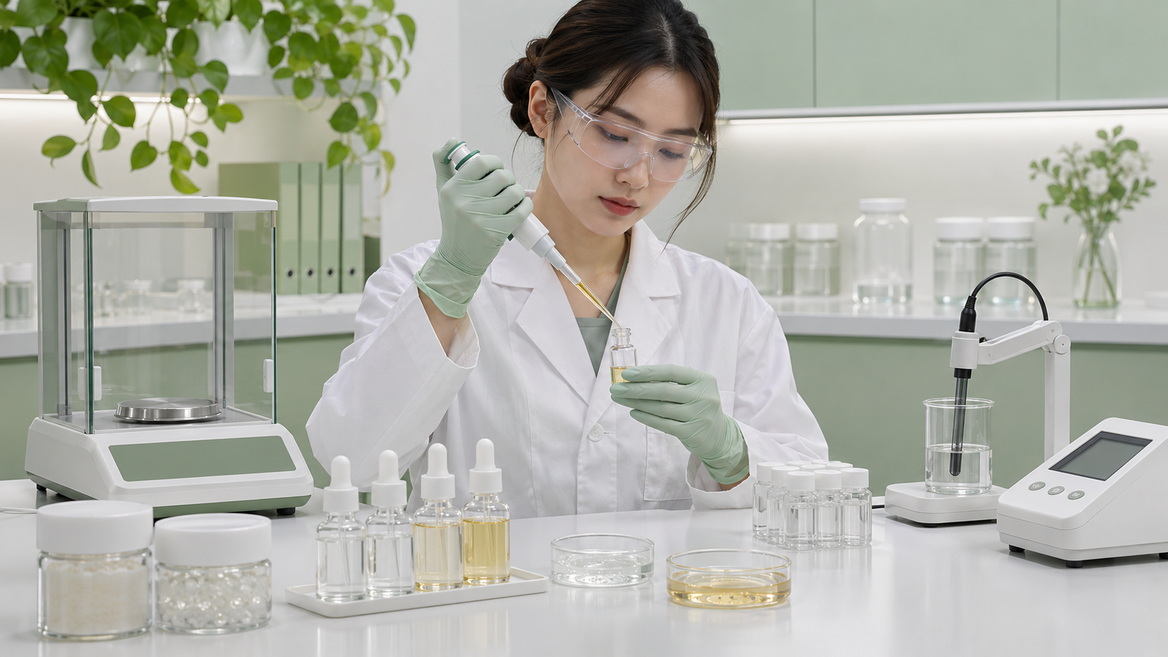
A purchasing brief should go beyond "hyaluronic acid serum" or "vitamin C serum."
Require the supplier to document:
- Exact INCI names and ingredient grades.
- Raw-material manufacturer and approved source.
- Active content in the supplied ingredient.
- Finished-formula concentration where relevant.
- Storage conditions and shelf life.
- Batch-specific certificates of analysis.
An illustrative procurement trap is confusing the percentage of an ingredient blend added to a formula with the concentration of its active component. A formula containing 2% of a hypothetical blend that is 10% active contains 0.2% of that active—not 2%.
Write the agreed basis of calculation into the product specification.
A serum is a complete formulation-and-packaging system.
The technical review should address pH, viscosity, appearance, odor, dispensing performance, microbiological quality, and stability in the intended commercial container. Cosmetic safety assessments also consider stability, impurities, and packaging-related information. [gov]
Ask for testing on the actual bottle, pump or dropper, gasket, and decoration—not only a laboratory container.
CE and RoHS should not be treated as general quality certifications for an ordinary cosmetic serum. Focus instead on cosmetic manufacturing controls and the destination market's product requirements.
For EU-bound products, the compliance framework includes a Responsible Person, safety assessment and CPSR, product information, and CPNP notification. These obligations are separate from a factory's quality-system certification. [gov]
For the United States, FDA facility registration and product listing are not approval. FDA explicitly states that it does not issue certificates verifying compliance with cosmetic registration or listing requirements. [fda]
For environmental positioning, distinguish environmental management from product claims. Bawei, for example, lists ISO 14001, but that does not by itself establish that a particular serum is organic, biodegradable, or environmentally superior. [baweicosmetic]
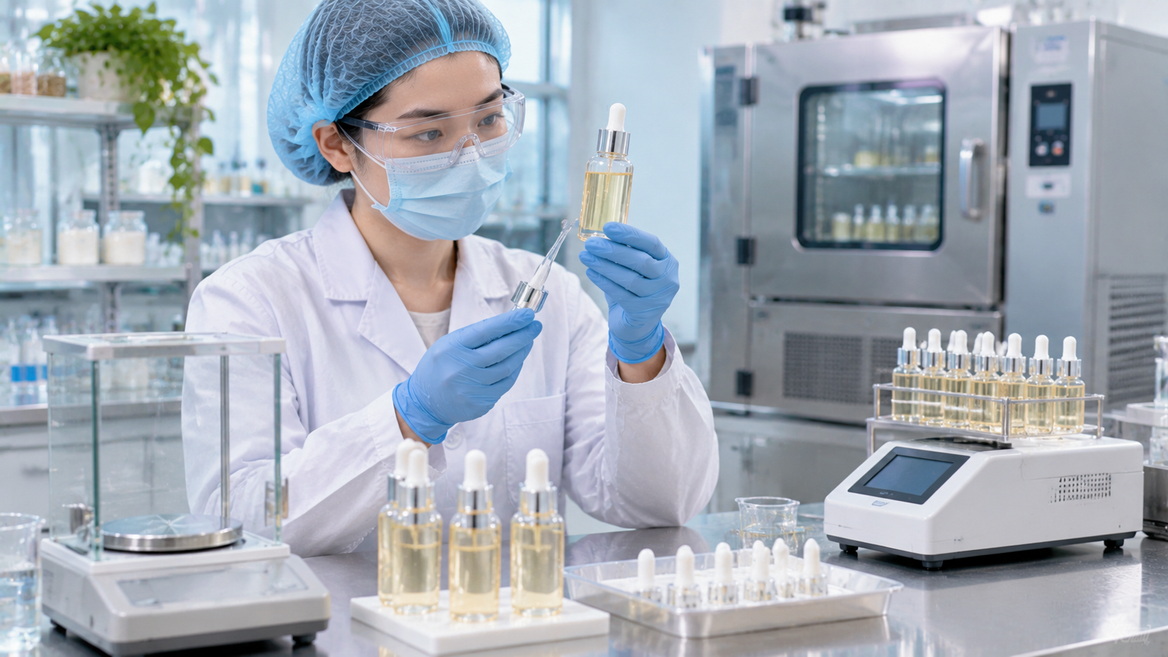
Request the legal business name, manufacturing address, production authorization where applicable, current certificates, and subcontracting arrangements.
Cross-check the entity on the quotation, contract, certificate, and batch documentation.
Specify target market, user profile, claims, benchmark texture, ingredient restrictions, fill size, packaging, target cost, launch quantity, and forecast.
Ask each manufacturer to quote against the same brief.
Use a documented sequence:
1. Formula screening.
2. Sensory and performance review.
3. Packaging selection.
4. Pilot or scale-up review.
5. Required safety, stability, and compatibility work.
6. Signed commercial specification.
Keep approved reference samples and record formula version numbers.
Include testing, artwork, tooling, cartons, inspection, freight, insurance, duties, and potential development charges.
A cheaper bottle price can become a more expensive launch if packaging minimums or testing costs are excluded.
Ask for separate dates for component ordering, sample approval, production booking, testing, release, and dispatch.
For shipment, agree on Incoterms, consignee responsibilities, customs classification, commercial documents, and any temperature or dangerous-goods considerations applicable to the specific formula.
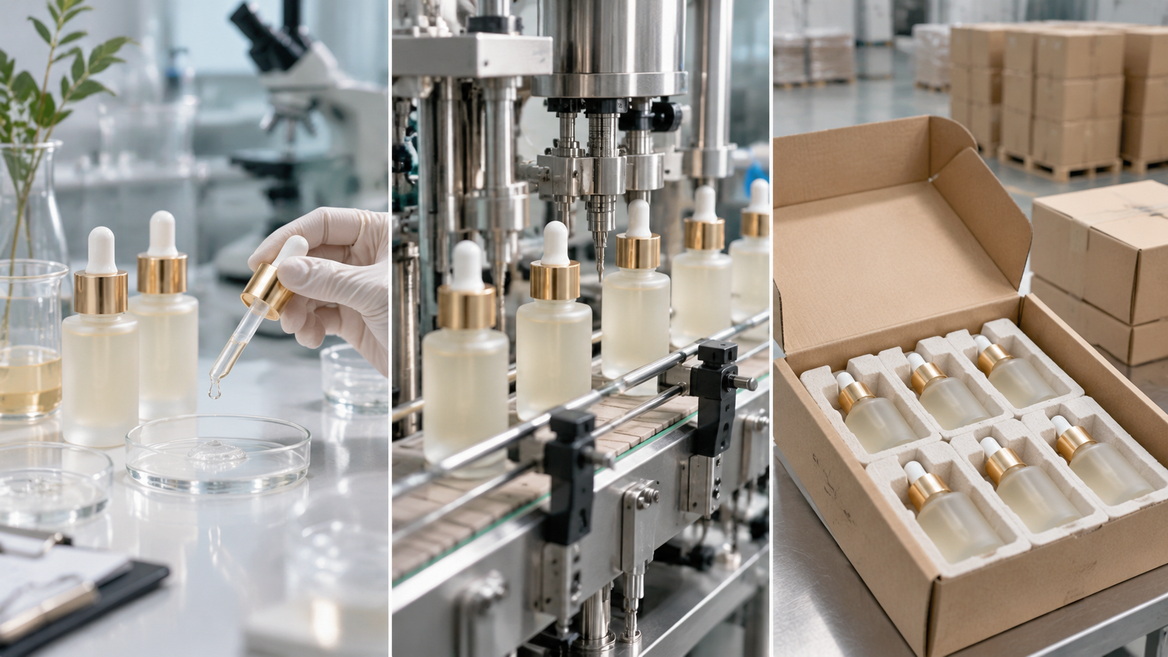
One particularly important procurement risk is treating an approved sample as a complete manufacturing agreement.
A sample may look right while the commercial contract leaves ingredient sources, formula version, packaging components, or process changes undefined.
The solution is change control.
Attach a technical schedule identifying:
- Approved formula code and revision.
- Critical raw-material specifications.
- Approved packaging components.
- Finished-product release limits.
- Required batch documentation.
- Changes requiring prior written consent.
Also ask the factory to explain differences between laboratory preparation and commercial manufacture. This turns "make it like the sample" into a traceable production requirement.
These ten suppliers serve different needs. LAIMEI, Ariel, TY Cosmetic, and Zicail warrant consideration for private label and growing-brand projects. COSMAX China, Nox Bellcow, Bawei, Kolmar Wuxi, BioTruly, and Easycare offer other combinations of scale, development infrastructure, testing, or specialized product concepts. Their suitability depends on the specific brief—not their position in a list. [lmoemcosmetics]
For a LAIMEI face serum project, submit your target market, product concept, preferred ingredients, packaging reference, and launch quantity. Request a written proposal covering formulation options, MOQ conditions, sample stages, manufacturing-site documents, testing responsibilities, and production milestones.
Check the certificate number, legal entity, site address, scope, issue date, and expiry date. Then verify its current status directly with the certification body through independently obtained contact details.
A PDF alone is insufficient. Also confirm that the scope covers the activity and facility proposed for your serum. ISO 22716 certification concerns cosmetic manufacturing practices, not approval of every product made at the site. [iso]
No. FDA states that cosmetic facility registration and product listing do not indicate approval of either a facility or its products.
FDA also states that it does not provide certificates verifying compliance with these registration or listing requirements. Buyers should therefore scrutinize third-party "FDA certificates" rather than treating them as product authorization. [fda]
Do not assume so. Ask the qualified assessor or testing specialist whether the change affects the supporting evidence.
Packaging information and product stability form part of cosmetic safety assessment considerations. The supplier should document whether the existing evidence remains applicable or additional testing is needed. [gov]
Ownership and transfer rights must be negotiated in writing. Paying a development fee does not, by itself, settle exclusivity, disclosure, or manufacturing-transfer rights.
Specify ownership of new work, treatment of pre-existing formulas, access to quantitative composition, permitted territories, confidentiality, and transfer documentation. For EU sales, ensure the agreed disclosure arrangements support the safety assessment and product information requirements. [gov]
Compare the complete commercial specification rather than quantity alone.
Ask whether each MOQ applies to filling, bulk formula, printed packaging, or a complete SKU. Then compare customization depth, testing, component stock, development charges, and repeat-order terms.
For example, LAIMEI advertises trial production from 500 units, while Zicail advertises 3,000 units. Neither figure establishes an equivalent serum specification or total project cost. [lmoemcosmetics]
- World Bank WITS / UN Comtrade, "China exports of beauty, make-up and skin-care preparations, HS 330499, 2025." Used for the export value and category limitations. [wits.worldbank]
- ISO, "ISO 22716:2007—Cosmetics: Good Manufacturing Practices." Used for the manufacturing-standard scope. [iso]
- ISO 11930:2019, "Cosmetics—Microbiology—Evaluation of the antimicrobial protection of a cosmetic product." Used for preservation testing and microbiological risk assessment. [cdn.standards.iteh]
- U.S. FDA, September 2026 clarification on cosmetic registration and listing certificates, plus Cosmetics Direct guidance. [fda]
- UK Government guidance on the EU/EEA and Northern Ireland cosmetics framework, including Responsible Person, CPSR, packaging information, and CPNP requirements. [gov]
- LAIMEI, "About Us," supplemented by the company brief supplied for this article. [lmoemcosmetics]
- COSMAX China, corporate history and China operations. [cosmax.com]
- Nox Bellcow, company profile; BASF corporate announcement confirming its background. [hknbc]
- Bawei Biotechnology, corporate profile and stated certifications. [baweicosmetic]
- Kolmar Wuxi, official business overview; July 2026 reporting on capacity and MFDS recognition. [hkkolmar]
- BioTruly, company overview, manufacturing history, and service scope. [biotruly]
- Easycare, official English company profile. [easycaregroup]
- TY Cosmetic, official manufacturing and service overview. [tycosmetic]
- Ariel Cosmetic, official company profile. [arielcosmetic]
- Zicail, official manufacturing and private label workflow overview. [zicail]


