
Views: 256 Author: Vera Publish Time: 2026-10-13 Origin: Site


Content Menu
● Sebaceous Filaments vs. Blackheads: A Quick Comparison
● What Are Sebaceous Filaments?
>> Why Are Sebaceous Filaments So Visible on the Nose?
>> Can You Remove Sebaceous Filaments Permanently?
● How to Tell Sebaceous Filaments from Blackheads Without Squeezing
>> 1. Look at the Overall Pattern
>> 2. Compare Color and Texture
● Best Ingredients for Blackheads and Visible Sebaceous Filaments
>> Salicylic Acid: A Targeted Option for Congestion
>> Adapalene: More Relevant to Acne Than Normal Pores
>> Moisturizers and Clay Masks: Supporting, Not Replacing, Treatment
● A Practical Routine for Sebaceous Filaments and Blackheads
>> Morning: Cleanse, Moisturize, Protect
>> Evening: Remove Residue and Use One Targeted Product
>> Evaluate Progress Over Weeks, Not Hours
● A Better Progress Test: Separate Congestion from Irritation
● Common Mistakes That Make Pore Care More Difficult
>> Squeezing and Repeated Pore-Stripping
>> Expecting Permanent Pore Closure
>> Introducing Too Many Products at Once
● A Formulation Perspective: Why Product Design Matters
>> Define the Intended Outcome First
>> Test the Finished Formula, Not Just the Ingredient Story
>> Keep Cosmetic and Acne Claims Distinct
● How LAIMEI Can Support Pore-Care Product Development
>> Are Sebaceous Filaments a Type of Acne?
>> Can Sebaceous Filaments Turn into Blackheads?
>> Why Do Dots on My Nose Return After Extraction?
>> Does Salicylic Acid Help Both Concerns?
>> Should I Use Pore Strips Every Week?
>> When Should I See a Dermatologist?
Sebaceous filaments vs. blackheads: those tiny dots on your nose may look similar, but they need different approaches. Sebaceous filaments are normal structures that help move oil to your skin's surface. Blackheads are clogged pores and a form of acne. Understanding the difference helps you choose suitable products, avoid unnecessary extraction, and set realistic expectations.
From a skincare development perspective, the distinction matters beyond appearance. A formula designed to improve visible oiliness should not automatically be presented as an acne treatment. Likewise, normal skin texture should not become a problem that requires increasingly aggressive products.
This guide combines dermatology guidance with a formulation-focused perspective to explain identification, ingredients, practical routines, and responsible product development.
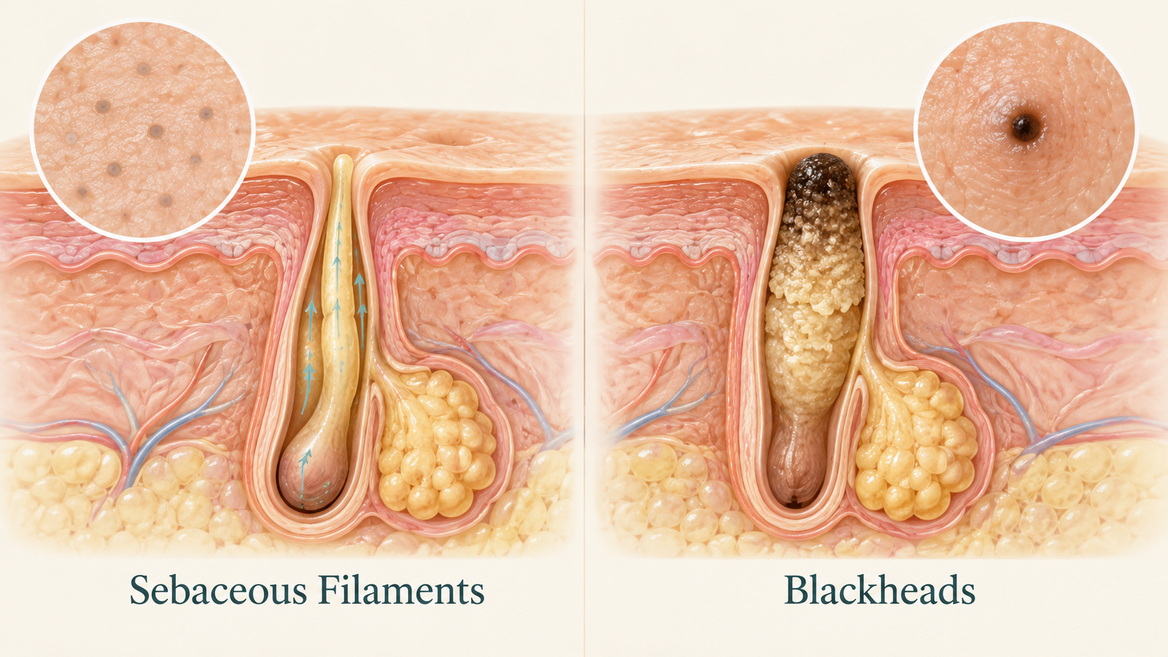
The most important distinction is function: sebaceous filaments support normal oil movement, while blackheads involve a blockage.
| Comparison point | Sebaceous filaments | Blackheads |
|---|---|---|
| What they are | Normal structures associated with oil transport | Open comedones, a type of acne |
| Typical appearance | Small, relatively uniform dots | More distinct dark dots or bumps |
| Common colors | Gray, yellowish, or light brown | Dark brown or black |
| Surface texture | Usually flat | May feel slightly raised |
| Common locations | Especially noticeable on the nose and central face | Face and other acne-prone areas |
| Pore blockage | No obstructing plug | Oil and dead skin form a plug |
| Main care goal | Reduce visibility if desired | Clear congestion and prevent new lesions |
| Permanent elimination | Neither realistic nor necessary | Individual lesions can clear, but new ones may develop |
Appearance provides clues, not a definitive diagnosis. Both can occur in the same area.
Sebaceous filaments are thin, threadlike structures associated with your skin's oil glands. They help move sebum, your skin's natural oil, toward the surface.
They are not dirt, evidence of poor hygiene, or acne.
The nose has a high concentration of oil glands. When oil production increases or pores become more noticeable, sebaceous filaments may become easier to see.
Typical features include:
- Small dots with a fairly consistent pattern.
- A flat appearance.
- Gray, yellowish, or light-brown coloring.
- No pain or discomfort.
Close-up photography and magnifying mirrors can make normal texture appear more dramatic. The presence of visible dots does not, by itself, mean your skin needs treatment.
No. Even if their contents are expressed, the pores refill because oil production continues.
The sensible goal is to manage their appearance without damaging the surrounding skin. A comfortable complexion with some visible pores is a more realistic outcome than permanently poreless skin.
Blackheads are open comedones. They develop when excess oil and dead skin accumulate inside a pore while its opening remains exposed.
The dark appearance results from oxidation of the exposed material, not simply dirt on the skin.
Blackheads form through a combination of oil production and the accumulation of skin cells within follicles. Hormonal changes and products that contribute to congestion may also play a role.
This explains why scrubbing harder is not a reliable solution. Removing surface oil does not necessarily correct the process occurring inside the pore.
Blackheads may also appear alongside whiteheads and inflamed pimples. When several types of lesions coexist, a broader acne treatment plan may be more useful than a nose-only product.
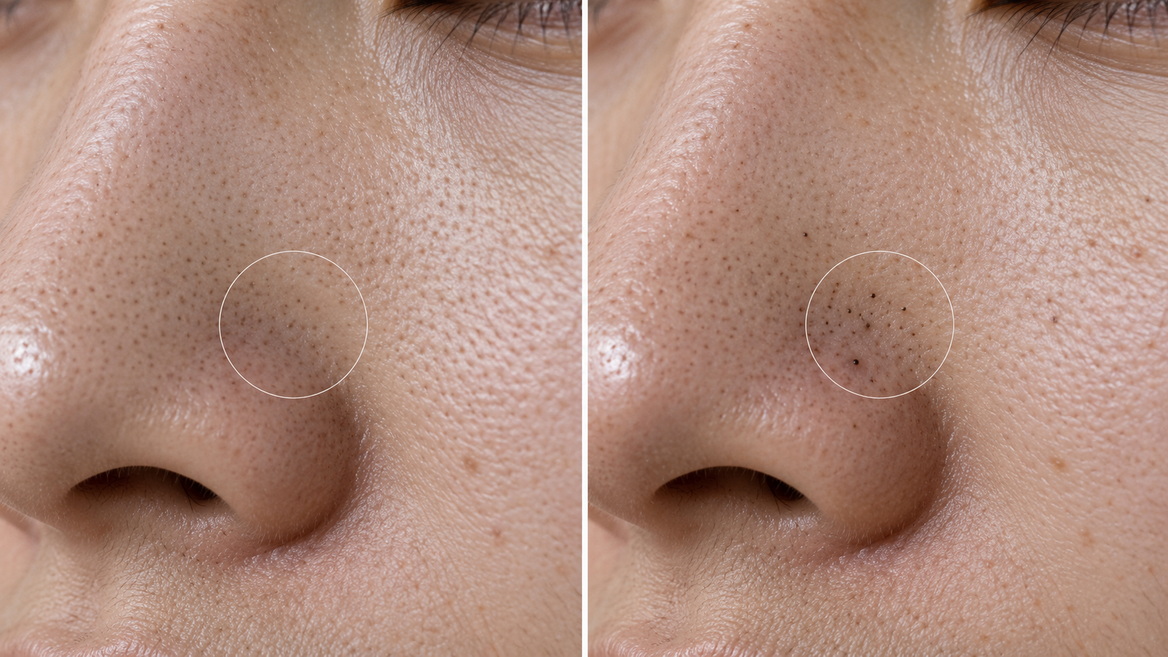
Use the following visual checks as an initial guide.
Many tiny, similarly sized dots across the nose suggest sebaceous filaments.
A smaller number of conspicuously dark, distinct spots may suggest blackheads.
Sebaceous filaments are usually lighter and flat. Blackheads tend to be darker and may feel slightly raised.
However, color and lighting vary. Neither feature is conclusive on its own.
Normal sebaceous filaments should not hurt. Redness, tenderness, swelling, or significant inflammation may indicate another issue.
Do not squeeze a spot to identify it. Extraction can irritate the skin and introduces an unnecessary risk of injury.
If a spot changes, bleeds, remains painful, or looks unlike surrounding pores, seek professional assessment rather than assuming it is a blackhead.
Ingredient selection should match the concern, skin tolerance, and product instructions. More active ingredients do not automatically produce better results.
| Ingredient or product type | Main purpose | Important limitation |
|---|---|---|
| Salicylic acid | Exfoliates and helps unclog pores | Can cause dryness or irritation |
| Adapalene | Treats acne, including blackheads and whiteheads | Requires careful introduction; pregnancy precautions apply |
| Gentle cleanser | Removes surface oil, makeup, and residue | Does not permanently remove filaments |
| Noncomedogenic moisturizer | Supports hydration during a routine | Not a substitute for acne treatment |
| Clay mask | Temporarily absorbs surface oil | Does not permanently change pore structure |
Salicylic acid is commonly used for blackheads because it helps exfoliate skin and unclog pores.
It may also make sebaceous filaments less noticeable, but that does not mean it eliminates them.
Choose one salicylic acid product initially and follow its directions. Introducing an exfoliating cleanser, toner, serum, and mask together makes it difficult to identify which product causes irritation.
For sensitive skin, suitability matters more than seeking the strongest formula.
Adapalene is a topical retinoid that helps clear blackheads, whiteheads, and pimples.
It is worth discussing with a dermatologist or pharmacist when persistent blackheads occur alongside other acne lesions. It is not necessary simply because normal filaments are visible.
Retinoids can irritate the skin. Avoid topical retinoids during pregnancy, and discuss treatment choices with your clinician if pregnant or planning pregnancy.
A noncomedogenic moisturizer can help maintain comfort while using acne products. Oily skin can still need hydration.
Clay masks may temporarily reduce a greasy appearance. They should remain optional, especially if your routine already contains exfoliating or acne-treatment products.
Persistent tightness, burning, or flaking is a reason to simplify the routine—not add another purifying step.
The following framework emphasizes consistency and tolerance rather than aggressive removal.
1. Cleanse gently with lukewarm water and a mild cleanser.
2. Apply a noncomedogenic moisturizer suited to your skin.
3. Use broad-spectrum SPF 30 or higher sunscreen.
Avoid abrasive brushes or repeated cleansing to make the nose feel completely oil-free.
1. Remove makeup and sunscreen thoroughly but gently.
2. Cleanse without scrubbing.
3. Apply your chosen treatment according to its label.
4. Moisturize as needed.
If sebaceous filaments are your only concern, a basic routine may be sufficient. An active product is optional, not an obligation.
For blackheads, choose a treatment approach that you can use consistently without persistent irritation.
Acne treatment generally needs several weeks before improvement becomes apparent. Dermatology guidance commonly recommends allowing six to eight weeks before judging early results.
Do not interpret this as a promise that every blackhead will disappear within that period.
Stop products that cause substantial irritation and seek advice. Patience is appropriate for gradual improvement, not for worsening discomfort.
A useful home-monitoring method is to track three outcomes separately:
- Congestion: Are distinct blackheads becoming less numerous?
- Comfort: Is the skin stinging, peeling, or feeling tight?
- Appearance: Is visible shine or pore contrast improving?
Take occasional photographs under similar lighting and at a similar distance. Avoid comparing a magnified close-up with a filtered image.
This is a practical observation method, not a validated clinical scoring system.
Its value is simple: a product that briefly makes pores look cleaner but repeatedly causes irritation may not be a sustainable choice. For sebaceous filaments, improved comfort and a less noticeable appearance can be a successful outcome even when dots remain visible.
Squeezing can injure the skin. Pore strips may also remove sebaceous filament contents without preventing their return.
Temporary removal is not equivalent to correcting blackhead formation.
For persistent blackheads, a dermatologist can determine whether professional extraction or a different treatment is appropriate.
Blackheads are not proof that someone is unclean. Repeated washing and harsh scrubbing can worsen irritation without resolving the underlying blockage.
Pores are normal skin openings. Claims about "closing" them permanently create unrealistic expectations.
A more credible goal is improving the appearance of pores or reducing visible congestion.
When several products start simultaneously, both results and adverse reactions become difficult to interpret.
A simpler routine creates a clearer connection between the product used and the outcome observed.
For skincare brands, sebaceous filaments vs. blackheads is not just a content topic. It affects formulation goals, testing, instructions, and marketing claims.
A product designed to reduce visible shine has a different objective from a product intended to treat acne.
Useful development questions include:
- Is the main concern surface oiliness, visible pore appearance, or acne?
- Who is the intended user?
- How will the product fit into an existing routine?
- What evidence will support the finished product's claims?
An ingredient's reputation alone does not establish the performance of the complete formula.
From a development standpoint, brands should consider stability, microbiological quality, packaging compatibility, and skin tolerance.
When measuring cosmetic appearance, standardized photographs and clearly defined assessment criteria can make comparisons more meaningful.
These are proposed development practices, not claims that a particular LAIMEI product has completed such testing or achieved a specific result.
In the United States, intended use influences whether a product is regulated as a cosmetic, a drug, or both. A claim to treat acne carries different implications from a claim to improve the appearance of oily skin.
Facility registration must not be described as product approval.
This distinction helps brands avoid presenting manufacturing credentials as evidence of clinical effectiveness.

According to the company information supplied for this article, GUANGZHOU LAIMEI CREATIVE RESEARCH INTELLIGENT BIOLOGICAL RESEARCH CO., LTD. has 13 years of skincare and cosmetics development and manufacturing experience.
The supplied profile describes:
- A 20,000 m² GMP-standard production base.
- Annual production capacity exceeding 50 million units.
- Support for formulation, packaging design, and manufacturing.
- Products supplied to more than 100 countries and regions.
- R&D collaboration involving dermatologists, engineers, and laboratory professionals.
These are company-provided statements, not independently verified findings. Buyers should request current documentation, confirm certification scope, and evaluate product-specific evidence.
For a pore-care range, a focused brief could include a gentle cleanser, an appropriately positioned exfoliating product, and a lightweight moisturizer.
Contact LAIMEI with your target market, customer profile, preferred texture, packaging requirements, and intended claims to discuss a tailored OEM/ODM development brief.
No. They are normal structures involved in moving oil to the skin's surface. Blackheads, by contrast, are a form of acne.
A pore containing normal filaments can also become clogged. However, filaments are not inherently early-stage acne, and their visibility does not mean blackheads will develop.
Sebaceous filaments refill as oil production continues. Blackheads can also recur if the conditions contributing to congestion remain.
It can help unclog pores and treat blackheads. It may also reduce the visibility of sebaceous filaments, but cannot permanently eliminate them.
Routine stripping is unnecessary for normal filaments. It offers temporary removal and may irritate the skin. Consistent, gentle care is generally a more sustainable approach.
Seek advice for painful or inflamed lesions, scarring, uncertainty about a spot, or persistent acne despite consistent treatment. Changing or bleeding spots need assessment rather than home extraction.
1. [Cleveland Clinic — Sebaceous Filaments: Difference From Blackheads & Treatment]. Source for filament function, appearance, recurrence, and care precautions. [my.clevelandclinic]
2. [American Academy of Dermatology — Adult Acne Treatment Dermatologists Recommend]. Source for salicylic acid, adapalene, and treatment timelines. [aad]
3. [American Academy of Dermatology — Acne: Diagnosis and Treatment]. Source for acne therapies, expected response time, and treatment precautions. [aad]
4. [American Academy of Dermatology — How to Treat Different Types of Acne]. Source for blackhead formation, avoiding scrubbing, and professional extraction. [aad]
5. [U.S. Food and Drug Administration — Is It a Cosmetic, a Drug, or Both?]. Source for distinctions involving cosmetic and acne-treatment claims. [fda]
6. [U.S. Food and Drug Administration — Registration & Listing of Cosmetic Product Facilities and Products]. Source confirming that registration and listing do not signify approval. [fda]
7. [Eminence Organic Skin Care — Sebaceous Filaments vs. Blackheads: What's the Difference?]. Comparison article supplied as the editorial starting point; this article uses original wording and additional clinical and manufacturing perspectives. [eminenceorganics]


