
Views: 244 Author: Vera Publish Time: 2026-10-16 Origin: Site


Content Menu
● Why Source Glow Serum From China?
>> A Growing Cosmetics Export Base
>> Multiple Manufacturing Clusters
● Selection Criteria: How to Evaluate a Glow Serum Manufacturer
>> What Certifications Do Not Prove
● Comparison Table: Capacity, MOQ, and Certification Evidence
● The Top 10 Glow Serum Manufacturers in China
>> 1. GUANGZHOU LAIMEI CREATIVE RESEARCH INTELLIGENT BIOLOGICAL RESEARCH CO.,LTD.
>> 3. Ausmetics
>> 5. Guangdong Bawei Biotechnology Corporation
>> 7. Guangzhou Xiran Cosmetics
● Glow Serum Technical Requirements Buyers Should Specify
>> Define "Glow" Before Requesting Samples
>> Specify Active Identity, Not Just Marketing Names
>> Evaluate the Formula and Packaging Together
● Buyer's Guide: From Factory Verification to Delivery
>> 1. Verify the Manufacturing Site
>> 2. Use a Structured Sampling Process
>> 3. Separate Formula MOQ From Packaging MOQ
>> 4. Prepare Compliance for the Destination Market
>> 5. Plan Transport Around the Product
● Insider Pitfall: A "10% Complex" May Not Mean 10% Active
● Conclusion: Choose a Partner You Can Verify
● FAQ
>> 1. How Can I Verify Whether a Manufacturer's ISO Certificate Has Expired?
>> 2. How Can I Confirm the Factory Is Registered With FDA Without an "FDA Certificate"?
>> 3. Can I Use the Supplier's Existing Stability and Challenge-Test Reports?
>> 4. How Do I Protect Formula Ownership and Prevent Silent Substitutions?
>> 5. Does a 500-Unit MOQ Make Fully Custom Manufacturing Economical?
● Source Notes and Official Verification Resources
Choosing a glow serum manufacturer requires more than comparing ingredient lists and unit prices. Professional buyers need a partner that can maintain formula consistency, protect sensitive active ingredients, document product safety, and deliver repeat orders without unexpected changes.
China offers several types of manufacturing partners: flexible private-label factories, established skincare ODM specialists, and multinational contract manufacturers with production facilities in China. The right choice depends on your target market, development budget, order volume, and documentation requirements.
This guide compares ten manufacturers worth evaluating for glow serum projects. It examines factory credentials, research capabilities, quality-control systems, production scale, and OEM/ODM support—not simply the size of a supplier's catalog.
Disclosure: This article was prepared for GUANGZHOU LAIMEI CREATIVE RESEARCH INTELLIGENT BIOLOGICAL RESEARCH CO.,LTD. LAIMEI appears first as the commissioning company, not as the winner of an independent factory audit. Other manufacturers were selected using publicly available information. Supplier statements, certificate validity, and project-specific capabilities require verification before contracting.
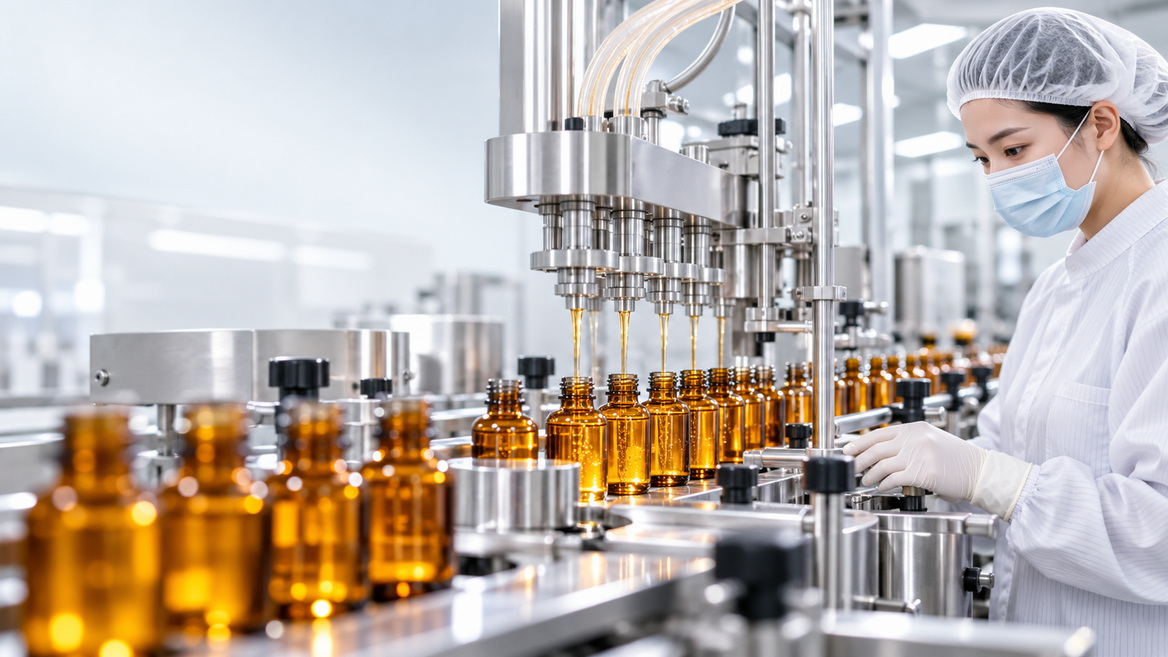
China's cosmetics exports reached approximately US$7.82 billion in 2025, increasing 9.2% year over year, according to industry reporting citing the General Administration of Customs. This figure covers cosmetics broadly; it is not a glow-serum-specific market estimate. Buyers should avoid treating total cosmetics exports as evidence of serum production capacity or product efficacy. [globalcosmeticsnews]
Nevertheless, the export scale provides useful context: buyers can evaluate manufacturers ranging from international contract manufacturing groups to suppliers serving emerging private-label brands.
The manufacturers in this guide illustrate two important sourcing regions:
- Guangdong: Guangzhou, Foshan, and Zhongshan host skincare OEM/ODM suppliers, including LAIMEI, TY Cosmetic, Blackbird Skincare, and NOX BELLCOW.
- The Yangtze River Delta: Shanghai, Suzhou, and Wuxi host manufacturing operations associated with COSMAX, Intercos, and Kolmar. [lmoemcosmetics]
These locations offer different partnership options. A startup seeking a limited first launch may prioritize packaging flexibility and accessible development support. An established brand may prioritize larger production systems, technology transfer, and structured supplier qualification.
The sourcing question is therefore not "Which factory is largest?" It is "Which factory can reliably manufacture our specific serum under our commercial and regulatory requirements?"
This shortlist uses six purchasing criteria. It does not claim that every supplier has passed an independent audit.
| Evaluation Area | Evidence Buyers Should Request | Why It Matters |
|---|---|---|
| Manufacturing identity | Business license, production address, manufacturing authorization, subcontracting disclosure | Confirms who actually makes the product |
| Quality systems | Current certificates, audit scope, deviations and corrective-action records | Shows whether controls cover the relevant facility |
| Formulation capability | Ingredient specifications, development process, stability data | Separates formula development from catalog relabeling |
| Product safety | Safety substantiation, microbiological testing, preservation assessment | Supports safe commercialization |
| Delivery reliability | Capacity allocation, component availability, documented lead times | Reduces launch and replenishment uncertainty |
| Commercial fit | MOQ by formula and packaging component, ownership terms, change-control agreement | Prevents hidden costs and supplier lock-in |
ISO 22716 addresses cosmetic good manufacturing practices, including production, control, storage, and shipment. ISO 11930 addresses antimicrobial protection, while ISO 17516 addresses microbiological quality. These serve different purposes: a factory quality-system certificate does not replace product-specific testing. [iccr-cosmetics]
FDA registration is not FDA approval. In September 2026, FDA reiterated that it does not issue certificates verifying cosmetic facility registration or product listing. A registration number does not indicate approval of the factory or its cosmetics. [fda]
Similarly, CE marking and RoHS should not be presented as the principal compliance credentials for an ordinary cosmetic serum. CE marking applies only to products covered by relevant legislation; ordinary cosmetic serums follow cosmetics-specific requirements. RoHS concerns restricted substances in electrical and electronic equipment, rather than ordinary serum formulations. [single-market-economy.ec.europa]
For environmental claims, request evidence matching the exact claim—such as packaging composition and recycled-content documentation—rather than accepting an unrelated certificate logo.
Capacity figures below are supplier-reported and cover different product categories and reporting periods. They are not directly comparable serum-output figures. "Not verified" means the reviewed sources did not establish a dependable project-specific number.
| Manufacturer | Main Sourcing Fit | Published Scale or Capacity | MOQ | Certification or Quality Evidence |
|---|---|---|---|---|
| LAIMEI | Emerging brands seeking integrated customization | Company brief states 20,000 m² and over 50 million units/year; independently unverified | Website advertises orders as low as 500 units, subject to project terms | Company brief claims ISO 22716 and GMPC; verify current scope |
| NOX BELLCOW | High-volume skincare and mask programs | Reports 50,000 m² GMP workshops and over 1 million skincare bottles/day | Obtain serum-specific quotation | GMP workshop claim; request current certificates |
| Ausmetics | Broad personal-care and international OEM/ODM projects | 2020 release reported 300 million units/year across product categories | Obtain quotation | ISO 22716 and GMPC reported in the 2020 release; reconfirm |
| TY Cosmetic | Private-label skincare and coordinated product launches | Reports three factories; serum capacity not verified | Obtain formula-and-packaging quotation | Three GMP-certified factories reported in 2025 |
| Guangdong Bawei | Integrated formulation, testing, and manufacturing | Website reports more than 68 production lines | Obtain quotation | Request site-specific certificates and testing scope |
| Blackbird Skincare | Independent brands needing sourcing coordination | Current serum capacity not verified | Obtain quotation | Certificate status not verified in reviewed source |
| Guangzhou Xiran | Serum-led OEM/ODM and packaging customization | Current serum capacity not verified | Obtain quotation | Website states GMPC and ISO 22716 |
| COSMAX China | Established brands seeking structured ODM development | China serum capacity not verified in reviewed primary source | Obtain quotation | Qualify the selected China facility |
| Intercos China | Premium projects seeking international development support | Official site confirms multiple Suzhou facilities | Obtain quotation | Request skincare-site quality documentation |
| Kolmar China | R&D-led skincare development and scale-up | Beijing and Wuxi operations confirmed; current serum capacity not verified | Obtain quotation | Request selected facility's current certificates |
Sources for the comparison: manufacturer pages and supplier-issued announcements. Historical production figures should not be used as current capacity commitments. [lmoemcosmetics]
LAIMEI is a relevant candidate for small and medium-sized brands seeking formula development, packaging coordination, and manufacturing support through one supplier.
The company-provided brief states 13 years of skincare and cosmetics manufacturing experience, a 20,000 m² production base, annual capacity exceeding 50 million units, and distribution to more than 100 countries and regions. These are company-supplied claims rather than independently audited findings; the legal incorporation year should be confirmed separately.
LAIMEI's public website describes formulation customization, packaging support, global compliance assistance, and trial production with MOQ as low as 500 units. It also describes formula adjustments, packaging optimization, and logistics tracking as part of its support model. [lmoemcosmetics]
Its practical appeal is the potential to coordinate several development tasks without requiring a new brand to manage separate formulation, packaging, and production vendors.
For a glow serum project, buyers should discuss:
- Existing-formula private labeling versus original formula development.
- Ingredient selection and target-market restrictions.
- Packaging compatibility and decoration options.
- Written sample revision stages.
- A named project contact and agreed response times.
- Pilot-order conditions and repeat-order specifications.
The company's cost-performance positioning should be evaluated through an itemized quotation, not assumed from its marketing. Likewise, communication efficiency should be tested during sampling.
A specific due-diligence issue is the difference between the supplied brief's reference to more than 1,000 associated professionals and the website's statement of more than 2,000 team members across its expanded operations. Buyers should clarify whether these figures describe direct employees, laboratories, affiliated factories, or a wider network. [lmoemcosmetics]
The brief also mentions "MADS certification." Request the certificate's full name, issuer, standard, scope, and expiry date before using that claim in customer-facing materials.
Established in 2004, NOX BELLCOW is based in Zhongshan, Guangdong, and focuses on ODM development and manufacturing of skincare, masks, and wipes. It reports exports to more than 40 countries and regions. [lp.hknbc]
Its published scale makes it worth evaluating for brands planning larger skincare programs or coordinated serum-and-mask launches. The company reports more than one million skincare bottles of daily production capacity, but buyers should confirm available serum filling capacity rather than equating total output with their allocated production slot. [lp.hknbc]
OEM/ODM discussions should cover formulation development, filling format, packaging integration, and testing responsibilities.
Purchase checkpoint: distinguish serum bottling capacity from mask production capacity, and obtain a written MOQ and lead-time commitment for the exact SKU.
Ausmetics Daily Chemicals (Guangzhou) Co., Ltd. was founded in 1998. Its stated OEM/ODM scope includes skincare, body care, hair care, and hygiene products, with exports to more than 40 countries and regions. [prnewswire]
A 2020 company-issued announcement described three production bases, two R&D centers, annual capacity of 300 million units, and ISO 22716 and GMPC credentials. It also mentioned support for COAs, SDSs, cosmetic safety reports, and dermatological testing reports. These historical statements need current confirmation. [prnewswire]
Ausmetics is relevant for buyers developing a glow serum within a broader personal-care range rather than purchasing a single isolated product.
Purchase checkpoint: ask which facility will manufacture the serum and whether the supplied test documents apply to the final formula and packaging.
TY Cosmetic was founded in Guangzhou in 2009. Its 2025 announcement described three GMP-certified factories, a 70-member R&D team, more than 7,900 tested formulations, and customers in over 74 countries. [prnewswire.co]
The company specializes in skincare and haircare OEM/ODM, serving private-label brands, e-commerce sellers, and startups. This makes it a candidate for buyers wanting coordinated development across several products. [prnewswire.co]
For glow serum sourcing, investigate how much customization is available beyond an existing formula: active selection, sensory profile, viscosity, fragrance, packaging, and claim support.
Purchase checkpoint: "tested formulation" does not automatically mean a finished serum has completed the stability, safety, and efficacy work required for your launch.
Founded in 2006, Guangdong Bawei describes an integrated business covering planning, research, testing, and manufacturing, including an independent third-party testing institution. Its website reports more than 68 production lines. [baweicosmetic]
Bawei is worth evaluating when testing coordination and development structure are important purchasing criteria.
Its OEM/ODM scope extends beyond filling a supplied formula, making it relevant to brands seeking a more organized development pathway. However, the reviewed sources do not establish a reliable export-market breakdown or serum-specific MOQ.
Purchase checkpoint: verify the testing institution's accreditation scope. A laboratory relationship does not mean every requested microbiological, chemical, or efficacy method falls within accredited services.
Blackbird's published company profile distinguishes three milestones: factory establishment in 2002, a foreign-trade division in 2009, and a formal foreign-trade company in 2015. Buyers should preserve that distinction rather than presenting one date as the incorporation year of every associated entity. [linkedin]
Based in Foshan, the company describes services for independent skincare brands, major businesses, and e-commerce retailers. Its stated scope includes development, raw-material and packaging sourcing, sampling, production, quality-control assessment, and delivery coordination. [linkedin]
This model is relevant to buyers needing supply-chain management as well as manufacturing.
Purchase checkpoint: identify the contracting company, the actual production facility, and any subcontractors. Its reviewed profile does not provide a detailed regional sales breakdown or independently verified current capacity.
Guangzhou Xiran Cosmetics states that it was founded in 2013. Its serum offering includes OEM/ODM development and formula and packaging customization. The company identifies Europe, North America, and the Middle East among its overseas markets. [xiranskincare]
Its website lists GMPC and ISO 22716 among its credentials. It also describes assistance with market documentation, including cosmetic safety reports and product information files. [xiranskincare]
Xiran is relevant for buyers seeking a supplier with an explicitly presented facial-serum development service.
Purchase checkpoint: distinguish documentation assistance from completed regulatory compliance. A service listing is not proof that the final SKU has a valid safety assessment or market notification.
COSMAX established its Shanghai operation in 2004 and its Guangzhou operation in 2013, according to its China history page. These are China-operation milestones, not the founding date of the international parent group. [cosmax.com]
Its China presence makes it a candidate for brands seeking localized development through an international ODM organization. Recent reporting describes its involvement in both mid-to-high-end skincare and color cosmetics. [lashnews]
Buyers should evaluate the selected facility's serum capabilities rather than relying on the group's reputation or aggregated production figures.
Purchase checkpoint: clarify the contracting entity, development site, manufacturing site, available export support, and project minimums before investing in extensive development discussions.
Intercos Group was founded in 1972 and identifies skincare and personal care among its manufacturing specialties. Its official China page lists multiple facilities in Suzhou, plus a Guangzhou sales and marketing office. The reviewed sources do not establish a single founding year for all China operations. [intercos]
Intercos is relevant to premium brands considering an international development and manufacturing network.
Its global presence should not obscure site-level qualification: the Guangzhou office is not listed as a production facility, and each proposed manufacturing site needs its own evaluation. [intercos]
Purchase checkpoint: confirm which China facility handles the proposed serum platform, what development support it provides, and whether its commercial requirements match your launch volume.
Kolmar's official history records the establishment of its Beijing company in May 2007 and construction of its Wuxi operation in 2018. [kolmar.co]
The China business describes cooperation with Korea Kolmar in planning, research, production, and quality control, with products developed for China and wider markets. [hkkolmar]
This makes Kolmar relevant to brands seeking R&D-led development and regional adaptation.
Purchase checkpoint: request current facility-specific capacity and documentation. Historical group or factory output statements are not a substitute for a serum production plan, available filling capacity, and contracted delivery dates.
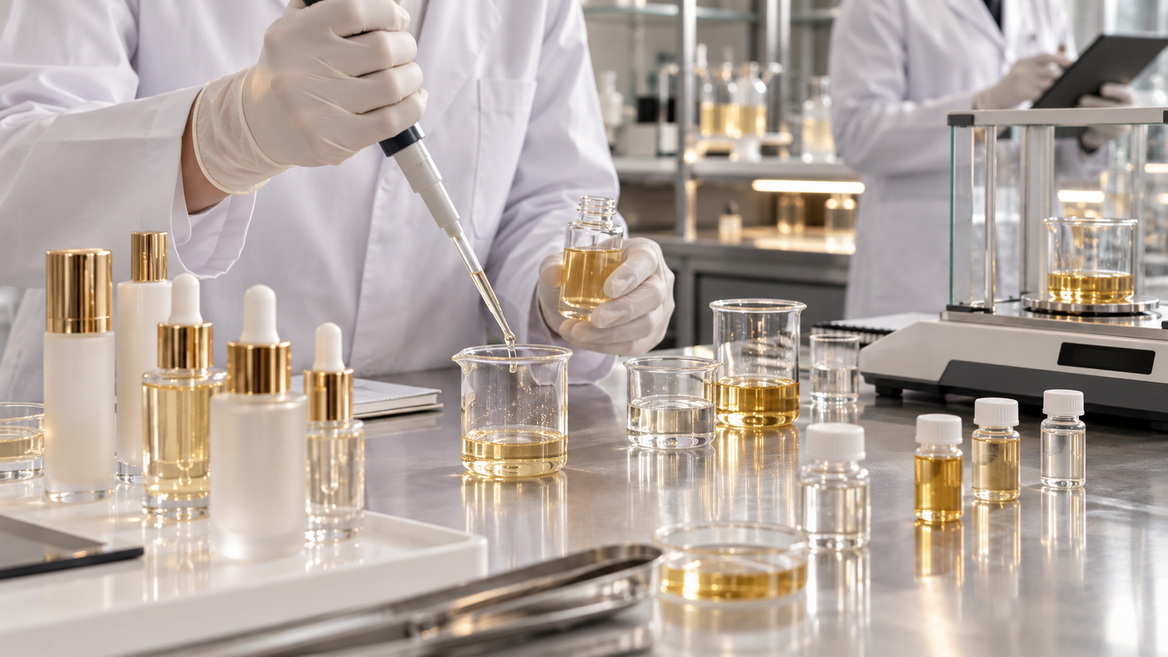
"Glow serum" is a commercial description, not a standardized formulation category. Your brief should explain whether the intended effect is:
- Immediate luminosity or a dewy finish.
- Improved hydration and smoother-looking skin.
- A more even-looking complexion.
- Reduced appearance of dullness.
- A combination of short-term appearance and longer-term measured effects.
Without this distinction, suppliers may propose products with very different ingredients, textures, testing needs, and claims.
Vitamin C is a useful example. L-ascorbic acid and vitamin C derivatives are not interchangeable formulation choices. Published research describes ascorbic acid's sensitivity to factors including light, heat, pH, and metal ions. [pmc.ncbi.nlm.nih]
Request specifications covering:
- Exact INCI identity.
- Raw-material supplier and traceability.
- Assay or purity specification.
- Actual active concentration in the finished product.
- Relevant impurities and contaminant limits.
- Storage conditions and retest or expiry information.
Do not accept "premium grade" as a measurable specification.
A serum's stability cannot be judged from a freshly prepared laboratory sample alone. For oxidation-sensitive products, the formula, manufacturing conditions, container, closure, and expected distribution environment all matter. [pmc.ncbi.nlm.nih]
Ask for a documented plan addressing:
- Physical and chemical stability.
- Active-content retention where relevant.
- Color, odor, pH, and viscosity changes.
- Container interaction and closure performance.
- Microbiological quality.
- Preservation efficacy or justified microbiological risk assessment. [iso]
A change from a dropper to a pump—or even a change in closure materials—should trigger a documented assessment of whether previous evidence still applies.
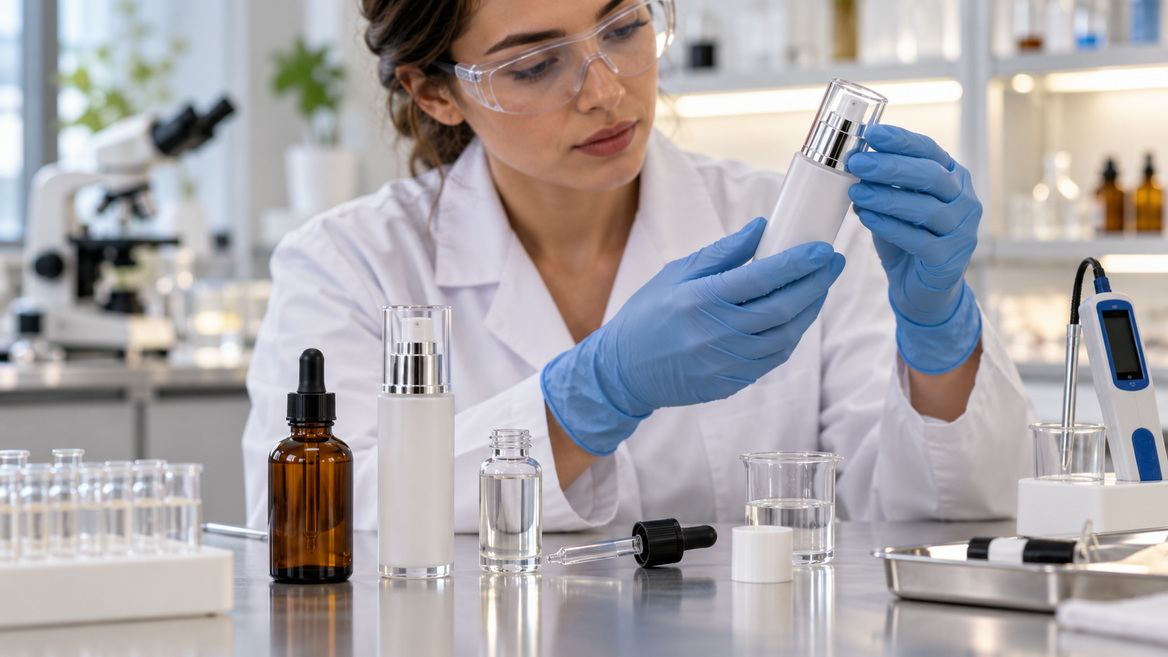
Request the business license, factory address, production authorization where applicable, current quality certificates, and an explanation of subcontracted activities.
During an audit, follow one batch through raw-material receipt, weighing, processing, filling, release, and retained samples. This aligns with the production and control areas addressed by cosmetic GMP guidance. [bpu]
A practical development sequence is:
1. Written product and target-market brief.
2. Laboratory samples with revision records.
3. Approved formula and sensory specification.
4. Packaging compatibility assessment.
5. Pilot production where justified.
6. Approved finished-product reference sample.
7. Commercial batch release against agreed specifications.
Make sample approval conditional on the relevant documentation, not simply on appearance and skin feel.
Ask for minimum quantities for bulk manufacture, filling, bottles, pumps, decoration, cartons, and testing.
An advertised 500-unit entry point may apply only to particular formulas and stock packaging. LAIMEI's published low-MOQ claim should therefore be confirmed against the exact project rather than treated as universal. [lmoemcosmetics]
For the United States, applicable MoCRA obligations include facility registration, biennial registration renewal, product listing, annual listing updates, and safety substantiation, subject to relevant exemptions. [fda]
For the European Union, buyers need to address an EU Responsible Person, a cosmetic product safety report, and CPNP notification. CPNP is a notification system, not a certification or product-approval badge. [single-market-economy.ec.europa]
Fragranced serums also require current labeling review. The European Commission states that noncompliant products may no longer be newly placed on the EU market under the updated fragrance-allergen labeling requirements from July 31, 2026. [single-market-economy.ec.europa]
Agree on shipping conditions, packaging protection, leakage checks, Incoterms, insurance, customs responsibilities, and required import documentation.
For stability-sensitive serums, discuss expected transit temperatures with the technical team. Heat sensitivity is a documented concern for ascorbic-acid formulations; accelerated testing should not be used to imply unlimited tolerance of uncontrolled shipping conditions. [pmc.ncbi.nlm.nih]
An easily overlooked procurement issue is the difference between the inclusion rate of a supplied ingredient blend and the concentration of its active component.
For illustration, if a formula contains 10% of a premix that itself contains 20% of the named active, the finished formula contains 2% of that active before accounting for processing or storage losses.
This is not evidence that a particular supplier misrepresents ingredients. It is a reason to define concentration precisely.
For key actives, request:
- Premix composition and raw-material assay.
- Actual finished-product active concentration.
- A suitable analytical method where necessary.
- Release acceptance limits.
- Relevant stability acceptance limits.
The same principle applies to commercial consistency: require written approval before changes to ingredient suppliers, premixes, preservatives, packaging materials, or production sites. A similar-looking replacement may not be equivalent to the approved product.
The most useful glow serum manufacturer is one that matches your technical requirements, launch volume, budget, and destination-market obligations.
LAIMEI is worth evaluating for its stated low-MOQ flexibility and integrated customization support. NOX BELLCOW and Ausmetics offer published large-scale manufacturing profiles. TY Cosmetic, Bawei, Blackbird, and Xiran provide different development and supply-chain options, while COSMAX, Intercos, and Kolmar offer China-based operations connected to international manufacturing groups. [lmoemcosmetics]
For a LAIMEI quotation, prepare your target market, serum concept, preferred actives, packaging format, launch quantity, and target price. Request a written development plan, itemized costs, certificate copies, and a sample schedule before committing to production.
Request the complete certificate, including the certificate number, issuing body, manufacturing address, scope, issue date, and expiry date.
Verify its current status directly with the issuing certification body. Check that it covers the actual production site and relevant activities. An unexpired certificate for a different entity or address does not establish coverage for your serum.
Also request recent surveillance-audit information and closure of relevant corrective actions. ISO 22716 concerns manufacturing practices; it is not a finished-product efficacy certificate. [bpu]
Request the facility's submission records, identifying details, and renewal information, then verify that they correspond to the actual manufacturing site.
FDA explicitly states that it does not issue cosmetic registration or listing certificates and that registration does not mean approval. Treat a privately issued "FDA certificate" as a separate document requiring explanation—not as FDA endorsement. [fda]
Only after establishing that the reports are applicable to your product.
Compare the tested formula, preservative system, packaging, process, and intended conditions with the proposed SKU. Material differences require a technical assessment of whether additional testing is necessary.
Preservation efficacy testing evaluates the protection of a formulation; it should not be assumed to cover every product in a supplier's catalog. [iso]
Define ownership, exclusivity, development rights, confidentiality, and access to specifications in the contract.
Attach the approved formula version and packaging specifications. Require prior written approval for changes to ingredients, suppliers, manufacturing sites, and packaging materials, with clear responsibility for revalidation costs.
For an existing ODM formula, confirm whether you are purchasing exclusive ownership, limited exclusivity, or permission to sell a nonexclusive platform.
Not necessarily. A low filling MOQ does not eliminate development, testing, decoration, tooling, or packaging-component minimums.
Compare total launch cost and repeat-order cost separately. Ask what happens to unused components, whether testing is included, and whether the quotation assumes an existing formula.
For LAIMEI's advertised 500-unit option, obtain written confirmation of the eligible formula, packaging, customization level, and documentation package. [lmoemcosmetics]
- LAIMEI company profile: published service model, low-MOQ statement, and company history. [lmoemcosmetics]
- Manufacturer evidence: NOX BELLCOW's profile, Ausmetics' historical announcement, TY Cosmetic's 2025 announcement, and Bawei's published information. [lp.hknbc]
- Additional supplier profiles: Blackbird Skincare, Xiran, COSMAX China, Intercos, and Kolmar. [linkedin]
- FDA: MoCRA requirements and the agency's September 2026 clarification on registration certificates. [fda]
- European Commission: cosmetics legislation, CPNP, CE-marking scope, and fragrance-allergen labeling requirements. [single-market-economy.ec.europa]
- ISO and international regulatory standards resources: cosmetic microbiology, preservation assessment, and GMP standards. [iccr-cosmetics]
- 2025 market context: industry reporting citing Chinese customs data; the export total is not serum-specific and was not independently checked against an underlying customs dataset for this article. [globalcosmeticsnews]
- Technical literature: published research on ascorbic-acid stability in cosmetic formulations. [pmc.ncbi.nlm.nih]


