
Views: 235 Author: Vera Publish Time: 2026-11-13 Origin: Site


Content Menu
● Private Label Skincare vs Custom Formulation: Understanding the Difference
>> What Is Private Label Skincare?
>> What Is Custom Skincare Formulation?
● Private Label vs Custom Formulation: Side-by-Side Comparison
● Which Route Creates a More Convincing Premium Product?
>> Premium Positioning Requires More Than an Original Formula
>> Custom Formulation Is Strongest When the Gap Is Specific
● Cost, Minimum Orders, and Timelines: Compare the Complete Project
>> Look Beyond the Manufacturing Unit Price
>> Use a Break-Even Test Before Commissioning Custom Development
>> Request Milestones, Not Unsupported Launch Promises
● Product Testing and Compliance: Neither Route Gets a Shortcut
>> Review Evidence for the Actual Finished Product
>> Distinguish Safety Evidence From Performance Evidence
>> Understand Market-Specific Responsibilities
● Formula Ownership and Exclusivity: Protect the Asset You Are Building
● A Practical Strategy: Custom Hero Products With Private Label Support
● How to Choose a Premium Skincare Manufacturing Partner
>> Evaluate Documents Alongside Samples
>> Where LAIMEI Fits Into the Decision
>> Is Private Label Skincare Suitable for Premium Brands?
>> Is Custom Formulation Always Better Quality?
>> Which Option Has a Lower Minimum Order Quantity?
>> Can I Modify a Private Label Formula?
>> Do I Own a Formula After Paying Development Fees?
>> Can I Launch With Private Label and Switch Later?
Private label skincare vs custom formulation is ultimately a decision about where your premium beauty brand needs to be different. Private label offers an established formulation platform, generally reducing development work and upfront investment. Custom formulation gives you greater control over product characteristics, but requires a more demanding development process.
My recommendation is to choose custom development when a distinctive product experience is central to your brand promise. Choose private label when an existing formula already meets that promise and preserving capital matters more than creating something entirely new.
Neither route automatically delivers better skincare. The stronger choice aligns product performance, supporting evidence, commercial economics, and customer expectations.

Private label skincare starts with a formula already developed by a manufacturer. A brand selects suitable products and sells them under its own identity, with agreed packaging and labeling.
Depending on the supplier, limited adjustments may be available. However, changing fragrance, ingredients, or texture can introduce additional development and assessment requirements.
The commercial advantage is a defined starting point. Instead of commissioning an entirely new moisturizer, you evaluate available formulas against your requirements.
For premium brands, this approach works when the existing product already delivers the desired sensory experience, performance, and documentation.
Custom skincare formulation starts with a product brief rather than a catalog selection.
The development team creates or substantially rebuilds a formula around requirements such as:
- Target skin concerns and intended users.
- Ingredient preferences and exclusions.
- Texture, absorption, and finish.
- Packaging and dispensing requirements.
- Intended claims and destination markets.
Custom development offers greater technical influence. It does not automatically provide superior efficacy, exclusive rights, or formula ownership. Those outcomes require appropriate development, evidence, and contractual terms.
Terminology varies between manufacturers. Always compare written deliverables rather than relying on labels such as OEM, ODM, or private label.
| Decision factor | Private label skincare | Custom formulation |
|---|---|---|
| Starting point | Existing manufacturer formula | Brand-specific development brief |
| Development investment | Generally lower | Generally higher |
| Launch readiness | Fewer formulation steps if the offered product fits | More development and evaluation stages |
| Product control | Limited to available options and agreed changes | Greater influence over composition and sensory characteristics |
| Differentiation | Often emphasizes positioning, packaging, and service | Can include distinctive product attributes |
| Minimum order quantity | Depends on supplier, formula, and packaging | Depends on materials, processes, and packaging |
| Formula ownership | Commonly retained by the manufacturer | Negotiated; not automatic |
| Exclusivity | Must be established contractually | Must also be established contractually |
| Testing requirements | Existing evidence needs applicability review | Evidence must support the developed product |
| Best strategic fit | Market validation and supporting products | Differentiated flagship products |
These are directional comparisons, not universal price, timing, or order-volume guarantees.
An original formula is valuable only when customers benefit from the difference.
A moisturizer may stand out through its elegant finish, compatibility with a daily routine, reliable dispensing, or substantiated hydration performance. A complicated ingredient story cannot compensate for an unpleasant application experience.
I would assess a premium concept through three questions:
1. What meaningful customer problem does it address?
2. Can customers recognize the intended benefit?
3. What evidence supports the exact promise?
An established formula can answer these questions convincingly. A custom formula can fail them.
Custom development becomes more compelling when available products cannot meet a commercially important requirement.
For example, a brand might need a fragrance-free moisturizer with a particular finish that works with its selected pump. Another might want a serum experience noticeably different from the available catalog options.
These are development objectives that can be evaluated.
"Make it more luxurious" is not enough. Translate that ambition into sample acceptance criteria, such as spreadability, residue, dispensing consistency, and user feedback.
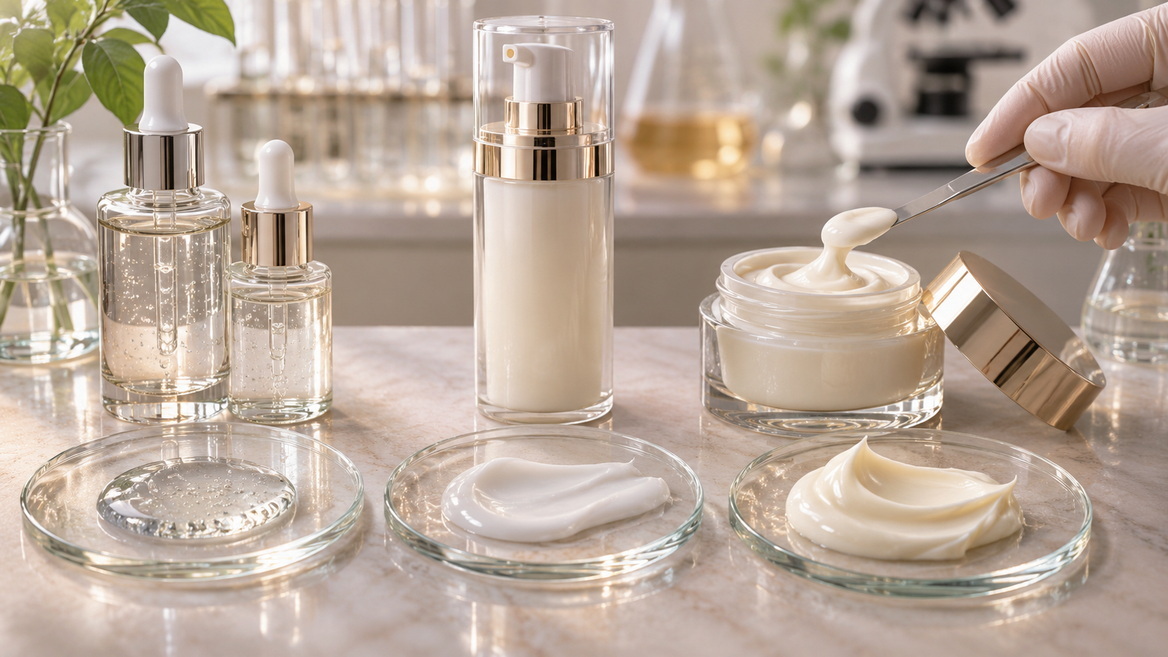
Private label typically reduces exploratory formulation work. Custom development adds activities such as feasibility assessment, prototype revisions, and manufacturing preparation.
However, either route can become expensive through packaging choices, excessive inventory, or poorly defined requirements.
Request an itemized quotation covering:
- Development and sample revisions.
- Testing and documentation.
- Bulk product, filling, and packaging.
- Artwork, tooling, and decoration.
- Freight and applicable import costs.
- Minimum quantities and reorder conditions.
Compare quotations using the same specification. A low product price is not directly comparable with an offer that includes substantially more services.
Consider this hypothetical planning example—not a supplier quotation or industry benchmark.
Custom development requires an additional $18,000. If the finished product generates $3 more contribution per unit than the alternative, recovering that investment requires 6,000 units.
Contribution means revenue remaining after relevant variable costs, not simply the difference between retail price and factory price.
Then challenge the assumptions:
- Will customers actually pay the proposed price?
- Does the additional contribution survive discounts and fulfillment costs?
- What happens if only half the forecast volume sells?
Custom development should solve a product problem and make commercial sense.
Existing formulas can reduce development time, but packaging procurement, documentation, testing gaps, and production scheduling still matter.
Custom projects introduce additional uncertainty through formulation iterations and material sourcing.
Ask for a schedule showing dependencies and approval gates. Avoid treating sample approval as confirmation that every commercial-launch requirement has been completed.
An ingredient study does not automatically demonstrate the performance of a finished serum.
Likewise, evidence for an existing formula should be reviewed for its relevance to the exact product, packaging, intended use, and claim.
A project-specific assessment may consider:
- Stability and physical characteristics.
- Microbiological quality and preservation.
- Packaging compatibility.
- Safety substantiation.
- Evidence for advertised benefits.
The appropriate program depends on the product and destination market. Do not assume every product requires an identical test package.
Safety substantiation and efficacy substantiation answer different questions.
A safety assessment does not establish a quantified hydration benefit. Consumer feedback about softness does not establish an instrumental measurement of hydration.
For each intended claim, define the required evidence before finalizing the product. Claims such as "clinically proven" need particular care because the wording must accurately reflect the supporting study.
For the United States, MoCRA establishes obligations involving safety substantiation, adverse-event reporting, facility registration, and product listing, with certain exemptions.
FDA registration is not product approval, and FDA does not issue cosmetic registration certificates.
For the European Union, relevant requirements include a responsible person, a Product Information File containing a Cosmetic Product Safety Report, and notification through the applicable portal. Claims must also meet evidential standards.
Manufacturer support is valuable, but responsibilities should be assigned explicitly rather than assumed.

Custom formulation does not automatically mean your brand owns the formula.
Before paying development fees, clarify:
1. Who owns the final quantitative formula?
2. What rights does the brand receive?
3. Can the supplier offer the same formula to competitors?
4. Does exclusivity cover particular territories, channels, or periods?
5. Can production move to another manufacturer?
6. What technical documentation would support that transfer?
An ingredient declaration is not a complete manufacturing package. Reproduction may require percentages, raw-material specifications, processing instructions, and other technical information.
Confidentiality, exclusivity, ownership, and manufacturing-transfer rights are separate issues. Have the agreement reviewed accordingly.
A premium range does not need to use one development model exclusively.
One practical approach is to invest custom-development resources in the flagship product while selecting suitable established formulas for supporting products.
For example, a brand could develop a distinctive moisturizer and evaluate existing cleansers for the same routine.
This is a hypothetical strategy, not a reported client case.
The advantages are focused development spending and a clearer product hierarchy. The limitation is that every supporting product must still meet the brand's standards. A weak cleanser can undermine confidence in an excellent moisturizer.
Avoid launching unnecessary products simply because they are available.
An attractive sample demonstrates only part of a supplier's capability.
Request relevant evidence covering manufacturing scope, quality systems, batch traceability, testing responsibilities, and change-control procedures.
Also ask how laboratory samples are translated into commercial production and how deviations are investigated.
Certificates should be checked for the correct legal entity, production site, scope, issuer, and validity. A facility certificate does not establish every product's safety or claimed performance.
According to the company background supplied for this article, GUANGZHOU LAIMEI CREATIVE RESEARCH INTELLIGENT BIOLOGICAL RESEARCH CO.,LTD. offers 13 years of skincare and cosmetics research and manufacturing experience.
The supplied profile describes:
- A 20,000 m² GMP-standard manufacturing base.
- Annual production capacity exceeding 50 million units.
- Formula development, packaging design, and manufacturing support.
- Products supplied to more than 100 countries and regions.
- A research network involving a Brazilian professor, dermatologists, engineers, and collaborating factory laboratories.
The stated network of more than 1,000 professionals includes collaborating personnel; it should not be interpreted as an independently verified in-house headcount.
The company also reports FDA registration and ISO 22716 and GMPC credentials. Buyers should request current supporting documents. The separately mentioned MADS credential needs clarification of its full name, issuing organization, and scope before reliance.
These company statements are supplied information, not independent audit findings.
Yes, when the selected product meets the brand's performance, sensory, documentation, and presentation requirements. An existing formula does not automatically prevent premium positioning.
No. Customization provides development flexibility, not a quality guarantee. Quality depends on the formula, manufacturing controls, assessment, and consistency of the finished product.
There is no universal answer. Formula batching, ingredient procurement, packaging, and supplier policies all influence minimum quantities. Request product-specific and packaging-specific minimums.
Some suppliers allow modifications. However, changing ingredients, fragrance, or texture may require additional development and review of existing safety, stability, or claims evidence.
Not necessarily. Ownership, licensing, exclusivity, and transfer rights depend on the written agreement. Resolve these terms before development begins.
Yes, but treat the replacement as a product-development project. Review performance, documentation, packaging compatibility, customer communication, and whether the new experience meets existing expectations.
1. Cosmetic-Labs. ["Private Label vs Custom Cosmetic Formulation: Compare the Routes."] Industry explanation of development scope, contractual rights, responsibilities, and manufacturing portability. [cosmetic-labs]
2. Cosmeta. ["Private Label vs Custom Formulation: Who Owns Your Formula?"] Industry discussion of quantitative formula ownership, licensing, documentation, and transfer rights. [cosmeta]
3. U.S. Food and Drug Administration. ["Modernization of Cosmetics Regulation Act of 2022 (MoCRA)."] Primary regulatory guidance on safety substantiation, reporting, registration, listing, and exemptions. [fda]
4. U.S. Food and Drug Administration. ["Registration & Listing of Cosmetic Product Facilities and Products."] Clarifies registration obligations, the absence of FDA-issued cosmetic registration certificates, and the distinction between registration and approval. [fda]
5. European Commission. ["Technical Document on Cosmetic Claims."] Guidance on evidential support, study relevance, and accurate interpretation of cosmetic claims. [webgate.ec.europa]
6. European Commission, Scientific Committee on Consumer Safety. ["Notes of Guidance for the Testing of Cosmetic Ingredients and Their Safety Evaluation."] Technical context for ingredient safety evaluation and finished-product safety documentation. [health.ec.europa]
7. European Commission. ["Cosmetic Product Notification Portal."] Official explanation of notification requirements under the cosmetics regulation. [single-market-economy.ec.europa]


