
Views: 235 Author: Vera Publish Time: 2026-09-08 Origin: Site


Content Menu
● Glycolic Acid vs. Salicylic Acid at a Glance
>> Glycolic Acid Benefits for Skin
>> Who Should Consider Glycolic Acid?
>> Glycolic Acid Formula Development Considerations
>> Salicylic Acid Benefits for Oily and Acne-Prone Skin
>> Who Should Consider Salicylic Acid?
>> Salicylic Acid Formula Development Considerations
● Glycolic Acid vs. Salicylic Acid: Which Is Better for Acne?
>> A Practical Acne Routine Example
● Which Acid Is Better for Dark Spots and Uneven Tone?
● Can Glycolic Acid and Salicylic Acid Be Used Together?
>> When Combining Acids Makes Sense
>> How to Build a Safer Multi-Acid Routine
● Expert Insight: Why Product Format Matters as Much as the Acid
● How Brands Can Choose the Right Ingredient Strategy
>> Choose Glycolic Acid When Your Brand Targets:
>> Choose Salicylic Acid When Your Brand Targets:
>> Choose a Combined AHA/BHA Strategy When Your Brand Targets:
● How to Introduce Acid Skincare Correctly
>> A Simple Introduction Method
● Final Verdict: Glycolic Acid or Salicylic Acid?
● FAQs
>> 1. Is glycolic acid or salicylic acid better for blackheads?
>> 2. Can I use glycolic acid and salicylic acid on the same day?
>> 3. Is glycolic acid better for dark spots?
>> 4. Is salicylic acid suitable for dry skin?
>> 5. What percentage of salicylic acid is commonly used in acne products?
>> 6. Can glycolic acid help with acne scars?
>> 7. Should I use sunscreen with glycolic acid or salicylic acid?
Glycolic acid vs. salicylic acid is not a question of which ingredient is universally better. The better choice depends on the skin concern, skin type, formula format, concentration, use frequency, and the overall routine surrounding the product.
For consumers, glycolic acid is often selected for surface dullness, uneven-looking tone, rough texture, and visible signs of skin aging. Salicylic acid is typically the more targeted option for oiliness, congested pores, blackheads, whiteheads, and acne-prone skin. For skincare brands, the distinction matters even more: each ingredient requires a different formulation strategy, positioning message, testing plan, and consumer-use guidance.
At GUANGZHOU LAIMEI CREATIVE RESEARCH INTELLIGENT BIOLOGICAL RESEARCH CO., LTD., we see this decision from both sides of the industry: the end user who wants clearer, smoother-looking skin, and the brand owner who needs a reliable, differentiated, market-ready formulation. With 13 years of skincare and cosmetics R&D and manufacturing experience, our team supports global brands with customized formulation development, packaging, manufacturing, and quality-control solutions.
This guide explains the real differences between glycolic acid and salicylic acid, how to choose between them, when to combine them, and how brands can develop high-performing exfoliating skincare products responsibly.
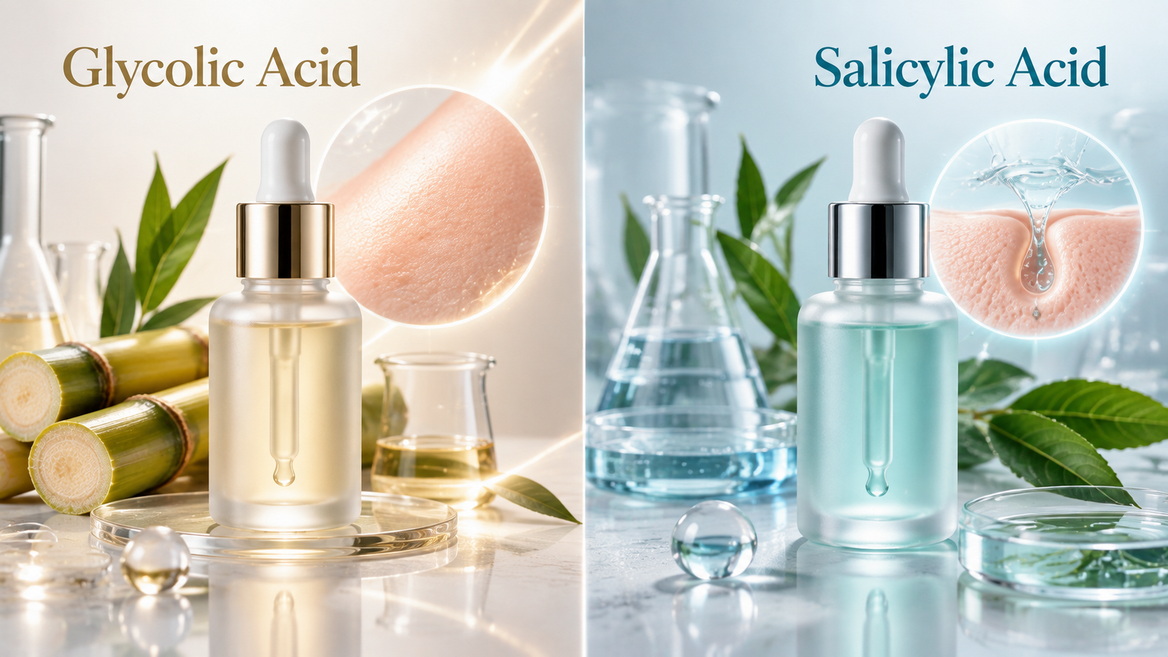
Glycolic acid and salicylic acid are both exfoliating acids, but they belong to different ingredient families and work in different ways.
| Feature | Glycolic Acid | Salicylic Acid |
|---|---|---|
| Acid family | Alpha hydroxy acid, or AHA | Beta hydroxy acid, or BHA |
| Solubility | Water-soluble | Oil-soluble |
| Main action | Helps exfoliate dead cells at the skin surface | Helps exfoliate and clear oil-related pore congestion |
| Best suited for | Dullness, rough texture, uneven-looking tone, fine lines | Oily skin, blackheads, whiteheads, blemishes, visible pore congestion |
| Typical product formats | Toners, serums, pads, masks, creams, professional peels | Cleansers, toners, spot products, serums, pads, masks |
| Key formulation concern | Managing irritation and maintaining skin comfort | Balancing pore-clearing performance with dryness control |
| Consumer positioning | Brightening, smoothing, resurfacing, refining | Clarifying, oil-balancing, pore-clearing, blemish care |
The central difference is simple: glycolic acid is generally chosen for visible surface renewal, while salicylic acid is often chosen for oil and pore-related concerns.
Neither ingredient should be promoted as a miracle solution. Effective acid skincare depends on realistic claims, properly selected concentrations, formula stability, preservation compatibility, pH control, user instructions, and skin-tolerance evaluation.
Glycolic acid is an alpha hydroxy acid. It is commonly associated with sugarcane and is widely used in exfoliating skincare formulas. Among common AHAs, glycolic acid has a relatively small molecular structure, which is one reason it is frequently used in products designed to improve the look of skin texture and radiance.
In a well-designed formula, glycolic acid helps loosen the accumulation of dead skin cells at the outermost layer of the skin. This can make the complexion appear smoother, fresher, and more even over time.
Consumers often look for glycolic acid when they have skin that looks tired, dry, rough, or uneven. It is particularly common in products marketed for complexion refinement and age-supportive skincare.
Potential cosmetic benefits include:
- Smoother-looking skin texture
- A brighter, more refreshed appearance
- Reduced visibility of rough or flaky surface buildup
- Improved-looking clarity for dull skin
- A more even-looking skin tone
- A refined appearance of fine lines caused by dryness or surface texture
- Better preparation for moisturizers and other leave-on products
Glycolic acid can also be relevant for people managing post-blemish marks and uneven-looking pigmentation. However, results vary significantly depending on the individual, their skin tone, product use habits, sun exposure, and whether they use daily sun protection.
Glycolic acid may be a suitable choice for consumers with:
- Normal or dry skin with dullness
- Rough-feeling skin texture
- Uneven-looking tone
- Visible surface dryness and flaking
- Early signs of photoaging
- Skin that appears tired or lacks radiance
- Post-acne marks after active breakouts are controlled
A glycolic acid toner, serum, peel pad, or mask may be especially attractive for customers who want a "skin renewal" experience rather than a blemish-focused treatment.
From a product-development perspective, glycolic acid requires much more than adding an AHA raw material to a standard base formula.
Important considerations include:
1. pH design
Acid performance and perceived comfort are closely connected to the finished product's pH. A formulation team must select a pH range that supports the intended product experience while respecting stability, compatibility, and tolerability goals.
2. Concentration strategy
A daily-use toner, a weekly resurfacing serum, and a professional-use peel should not be built around the same concentration philosophy. Brands need a clear use scenario before selecting the active level.
3. Barrier-supporting ingredients
Humectants, soothing agents, emollients, and skin-conditioning ingredients can improve the overall consumer experience. A formula should not feel aggressively stripping merely because it is designed to exfoliate.
4. Packaging compatibility
Acid formulas need packaging that supports product stability and a clean dispensing experience. Pump bottles, airless systems, treatment droppers, sachets, and single-dose ampoules each create different positioning opportunities.
5. Clear usage directions
Glycolic acid products need practical instructions. Consumers should understand when to use the product, how frequently to use it, and when to reduce frequency.
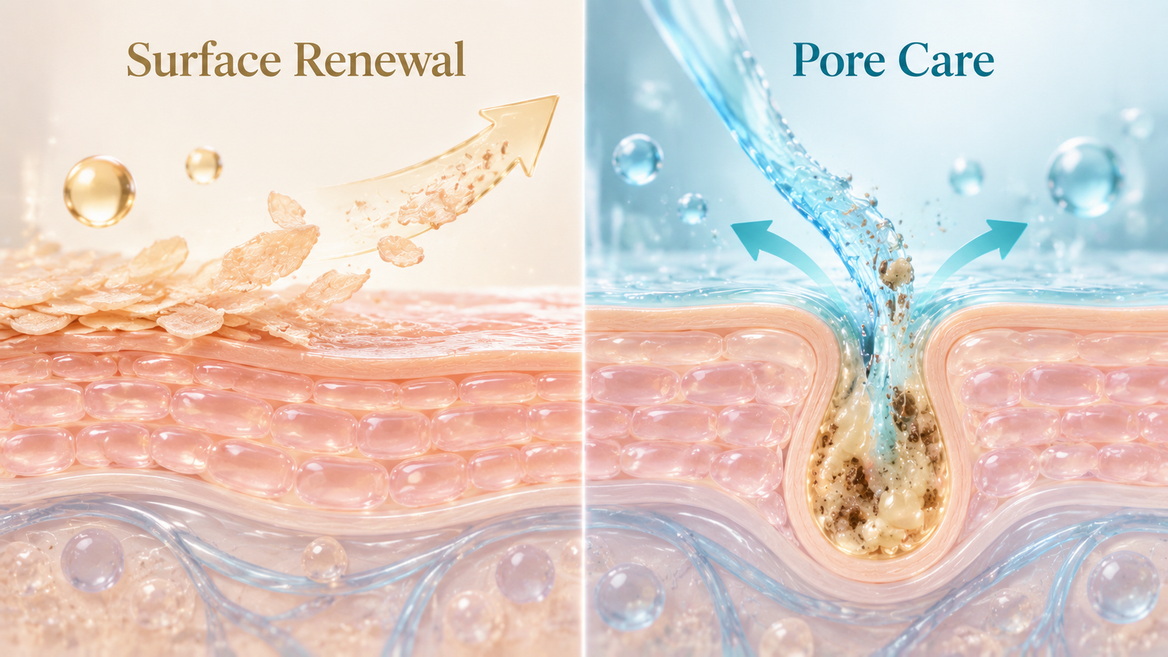
Salicylic acid is a beta hydroxy acid with oil-soluble characteristics. This makes it especially relevant in formulas designed for oily, congested, and acne-prone skin.
Because it is oil-soluble, salicylic acid is commonly positioned as a pore-focused ingredient. It can help exfoliate the skin and support the removal of buildup associated with excess oil and clogged pores. Dermatology guidance commonly identifies salicylic acid as an option that helps open clogged pores and exfoliate the skin, especially for whiteheads and pimples. [aad]
Salicylic acid is one of the most recognizable active ingredients in blemish-care products. It can be used in facial cleansers, spot gels, exfoliating pads, clarifying toners, masks, and targeted serums.
Potential benefits include:
- Helps clear the appearance of clogged pores
- Supports blackhead and whitehead care
- Helps reduce excess surface oil
- Improves the look of congested skin
- Provides exfoliation for acne-prone skin
- Can be used in targeted blemish-care routines
- Helps create a cleaner, less greasy skin feel
For over-the-counter acne drug products in the United States, salicylic acid is included within a 0.5% to 2% concentration range under the relevant FDA monograph framework. Brands planning products for the U.S. market should evaluate whether their product is a cosmetic, an OTC drug product, or subject to different labeling and compliance expectations based on its claims. [accessdata.fda]
Salicylic acid is often better aligned with consumers who have:
- Oily or combination skin
- Blackheads around the nose, chin, or forehead
- Whiteheads and small clogged bumps
- Recurring blemishes
- Visible pore congestion
- A shiny T-zone
- Skin that feels heavy or congested after sunscreen or makeup use
For a customer who says, "My skin is oily, my pores look blocked, and I keep getting blackheads," salicylic acid is usually the more intuitive starting point.
Salicylic acid products can deliver strong consumer appeal, but brands need to balance effectiveness with comfort.
Key factors include:
- Solubilization and formula clarity: Salicylic acid can be challenging to formulate elegantly in certain water-based systems. A skilled R&D team needs to select compatible solvents, emulsifiers, and delivery approaches.
- Skin-feel optimization: A product designed for oily skin should feel fresh and non-greasy, but it should not leave the skin uncomfortably tight.
- Claim alignment: "Clarifying," "pore care," "oil control," and "blemish-prone skin care" may belong to different claim strategies depending on the market.
- Packaging selection: Acne spot treatments, low-viscosity toners, cleansing gels, and serum concentrates each require appropriate packaging and dispensing systems.
- User education: Consumers should avoid overusing strong exfoliating products in an attempt to get faster results.
For acne-related concerns, salicylic acid is usually the more directly targeted choice because of its oil-soluble nature and its close association with clogged pores, whiteheads, and pimples. The American Academy of Dermatology notes that salicylic acid can open clogged pores and exfoliate skin. [aad]
That said, glycolic acid can still be valuable in an acne-supportive routine. It may help improve the appearance of uneven texture, dullness, and post-blemish marks. In other words, salicylic acid often addresses the active congestion problem, while glycolic acid may be more relevant to the visible texture and tone concerns that remain afterward.
A consumer with oily, blemish-prone skin might use:
1. A gentle cleanser in the morning
2. A lightweight moisturizer and broad-spectrum sunscreen
3. A salicylic acid cleanser or leave-on product on selected evenings
4. A glycolic acid product on a separate evening, introduced gradually
5. A soothing, fragrance-conscious recovery product if dryness develops
Do not begin multiple strong exfoliating products at the same time. This often leads to discomfort, visible irritation, and poor consumer retention.
For brands, this creates a clear opportunity: instead of launching one overly aggressive "all-in-one acid" product, consider developing a structured range with a daily cleanser, a targeted clarifying serum, a weekly resurfacing treatment, and a barrier-supporting moisturizer.
When the primary concern is dullness, rough texture, and uneven-looking tone, glycolic acid is often the preferred ingredient. It is commonly used in superficial exfoliating treatments and is included among AHAs used in skin-resurfacing applications. [pmc.ncbi.nlm.nih]
However, dark spots and post-blemish marks are not solved by exfoliation alone. They are influenced by skin inflammation, sun exposure, individual biology, skin tone, hormonal changes, and product consistency.
For this reason, a strong brightening product concept often combines exfoliation with complementary ingredients such as:
- Niacinamide
- Panthenol
- Licorice-root derivatives
- Stable vitamin C derivatives
- Tranexamic-acid-based concepts, where appropriate for the intended market
- Ceramides and humectants to support the skin barrier
Daily sunscreen is essential when consumers use exfoliating acids. Without consistent UV protection, visible unevenness may persist or become more noticeable.
Yes, glycolic acid and salicylic acid can be used in the same overall skincare routine. They can also be formulated together in one product, but the combination needs careful product design.
A combined AHA/BHA concept can be commercially attractive because it addresses several consumer needs at once:
- Surface dullness
- Rough-feeling texture
- Excess oil
- Clogged pores
- Breakout-prone skin
- Uneven-looking tone
Superficial chemical peels may use glycolic acid, salicylic acid, or both as part of their treatment approach. [dermnetnz]
A combined formula may be suitable for:
- Weekly exfoliating pads
- Clarifying masks
- Resurfacing toners
- Multi-acid facial serums
- Back-acne and body-care products
- Men's grooming products for ingrown-hair-prone areas
- Professional treatment concepts
However, more acids do not automatically create a better product. The best formula is one that consumers can use consistently and comfortably.
For consumers, a gradual schedule is usually better than daily layering:
| Day | Suggested Approach |
|---|---|
| Monday | Salicylic acid cleanser or leave-on product |
| Tuesday | Gentle, non-exfoliating routine |
| Wednesday | Glycolic acid toner or serum |
| Thursday | Barrier-supporting routine |
| Friday | Salicylic acid product if needed |
| Saturday | Gentle hydration-focused routine |
| Sunday | Optional exfoliation only if skin feels comfortable |
This schedule is only an example. Individual tolerance varies, and users with persistent acne, eczema, rosacea, severe irritation, pregnancy-related concerns, or prescription skincare should seek guidance from a qualified healthcare professional.
One of the biggest mistakes in acid skincare is focusing only on the ingredient name. In practice, product format often changes the user experience as much as the acid itself.
A 0.5% salicylic acid rinse-off cleanser behaves differently from a 2% leave-on spot gel. A low-level glycolic acid daily toner does not create the same experience as a high-intensity weekly peel pad.
| Product Format | Glycolic Acid Role | Salicylic Acid Role | Best Brand Positioning |
|---|---|---|---|
| Cleanser | Gentle daily resurfacing support | Daily pore-clearing and oil-control support | Entry-level active skincare |
| Toner | Texture and radiance refinement | Clarifying and congestion support | Daily or alternate-day treatment |
| Serum | Targeted tone and texture support | Focused blemish and pore care | Premium treatment category |
| Peel pad | Weekly resurfacing experience | Clarifying exfoliation | Convenient, high-perceived-value product |
| Mask | Immediate glow and smoothing concept | Deep-cleansing and oil-balancing concept | Spa-inspired home treatment |
| Spot treatment | Less common as a primary format | Strong consumer relevance | Acne-focused targeted solution |
For private-label and custom skincare brands, this creates opportunities to build a complete acid-care collection rather than relying on one product alone.
A skincare brand should begin with the consumer problem, not the ingredient trend.
- Dull and uneven-looking skin
- Skin texture refinement
- Brightening and radiance
- Anti-aging-inspired product concepts
- Dry or normal skin categories
- At-home peeling and weekly renewal products
- Premium glow-focused skincare lines
- Oily and acne-prone skin
- Blackhead and whitehead care
- Teen skincare and young-adult skincare
- Men's grooming and post-shave congestion
- Clarifying facial cleansers
- Pore-focused treatment products
- Back, chest, and body blemish-care concepts
- Multi-concern skincare
- Texture plus congestion
- Post-blemish skin appearance
- Weekly treatment products
- Advanced skincare users
- Professional-inspired home skincare
- Premium exfoliation collections
At LAIMEI, our formulation and manufacturing teams can help brands develop customized glycolic acid and salicylic acid product concepts across cleansers, toners, serums, creams, masks, peel pads, and body-care formats. Our GMP-standard production base covers 20,000 square meters and supports both small-batch product development and scalable production for global brand growth.
The strongest product is not always the best long-term product. Consumers need products that fit into real routines.
1. Start slowly
Use one exfoliating acid product one or two times per week.
2. Use a small amount
Applying more does not necessarily improve performance.
3. Avoid stacking strong actives immediately
Do not introduce glycolic acid, salicylic acid, retinoids, strong vitamin C products, and physical scrubs all at once.
4. Support the skin barrier
Use a suitable moisturizer with hydrating and skin-conditioning ingredients.
5. Wear sunscreen daily
Sun protection is especially important when using exfoliating products.
6. Reduce use if discomfort develops
Stinging, flaking, tightness, or persistent redness can signal overuse.
7. Seek professional advice for persistent concerns
Moderate to severe acne, painful breakouts, unusual rashes, and ongoing irritation should be assessed by a qualified clinician.
Choose glycolic acid if your core concern is dullness, rough texture, uneven-looking tone, or a lack of radiance.
Choose salicylic acid if your core concern is excess oil, clogged pores, blackheads, whiteheads, or recurring blemishes.
Choose both carefully if you want a broader exfoliation strategy that addresses texture and congestion without overwhelming the skin.
For skincare brands, the most successful decision is not simply choosing glycolic acid vs. salicylic acid. It is creating the right formula, format, claims, packaging, and usage guidance for a specific market and consumer need.
GUANGZHOU LAIMEI CREATIVE RESEARCH INTELLIGENT BIOLOGICAL RESEARCH CO., LTD. provides end-to-end OEM/ODM support for global skincare brands—from custom acid-based formulation development and efficacy-oriented product concepts to packaging design, GMP production, and scalable delivery. Create an exfoliating skincare line that gives your customers clarity, comfort, and a reason to return.

Salicylic acid is generally the better choice for blackheads because it is oil-soluble and commonly used in products designed to address clogged pores, excess oil, and blemish-prone skin. It is frequently found in cleansers, leave-on toners, serums, and spot-care products.
It is possible, but it may not be suitable for every skin type. People new to exfoliating acids should introduce one product at a time and avoid using several strong actives together. Alternating acids on different nights is often a more comfortable starting strategy.
Glycolic acid is commonly used for dullness, rough texture, and uneven-looking tone. It may help improve the appearance of post-blemish marks and surface discoloration over time, especially when combined with daily sunscreen and a consistent skincare routine.
Salicylic acid can be used by some people with dry or combination skin, but product format and frequency matter. A gentle rinse-off cleanser may be more suitable than a strong leave-on treatment. Consumers should use a moisturizer and reduce frequency if dryness occurs.
For U.S. over-the-counter acne drug products, salicylic acid is included within a 0.5% to 2% range under the FDA monograph framework. The ideal concentration depends on whether the product is rinse-off or leave-on, the intended consumer group, and the product's regulatory position. [accessdata.fda]
Glycolic acid may help improve the look of uneven texture and post-blemish marks at the skin surface. It does not replace professional treatment for deep, pitted, or severe acne scars. A dermatologist can recommend appropriate options for more significant scarring.
Yes. Daily broad-spectrum sunscreen is a sensible part of any exfoliating skincare routine. It helps protect the skin from UV exposure and supports a more consistent approach to managing visible dullness, uneven tone, and post-blemish marks.
1. [IMAGE Skincare — Glycolic Acid vs. Salicylic Acid: Benefits, Uses, and What's Best for You]
2. [American Academy of Dermatology — Acne: Diagnosis and Treatment]
3. [U.S. Food and Drug Administration — Topical Acne Drug Products for Over-the-Counter Human Use]
4. [Electronic Code of Federal Regulations — 21 CFR Part 333, Subpart D: Topical Acne Drug Products]
5. [DermNet — Alpha Hydroxy Acid Facial Treatments]
7. [National Library of Medicine — Dual Effects of Alpha-Hydroxy Acids on the Skin]


