
Views: 224 Author: Vera Publish Time: 2026-09-05 Origin: Site


Content Menu
● What Is Protein Haircare for Curly Hair?
>> Why Protein Ingredients Are Popular in Curl Care
>> Best Product Formats for Protein Curl Care
● What Is Protein-Free Haircare for Curls?
>> Why Customers Choose Protein-Free Products
>> Best Product Formats for Protein-Free Curl Care
● Protein vs. Protein-Free Haircare: Key Differences
● How to Help Customers Choose the Right Curl-Care Product
>> Five Questions That Improve Product Recommendations
>> Product Selection Guide for Curly-Hair Customers
● A Smarter Product Strategy: Build a Two-Step Curl System
>> Step One: Protein Curl Repair Mask
>> Step Two: Protein-Free Daily Moisture Conditioner
● Formulation Considerations for Private-Label Curl Brands
>> Match Ingredients to the Product's Job
>> Select the Right Protein Type
● Common Misunderstandings About Protein Haircare
>> Myth One: Every Curly-Hair Customer Needs Protein
>> Myth Two: Protein-Free Products Are Always More Moisturizing
>> Myth Three: Protein Products Permanently Repair Hair
>> Myth Four: Protein Is Always Wrong for Low-Porosity Hair
● Creating a Complete Curly-Hair Collection
● FAQ
>> Is protein haircare good for curly hair?
>> What is the difference between protein and protein-free conditioner?
>> Can curly-hair brands offer both protein and protein-free products?
>> How often should curly-haired customers use protein treatments?
>> Does protein-free haircare work for damaged curls?
>> Which protein ingredient is best for curly-hair products?
>> Is protein-free haircare better for everyday use?
Choosing between protein and protein-free haircare for curls is not about declaring one formula category superior to the other. The most effective curly-hair product range recognizes that customers have different hair histories, styling habits, sensory preferences, and expectations for curl performance.
Some customers need products that help their curls feel more resilient after color processing, frequent heat styling, bleaching, or mechanical stress. Others are primarily looking for hydration, softness, detangling slip, flexible definition, and a lightweight finish for everyday use. For brands, the opportunity lies in developing clear, easy-to-understand product options that guide customers toward the right routine.
For private-label and custom haircare brands, protein-containing products can support strengthening and damage-care positioning, while protein-free products can lead with moisture, softness, and daily curl comfort. When developed as part of one well-structured collection, both categories can help a brand serve a wider range of curly, coily, and wavy hair consumers.
GUANGZHOU LAIMEI CREATIVE RESEARCH INTELLIGENT BIOLOGICAL RESEARCH CO., LTD. supports global brands with customized haircare development, packaging design, manufacturing, and quality-control services. With 13 years of cosmetics R&D and manufacturing experience, the company provides flexible OEM/ODM solutions for curl-care brands seeking products that combine strong market positioning with practical consumer benefits.
> Key insight: Curly hair does not need one universal routine. The best product choice depends on the customer's hair condition, lifestyle, styling habits, and desired curl finish.
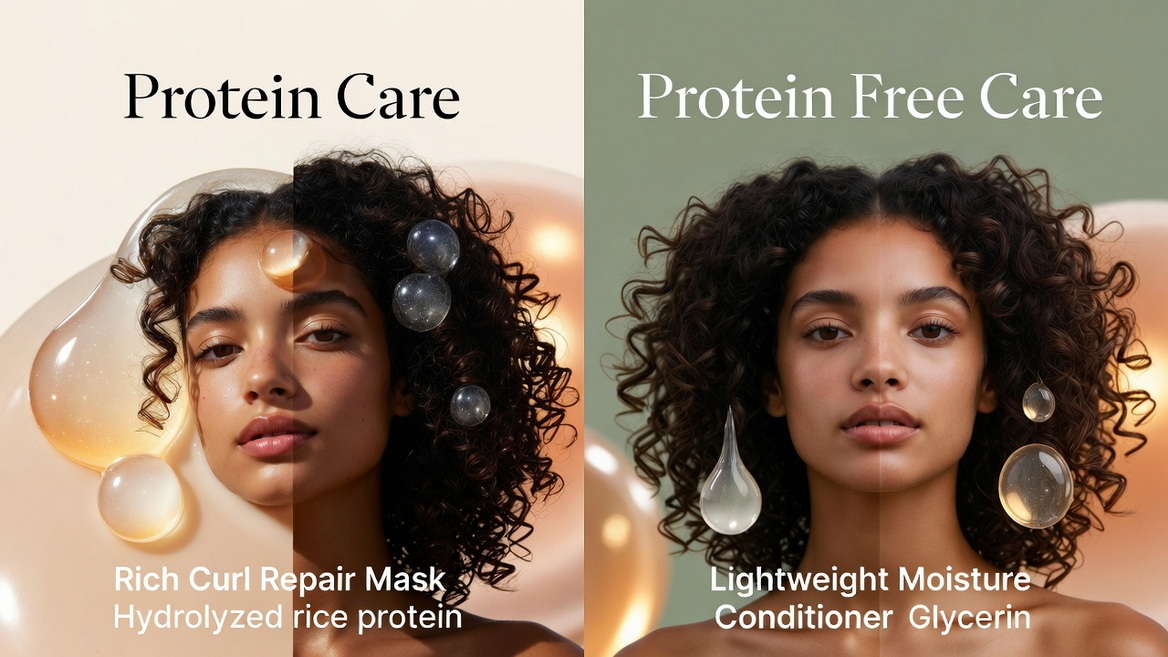
Protein haircare includes shampoos, conditioners, masks, leave-in treatments, curl creams, and styling products formulated with protein-derived cosmetic ingredients. These ingredients are commonly used to support hair conditioning, improve the feel of stressed hair, enhance curl definition, and create a smoother or more resilient-looking finish.
In cosmetic formulations, proteins are often processed into smaller, more formula-compatible components. These may include hydrolyzed proteins, peptides, amino acids, and protein derivatives. Their role is not to transform hair permanently, but to help improve the immediate appearance, texture, manageability, and styling experience of the hair fiber.
Common protein-related ingredients found in curly-hair products include:
- Hydrolyzed keratin
- Hydrolyzed wheat protein
- Hydrolyzed rice protein
- Hydrolyzed silk
- Hydrolyzed soy protein
- Hydrolyzed quinoa
- Hydrolyzed collagen
- Keratin amino acids
- Plant-derived protein complexes
- Peptides and amino acids
For customers with curls that feel weak, limp, rough, or stressed by styling, protein-focused products can provide a more structured and polished hair feel. They are especially relevant in masks, deep conditioners, repair-inspired treatments, rinse-out conditioners, and strengthening sprays.
Curly and coily hair often experiences more friction during detangling, washing, protective styling, and daily wear. The twists and bends in the hair fiber can make natural oils less likely to travel evenly from the scalp to the ends. This means customers may experience dryness, tangling, roughness, and breakage-like concerns more frequently.
Protein-containing haircare can help support a product story focused on:
- Stronger-feeling hair
- Smoother curl texture
- Improved curl definition
- More polished-looking lengths
- Reduced roughness
- Better detangling performance
- Enhanced body for fine curls or waves
- A more resilient feel after repeated styling
For a brand, the appeal of protein haircare is clear. It creates a recognizable product category for customers who feel their curls need more structure or support. However, successful products should communicate realistic cosmetic benefits and explain how the formula fits into a complete routine.
Protein ingredients can be incorporated into different haircare formats depending on the desired use experience.
| Product Type | Primary Customer Need | Protein-Focused Product Direction |
|---|---|---|
| Repair mask | Curls feel stressed, dry, or weak after styling | Rich treatment with hydrolyzed protein, conditioning agents, and emollients |
| Rinse-out conditioner | Customers want smoother, easier-to-manage curls | Creamy conditioner with lightweight protein and detangling support |
| Curl cream | Customers want definition with a more structured finish | Styling cream with flexible hold, conditioning ingredients, and protein support |
| Leave-in spray | Fine waves or curls need light conditioning | Lightweight mist with amino acids or hydrolyzed protein |
| Strengthening serum | Customers want targeted care for lengths and ends | Silicone-free or silicone-based serum with smoothing and protective ingredients |
| Co-wash | Customers want gentle cleansing with added conditioning | Low-foam cleansing formula with protein derivatives and moisturizing agents |
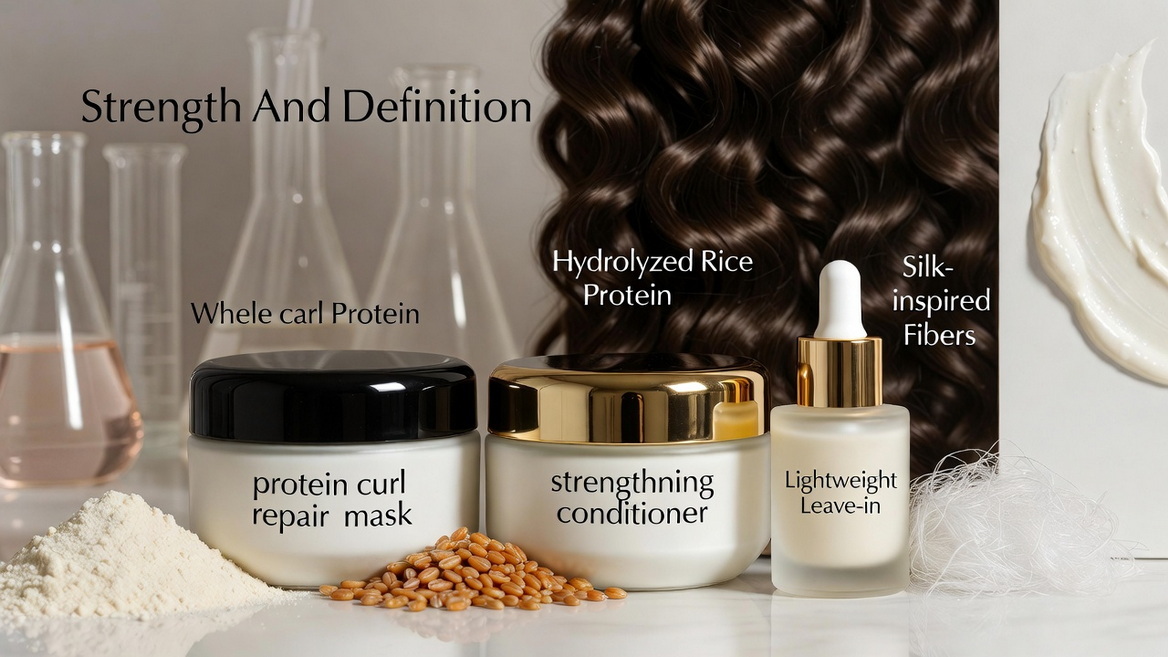
Protein-free haircare is formulated without intentionally added protein-derived ingredients such as hydrolyzed keratin, hydrolyzed wheat protein, hydrolyzed silk, hydrolyzed soy protein, collagen, peptides, or similar protein complexes.
This category is often built around hydration, lubrication, conditioning, softness, curl flexibility, scalp comfort, and easy detangling. Protein-free haircare can be highly effective for customers who prefer a softer finish, use leave-in products regularly, or want a simple daily routine without a strengthening-focused product message.
A high-performance protein-free curl formula may include:
- Humectants such as glycerin, betaine, panthenol, and sodium PCA
- Conditioning agents that improve wet and dry combing
- Plant oils, esters, and butters for nourishment and softness
- Flexible film-forming ingredients for curl definition
- Lightweight emollients for smoother slip
- Botanical extracts for sensory appeal and product storytelling
- Scalp-comfort ingredients where appropriate
- Frizz-control systems that preserve natural curl movement
Protein-free does not mean basic or less effective. In many collections, protein-free formulas are the products customers reach for most often. They can serve as the daily conditioner, leave-in cream, detangler, moisturizing mask, co-wash, or curl-refresh spray.
Many curly-hair consumers are not looking for a heavy treatment effect. They want hair that feels soft, touchable, moisturized, and easy to style. They may also prefer products that fit a frequent wash-day schedule, a simple low-maintenance routine, or a gentle care philosophy.
Protein-free products are especially useful for customers who want:
- Daily hydration
- Softness without stiffness
- Improved detangling
- Flexible curl movement
- A lightweight feel
- Comfortable leave-in conditioning
- Reduced friction during styling
- A more natural-looking curl finish
For brands, protein-free positioning can also create a strong education opportunity. It allows product pages, packaging, and retail materials to explain that customers can choose hydration-focused care without implying that protein is harmful or unnecessary for everyone.
| Product Type | Primary Customer Need | Protein-Free Product Direction |
|---|---|---|
| Daily conditioner | Softness, slip, and easy detangling | Rich conditioning formula with humectants and emollients |
| Leave-in conditioner | Everyday moisture and curl flexibility | Lightweight cream or spray with conditioning polymers and panthenol |
| Moisture mask | Deep conditioning without a strengthening focus | Buttery treatment with plant oils, esters, and slip-enhancing ingredients |
| Curl refresher | Revive curls between wash days | Fine mist with humectants and flexible curl-support ingredients |
| Co-wash | Gentle cleansing for dry curls | Mild cleansing base with moisturizing and detangling benefits |
| Curl butter | Rich nourishment for thick curls and coils | Dense cream with butters, oils, and conditioning ingredients |
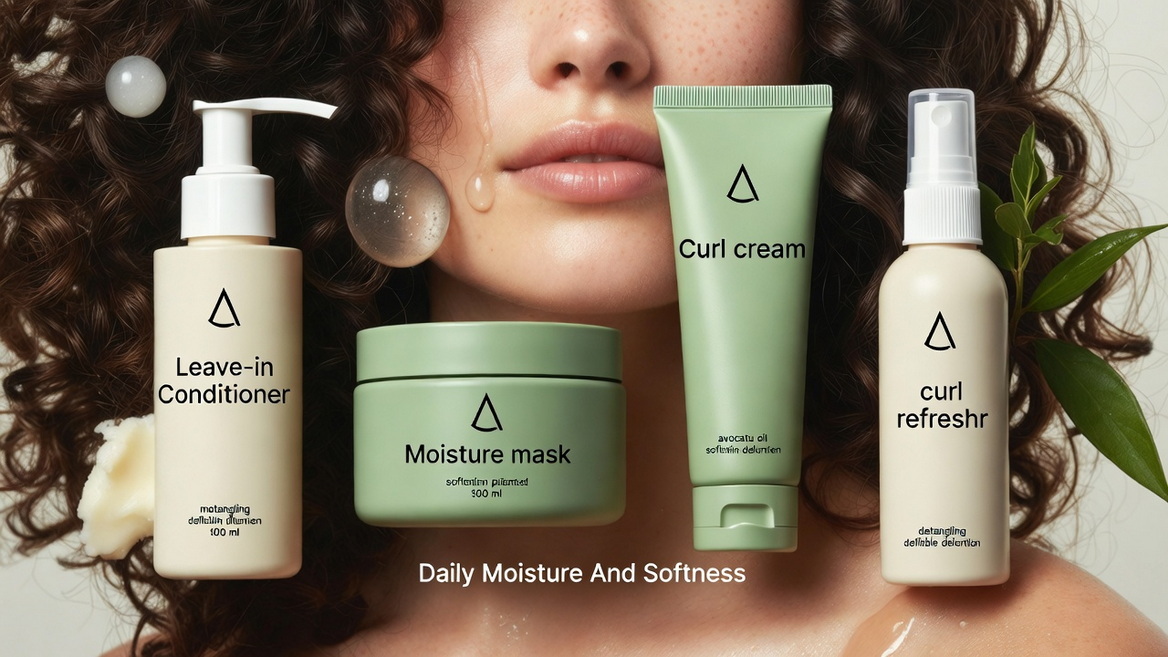
Protein and protein-free haircare are designed around different consumer expectations. While both can be beneficial for curls, they usually serve different product roles within a complete routine.
| Comparison Area | Protein Haircare for Curls | Protein-Free Haircare for Curls |
|---|---|---|
| Main product role | Supports a stronger-feeling, smoother, and more structured curl finish | Supports hydration, softness, slip, and flexible curl movement |
| Common ingredients | Hydrolyzed keratin, rice protein, wheat protein, silk protein, peptides, amino acids | Humectants, plant oils, esters, butters, conditioning agents, flexible film-formers |
| Ideal customer profile | Customers with heat-styled, color-treated, fragile, limp, or stressed curls | Customers who want daily moisture, softness, detangling, and lightweight care |
| Typical product format | Masks, repair conditioners, strengthening sprays, curl treatments | Leave-ins, daily conditioners, moisturizing masks, detanglers, curl refreshers |
| Sensory experience | More structured, polished, reinforced, or volumized feel | More cushioned, soft, flexible, and touchable feel |
| Suggested routine use | Periodic or need-based use depending on the product design | Often suitable for regular use depending on the product design |
| Suitable brand message | Strength, resilience, curl definition, damaged-hair support | Moisture, softness, slip, daily curl comfort, flexible definition |
| Product education focus | Explain when customers may benefit from a strengthening-oriented product | Explain that hydration and conditioning are essential parts of curl care |
The strongest collections do not ask customers to choose one side forever. Instead, they provide products for different wash days, styling situations, and hair conditions.
For example, a customer may use a protein-free leave-in conditioner after most wash days but choose a protein-containing mask after coloring, heat styling, or periods when their curls feel less defined and more fragile.
The most useful product recommendation begins with hair history rather than curl pattern alone. Two customers with similar curls may need completely different products because one colors her hair monthly and the other wears her natural hair with minimal heat or chemical processing.
1. Has the hair been bleached, colored, relaxed, permed, or heat-styled frequently?
2. Does the customer experience breakage, roughness, tangling, or weak-feeling ends?
3. Does the hair feel overly soft and limp, or dry and rigid?
4. Is the customer looking for a weekly treatment, a daily conditioner, or a leave-in styling product?
5. Does the customer prefer structured definition or a soft, flexible curl finish?
These questions can be transformed into a product quiz for an e-commerce website, a consultation guide for salons, or a simple comparison chart on a product collection page.
| Customer Situation | Suggested Product Direction | Example Product Concept |
|---|---|---|
| Bleached curls that feel weak during detangling | Protein-focused conditioning treatment | Hydrolyzed rice protein repair mask |
| Fine waves that lose volume and shape | Lightweight protein-support formula | Amino-acid curl mousse or lightweight conditioner |
| Healthy curls needing daily softness | Protein-free hydration formula | Glycerin and panthenol leave-in conditioner |
| Thick coils that need more slip on wash day | Protein-free detangling and moisture system | Rich detangling conditioner with emollients |
| Customers who use heat tools often | Protein treatment paired with moisture care | Strengthening mask plus protein-free leave-in |
| Customers unsure about their needs | Balanced routine with two product options | Weekly treatment mask plus daily moisture conditioner |
Instead of launching a single generic product for all curly hair, brands can create a simple two-step system. This makes the collection easier to understand, supports repeat purchase, and gives customers a more personalized routine.
A protein-focused mask can be designed for customers whose hair has been exposed to heat styling, color treatments, bleaching, repeated brushing, or environmental stress.
Possible product positioning:
> "A rich curl treatment designed to help hair feel smoother, more manageable, and more resilient after styling stress."
Possible formula direction:
- Hydrolyzed rice protein or hydrolyzed keratin
- Conditioning emulsifiers
- Panthenol
- Lightweight plant oils or esters
- Detangling agents
- A creamy, rich texture for wash-day rituals
- A fragrance profile that matches the brand identity
- Optional silicone-free or silicone-based versions depending on the market strategy
This type of product can be positioned as a weekly or need-based treatment rather than an everyday essential.
A protein-free conditioner can become the regular-use product in the routine. It should focus on softness, slip, curl comfort, and flexible definition.
Possible product positioning:
> "A daily moisture conditioner that helps detangle, soften, and support natural curl movement without a heavy finish."
Possible formula direction:
- Glycerin, betaine, or panthenol
- Cationic conditioning agents for easy combing
- Plant-derived oils and lightweight esters
- Flexible curl-support ingredients
- Frizz-control ingredients
- A soft cream or lotion texture
- A lower-weight sensory profile for everyday use
Together, these products create a clear haircare story. Customers use the protein mask when their curls need more structure and support. They use the protein-free conditioner when they want reliable everyday hydration and softness.
Creating a successful curly-hair product requires more than selecting a fashionable ingredient. The formula must deliver the expected texture, fragrance, spreadability, rinse performance, detangling ability, curl finish, packaging compatibility, shelf stability, and consumer experience.
Every product should have one primary purpose.
For a protein curl treatment, the product's job may be:
> "Help stressed curls feel smoother, stronger, and easier to manage."
For a protein-free leave-in conditioner, the product's job may be:
> "Provide daily hydration, detangling slip, and soft curl definition."
This level of clarity helps formulation teams choose ingredients that work together. It also helps brand teams create product names, labels, and product descriptions that are easy for customers to understand.
Different protein ingredients can support different product concepts.
| Protein Ingredient | Suitable Product Positioning | Typical Sensory or Marketing Direction |
|---|---|---|
| Hydrolyzed keratin | Damaged-hair and strengthening concepts | Smooth, reinforced, resilient-feeling hair |
| Hydrolyzed rice protein | Volume and lightweight conditioning concepts | Fuller-looking curls and improved body |
| Hydrolyzed wheat protein | Conditioning and texture-support concepts | Softness, manageability, and curl enhancement |
| Hydrolyzed silk | Premium smoothness and shine concepts | Silky, polished, luxurious hair feel |
| Hydrolyzed soy protein | Plant-forward conditioning concepts | Nourishing, botanical-inspired product story |
| Amino acids | Lightweight and modern care concepts | Fresh, clean, flexible, and moisture-supportive feel |
The selected protein should align with the product's target customer, sensory profile, price point, and marketing direction. It should also be evaluated within the complete formula rather than treated as the only performance ingredient.
A protein ingredient works best when combined with a complete conditioning system. Haircare products should balance cleansing, moisturization, lubrication, detangling, texture, fragrance, and styling performance.
A well-designed curl-care formula may include:
- Conditioning emulsifiers
- Humectants
- Emollients
- Film-formers
- Detangling agents
- Frizz-control ingredients
- Viscosity modifiers
- Preservative systems
- Fragrance or fragrance-free options
- Packaging compatible with the final texture
For example, a protein hair mask without enough conditioning support may feel too light or insufficiently moisturizing. A protein-free conditioner without enough detangling ingredients may not deliver the slip curly-haired customers expect.
The goal is not to make a formula simply "protein-rich" or "protein-free." The goal is to make the product perform well in the customer's hands.
Not every customer needs a strengthening-oriented product at the same time. Some curls may benefit from a protein-focused treatment after chemical processing or frequent heat exposure, while others may need a gentle moisturizing routine as their primary care system.
Hair history, styling habits, and desired results matter more than curl pattern alone.
Protein-free products can be very moisturizing, but the absence of protein does not automatically guarantee hydration. Moisture and softness depend on the entire formula, including humectants, emollients, conditioning agents, cleansing ingredients, and product usage method.
A protein-containing conditioner can also feel soft and moisturizing when it includes an effective blend of conditioning and emollient ingredients.
Haircare products can improve the look, feel, smoothness, and manageability of the hair fiber. They can help hair feel more conditioned and may support a more polished appearance. However, product communication should remain realistic and avoid suggesting that cosmetic products permanently restore hair in the same way that medical treatments address living tissue.
Hair porosity is only one factor in a customer's routine. Formula suitability can also depend on product buildup, wash frequency, cleansing strength, heat exposure, coloring history, styling products, and the customer's desired finish.
A better recommendation is to encourage customers to observe how their hair responds to a product over time and adjust their routine based on softness, curl shape, manageability, and overall comfort.
A well-planned collection can serve customers across multiple curl-care needs without making the range confusing. The key is to organize products by function.
A complete curly-hair collection may include:
- A gentle curl shampoo for regular cleansing
- A protein-free daily conditioner for hydration and detangling
- A protein curl repair mask for stressed or processed hair
- A leave-in conditioner for moisture and easy styling
- A curl cream for definition and flexible hold
- A curl mousse for lightweight volume
- A refreshing spray for non-wash days
- A scalp-care serum for customers who want a more complete routine
- A finishing oil or serum for shine and reduced friction
This type of collection enables customers to build a routine based on their own needs. It also allows a brand to create bundle options, seasonal campaigns, product-education pages, and targeted product recommendations.
Protein and protein-free haircare both have an important place in modern curl-care collections. Protein-based products can support a more resilient, smooth, and structured curl experience, especially for customers with color-treated, heat-styled, or stressed hair. Protein-free products can provide the hydration, softness, detangling slip, and flexible movement that many customers want for regular use.
The best approach is not to position one category as universally right and the other as wrong. Instead, create a clear product system that helps customers choose according to their hair condition and desired result.
For brands, a protein mask paired with a protein-free conditioner creates a strong and easy-to-explain routine. It supports better customer education, a more complete product collection, and a more personalized curly-hair experience.
GUANGZHOU LAIMEI CREATIVE RESEARCH INTELLIGENT BIOLOGICAL RESEARCH CO., LTD. provides one-stop OEM/ODM support for custom curly-hair products, including formula development, packaging design, production, and quality control. Through flexible development capabilities and scalable manufacturing, the company helps beauty brands create differentiated protein and protein-free haircare solutions for global markets.
Protein haircare can be suitable for curly hair that feels weak, rough, heat-styled, color-treated, or more difficult to manage. It is often used in masks, treatments, conditioners, and styling products designed to support a smoother and more resilient curl feel.
A protein conditioner contains protein-derived ingredients such as hydrolyzed keratin, hydrolyzed rice protein, hydrolyzed wheat protein, silk protein, peptides, or amino acids. A protein-free conditioner does not contain intentionally added protein ingredients and generally focuses on hydration, softness, detangling, and flexible curl movement.
Yes. Offering both product types can create a more complete curl-care collection. A protein mask can serve customers with stressed or processed curls, while a protein-free conditioner or leave-in product can support daily moisture and softness.
Usage frequency depends on the finished product formula and the customer's hair condition. Many protein-focused masks are designed as weekly, biweekly, or need-based treatments, while protein-free conditioners may be used more frequently. Product instructions should always guide the customer's routine.
Yes. Protein-free products can be valuable for damaged curls because they can provide conditioning, detangling slip, softness, and reduced friction during styling. Some customers may benefit from using a protein-free daily product together with a separate protein-based treatment.
The best protein ingredient depends on the product concept. Hydrolyzed keratin may fit a strengthening or damaged-hair story, hydrolyzed rice protein may support a lightweight volume concept, and hydrolyzed silk may work well in premium smoothness and shine products. The final choice should match the formula, sensory target, customer profile, and brand positioning.
Protein-free haircare is often suitable for frequent use because many such products are designed around daily hydration, softness, and detangling. However, whether a product is suitable for everyday use depends on the full formula, the customer's hair condition, and the instructions provided by the brand.
1. Cosmetic Ingredient Review. "Safety Assessment of Keratin and Keratin-Derived Ingredients as Used in Cosmetics." International Journal of Toxicology.
2. Burnett, C. et al. "Safety Assessment of Hydrolyzed Wheat Protein and Hydrolyzed Wheat Gluten as Used in Cosmetics." International Journal of Toxicology, 2018.
3. Castaño, V. M. et al. "Biotechnology of Functional Proteins and Peptides for Hair Cosmetic Formulations." Trends in Biotechnology, 2022.
4. International Organization for Standardization. "ISO 22716:2007—Cosmetics: Good Manufacturing Practices."
5. U.S. Food and Drug Administration. "Modernization of Cosmetics Regulation Act of 2022."
6. European Commission. "Technical Document on Cosmetic Claims."
7. EUR-Lex. "Commission Regulation (EU) No 655/2013."


