
Views: 246 Author: Vera Publish Time: 2026-10-31 Origin: Site


Content Menu
● Private Label Skincare vs White Label Skincare: What Is the Difference?
>> White Label Skincare: An Existing Formula Under Your Brand
>> Private Label Skincare: Greater Control Over Product Specifications
>> Why Manufacturing Terminology Needs Clarification
● Private Label vs White Label Skincare: Side-by-Side Comparison
● Which Model Creates Stronger Brand Differentiation?
>> Formula Differentiation: Design Around a Specific Customer Problem
>> Experience Differentiation: Make the Product Recognizable in Use
>> Brand Differentiation: White Label Still Has a Role
● Investment and Launch Timing: Compare the Whole Project
>> Separate Development Costs from Production Costs
>> Ask What the Timeline Actually Includes
● Formula Ownership and Exclusivity: Protect the Difference You Pay For
● Quality and Regulatory Responsibilities Apply to Both Models
>> An Existing Formula Does Not Eliminate Documentation Review
>> Understand What Manufacturing Certifications Demonstrate
>> Match the Claims Plan to the Product Brief
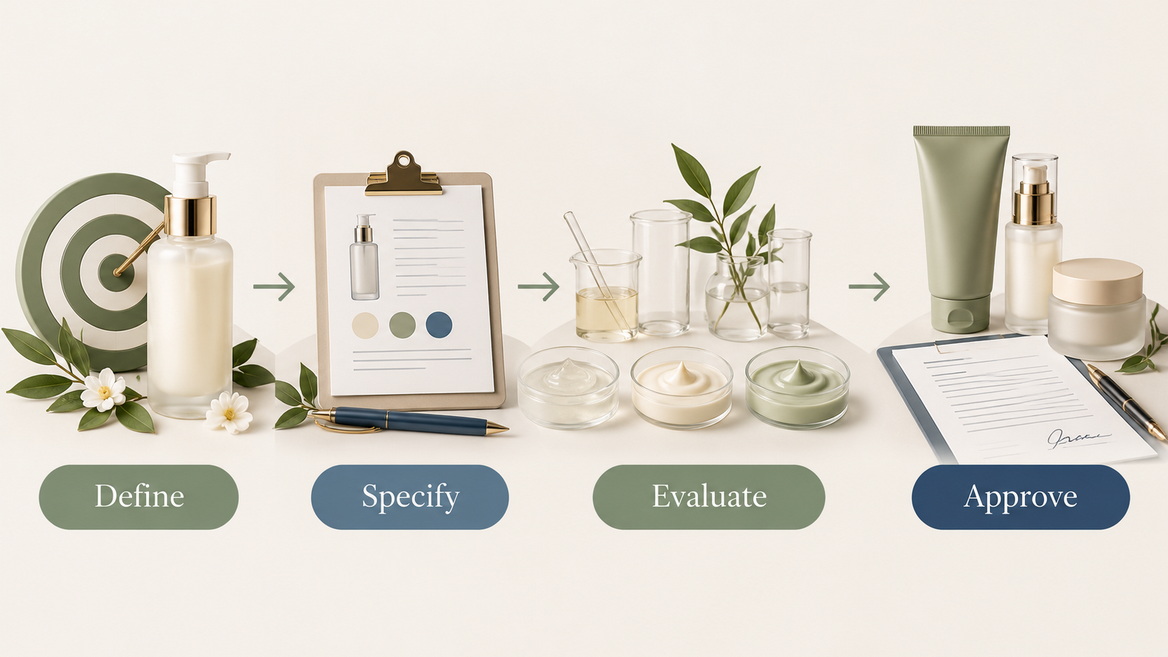
● A Practical Decision Framework for Skincare Brands
>> Step 1: Identify the Advantage Customers Must Notice
>> Step 2: Separate Essential Requirements from Preferences
>> Step 3: Evaluate Samples Against the Same Brief
>> Step 4: Approve Commercial and Technical Terms Together
● An Illustrative Hybrid Strategy: Customize the Hero Product
● How LAIMEI Supports Skincare Development
>> Is Private Label Skincare Always Better Than White Label?
>> Can a White Label Formula Be Exclusive?
>> Does Private Label Mean I Own the Formula?
>> Which Model Has the Lower Minimum Order Quantity?
>> Is White Label Skincare Exempt from Safety Requirements?
>> Can We Start with White Label and Develop Custom Products Later?
Private label skincare generally offers stronger product-level differentiation, while white label skincare offers a simpler route to market. For brands comparing private label skincare vs white label skincare, the right choice depends on what must be distinctive: the formula, the customer experience, the packaging, or the overall brand proposition. Neither model automatically guarantees exclusivity or commercial success. [arisecosmetic]
At GUANGZHOU LAIMEI CREATIVE RESEARCH INTELLIGENT BIOLOGICAL RESEARCH CO.,LTD., our perspective is straightforward: choose the manufacturing model around your intended competitive advantage—not around the most attractive quotation.
This guide compares customization, investment, testing, ownership, and scalability, then provides a practical framework for selecting the right manufacturing partnership.

White label skincare typically uses a manufacturer's existing formulation, which multiple brands may purchase. You select the product and apply your branding, usually with packaging choices drawn from available options.
This approach reduces formulation-development work. However, another brand may sell the same underlying product, making differentiation more dependent on positioning, presentation, distribution, and service. [bioavenues]
Private label skincare generally allows greater influence over the product. Depending on the manufacturer, this may involve modifying an existing base or developing a formulation around a brand-specific brief.
Possible adjustments include ingredients, texture, fragrance, finish, and packaging. Nevertheless, customization does not automatically confer formula ownership or exclusivity. Those rights require explicit contractual terms. [arisecosmetic]
Suppliers use these terms differently. One manufacturer may describe a lightly modified catalog formula as private label; another may reserve that term for bespoke development.
OEM and ODM labels also do not replace a detailed project agreement. Ask what development work is included, who controls the specifications, and what competitors can purchase. The deliverables matter more than the terminology. [labtree]
The following comparison describes common arrangements, not universal supplier commitments. Actual costs, minimum orders, customization, and rights must be confirmed in writing. [arisecosmetic]
| Decision factor | Private label skincare | White label skincare |
|---|---|---|
| Formula | Modified base or custom development | Existing manufacturer formulation |
| Customization | Broader product-development options | Usually limited product changes |
| Differentiation | Greater potential at product level | More dependent on branding and experience |
| Initial investment | Typically more development-related expenditure | Typically less formulation-development expenditure |
| Launch preparation | More sampling and validation may be needed | Less formulation-development work |
| Exclusivity | Available only where agreed | Shared formulas are common |
| Formula ownership | Determined by contract | Usually retained by manufacturer |
| Best strategic fit | A differentiated product proposition | Demand testing or a simpler initial launch |
A custom formula has commercial value only when its differences matter to the intended customer.
Consider a hypothetical moisturizer brief for humid-weather use. "Premium hydration" offers little development direction. A more useful brief would specify:
- A lightweight texture.
- Minimal greasy after-feel.
- Compatibility with the intended packaging.
- Defined fragrance preferences.
- Performance objectives supported by an appropriate evaluation plan.
Our recommendation is to translate positioning into measurable product requirements. An unusual ingredient list alone is not a differentiation strategy.
Compare samples through a consistent evaluation process rather than selecting whichever feels most impressive during one demonstration.
For example, score spreadability, absorption, residue, scent, dispensing, and suitability within the intended routine. Use the same application instructions and record feedback systematically.
This turns "we prefer this sample" into a decision connected to the brand brief.
White label does not mean a brand must be indistinguishable. A shared formula can sit within a distinctive customer proposition built around education, packaging, service, or a carefully selected routine.
The limitation is that these advantages do not make the underlying formulation exclusive. If product uniqueness is central to your promise, a shared catalog formula may leave an important strategic gap. [bioavenues]

Private label manufacturing can introduce expenditure for formulation work, sampling, evaluation, and packaging development. White label generally reduces the formulation-development component, but still requires a realistic launch budget. [bioavenues]
We recommend requesting separate quotation lines for:
1. Formula development and sample revisions.
2. Testing and supporting documentation.
3. Packaging components and decoration.
4. Filling, assembly, and quality checks.
5. Freight and other agreed logistics.
6. Reorder quantities and pricing assumptions.
Compare quotations against identical specifications. Otherwise, a lower price may simply represent a narrower scope.
White label usually offers a shorter development route because the formula already exists. Private label requires more time when the project includes reformulation and additional evaluation. [bioavenues]
However, do not accept a single "production lead time" as the entire launch schedule.
Ask suppliers to distinguish sample approval, packaging procurement, documentation preparation, manufacturing, and shipment. Identify the longest dependency before committing to a launch date.
Exclusivity is a contractual right, not an automatic feature of private label skincare.
Paying development fees does not necessarily give your brand ownership of the formulation or permission to transfer it to another factory. Those arrangements must be negotiated explicitly. [labtree]
Before approval, establish:
- Who owns the base formula and subsequent modifications?
- Can the manufacturer sell the identical formulation elsewhere?
- Does exclusivity cover particular countries, channels, or periods?
- Are minimum purchases required to maintain exclusive rights?
- What technical information can the brand access?
- What happens if the manufacturing relationship ends?
Our recommendation is to review ownership, exclusivity, confidentiality, and transfer rights separately. A contract can address one without granting the others.
A catalog formula may come with an established technical package, but brands should verify what that package covers.
For a U.S. launch, the responsible person must ensure and maintain records supporting adequate product safety substantiation. Choosing white label rather than private label does not remove that responsibility. [fda]
Ask the manufacturer which supporting documents are available, whether they relate to the intended product configuration, and what additional assessment the project requires.
ISO 22716 provides guidelines for cosmetic good manufacturing practices. It is relevant to evaluating manufacturing controls, but it should not be presented as proof that a finished product delivers a particular consumer benefit. [iso]
Similarly, FDA facility registration is not product approval. FDA generally does not preapprove cosmetics or their ingredients, apart from certain color additives. Registration claims should therefore never be rewritten as "FDA-approved skincare." [fda]
Our recommendation is to agree on intended claims before finalizing the formula.
Create a document listing each proposed claim, its intended wording, the evidence required for the target market, and the party responsible for obtaining that evidence.
This helps prevent a late mismatch between what the product team develops and what the marketing team wants to communicate.
Complete this sentence:
"Our customer should choose this product because it delivers ______."
If the answer depends mainly on convenience, presentation, or an existing audience relationship, white label may be sufficient.
If it depends on a distinctive texture, formulation specification, or product experience, investigate private label development.
Divide the brief into three categories:
- Non-negotiable product requirements.
- Features that would improve the proposition.
- Optional details that can wait.
This is our recommended planning method, not an industry certification framework. Its purpose is to prevent optional customization from consuming the budget needed for essential work.
Do not compare one supplier's stock sample with another supplier's custom prototype without acknowledging the difference.
Use a common scorecard and document why a sample passes or fails. Include packaging and dispensing observations, not just the formula's initial feel.
A good sample is only one part of a manufacturing agreement.
Before ordering, align the approved specification, quality requirements, documentation, change-control process, ownership terms, and delivery responsibilities.
Not every product in a skincare range needs the same level of development.
Consider a hypothetical brand launching a cleanser and moisturizer. The moisturizer carries the central promise: a distinctive texture designed for the target customer's routine. The cleanser plays a supporting role.
A practical strategy could be:
1. Develop the moisturizer through a private label project.
2. Evaluate an existing cleanser against the supporting brief.
3. Keep packaging and brand communication consistent.
4. Use customer feedback to guide later development.
This is an illustrative recommendation, not a reported client result. It shows how a brand can concentrate development resources where differentiation matters most.
The important question is not "Which model should every product use?" It is "Which product deserves the greatest investment in uniqueness?"
According to the company background supplied for this article, LAIMEI has 13 years of skincare and cosmetics research and manufacturing experience, offering formulation development, packaging design, and production support.
The supplied profile reports:
- A 20,000-square-meter production base.
- Annual production capacity exceeding 50 million units.
- Support across cleansers, serums, moisturizers, and masks.
- Products supplied to more than 100 countries and regions.
These are company-provided statements, not independently audited findings in this article. Prospective partners should request current documentation, clarify the relevant manufacturing entity, and verify which capabilities apply to their project.
For us, the most useful starting point is a clear brief—not simply a request for the lowest unit price.
No. Private label generally provides more product customization, while white label can suit brands prioritizing a simpler initial launch. The better choice depends on whether formula-level differentiation is necessary for the intended proposition. [bioavenues]
Only if the manufacturer agrees to suitable terms. Do not assume that a standard catalog formula becomes exclusive because you order custom packaging. Ask whether exclusivity is available and define its scope in writing. [arisecosmetic]
No. Ownership depends on the agreement. Confirm rights to the formula, modifications, technical information, and manufacturing transfer before paying development fees. [labtree]
There is no reliable universal answer. Request project-specific minimums for the formula, packaging, decoration, and finished-product assembly rather than assuming one advertised quantity covers everything.
No. For U.S. cosmetics, the responsible person must ensure and maintain adequate safety substantiation records. The sourcing model does not replace this obligation. [fda]
Yes, as a planned commercial approach. Treat the later custom formulation as a separate development project, with its own brief, evaluation, documentation, and contractual terms.
1. Arise Cosmetic. "White Label vs Private Label Cosmetics: What Is the Actual Difference?" Industry perspective on customization, commercial arrangements, and contractual rights. [arisecosmetic]
2. BioAvenues. "Private Label vs. White Label Cosmetics: What Every Brand Should Know." Industry comparison of development scope, investment, timing, and positioning. [bioavenues]
3. LabTree. "Private Label Cosmetics Manufacturer: Guide for New Development." Discussion of terminology, formula ownership, and contractual provisions. [labtree]
4. International Organization for Standardization. "ISO 22716:2007 — Cosmetics — Good Manufacturing Practices (GMP) — Guidelines on Good Manufacturing Practices." [iso]
5. U.S. Food and Drug Administration. "Cosmetics & U.S. Law." Explanation of cosmetic regulatory responsibilities and the distinction between registration and approval. [fda]
6. U.S. Food and Drug Administration. "Modernization of Cosmetics Regulation Act of 2022 (MoCRA)." Requirements concerning safety substantiation, registration, and product listing. [fda]
7. LAIMEI company background supplied for this article. Source for company history, facilities, capacity, product categories, and market coverage; no public source page was provided.


