
Views: 216 Author: Vera Publish Time: 2026-10-30 Origin: Site


Content Menu
● What Does a Low MOQ Cosmetics Manufacturer Actually Offer?
● Private Label, OEM, and ODM: Choose the Right Development Route
● Why Low MOQ Skincare Manufacturing Still Requires Careful Budgeting
>> Calculate Cost per Sellable Unit
>> Separate Launch Costs from Repeat-Order Costs
● Start with One Product That Has a Clear Customer Purpose
● How LAIMEI Supports Small-Batch Development and Scalable Production
>> Research Support from Formula Brief to Performance Evaluation
>> Manufacturing Capacity with Project-Specific Planning
● Quality Assurance: What to Check Beyond a Certificate
>> Understand the Three Quality-Control Stages
>> Test the Formula and Packaging Together
● International Compliance: Define Responsibilities Before Production
>> United States: Registration Is Not Product Approval
>> European Union: Notification Is Only Part of Compliance
● Turn Customer Feedback into Better Product Decisions
● A Six-Step Low MOQ Cosmetic Manufacturing Workflow
>> 1. Submit a Focused Product Brief
>> 2. Compare Feasible Development Routes
>> 3. Evaluate Samples Against Written Criteria
>> 4. Approve Testing, Packaging, and Artwork
>> 5. Confirm the Production Agreement
>> 6. Review the Pilot Before Reordering
● Frequently Asked Questions About Low MOQ Cosmetics Manufacturing
>> What is LAIMEI's minimum order quantity?
>> Can I customize a formula for a small order?
>> How long does a private label skincare launch take?
>> Does FDA registration mean a cosmetic is approved?
>> What should I prepare before requesting a quotation?
>> How can I assess whether a manufacturer can scale?
● Request a Product-Specific OEM/ODM Proposal
Choosing a low MOQ cosmetics manufacturer is about more than ordering fewer products. It is about protecting your launch budget while developing skincare that customers want to buy again. For emerging brands, the right private label skincare manufacturer should offer practical customization, transparent specifications, reliable quality controls, and a clear route from pilot production to repeat orders.
At GUANGZHOU LAIMEI CREATIVE RESEARCH INTELLIGENT BIOLOGICAL RESEARCH CO., LTD., we support beauty brands through integrated formulation development, packaging design, and manufacturing. Our approach begins with understanding your product, target market, and commercial constraints—not promising the same minimum quantity for every project.
This guide explains how to evaluate low MOQ cosmetic manufacturing and build a launch plan around evidence rather than attractive headline prices.

MOQ means minimum order quantity: the smallest production order a supplier accepts under agreed conditions.
However, a cosmetic product can involve several minimums. The formula, bottle, pump, printed carton, and decoration process may each have different purchasing requirements.
Before comparing quotations, ask whether the stated minimum applies to:
- Each formula or product type.
- Each shade, fragrance, or size.
- Each packaging design.
- The complete order or individual stock-keeping unit.
- Initial production only or subsequent reorders.
A low MOQ private label cosmetics manufacturer may offer flexibility through existing formulas and standard packaging. A completely new formula with custom-molded packaging requires a different assessment.
The important question is not simply, "What is your lowest MOQ?" It is, "What can we launch at this quantity without compromising product suitability or financial discipline?"
Suppliers do not always use these terms consistently. Define the actual deliverables before signing an agreement.
| Development route | Typical starting point | Potential advantage | What to clarify |
|---|---|---|---|
| Private label | An existing manufacturer-developed formula | Fewer development decisions | Available modifications and formula availability |
| ODM | Manufacturer-led development adapted to a brief | Technical support for a distinctive concept | Development scope, ownership, and exclusivity |
| OEM | Production against agreed specifications | Greater control over a defined product | Technical transfer, responsibilities, and documentation |
For a first launch, selecting an established formulation platform may simplify development. Brands with a specific performance target may need additional laboratory work and testing.
Neither route is automatically better. Choose according to your differentiation needs, budget, launch schedule, and access to technical expertise.
Confirm ownership of formulas, artwork, molds, and testing records separately. Paying a development fee does not, by itself, explain which rights transfer to your brand.
A smaller order reduces the number of units purchased. It does not automatically produce the lowest cost per unit or eliminate inventory risk.
Your launch budget should account for development, packaging, testing, logistics, and selling costs—not just filling and manufacturing.
Consider this illustrative scenario, not a supplier quotation:
| Expense | Hypothetical amount |
|---|---|
| 1,000 finished products at $3 each | $3,000 |
| Development, testing, and artwork | $1,500 |
| Freight, insurance, and import-related costs | $800 |
| Total initial expenditure | $5,300 |
The initial cost is $5.30 per ordered unit. If 100 units are allocated to samples and promotion, the expenditure spread across 900 remaining units becomes approximately $5.89 each.
That figure still excludes advertising, fulfillment, payment fees, returns, and other operating expenses.
From a procurement perspective, the useful comparison is sellable-unit economics, not the lowest factory price.
Ask suppliers to distinguish one-time expenses from recurring charges.
Packaging molds, artwork setup, and initial development may be treated differently from ingredients, bottles, filling, and inspection. Your second order should therefore have its own cost model.
Also clarify who owns unused packaging and whether storage, aging, or disposal charges apply.
A broad collection can spread a new brand's budget across too many formulas, packaging formats, and purchasing decisions.
A focused launch makes it easier to evaluate feedback and identify what deserves a reorder.
Our manufacturing scope includes cleansers, serums, moisturizers, and masks. Selecting among them should begin with a customer need rather than an ingredient trend.
| Product | Useful development questions |
|---|---|
| Facial cleanser | Does the cleansing feel suit the intended user and routine? |
| Face serum | Are texture, dispensing, and layering appropriate? |
| Moisturizer | Does the finish match customer expectations and packaging? |
| Face mask | Are the format, application method, and usage instructions clear? |
For example, a lightweight serum concept needs more than a fashionable ingredient list. Define the desired finish, fragrance preference, packaging, target price, and claims before requesting samples.
Describe cosmetic benefits precisely. Claims suggesting treatment or prevention of disease can change a product's regulatory classification and require specialist review.
Our company profile describes 13 years of skincare and cosmetics research and manufacturing experience, with one-stop OEM/ODM support for international brands.
These capabilities provide the foundation for project discussions. They should be evaluated alongside product-specific samples, documentation, and commercial terms.
According to our company information, our research team is led by a Brazilian professor and includes experienced dermatologists and senior technical engineers.
Across our associated factory laboratory network, the reported professional workforce exceeds 1,000 people. This describes the wider collaborative network, not necessarily personnel employed at one facility.
For buyers, the practical question is how those resources support a particular product.
Ask who will manage formulation, review ingredient suitability, coordinate testing, and approve technical changes. An impressive team profile becomes useful when responsibilities and deliverables are clear.
Our company reports a 20,000-square-meter GMP-standard production base and annual capacity exceeding 50 million units.
We support discussions ranging from small-batch trials to larger production programs. However, total capacity does not establish a universal minimum order or guarantee an individual delivery date.
Your quotation should identify the proposed batch size, packaging availability, production allocation, and conditions for scaling.
A successful pilot should create a repeatable manufacturing specification—not a product that becomes difficult to reproduce when demand increases.
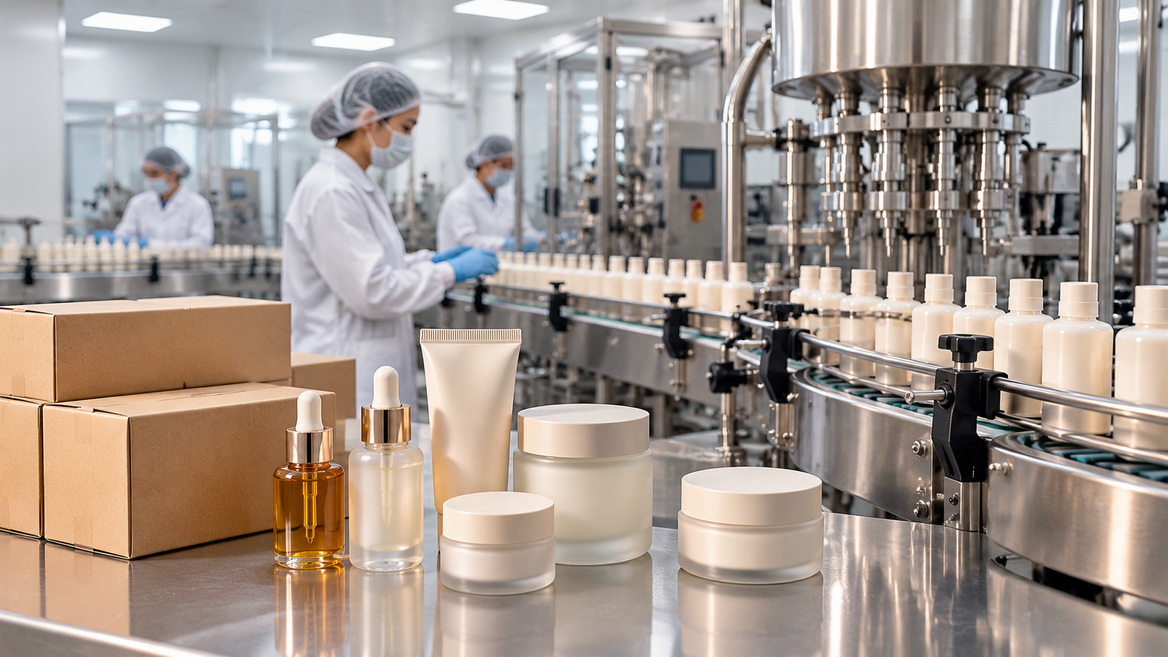
A certificate can support supplier evaluation, but it does not replace product-specific evidence.
ISO 22716 provides guidelines covering cosmetic production, control, storage, and shipment. It should not be presented as proof that every product delivers a particular skincare result.
Our company profile reports ISO 22716 and GMPC credentials. Buyers should review the certificate holder, manufacturing address, scope, issuing body, and validity.
Our stated quality framework covers incoming materials, production inspections, and finished-product release.
Request clarity on what happens at each stage:
1. Incoming materials: identity checks, specifications, supplier documents, and acceptance decisions.
2. In-process controls: relevant processing parameters, filling checks, appearance, and packaging verification.
3. Finished-product release: agreed specifications, applicable testing, batch review, and release authorization.
The relevant records matter more than a general promise of "strict quality."
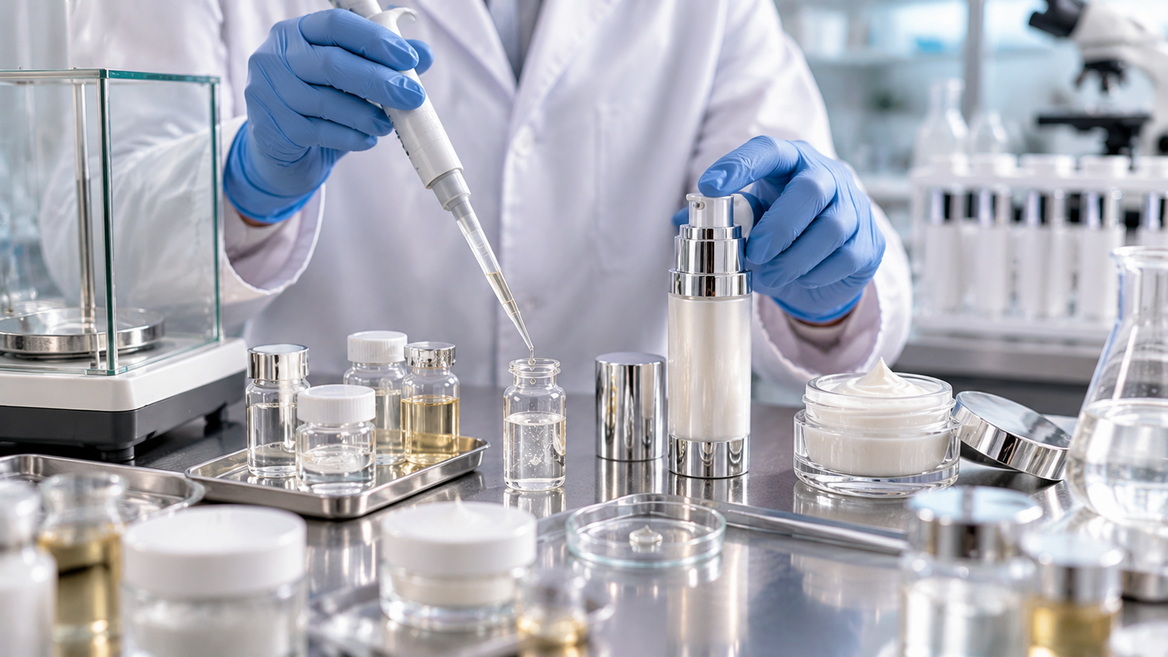
A sample that looks acceptable in a laboratory container may behave differently in its final package.
Discuss stability, microbiological quality, preservative effectiveness where appropriate, and packaging compatibility with qualified technical personnel.
A pump must dispense the intended texture. A closure must remain suitable during expected storage and transport. Labels must remain readable under anticipated use conditions.
Agree on acceptance criteria before production. This makes deviations easier to identify and resolve objectively.
Our company reports supplying products to more than 100 countries and regions. That experience does not mean one documentation package automatically meets every destination's requirements.
Select your first market early and specify who manages local regulatory obligations.
Our company profile reports FDA registration. This must not be described as FDA certification or approval of the facility or its cosmetics.
Under MoCRA, applicable obligations include facility registration, product listing, and maintaining adequate safety-substantiation records, subject to relevant exemptions.
Your agreement should identify which party handles each applicable obligation. Manufacturer support does not automatically transfer the brand's legal responsibilities.
EU market preparation involves more than submitting a notification.
Relevant requirements include an EU-established Responsible Person, a cosmetic product safety assessment and report, a Product Information File, appropriate labeling, and CPNP notification.
Confirm which services are included, which require external specialists, and who maintains the records.
For other destinations, obtain a separate market-specific review rather than assuming that U.S. or EU preparation is sufficient.
Authentic reviews can reveal issues that a technical specification misses. However, this article does not include customer testimonials because none were supplied for verification.
For your own sampling program, collect structured feedback instead of asking only whether testers "liked" a product.
Use consistent questions covering:
- Application feel and absorption.
- Fragrance preference.
- Dispensing and packaging usability.
- Compatibility with the intended routine.
- Willingness to purchase at the proposed price.
Record the sample version and testing conditions. Keep sensory feedback separate from substantiated efficacy claims.
A tester saying that skin "feels softer" is useful product feedback. It is not equivalent to a controlled study demonstrating a quantified benefit.
Before publishing a testimonial, obtain permission and preserve its original meaning.
Include your target customer, destination market, product format, intended benefits, price positioning, packaging preference, and estimated quantity.
Request an explanation of existing-formula, adapted-formula, and new-development options, including their cost and timing implications.
Assess texture, fragrance, appearance, application, and dispensing. Record revisions rather than relying on informal descriptions.
Identify the required assessments, final packaging components, label responsibilities, and approval checkpoints.
Document quantities, specifications, payment terms, inspection arrangements, delivery terms, and procedures for handling nonconforming goods.
Compare batch quality, customer feedback, sales, returns, and actual landed costs. Reorder against defined evidence rather than initial enthusiasm.
MOQ depends on the formula, packaging, customization, and production requirements. Request a product-specific quotation; this article does not promise a fixed minimum.
Potentially. Feasibility depends on the modification, ingredient availability, development work, testing, and batch requirements. Confirm the scope before paying development fees.
Timing depends on sample approval, testing, packaging procurement, documentation, and production scheduling. Request a milestone-based schedule instead of a universal delivery promise.
No. Facility registration and product listing do not indicate FDA approval. Product safety and other applicable legal obligations remain separate responsibilities.
Provide the product category, intended market, quantity, formulation preferences, packaging needs, target price, and desired launch window. Mention any existing artwork or specifications.
Review capacity alongside batch consistency, material sourcing, production planning, traceability, and change-control procedures. Ask how pilot specifications transfer to repeat production.
Send LAIMEI your product concept, target market, expected first-order quantity, packaging preferences, and budget range.
Ask our team for a proposal covering formulation options, packaging minimums, sample development, testing responsibilities, and production milestones.
A productive manufacturing partnership begins with a clear brief—and a quotation that explains what your brand will actually receive.
1. DLAB Custom Cosmetics. "The Leading Low MOQ Cosmetics Manufacturer for Beauty Brands." Used as the original article for structural analysis and content-gap assessment; its commercial claims are not presented as LAIMEI's capabilities. [dlabcosmetics]
2. International Organization for Standardization. "ISO 22716:2007 — Cosmetics — Good Manufacturing Practices (GMP) — Guidelines on Good Manufacturing Practices." Source for the standard's scope covering production, control, storage, and shipment. [iso]
3. U.S. Food and Drug Administration. "Registration & Listing of Cosmetic Product Facilities and Products." Source for the distinction between registration, listing, certification, and approval. [fda]
4. U.S. Food and Drug Administration. "Modernization of Cosmetics Regulation Act of 2022 (MoCRA)." Source for applicable registration, listing, and safety-substantiation requirements. [fda]
5. European Union. "Regulation (EC) No 1223/2009 on Cosmetic Products." Source for the Responsible Person, safety assessment, safety report, product documentation, notification, and relevant safety-information requirements. [eur-lex.europa]
6. European Commission. "Cosmetics." Background on European cosmetic safety requirements and expert scientific safety assessment before sale. [single-market-economy.ec.europa]


