
Views: 223 Author: Vera Publish Time: 2026-10-10 Origin: Site


Content Menu
● Gel vs Cream vs Oil Cleansers: A Quick Comparison
>> When Gel Cleansers Make Commercial Sense
>> What Brands Should Validate
>> When Cream Cleansers Make Commercial Sense
>> What Brands Should Validate
>> When Oil Cleansers Make Commercial Sense
>> What Brands Should Validate
● Which Cleanser Should Your Brand Launch First?
>> Choose Gel for an Everyday Cleansing Proposition
>> Choose Cream for a Comfort-Led Proposition
>> Choose Oil for a Removal-Led Proposition
● Beyond Texture: How to Build a Better Cleanser Formula
>> Evaluate the Whole Cleansing System
>> Treat pH as One Variable, Not a Quality Shortcut
>> Match Packaging to Actual Use
● A Practical Validation Plan for OEM/ODM Cleanser Development
>> Step 1: Define the Customer and Cleansing Job
>> Step 2: Compare Prototypes Under Consistent Conditions
>> Step 3: Assess Stability, Microbiology, and Packaging
>> Step 4: Match Claims to Evidence
● What Published Sunscreen-Removal Data Actually Tells Brands
● How LAIMEI Supports Cleanser Development
>> 1. Is a gel cleanser better than a cream cleanser?
>> 2. Can a cream cleanser remove sunscreen?
>> 3. Should every customer double cleanse?
>> 4. Are oil cleansers suitable for oily skin?
>> 5. Does more foam mean better cleansing?
>> 6. What should an OEM/ODM cleanser brief include?
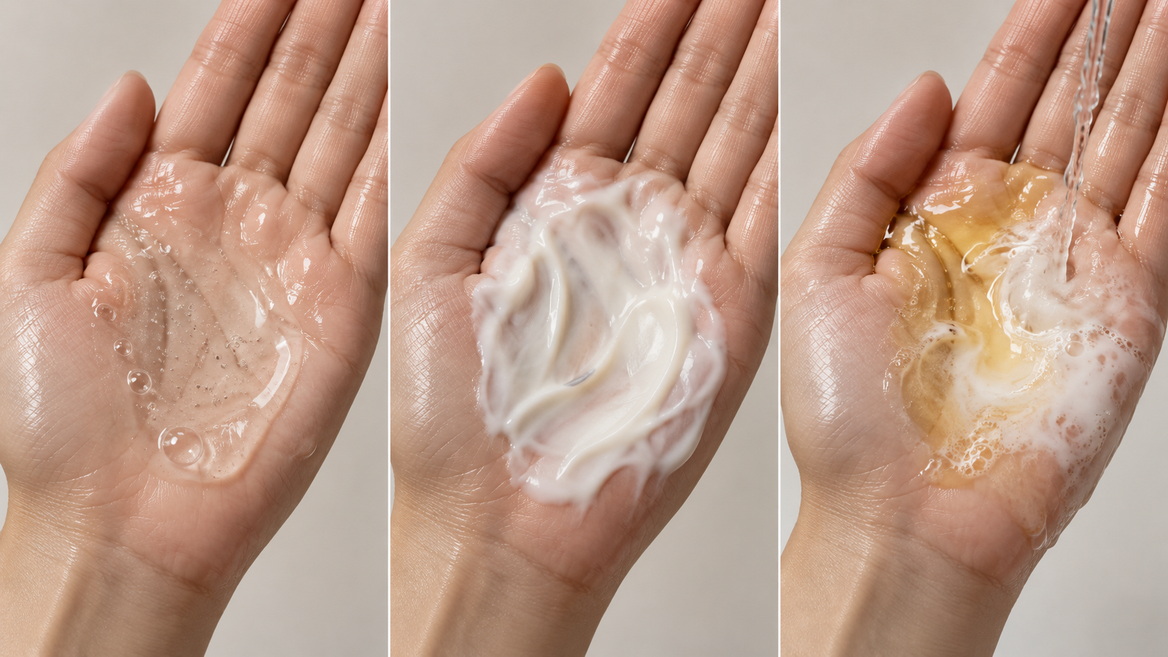
Gel vs cream vs oil cleansers is more than a texture comparison. For a skincare brand, the choice shapes customer satisfaction, formulation requirements, packaging, and product positioning. Gel cleansers can suit everyday washing, cream cleansers can serve customers seeking a softer after-feel, and cleansing oils can address makeup and water-resistant sunscreen removal.
My recommendation from a product-strategy perspective is straightforward: choose the cleanser around your customer's main cleansing problem, then validate the finished formula. Do not select a format simply because competitors sell it.
This guide compares all three categories and explains how to turn that comparison into a practical OEM/ODM development brief.

The following table is a starting point for product development, not a guarantee of how every formula performs.
| Comparison factor | Gel cleanser | Cream cleanser | Oil cleanser |
|---|---|---|---|
| Typical structure | Water-based, thickened cleansing system | Usually an emulsion containing water and emollients | Oil-rich system, often with rinse-off emulsifiers |
| Typical texture | Lightweight gel | Creamy, milky, or lotion-like | Fluid oil; some turn milky with water |
| Common positioning | Fresh daily cleansing | Comfort-focused cleansing | Makeup and sunscreen removal |
| Potential audience | Normal, combination, or oily skin | Dry skin or customers who dislike tightness | Makeup and water-resistant sunscreen users |
| Foam profile | Variable; often foaming | Often low-foaming | Usually little foam |
| Main development risk | Excessive cleansing or uncomfortable tightness | Poor rinsing or unwanted residue | Greasy after-feel or incomplete emulsification |
| Useful validation focus | Mildness and cleansing balance | Comfort, removal, and rinseability | Removal efficiency and rinse-off performance |
The most important distinction is between format and performance. A gel can be gentle. A cream can irritate. An oil can rinse cleanly—or leave an unpleasant film. The complete formulation determines the result.
A gel cleanser typically combines water, surfactants, and ingredients that control viscosity. Surfactants help lift and disperse oils and dirt so they can be rinsed away.
The transparent appearance and refreshing feel can support a clean, uncomplicated brand identity. However, transparency does not demonstrate purity, and abundant foam does not prove superior cleansing.
A private label gel cleanser is worth considering when your audience wants:
- A familiar morning-and-evening face wash.
- A lightweight texture.
- Easy application and rinsing.
- A fresh feel without a heavy residue.
For oily skin, the American Academy of Dermatology recommends a gentle foaming face wash rather than harsh cleansing intended to dry the skin aggressively.
That distinction matters commercially. "For oily skin" should describe the intended audience, not justify an unnecessarily stripping formula.
Evaluate tightness, stinging, rinsing, and user satisfaction alongside cleansing ability. Humectants such as glycerin may support a more comfortable formulation, but an ingredient list alone cannot establish finished-product mildness.
Avoid promising acne treatment simply because a gel targets oily skin. Intended claims and ingredients can change a product's regulatory classification.
A cream cleanser generally uses an emulsion structure to combine cleansing ingredients with an emollient-rich texture.
Some formulas resemble a lotion. Others feel thicker and produce little foam. Rinse-off and wipe-off versions also require different instructions and performance expectations.
Cream cleansers are a useful development direction for brands targeting:
- Dry-feeling skin.
- Customers who dislike foamy washes.
- Comfort-led daily routines.
- Richer, more cushioning sensory experiences.
The opportunity is not simply to sell "more moisture." It is to deliver adequate cleansing with an after-feel customers enjoy.
A cream cleanser should still remove the soils relevant to its intended use. A pleasant texture cannot compensate for inadequate cleansing.
Test rinseability, residual film, after-wash comfort, and tolerance.
Do not assume a creamy appearance makes a product suitable for sensitive skin. Fragrance, preservatives, surfactants, and other ingredients can influence tolerance. "Sensitive skin" positioning should reflect the finished formula and supporting evaluation, not texture alone.
Likewise, avoid describing a rinse-off cleanser as repairing the skin barrier without evidence appropriate to that claim.
A cleansing oil uses an oil-rich phase to loosen oil-soluble materials, including some makeup and sunscreen residues. Many rinse-off formulas contain emulsifiers that help the product disperse when water is added.
This distinction separates a formulated cleansing oil from applying an ordinary facial oil and attempting to rinse it away.
Oil cleansers offer a clear use-case opportunity for:
- Makeup-focused skincare collections.
- Customers wearing water-resistant sunscreen.
- Evening cleansing routines.
- Brands building a first-step cleansing product.
A small study involving 20 participants found substantially lower residue from the tested waterproof sunscreen after cleansing oil than after the tested foaming cleanser.
That supports further development of removal-focused products. It does not establish that every cleansing oil removes every sunscreen equally well.
Assess removal efficiency, emulsification speed, eye-area tolerance where relevant, and residual greasiness.
Oily or acne-prone skin deserves particular caution. Dermatology guidance for oily skin recommends avoiding oil-based cleansers. Brands should not generalize that cleansing oils suit everyone or cannot contribute to breakouts.
A second cleansing step may be useful for some routines, but it should not become an automatic requirement.
The best first product is the one with the clearest audience, strongest use case, and most manageable validation requirements.
A gel is a practical candidate when customers want a familiar daily face wash and your brand can clearly explain its benefits.
Focus the brief on cleansing without uncomfortable tightness. Avoid competing only through stronger foam, added actives, or "deep cleansing" language.
A cream is worth prioritizing when your audience repeatedly reports dryness, dislikes squeaky-clean finishes, or prefers richer textures.
The differentiator should be demonstrated after-wash comfort, not an assumption that every cream cleanser is gentler.
An oil cleanser makes sense when makeup or water-resistant sunscreen removal is central to the customer's routine.
This gives the product a specific purpose. However, application instructions and rinse-off behavior need careful attention because customers may be unfamiliar with the format.
Launching all three immediately can increase development work and inventory exposure. A focused launch followed by evidence-led expansion is often easier to manage.
Research on cleanser mildness describes how surfactants can interact with skin proteins and lipids. The resulting formulation—not simply one "hero" ingredient—affects cleansing and irritation potential.
Ask your manufacturer to explain the proposed surfactant system, its intended role, and the evidence needed to support your claims.
For suitable water-containing formulas, pH is an important development parameter. However, a preferred pH does not automatically establish gentleness.
Anhydrous oils also should not be assigned a conventional aqueous pH without specifying a meaningful measurement method.
Compare products using appropriate methods rather than identical marketing checkboxes.
Packaging should support the finished formula:
- Test gel dispensing through the intended pump or closure.
- Check whether a cream can be emptied conveniently.
- Assess oil leakage, pump output, and component compatibility.
- Verify that instructions remain legible in bathroom conditions.
A technically sound formula can still disappoint if the dispenser delivers an inconvenient amount or leaks during transport.
The following framework is a development recommendation, not a record of completed LAIMEI testing.
Specify skin characteristics, makeup habits, sunscreen use, preferred texture, target price, and sales market.
Replace "gentle cleanser for everyone" with a focused brief such as: "An evening rinse-off cleanser for customers who wear water-resistant sunscreen."
Keep the application amount, cleansing time, water conditions, and target soil consistent.
Record:
- Removal performance.
- Application and rinsing experience.
- Immediate tightness or stinging.
- Residual film.
- Overall user preference.
A controlled comparison is more useful than choosing whichever sample feels nicest during one informal demonstration.
Develop a testing plan appropriate to the formula and market. Consider stability, microbial quality, preservation effectiveness where relevant, and packaging compatibility.
Oil-rich products still need a risk assessment. Low water content should not replace evaluation of manufacturing conditions and foreseeable consumer use.
Create a claims checklist before approving artwork.
For each proposed statement—such as "removes waterproof makeup," "non-comedogenic," or "suitable for sensitive skin"—identify the necessary evidence and review the exact wording.
Evidence for an ingredient cannot automatically substantiate every claim about the finished cleanser.

In the 20-participant study, the tested waterproof sunscreen showed mean residue rates of approximately:
| Cleansing method | Mean waterproof sunscreen residue |
|---|---|
| Water alone | 59.3% |
| Tested foaming cleanser | 36.8% |
| Tested cleansing oil | 5.8% |
These findings provide a useful reason to investigate oil-based removal systems.
The limitations are equally important. The study was small and examined particular products under specific conditions. Its figures should not appear on your packaging as proof of your own formula's performance.
The practical lesson is to test your cleanser against representative products your customers actually use.
According to company-provided information, GUANGZHOU LAIMEI CREATIVE RESEARCH INTELLIGENT BIOLOGICAL RESEARCH CO., LTD. has 13 years of skincare and cosmetics research and manufacturing experience.
Its stated capabilities include:
- A 20,000 m² GMP-standard production base.
- Annual capacity exceeding 50 million units across product categories.
- Services covering formulation, packaging design, and manufacturing.
- Support from small-batch trials to larger production.
- Products supplied to more than 100 countries and regions.
The company also describes a professor-led research team involving dermatologists, technical engineers, and more than 1,000 personnel across associated factory laboratories. These are company-supplied statements, not independently verified findings in this article.
For procurement, request documents supporting relevant capacity, certification scope, and project-specific capabilities.
ISO 22716 provides guidance on cosmetic production, control, storage, and shipment. FDA facility registration is not product approval or an endorsement of efficacy.

Neither is universally better. Gel can suit a lightweight daily-washing proposition, while cream can support comfort-led positioning. Compare finished formulas against the intended customer's needs.
Some can, but performance depends on the cleanser and sunscreen. Test removal directly, especially when targeting water-resistant products, rather than assuming the texture guarantees adequate cleansing.
No. The need depends on makeup, sunscreen, cleansing performance, and skin tolerance. Recommend the least complicated routine that cleans adequately without unnecessary discomfort.
Not automatically. Dermatology guidance for oily skin recommends avoiding oil-based cleansers. Brands should evaluate their intended audience carefully and avoid universal suitability claims.
No. Foam is a sensory characteristic, not a standalone measure of removal efficiency or mildness. Evaluate cleansing results and after-wash comfort separately.
Include the audience, target soils, preferred texture, claims, packaging, sales markets, target cost, and validation requirements. These details help manufacturers propose relevant prototypes.
1. [RainShadow Labs — "Gel vs Cream vs Oil Cleansers: Which One Should Brands Sell?"]
Original comparison topic and category positioning. The page could not be retrieved directly; the available search extract was used only for its broad comparison. [rainshadowlabs]
2. [American Academy of Dermatology — "Face Washing 101"]
Dermatologist guidance on gentle cleansing, application, rinsing, and washing frequency. [aad]
3. [American Academy of Dermatology — "How to Control Oily Skin"]
Recommendations on gentle foaming washes and avoiding oil-based cleansers for oily skin. [aad]
Review explaining surfactant interactions, mildness, moisturizing agents, and skin-barrier effects. [pubmed.ncbi.nlm.nih]
Source of the 20-participant sunscreen-removal study and reported residue percentages. DOI: 10.1111/jocd.12995. [pubmed.ncbi.nlm.nih]
6. [International Organization for Standardization — ISO 22716:2007]
Scope of cosmetic good manufacturing practice guidance. [iso]
Explanation that facility registration and product listing do not constitute approval. [fda]
8. [U.S. Food and Drug Administration — "Modernization of Cosmetics Regulation Act of 2022"]
Safety-substantiation responsibilities and supporting records. [fda]


